Ready to create your own branded paper cups or packaging?
Tell us your requirements — size, coating, printing, and destination — and our team will prepare a detailed quotation within 24 hours.

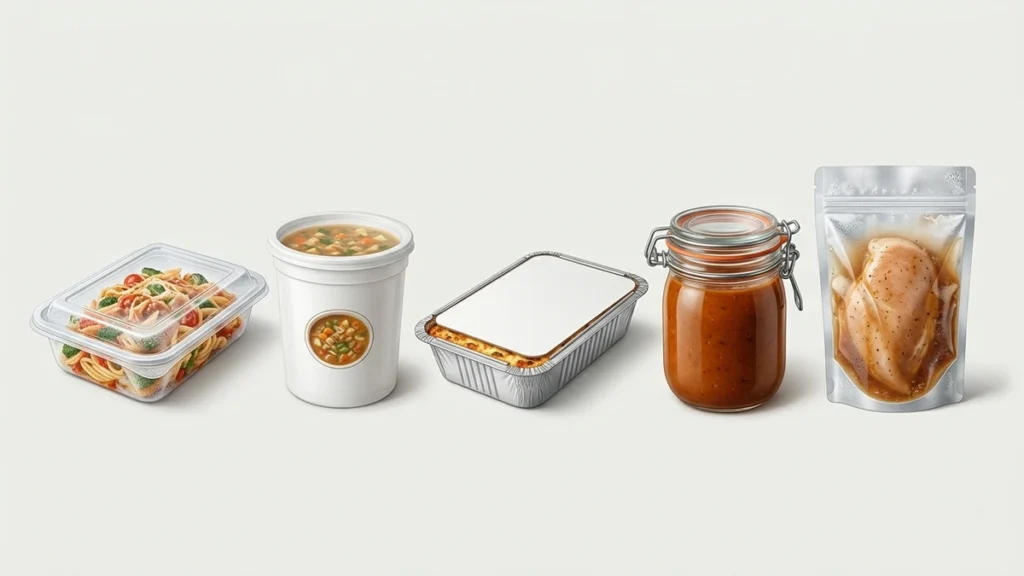
Freezer safe containers for prepared food and delivery are packaging formats designed to keep their shape, maintain lid or seal performance, and stay suitable for food contact through freezing, storage, handling, and final delivery. For commercial buyers, the term covers PP trays and tubs, HDPE containers, CPET trays, aluminum foil formats, flexible pouches, and selected coated fiber-based options.
What makes freezer safe containers different from standard chilled-food packaging is not just the resin or tray shape. Real freezer performance depends on three things working together: low-temperature durability, closure integrity, and suitability for the full distribution cycle. A container that survives static freezer storage may still fail when it is hot-filled, blast frozen, stacked, moved through a warehouse, and then delivered to the customer.
Food-contact compliance also remains essential in frozen use. Buyers should request material declarations and intended-use coverage for the exact market and application, including any coating, adhesive, ink, or lid component. In the U.S., the FDA framework for food contact substances is the main reference point: FDA food contact substances guidance.
For direct-to-consumer meal programs, insulation matters too, but it is secondary to primary pack integrity. The container must resist leakage, lid lift, and cracking if the shipment experiences minor temperature cycling during staging or route delays. If your shipping window extends beyond a short local route, container qualification should be done with the full shipper system, not as a stand-alone packaging test.
The right format depends on product type, reheat method, storage duration, filling process, and freight economics. In practice, most prepared-food buyers compare five main freezer safe containers.
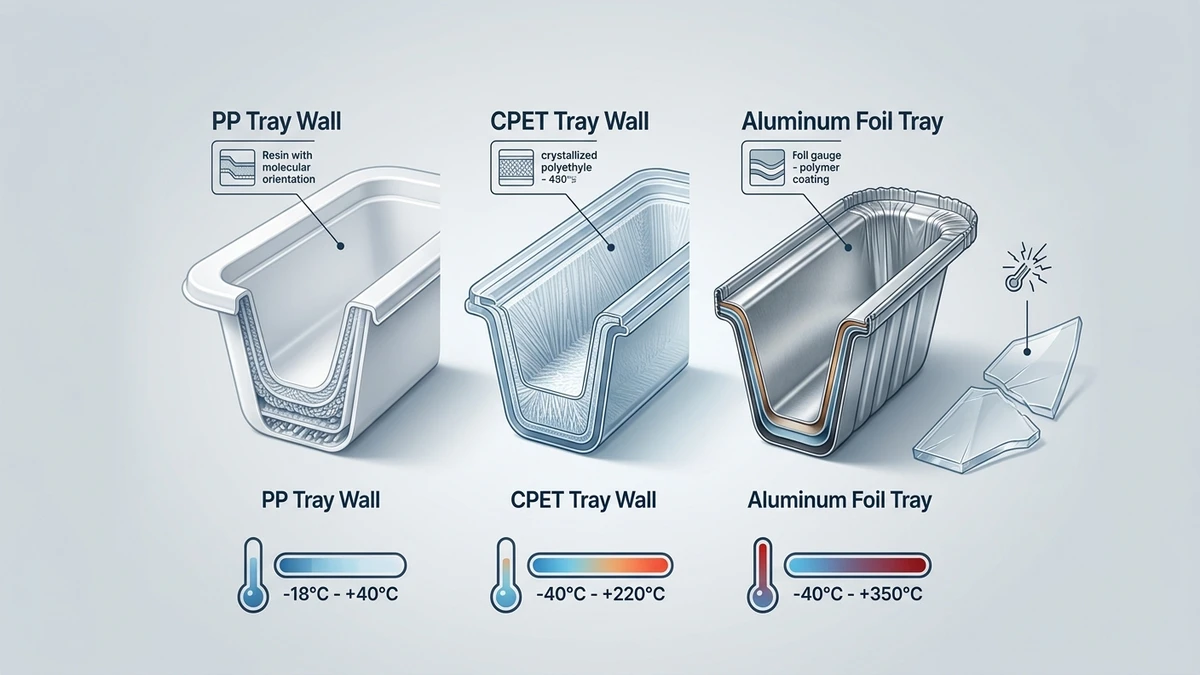
PP rigid trays and tubs are often the default choice for meal prep and frozen delivery. They balance cost, stackability, microwave compatibility, and supply availability. The main risk is under-specifying the lid. In many operations, lid inconsistency causes more complaints than tray wall failure.
HDPE containers are useful for soups, sauces, and larger liquid-heavy packs. They hold impact strength well in cold conditions and can reduce leakage risk in bulk portions. They are less suitable when the consumer expects direct oven reheating.
CPET trays are commonly chosen when the product must move from freezer to oven. They can support dual-ovenable applications, but buyers should confirm compatibility with their sealing equipment and assess the higher unit cost against the product margin.
Aluminum foil trays are strong for oven-ready frozen entrees and longer storage windows. They offer stable low-temperature performance and strong barrier potential when paired with the right lid system. They are not suitable for microwave use.
Flexible pouches save storage space and shipping weight. They are especially practical for soups, sauces, proteins, and dense freezer storage programs. However, they require more careful line validation and may be less attractive where shelf presentation matters.
A simple buyer view is this:
| Format | Best fit | Main watch-out |
|---|---|---|
| PP tray or tub | Meal prep and microwave reheat | Lid lift or poor snap-fit consistency |
| HDPE tub | Bulk soups and sauces | Not ovenable |
| CPET tray | Freezer-to-oven meals | Higher cost and equipment fit |
| Aluminum tray | Oven-ready entrees | No microwave use |
| Flexible pouch | Dense storage and freight efficiency | Less rigid presentation |
Glass may appear in premium reusable programs, but for most B2B frozen distribution it is a niche option because of weight, breakage risk, and freight cost.
Selecting freezer safe containers should start with the full thermal and handling journey, not with unit price. Teams that choose by catalog image or sample appearance often discover leakage, cracked corners, or line-speed issues later.
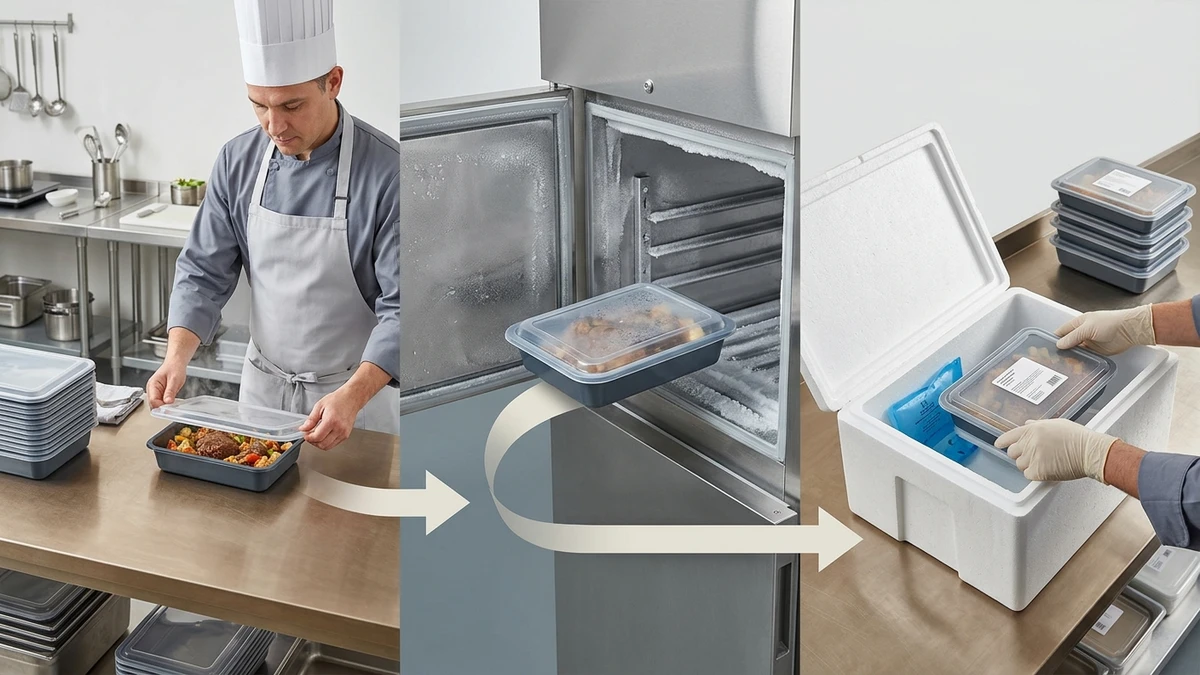
First, map every temperature event the package will see. That can include hot fill or cook-chill transfer, blast-freeze entry, frozen storage, case packing, route handling, and final reheating. A container that is acceptable at frozen storage temperatures may still deform if your line fills at high temperature before freezing begins.
Second, choose the seal system based on the actual distribution risk. Snap-fit lids are fast and economical, but they are usually better for lower-risk products and shorter frozen cycles. Heat-sealed film lids provide stronger barrier and tamper evidence, which often makes them the safer option for retail or multi-step distribution. Screw-cap systems can work well for liquid applications. Pressure-sensitive closures should only be used when cold-surface performance is fully specified.
Third, match the container to the product profile. A saucy pasta meal, a portioned curry, and a bulk soup may all be frozen products, but they do not stress the package in the same way. Foods with oil, broth, particulates, or expansion during freezing can expose weak lid geometry quickly.
Fourth, validate the actual filled pack. A useful commercial approach is to test the final SKU through fill, seal, freeze, stacking, handling, and reheat. Buyers should not approve freezer safe containers based only on empty sample inspection. Real recipe behavior matters, especially when the seal area may be contaminated by sauce or fat.
A practical validation checklist includes:
For frozen soups and sauces, leaving about 10 to 15 percent headspace is a sensible starting point to accommodate expansion.
Commercial claims such as leak resistant or freezer suitable are not enough. Buyers should compare freezer safe containers using measurable specifications that affect shelf life, damage rates, and line efficiency.
The key issue is not the printed rating alone. Buyers need to know whether the material still resists cracking and keeps its closure functional at the true coldest point of the operation. Blast freezing may create a more severe stress point than standard storage at minus 18 C.
The seal is often the weakest point in frozen packaging. Base and lid components can contract differently, causing corner gaps or lid lift. For this reason, lid fit should be treated as a technical specification, not a generic accessory choice. Standardizing around one lid family where possible can reduce packing-line errors and sourcing risk.
Thin walls may lower cost, but they can also reduce stack stability and push lids out of alignment. This matters in warehouse stacking, insulated meal bag loading, and route handling. Ask suppliers for nominal wall thickness, tolerance ranges, and any stack-load data available.
If the product turns quickly, a simpler pack may be enough. If frozen storage runs for several weeks or longer, moisture and oxygen barrier become more important. Ask whether the supplier can provide barrier data or real application guidance for your storage window. For pouches and sealed tray systems, this can be a major differentiator.
The right freezer safe container must also fit your line. Check compatibility with your filler, sealer, labeler, and case-pack pattern. Verify nesting ratio, pallet efficiency, and whether lid and base lead times are aligned. A good pack that causes slowdowns or mismatched inventory is not a good buy.
Frozen conditions change how labels and graphics perform. Condensation, cold-surface adhesion, and substrate flex can all affect appearance and durability.
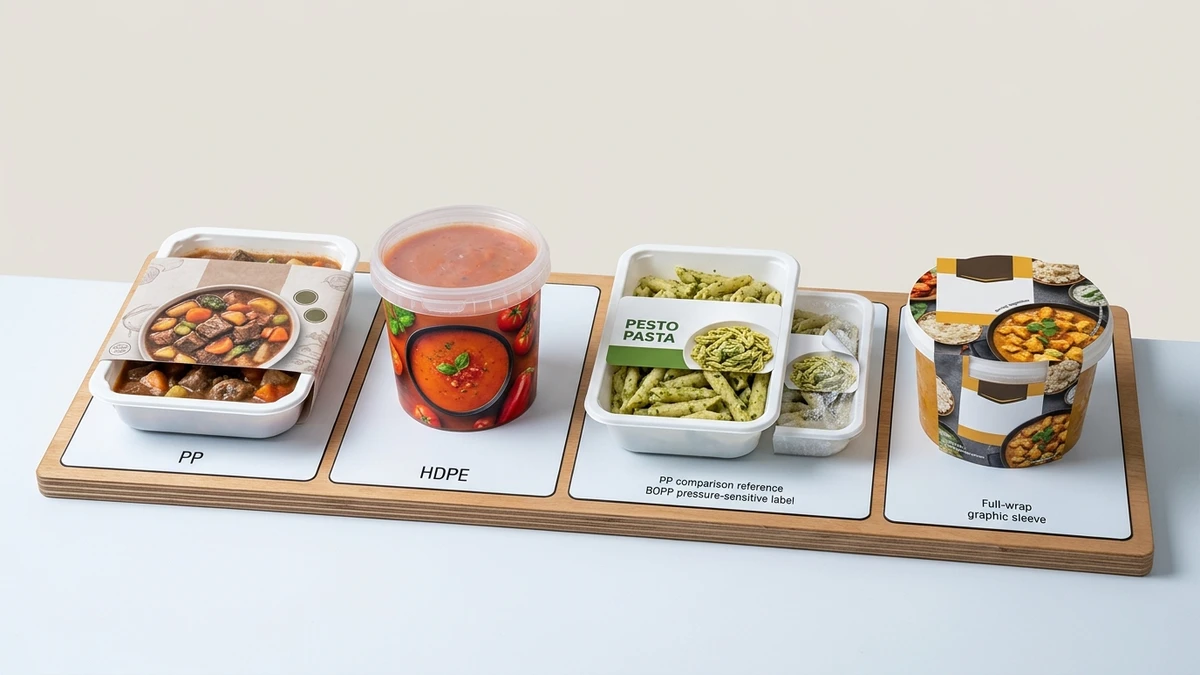
Pressure-sensitive labels are often the most practical option for small and medium runs, but the adhesive must be rated for the real application temperature. Standard ambient adhesives may curl, lift, or release after freezing and handling. BOPP and polyester face stocks generally perform better than paper labels in frozen conditions.
In-mold labeling can be a strong option for proven, stable SKUs because it integrates the label with the container wall. It performs well under moisture exposure and freeze-thaw stress, but setup costs make it less flexible for short runs or frequent menu changes.
Direct flexographic printing can eliminate label-edge problems and support a cleaner pack appearance, though it usually makes the most sense at higher volume. Sleeve labels offer broad design freedom, but they add another material layer and another validation point for cold storage.
When planning graphics, keep readability and condensation exposure in mind. Papacko’s guidance on simplified presentation and pack readability is useful for early label planning. If your frozen meal line will also use branded secondary packaging, it helps to align the print plan with future bag and secondary-pack branding systems.
For B2B buyers, freezer safe containers should be approved through documentation as well as testing. The exact substrate, coating, lid material, adhesive, and print system should be covered by supplier paperwork for the intended use.
At minimum, request:
If you are evaluating coated paper or hybrid formats, confirm both freezer performance and end-of-life claims. Compostable and recyclable are separate questions from low-temperature durability. Papacko’s overview of broader material and end-of-life considerations can help frame these discussions.
Sourcing details matter just as much as material choice. MOQ usually rises with customization level. Stock, unprinted containers are typically the easiest route for trials. Custom color, tooling, or print can raise MOQ significantly, especially for imported formats.
Lead time also tends to be longer than the quoted production window once sampling, artwork approval, documentation review, and freight are included. Buyers should ask for lead times on both base and lid, not only the main container.
A practical sourcing checklist includes:
Before placing a larger order, it is useful to benchmark options against broader category specs and review supporting component choices, especially when lids, films, labels, or tamper-evident elements are part of the final system.
The best freezer safe containers are not simply the thickest or cheapest option. They are the ones that match the full system: product behavior, freeze cycle, closure type, storage duration, reheat method, and supply model.
For most meal-prep and delivery programs, PP remains the most practical starting point because it offers a strong balance of cost, microwave use, and sourcing flexibility. For oven-ready entrees, CPET or aluminum will often be better. For soups and sauces, HDPE tubs or well-designed pouches may reduce leakage risk. The right answer depends on your operation, not on a generic ranking.
Commercial buyers should qualify freezer safe containers in this order:
A slightly higher-cost package that seals reliably, stacks well, and ships on time usually produces lower total delivered cost than a cheaper pack that creates leakage, complaints, or rework.
PP is usually the most practical option for meal prep because it balances freezer performance, microwave compatibility, cost, and supply availability. The final choice still depends on the recipe, lid system, and whether the pack must also handle hot fill or reheating.
No. Some plastics perform well in chilled storage but become brittle or lose lid fit at lower temperatures. Buyers should confirm the actual operating temperature range and closure performance, not just assume a plastic container is suitable for frozen distribution.
It depends on the reheat method. Aluminum is often better for oven-ready meals and longer frozen storage. PP is usually better for microwave-oriented meal programs and high-volume meal prep where stackability and lower cost matter.
A practical starting point is around 10 to 15 percent headspace to allow for expansion during freezing. The exact allowance depends on recipe density, fill temperature, and how much free liquid is in the product.
Often, yes. In frozen applications, lid geometry and seal retention are major failure points. A freezer-capable tray base paired with a weak or poorly matched lid can still result in leakage and customer complaints.
Treating them like standard takeaway packaging. Many avoidable failures come from skipping filled-pack validation, under-checking lid fit, or ignoring real MOQ and lead-time constraints during scale-up.