Ready to create your own branded paper cups or packaging?
Tell us your requirements — size, coating, printing, and destination — and our team will prepare a detailed quotation within 24 hours.

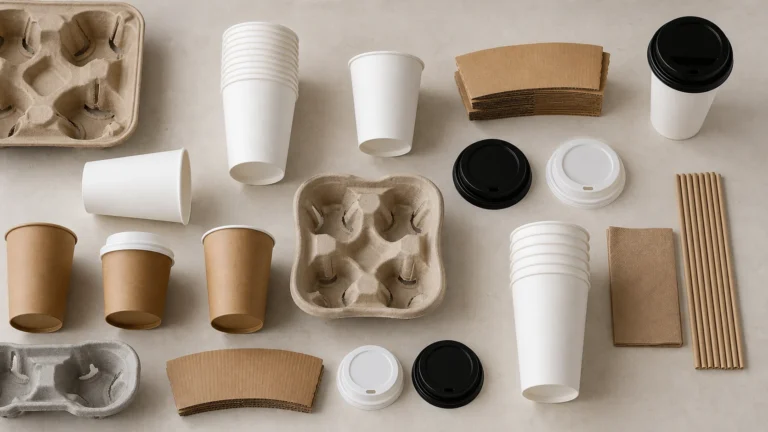
Choosing the right coffee cups to go is a specification decision, not just a style choice. Cup size affects working fill volume, lid compatibility, sleeve fit, carrier loading, branding area, and service speed. For buyers managing cafes, QSR, office coffee, or distributor programs, the best result usually comes from selecting the cup first, then the lid, then the sleeve, and finally the print method.
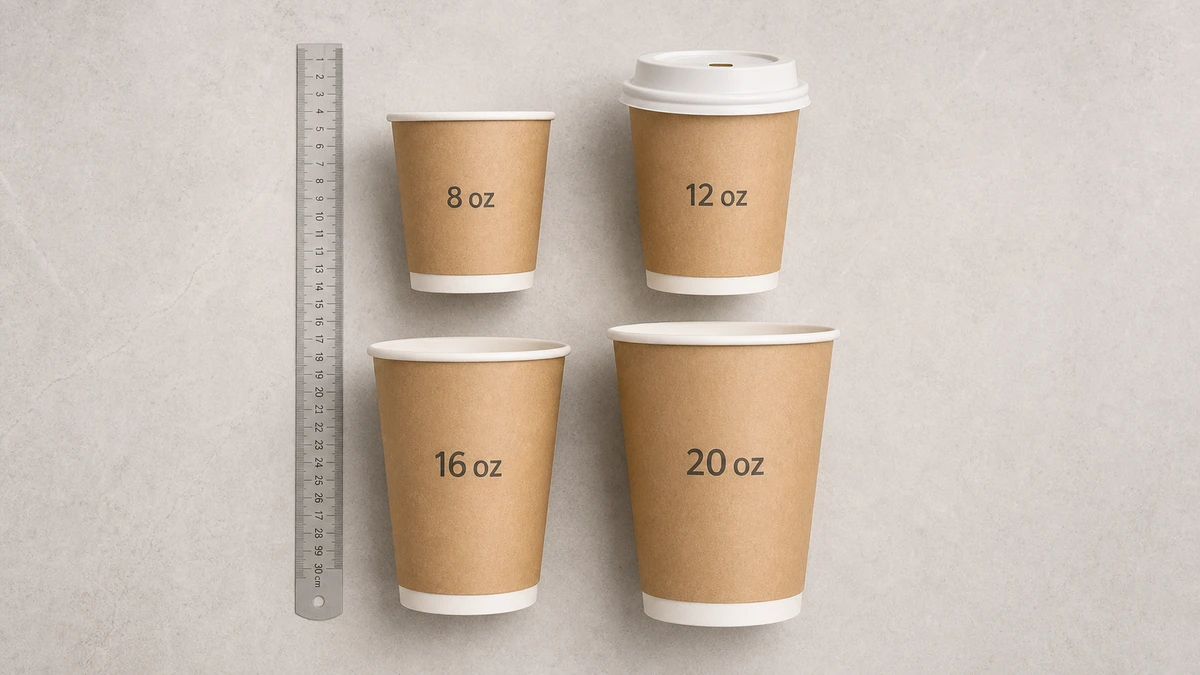
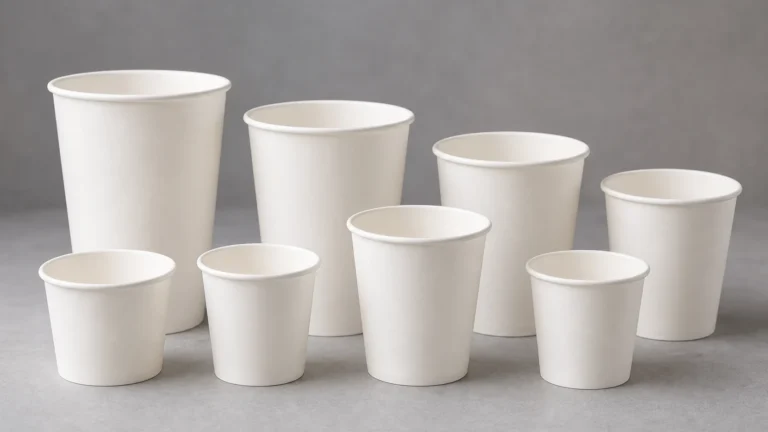
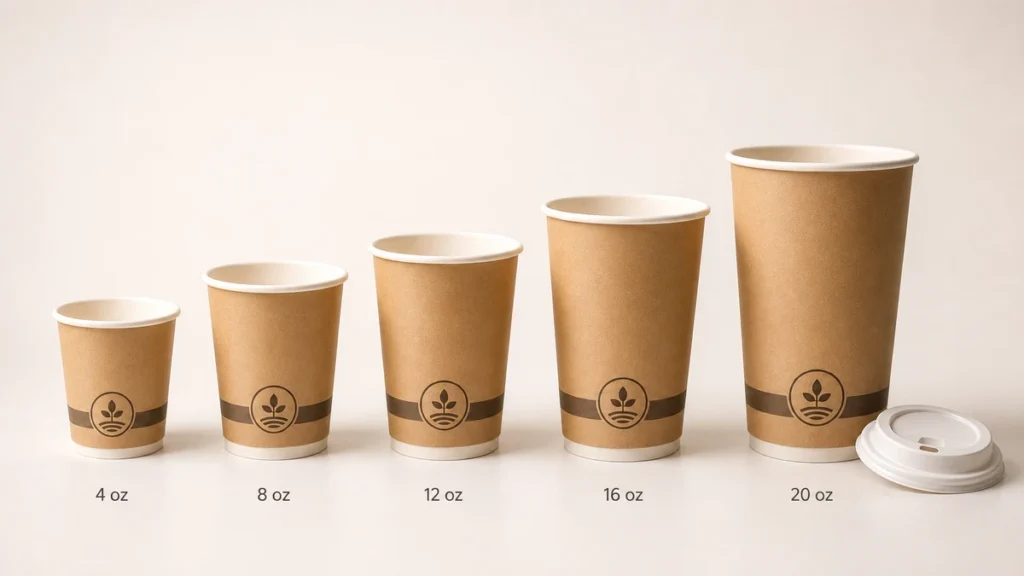
For most hot beverage programs, 8 oz, 12 oz, and 16 oz cover the core range. A 20 oz size may be useful when large drinks are a meaningful share of sales, but it adds complexity in sleeves, carriers, and storage. The practical default for many operators is 12 oz, with 16 oz as the next most common add-on.
One important detail: the printed ounce rating is usually brim-fill capacity, not the normal service fill. A 12 oz cup filled below the rim for safe lid seating will often deliver closer to 10 to 11 oz of usable beverage. Buyers should confirm the intended service fill, not only the nominal cup size.
| Nominal Size | Common Use | Typical Rim Range | Buying Note |
|---|---|---|---|
| 4 oz | Espresso, samples | 62 mm | Limited lid need |
| 6 oz | Cortado, small flat white | 80 mm | Check sleeve availability |
| 8 oz | Small coffee, cappuccino | 80 to 89 mm | Common secondary size |
| 10 oz | Americano, mid-size drip | 89 mm | Verify actual series fit |
| 12 oz | Standard hot coffee, latte | 89 to 90 mm | Best default size |
| 16 oz | Large latte, large coffee | 90 mm | Often shares lid with 12 oz |
| 20 oz | Extra-large hot or cold drinks | 90 mm | Check carrier and sleeve fit |
A simple stocking strategy is often best. Start with two hot sizes and add more only when menu demand clearly supports them. Many buyers reduce waste and purchasing errors by standardizing on fewer SKUs with shared lid diameters.
If you are sourcing paper coffee cups, ask the supplier for the exact rim diameter, cup height, top diameter, bottom diameter, and recommended lid series. Those details matter more than the marketing name of the cup.
The construction of coffee cups to go determines hand comfort, insulation, print surface, and total system cost. The three main options are single-wall, double-wall, and ripple-wall.
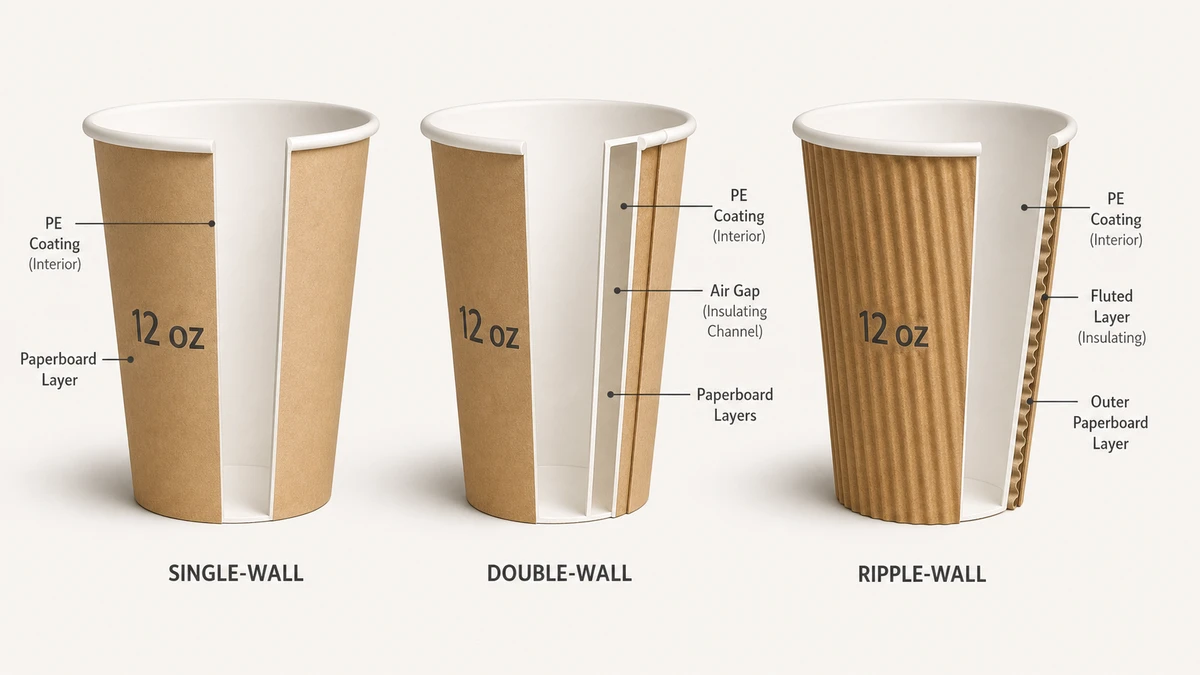
Single-wall cups use one paperboard layer with an interior barrier, commonly PE, water-based coating, or another approved lining depending on the target market and disposal claim. They are lightweight, cost-efficient, and widely available. For hot drinks, they usually need a sleeve.
Double-wall cups use two paperboard layers with an air gap between them. That extra structure improves insulation and lets many operators serve hot drinks without a separate sleeve. This can simplify front-counter workflow and reduce one additional SKU.
Ripple-wall cups add a textured outer layer that creates insulation and grip. They often sit between single-wall and double-wall in both cost and performance, but the textured surface can limit fine print detail.
| Factor | Single-Wall | Double-Wall | Ripple-Wall |
|---|---|---|---|
| Hand insulation | Low | High | Medium to high |
| Sleeve need | Usually yes | Usually no | Usually no |
| Print surface | Smooth | Smooth | Textured |
| Unit cost | Lowest | Highest | Mid-range |
| Best for | High volume, cost control | Premium or sleeve-free service | Mid-volume sleeve-free service |
For buyers, the decision is usually operational:

If your program is moving toward sleeve-free hot service, double-wall cups are often the cleanest upgrade path. Still, always test the cup with the actual beverage temperature and hold time used in service.
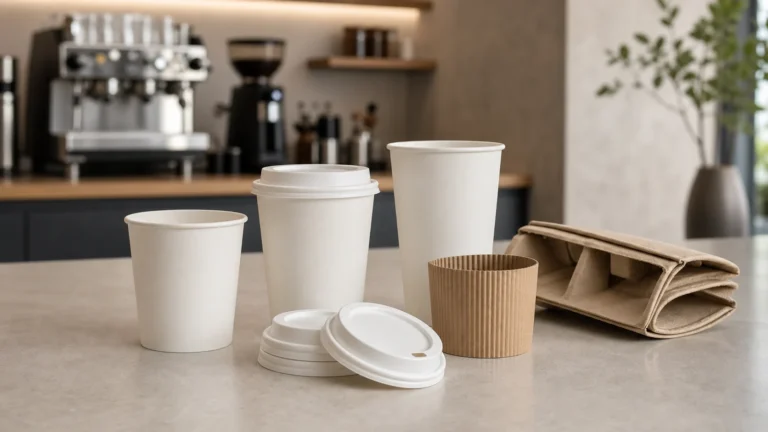
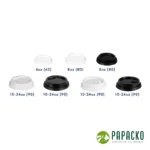
Lid fit is one of the most important technical details in coffee cups to go. A lid that is close in size but not made for the exact cup series can pop off, leak, or require too much force during application. Buyers should match lids by cup series and rim specification, not by ounce label alone.
For hot drinks, the most common lid types are sipper lids, flat lids, and traveler lids. Sipper lids are the standard choice for everyday takeaway coffee because they offer simple drink-through use and fast application. Traveler lids can improve closure during transport but may cost more and slow service slightly. Flat lids can stack well and work for some formats, but they are less common for direct drink-through hot coffee service.
When reviewing coffee cup lids, ask for:
– Compatible cup SKUs
– Rim diameter and tolerance
– Material specification
– Heat resistance
– Fit test samples
– Carton pack count
– Compliance declaration
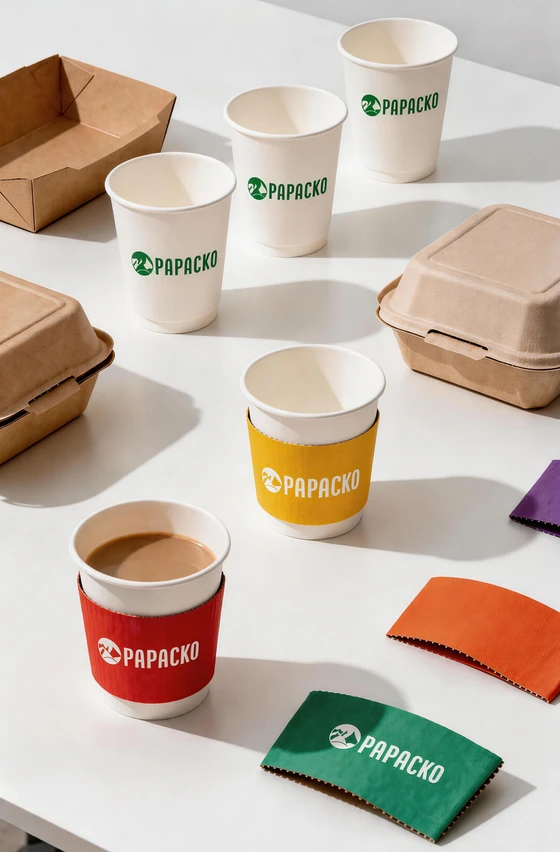
Sleeves are mainly used with single-wall cups. Their function is simple: they create a barrier between the user’s hand and the cup wall. They do not significantly improve beverage heat retention. Corrugated kraft sleeves usually offer the best insulation, while flat printed board sleeves may offer cleaner print quality.
When selecting coffee cup sleeves, confirm:
– Which cup sizes and series they fit
– Whether they are intended for automatic or manual application
– Board type and thickness
– Print method
– Bundling and case quantity
– Lead time for plain and printed versions
A sleeve that fits one supplier’s 12 oz cup may not fit another supplier’s 12 oz cup because taper and outer diameter differ. Physical fit samples are essential before placing a large order.
Branded coffee cups can support recognition at handoff, in-store consistency, and takeaway presentation, but cup printing should be planned around realistic MOQ, artwork limits, and lead times. The most common mistake is choosing a print method that does not match the order volume.
For custom printed coffee cups, buyers usually compare three routes:
| Print Method | Typical MOQ | Lead Time | Best Use |
|---|---|---|---|
| Offset pre-print | 50000+ units | 6 to 10 weeks | Large stable programs |
| Flexographic print | 10000 to 25000 units | 3 to 6 weeks | Regional volume |
| Digital print | 500 to 5000 units | 1 to 3 weeks | Tests, seasonal runs |
Offset pre-print gives strong wrap coverage and clean registration, but MOQ is usually high. Flexographic print works well for logos and limited color designs at mid-volume. Digital print supports shorter runs, though unit cost is typically higher.
Buyers should request the supplier’s wrap guide before final artwork. Tapered cups distort design near the top and bottom, and safe print zones can vary by size. Also confirm whether the ink is exterior only. Interior print or print near the lip area may require additional compliance review.
For low-volume programs, plain cups plus printed sleeves can sometimes be more flexible than printed cups. For higher-volume programs, direct branded cups may lower total assembly steps and present a cleaner finished look.
Coffee cups to go are food-contact packaging, so compliance cannot be handled as a marketing afterthought. Buyers should request written documentation for the exact SKU they are ordering, including size, material, coating, and print system.
Typical material and coating questions include:
– Paperboard grade and gsm
– PE lining, water-based coating, or other barrier type
– Recycled content or virgin fiber claim
– FSC or chain-of-custody status
– Suitability for hot liquids
– Recommended use conditions
Supplier documentation should usually include:
– Food contact declaration for the destination market
– Product specification sheet
– Carton packing details
– Factory quality certification
– Traceability or lot coding information
– Test reports where applicable
– Artwork approval record for printed items
For US buyers, the supplier should be prepared to discuss food-contact suitability for the relevant materials used in the finished cup system. The FDA’s food-contact substances guidance is a useful reference point when checking cup lining, lid resin, coating, and ink documentation.
Sustainability claims also need care. Compostable, recyclable, or fiber-sourced claims should match the actual cup body, lid, and local waste pathway. A compostable cup body does not automatically mean the full cup-and-lid set can be marketed as compostable in practice.
A good cup program works as a matched system. Before issuing a purchase order, buyers should confirm the following points for coffee cups to go:
Core size lineup
Keep the range narrow unless sales data supports more SKUs.
Working fill volume
Confirm usable fill below the rim, not just brim capacity.
Lid compatibility
Test lids on filled cups with actual service handling.
Sleeve fit
Match sleeve geometry to the real cup, not only the ounce rating.
Material and coating choice
Verify whether PE, water-based, or other barrier options are available.
MOQ
Ask separately for plain stock, custom print, and sleeves. MOQ often differs by item.
Lead time
Confirm lead time for samples, production, and shipping. Printed orders may require artwork approval before the clock starts.
Samples
Request plain cup samples, lid samples, and if possible pre-production printed mockups.
Documentation
Get declarations, specs, and certifications before launch, not after.
Supply continuity
Ask whether lids, sleeves, and cups can be replenished together with consistent fit across batches.
For many B2B buyers, the best path is to validate one complete set: 12 oz and 16 oz hot cups, one lid series, and either one sleeve or a double-wall format. That creates a manageable starting point for rollout and future volume planning.
For most operators, 12 oz is the best default because it handles standard hot drinks, works with common lid systems, and fits most sleeves and carriers. Add 16 oz if large-format drinks are a core part of the menu.
Not always, but many supplier lines do share the same rim diameter across those sizes. Always confirm the cup’s rim spec and test the actual lid before placing a stocking order.
No. Double-wall improves hand comfort, but it also costs more and adds weight. If you already use sleeves and want lower unit cost, single-wall can be the better commercial choice.
Ripple-wall is a good middle ground when you want sleeve-free service without paying full double-wall cost. It is useful for mid-volume coffee bars, but the textured surface is less ideal for very fine print.
No. Compostability depends on the product certification and the local composting infrastructure that receives it. Verify the cup body, lid, and disposal pathway before making a compostable claim on the menu or packaging.
Confirm the wrap guide, the exact cup substrate, the print method, the ink system, and the MOQ. If you are buying for a rollout, also check lead time and sample the lid fit before the print run is released.