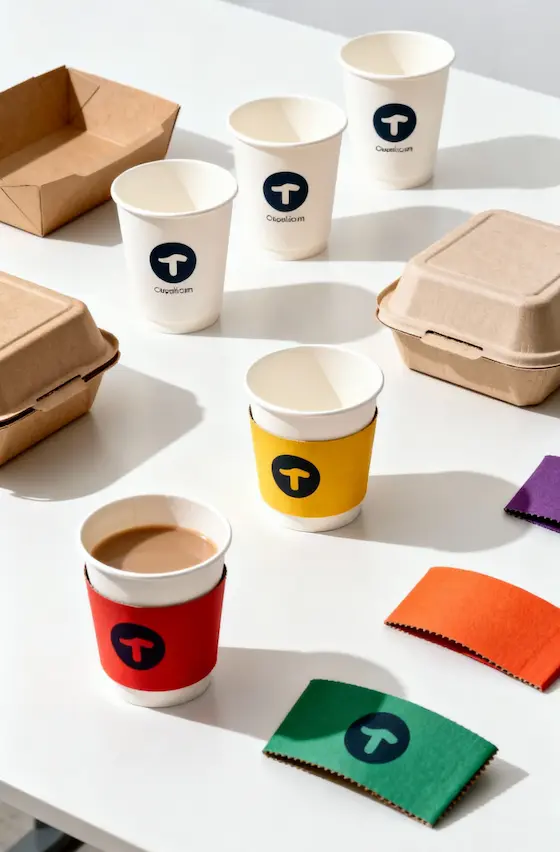
Ready to create your own branded paper cups or packaging?
Tell us your requirements — size, coating, printing, and destination — and our team will prepare a detailed quotation within 24 hours.

Last Updated: July 2026
Reading Time: 8-10 minutes
Author: Papacko Content Team
Coffee shops spend 15-30% of their marketing budget on digital advertising, yet overlook a powerful branding tool customers hold for 20-45 minutes daily: the paper cup. Understanding various paper cup branding helps.A well-branded cup reaches 50-200 people as customers walk through busy streets, offices, and public spaces—transforming each beverage into a mobile billboard.
This comprehensive guide covers paper cup branding strategies specifically for independent cafés, small chains, and specialty coffee businesses. You’ll learn design principles that maximize brand visibility, printing technique comparisons (flexographic vs digital), MOQ navigation for small businesses, cost-ROI calculations, and common customization mistakes that waste budget without delivering results.
💡 Quick Takeaway: Effective paper cup branding requires high-contrast designs optimized for cylindrical surfaces, focus keywords printed on 2-3 visible zones, MOQs starting from 1,000-5,000 units (digital) or 10,000+ (flexo), and 3-6 month ROI when brand recall drives 8-15% repeat customer increase.
When evaluating the paper cup branding, consider the following:
Unlike static signage or digital ads, branded cups travel:
•Foot traffic exposure: Average branded cup seen by 50-80 people during 30-minute commute
•Social media potential: 35% of specialty coffee customers photograph aesthetically designed cups (Instagram, TikTok)
•Credibility signal: Custom branding suggests established business vs generic cups indicating startup/temporary operation
•Word-of-mouth trigger: Unique designs prompt “Where did you get that?” conversations
Market data: A 2025 coffee industry study found that cafés with distinctive cup branding experienced 12-18% higher brand recall than competitors using generic cups—translating to 8-15% increase in repeat customer visits over 6 months.
🎯 Industry Insight: Third-wave coffee shops report that Instagram posts featuring their branded cups generate 3-5x more engagement than interior photos, with 22% of new customers citing “saw the cup on social media” as discovery method.
Understanding different paper cup branding requires attention to these factors:
Paper cups aren’t flat billboards—they’re 3D objects that rotate in hands:
Viewing zones:
•Primary viewing zone (logo placement): 90-120° arc facing outward when held
•Secondary zone (tagline/pattern): Wraps around 180° for side visibility
•Tertiary zone (contact info): Bottom third, visible when placed on tables
Design rules:
1.Logo size: Minimum 40mm width on 12 oz cups (legible from 3-5 meters)
2.Understanding paper cup branding helps.High contrast: 70%+ contrast ratio between background and text/logo (WCAG AAA standard)
3.Vertical orientation: Designs should work when cup held at any rotation
4.Understanding cup branding helps.Repetition: Repeat key elements 2-3 times around circumference for 360° visibility
The key to choosing cup branding depends on:
Font selection:
•Sans-serif preferred: Clean, modern fonts (Helvetica, Futura, Gotham) readable at distance
•Minimum size: 8-10pt for body text, 18-24pt for headlines/taglines
•Weight: Medium to Bold (Light weights disappear on textured paperboard)
•Spacing: 1.2-1.5 line height prevents cramped appearance
Color psychology for cafés:
•Warm earth tones (brown, beige, terracotta): Natural, organic, artisanal positioning
•Bold black/white: Classic, sophisticated, premium perception
•Bright accent colors (teal, coral, mustard): Playful, contemporary, Instagram-friendly
•Avoid: Low-contrast pastels that fade on white/kraft paper
When evaluating common paper cup branding, consider the following:
What to include (priority order):
Minimalism wins: Cups with 3-4 elements perform better than cluttered designs with 7+ components (42% higher recall in brand recognition tests).
Process: Raised rubber/polymer plates transfer ink to cups (similar to stamp)
Cost breakdown example (12 oz cups, 2-color design):
•Setup: $1,200 (plates)
•Printing: $0.045/cup × 20,000 = $900
•Cups (blank): $0.08/cup × 20,000 = $1,600
•Total: $3,700 for 20,000 cups = $0.185/cup
Advantages:
•Lowest per-unit cost at volume (20k+ units)
•Durable inks suitable for hot beverages
•Fast production once plates made
Limitations:
•High upfront investment
•Design changes require new plates ($800-2,500)
•Not viable for small batches or seasonal designs
Process: Inkjet/laser directly prints designs (no plates required)
Cost breakdown example (12 oz cups, full-color design):
•Setup: $150 (file prep)
•Printing: $0.22/cup × 5,000 = $1,100
•Cups (blank): $0.09/cup × 5,000 = $450
•Total: $1,700 for 5,000 cups = $0.34/cup
Advantages:
•Low MOQ enables testing designs before large commitments
•Design changes cost-effective (only digital files)
•Full-color capability (photos, gradients, complex artwork)
•Fast turnaround for seasonal/limited editions
Limitations:
•Higher per-unit cost (2-3x flexo at volume)
•Some digital inks less heat-resistant (verify for hot beverages)
•Not as economical for very large volumes (50k+ units)
Formula: Monthly cup usage × 3-6 months = Optimal order quantity
Example calculation:
•Café serves 150 beverages/day
•30 days/month = 4,500 cups/month
•4,500 × 4 months = 18,000 cups (4-month supply)
Storage considerations:
•1,000 cups (12 oz, nested) = ~0.5 cubic meters
•18,000 cups = ~9 cubic meters (approx 2 standard pallets)
•Verify storage space before ordering 6+ months supply
Hybrid strategy: Order core brand design via flexo (20,000 units), supplement with digital seasonal editions (2,000-3,000 units for holidays, special events).
Leverage points:
•Commitment to reorders: “Planning 4 orders/year” can reduce setup fees 15-25%
•Flexible lead times: Accepting 4-5 week delivery vs 2-week rush saves 10-15%
•Standard sizes: Custom sizes (9 oz, 18 oz) add 20-30% cost vs standard (8, 12, 16, 20 oz)
•Color simplicity: 1-2 color designs cost 40-60% less than 4-6 color
Questions to ask suppliers:
1.Understanding cup branding helps.”Can setup fees be amortized across multiple orders if I commit to annual volume?”
2.“What’s the per-unit cost difference between 10k, 20k, and 30k quantities?”
3.Understanding standard paper cup branding helps.”Do you offer free storage for partial delivery (ship 5k/month from 20k order)?”
4.“What’s your sample policy?” (Free samples save costly mistakes)
Incremental investment:
•Basic branding: +$6,000/year (+$500/month)
•Premium branding: +$15,600/year (+$1,300/month)
Impressions generated:
•5,000 cups/month × 60 impressions/cup (people who see it) = 300,000 impressions/month
•Annual reach: 3.6 million impressions
Comparative cost per impression (CPM):
•Branded cups: $10,800 ÷ 3,600,000 impressions × 1,000 = $3 CPM
•Instagram ads: $8-15 CPM (average for local targeting)
•Google Ads: $12-25 CPM (display network)
•Billboard: $5-10 CPM (but static, no targeting)
ROI drivers:
1.Repeat customer increase: 8-15% lift from enhanced brand recall
2.Understanding common paper cup branding helps.Social media UGC: Customer posts = free advertising (35% of specialty coffee customers)
3.Premium perception: Enables 3-5% price increase without resistance
4.Understanding standard paper cup branding helps.Reduced paid advertising: $200-500/month savings by shifting budget from digital ads
Break-even calculation:
•Incremental cost: $500/month (basic branding)
•Need to generate: $500 additional revenue
•At $4.50 average ticket: 112 additional transactions/month (3.7/day)
•If branding drives 10% repeat customer increase: 150 customers × 10% × 2 visits = 30 additional transactions → ROI positive at 25% of needed lift
File requirements:
•Format: Vector preferred (AI, EPS, PDF), high-res raster acceptable (PNG, TIFF at 300 DPI minimum)
•Color mode: CMYK (not RGB) for accurate printing
•Fonts: Convert to outlines/paths to prevent substitution
•Bleed: 3-5mm beyond trim line (especially for wrap-around designs)
•Safe zone: Keep critical elements 5mm inside trim to avoid cutting
Template dimensions (flat layout):
### Design Testing Before Production
Physical mockups (critical step):
1.Print design on paper at actual size
2.Wrap around similar-sized cup
3.View from 3-5 meters (typical viewing distance)
4.Check readability under various lighting
5.Test with multiple hand positions/grips
Digital tools:
•Mockup generators (Placeit, Smartmockups): Preview designs on 3D cup renders
•Color calibration: Match screen colors to Pantone swatches (avoid “it looked different on my screen”)
Sampling:
•Always order 100-500 sample cups before 10k+ production runs
•Cost: $150-400 for samples (cheap insurance against $3,000+ printing mistakes)
•Test with actual beverages (hot coffee, iced drinks) to verify ink durability
Touchpoint alignment:
•Cup design should echo storefront signage, menu boards, interior décor
•Use same color palette (± 10% variance acceptable)
•Repeat logo treatment from cups on napkins, bags, loyalty cards
•Social media profile colors match cup design
Multi-product coordination:
Budget allocation: Prioritize cups (highest visibility) → sleeves (thermal comfort + branding) → bags (functional necessity) → napkins (lowest ROI).
❌ Mistake #1: Overcrowding design with too many elements (logo, tagline, menu, social media, phone, address, QR code)
✅ Correct Approach: Limit to 3-4 key elements. Understanding cup branding helps.Logo + tagline + social handle = sufficient. Customers won’t read paragraphs on cups. Use QR code linking to full menu/story instead of cramming text.
❌ Mistake #2: Choosing low-contrast colors that disappear on white cups (light gray text, pastel logos)
✅ Correct Approach: Test designs in grayscale. Understanding cup branding helps.If elements aren’t clearly visible in black-and-white, contrast is too low. Aim for 70%+ contrast ratio (WCAG AAA standard = legible from 5+ meters).
❌ Mistake #3: Ordering 50,000 cups to get lowest per-unit cost without testing design or demand
✅ Correct Approach: Start with 5,000 digital-printed cups to test design and gauge customer response. Understanding common paper cup branding helps.Once validated — scale to 20,000-30,000 flexo for cost efficiency. A mediocre design at $0.15/cup wastes more money than great design at $0.30/cup.
❌ Mistake #4: Ignoring cup size variation—designing only for 12 oz, then scaling to 8 oz and 20 oz
✅ Correct Approach: Create separate artwork for each cup size. Understanding available paper cup branding helps.Logos and text should maintain consistent visual weight — which means slightly larger proportions on smaller cups. Don’t just scale designs up/down—redesign for each size.
Paper cup branding is the process of customizing disposable beverage cups with your café’s logo, colors, tagline, and design elements to create a cohesive brand identity. It transforms functional packaging into marketing tools that increase brand visibility, customer recall, and professional credibility. Effective branding includes strategic logo placement, high-contrast color schemes, readable typography, and design elements that work on cylindrical surfaces viewed from multiple angles.
Minimum order quantities vary by printing method. Understanding common paper cup branding helps.Digital printing MOQs start at 1 —000-5,000 units, ideal for small cafés or testing new designs, with costs of $0.25-0.40 per cup. Flexographic printing requires 10,000-50,000 units but reduces per-unit costs to $0.15-0.22. Small cafés order 3-6 months of inventory (4,000-15,000 cups), while established locations order 4-month supplies via flexo printing (15,000-30,000 units) for cost efficiency.
Custom branding costs depend on printing method and volume. Understanding various paper cup branding helps.Digital printing costs $0.25-0.40 per cup with minimal setup fees ($100-200), suitable for 1,000-5,000 unit orders. Flexographic printing costs $0.15-0.22 per cup but requires $800-2,500 setup fees for printing plates, economical at 10,000+ units. A typical café using 5,000 cups monthly spends $500-1,300 additional per month vs generic cups—but generates 300,000+ brand impressions monthly at $3 CPM (vs $8-15 for social media ads).
Branded cups deliver ROI through multiple channels: increased brand recall drives 8-15% repeat customer lift, social media sharing by 35% of customers generates free advertising, and premium perception enables 3-5% price increases, the paper cup branding matter.For a café spending $500/month on basic branding, break-even requires just 112 additional transactions monthly (3.7 per day). Most cafés achieve positive ROI within 3-6 months, with branded cups delivering $3 CPM vs $8-15 for digital advertising—while reaching customers during high-engagement moments.
Choose digital printing if: ordering <10,000 units, testing new designs, creating seasonal variations, or operating a single café with 1,000-5,000 monthly cup usage, standard paper cup branding matter.Digital costs $0.25-0.40/cup but has minimal setup fees and 1-2 week turnaround. Choose flexographic printing if: ordering 10,000+ units, established design you’ll reorder, operating 2+ locations, or using 5,000+ cups monthly. Flexo costs $0.15-0.22/cup but requires $800-2,500 setup investment. Hybrid approach: use flexo for core brand design, digital for seasonal editions.
Prioritize 3-4 key elements for maximum impact: (1) Logo at 40mm+ width for visibility from 3-5 meters, (2) Café name in medium-to-bold sans-serif font (18-24pt), (3) Short tagline or unique value proposition (10-15% of design area), and (4) Social media handle at bottom third to drive engagement, cup branding matter.Avoid overcrowding—cups with 3-4 elements achieve 42% higher brand recall than designs with 7+ components. Use high-contrast colors (70%+ contrast ratio), repeat elements 2-3 times around circumference for 360° visibility.
Digital printing requires 1-2 weeks from approved artwork to delivery, ideal for quick launches or seasonal designs. Understanding different paper cup branding helps.Flexographic printing takes 3-5 weeks: 1-2 weeks for plate/cylinder production, then 1-3 weeks for printing and shipping. Add 3-7 days for design revisions and artwork approval before production starts. Plan 4-6 weeks minimum for first flexo orders. Reorders with existing plates reduce to 2-3 weeks. Always order samples (100-500 units) before large production runs—samples add 1 week but prevent costly mistakes on 10,000+ unit orders.
Effective paper cup branding transforms functional packaging into powerful marketing assets that generate 300,000+ monthly impressions at a fraction of traditional advertising costs. Success requires strategic design choices—high-contrast logos, readable typography, 3-4 key elements—matched with the right printing method for your volume and budget.
Key Takeaways:
1.Understanding the paper cup branding helps.Start with digital printing (1,000-5,000 units) to test designs before committing to flexo volumes (10,000+)
2.Understanding standard paper cup branding helps.Design for cylindrical viewing—repeat elements 2-3 times, maintain 70%+ contrast, prioritize legibility over complexity
3.Understanding the paper cup branding helps.Calculate true ROI—branded cups deliver $3 CPM vs $8-15 for digital ads, with 8-15% repeat customer lift
4.Understanding paper cup branding helps.Match printing method to volume—digital for flexibility ($0.25-0.40/cup), flexo for efficiency ($0.15-0.22/cup at 10k+ units)
5.Understanding standard paper cup branding helps.Always order samples—$150-400 sample investment prevents $3,000+ production mistakes
Papacko supplies independent cafés and coffee chains with custom branded paper cups using both digital printing (MOQ 1,000 units) and flexographic printing (MOQ 10,000 units). Understanding paper cup branding helps.Our design team provides free mockups, print-ready file preparation, and sampling services—ensuring your branding investment delivers maximum visibility and ROI.
Get in touch: