Ready to create your own branded paper cups or packaging?
Tell us your requirements — size, coating, printing, and destination — and our team will prepare a detailed quotation within 24 hours.

Last Updated: December 2025
Reading Time: 14 minutes
Author: Papacko Content Team
Your coffee shop serves 400 cups daily in generic white packaging. Meanwhile, the cafe down the street generates 80+ Instagram posts weekly featuring their bold, custom-printed cups—each cup becomes a walking billboard generating 50-200 brand impressions as customers carry them through streets, offices, and social feeds. You’ve researched custom printing, but quotes show 50,000-unit minimums at $0.12/cup plus $800 setup fees, and you’re unsure if your simple logo will print clearly or if colors will match your brand.
Custom printed paper cups transform disposable packaging into powerful brand amplifiers. That said, customization success depends on printing method selection (flexographic vs offset vs digital), design optimization for curved surfaces, color matching accuracy, and supplier capability. Poor decisions result in blurry logos, mismatched colors, or wasted budget on excessive quantities—damaging brand perception than enhancing it.
In this guide, you’ll learn:
•Printing method comparison: flexo, offset, digital (technical specs, costs, MOQs)
•Design optimization for cylindrical cup surfaces and viewing angles
•Pantone color matching for brand consistency across orders
•MOQ negotiation: reducing 50,000 minimums to 5,000-10,000 units
•True cost analysis: setup fees, per-unit pricing, design charges
•Supplier vetting: quality control and print capability assessment
•Common design mistakes that waste thousands in reprints
Quick Takeaway: Custom printed paper cups cost $0.06-0.35 per unit depending on method: Flexographic $0.06-0.09 (30K+ MOQ, bold logos), Digital $0.18-0.35 (500+ MOQ, complex designs), Offset $0.10-0.15 (50K+ MOQ, photographic quality). Setup fees: $300-800 flexo, $800-1,200 offset, $0-150 digital. Design requirements: 300 DPI minimum resolution, vector formats (AI/EPS/PDF), Pantone color specification (not RGB), 5mm minimum text height. MOQ negotiation tactics: Trial order premiums (pay 12-15% more for half MOQ), mixed size orders (combine SKUs), scheduled orders (lock volume pricing across shipments). Lead time: 30-45 days flexo/offset, 10-15 days digital. Critical: Always approve physical proof samples—digital mockups never accurately represent final print quality on curved surfaces.
Understanding various custom printed paper cups requires attention to these factors:
Marketing Impact Quantified:
Brand Visibility Multiplication:
•Average cup carried 45 minutes (office delivery, commute, meetings)
•Viewing impressions per cup: 50-200 people (streets, offices, public transit)
•Daily reach: 400 cups × 100 average impressions = 40,000 brand exposures
•Monthly impressions: 1.2 million (equivalent to $8,000-12,000 in paid advertising)
Customer Behavior Data:
•68% customers photograph branded cups for social media (Instagram, Facebook)
•Average branded cup post reaches 120-400 followers
•User-generated content creates authentic brand advocacy (more trusted than ads)
•Branded packaging increases perceived quality by 15-23% (consumer psychology studies)
ROI Calculation Example (Small cafe: 300 cups/day):
Beyond Direct Marketing: Custom cups enhance brand professionalism, differentiate from competitors, support premium pricing (customers pay 5-8% more for perceived quality), and create memorable brand touchpoints.
For the custom printed paper cups, focus on:
Design Complexity Levels:
Level 1: Simple Logo Print (Most common, 65% of custom orders):
•Single-color logo on white cup
•Company name or tagline
•Minimal design elements
•Ideal printing method: Flexographic
•Cost: $0.06-0.08 per cup (30K MOQ)
•Lead time: 30-35 days
Level 2: Multi-Color Branding (25% of custom orders):
•2-4 color logo
•Brand colors + secondary elements
•Pattern or texture backgrounds
•Ideal printing method: Flexographic (spot colors) or Digital (CMYK)
•Cost: $0.09-0.15 per cup (flexo 30K MOQ, digital 2K MOQ)
•Lead time: 35-40 days flexo, 10-15 days digital
Level 3: Full-Color Artwork (10% of custom orders):
•Photographic images
•Gradients and complex illustrations
•Unlimited colors
•Variable designs per cup
•Ideal printing method: Offset (high volume) or Digital (low volume)
•Cost: $0.12-0.18 per cup offset (50K MOQ), $0.25-0.35 digital (500+ MOQ)
•Lead time: 40-50 days offset, 10-15 days digital
Additional Customization Elements:
•Cup sizes: 4oz, 8oz, 12oz, 16oz, 20oz (most common: 12oz and 16oz)
•Materials: PE-coated, PLA-coated, double-wall, kraft paper
•Lid customization: Matching branded lids available (+$0.04-0.08 per lid)
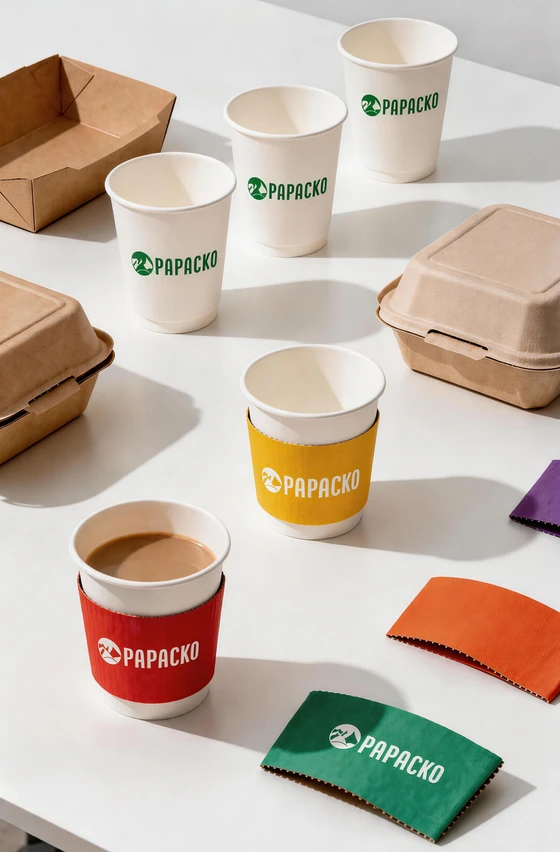
•Sleeve customization: Branded sleeves for double-wall effect (+$0.08-0.15 per sleeve)
•Interior printing: Less common, premium option (+40-60% cost premium)
For standard custom printed paper cups, focus on:
Technical Process: Raised rubber/polymer plates transfer ink directly to cup surface (modern stamp printing at industrial scale)
Detailed Specifications:
•Resolution: 120-150 LPI (lines per inch)—adequate for logos, insufficient for photos
•Color system: Spot colors (Pantone matching system)
•Colors per design: 1-6 colors (each requires separate plate)
•Minimum line width: 1.0mm (0.04″)—finer lines may blur or break
•Registration tolerance: ±0.5mm (slight color misalignment acceptable)
•Production speed: 8,000-12,000 cups/hour
•Ink type: Water-based or UV-curable (food-safe, fast-drying)
•Durability: Excellent (scratch-resistant, moisture-proof)
Optimal Design Characteristics:
•Bold, simple logos with clean edges
•Solid color blocks without gradients
•Sans-serif fonts (minimum 8pt for readability, 12pt recommended)
•High contrast color combinations (dark on light or vice versa)
•2-3 colors ideal (more colors = proportionally higher costs)
•Vector artwork (AI, EPS formats—infinitely scalable without quality loss)
Cost Breakdown (12oz cup, 2-color design):
Setup Cost Components:
•Plate engraving: $180-280 per color (2 colors = $360-560)
•Printing cylinder preparation: $80-120
•Color proofing: $60-100
•Machine setup labor: $100-150 (2-3 hours setup time)
•Total setup: $400-600
Plate Reusability: Plates last 50,000-100,000 impressions if stored properly. Reorders using existing plates: $0 setup fee, only pay per-cup cost.
Advantages:
•✅ Lowest per-unit cost at volume ($0.06-0.09 for 30K+)
•✅ Superior ink adhesion (won’t scratch or fade with handling)
•✅ Fast production (30,000 cups in 2.5-4 hours)
•✅ Pantone color matching for brand consistency
•✅ Plates reusable for reorders (eliminates setup cost)
•✅ Excellent for ongoing orders (cafes, restaurants, chains)
Disadvantages:
•❌ High MOQ requirement (30,000-50,000 economically viable)
•❌ Significant upfront setup investment ($400-600)
•❌ Limited to spot colors (cannot mix colors for gradients)
•❌ Design changes expensive (new plates: $400-600 per revision)
•❌ Cannot reproduce photographs or complex artwork
•❌ 30-45 day lead time (plate creation + production + shipping)
Best Applications:
•Established businesses with proven branding
•High-volume needs (5,000+ cups/month consumption)
•Simple, bold logo designs
•Repeat orders (plate reusability maximizes value)
•Budget-conscious projects requiring professional appearance
Understanding standard custom printed paper cups requires attention to these factors:
Technical Process: Direct inkjet-style printing adapted for cylindrical cup surfaces (no plates required)
Detailed Specifications:
•Resolution: 600-1200 DPI—photographic quality
•Color system: CMYK + spot colors (unlimited color mixing)
•Colors: Unlimited (full-color spectrum available)
•Minimum line width: None—digital precision handles finest details
•Registration tolerance: ±0.1mm (digital precision, no mechanical alignment)
•Production speed: 2,000-4,000 cups/hour (slower than flexo)
•Ink type: UV-curable digital inks (instant drying)
•Variable data: Can print different designs in same run
Optimal Design Characteristics:
•Complex, multi-color artwork
•Photographic images or realistic illustrations
•Gradient backgrounds and color transitions
•Fine text and intricate details
•Limited edition or seasonal designs
•Personalization (names, numbers, unique messages per cup)
Cost Breakdown (12oz cup, full-color design):
Setup Requirements:
•Digital file preparation: $50-100
•Color calibration: $30-50
•Proof sample production: $20-50
•Total setup: $100-200 (minimal compared to flexo)
Advantages:
•✅ Ultra-low MOQ (500-1,000 units feasible)
•✅ Minimal or no setup fees ($100-200 vs $400-800)
•✅ Fast turnaround (10-15 days total vs 30-45)
•✅ Excellent for testing designs before committing to high volume
•✅ Easy design iteration (change designs affordably)
•✅ Variable data printing (personalized cups)
•✅ Photographic quality reproduction (600+ DPI)
•✅ Unlimited colors without additional cost
Disadvantages:
•❌ Highest per-unit cost ($0.20-0.35 per cup)
•❌ Not economical above 10,000 units (flexo becomes cheaper)
•❌ Lower durability (ink may fade faster with UV exposure)
•❌ Color consistency varies batch-to-batch (less precise than Pantone)
•❌ Limited supplier availability (newer technology, fewer printers)
•❌ Slightly lower scratch resistance than flexo
Best Applications:
•New businesses testing custom packaging
•Seasonal or promotional designs (holiday cups, limited editions)
•Small cafes with <1,000 cups/week consumption
•Events and special occasions (weddings, conferences)
•Multi-location chains wanting location-specific designs
•Launching new brands (test market response before large orders)
When evaluating various custom printed paper cups, consider the following:
Technical Process: Ink transferred from plate → rubber blanket → cup surface (indirect transfer allows finer detail)
Detailed Specifications:
•Resolution: 175-200 LPI—near-photographic quality
•Color system: CMYK process (four-color mixing creates unlimited colors)
•Gradient reproduction: Excellent (smooth color transitions)
•Minimum line width: 0.1mm (0.004″)—extremely fine details possible
•Registration tolerance: ±0.2mm (very precise alignment)
•Production speed: 5,000-8,000 cups/hour
•Ink type: Heat-set or UV-curable offset inks
•Color consistency: Excellent batch-to-batch consistency
Cost Breakdown (12oz cup, CMYK full-color):
Setup Cost Components:
•CMYK plate creation: $600-800 (four plates required)
•Color calibration and proofing: $150-250
•Machine setup and waste: $200-300
•Total setup: $950-1,350
Advantages:
•✅ Superior print quality (magazine-quality reproduction)
•✅ Unlimited colors via CMYK mixing
•✅ Photographic images print accurately
•✅ Complex artwork with fine details
•✅ Excellent for premium brand positioning
•✅ Good cost efficiency at very high volumes (100K+)
Disadvantages:
•❌ Very high MOQ (50,000-100,000 for economic viability)
•❌ Highest setup costs ($950-1,350)
•❌ Longer setup time (color calibration intensive)
•❌ 35-50 day lead time
•❌ Design changes very expensive (new CMYK plates)
Best Applications:
•Large chains with 100,000+ monthly consumption
•Premium brands where packaging quality signals product quality
•Complex visual identities requiring photographic reproduction
•National campaigns with consistent high-volume demand
For various custom printed paper cups, focus on:
Step-by-Step Selection Process:
Step 1: Assess Monthly Consumption
•<1,000 cups/month → Digital printing
•1,000-5,000 cups/month → Digital (start) → Flexo (scale)
•5,000-15,000 cups/month → Flexographic
•15,000+ cups/month → Flexographic or Offset
Step 2: Evaluate Design Complexity
•Simple logo (1-3 colors, solid blocks) → Flexographic
•Multi-color with gradients → Digital or Offset
•Photographic images → Digital (low volume) or Offset (high volume)
Step 3: Calculate Break-Even Points
Flexo vs Digital Comparison (2-color design):
•Digital: $0.30 per cup all-in (no significant volume discounts)
•Flexo: $0.075 per cup + $450 setup
Break-even calculation:
“`
Setup cost / (Digital cost – Flexo cost) = Break-even quantity
$450 / ($0.30 – $0.075) = 2,000 cups
“`
Interpretation: Above 2,000 cups, flexo becomes cheaper despite setup fee.
Step 4: Consider Reorder Likelihood
•One-time order (event, promotion) → Digital
•Ongoing orders (cafe, restaurant) → Flexo (plates reusable, no future setup fees)
Step 5: Account for Timeline
•Needed within 2-3 weeks → Digital only option
•6-8 week timeline acceptable → Flexo or Offset
For various custom printed paper cups, focus on:
The Curvature Challenge:
Paper cups are conical/tapered cylinders, not flat surfaces. Artwork must account for:
•Curvature distortion: Images wrap around curved surface, causing stretching
•Viewing angles: Cups viewed from front, sides, above (different perspectives)
•Seam area: 8-12mm overlap where cup edges join (non-printable zone)
•Taper angle: Cup diameter smaller at bottom than top (affects logo positioning)
Template-Based Design Workflow:
Step 1: Request Supplier Template
•Most suppliers provide cup-specific templates (AI, EPS, PDF formats)
•Template shows:
– Printable area (safe zone for critical elements)
– Seam area (avoid placing text or logos here)
– Distortion guides (how flat artwork maps to curved surface)
– Bleed area (extend backgrounds beyond trim line)
Step 2: Design Within Safe Zones
•Place logo and critical text in marked safe zones (typically0-70% of template)
•Avoid placing important elements within 15mm of seam area
•Extend background patterns/colors to bleed area for full coverage
Step 3: Account for Distortion
•Logos near cup bottom (narrower diameter) appear compressed
•Logos near rim (wider diameter) appear stretched
•Solution: Request distortion-compensated template (pre-adjusts for curvature)
Step 4: Physical Mockup Testing
•Print template at actual size (100% scale)
•Wrap around physical cup to preview how design appears
•Check logo visibility, text readability, seam placement
•Iterate design based on physical mockup feedback
Step 5: Request Digital 3D Mockup
•Supplier creates 3D rendering showing design wrapped on cup shape
•View from multiple angles (front, side, top)
•Approve mockup before proceeding to proof samples
The key to choosing available custom printed paper cups depends on:
Text Size Requirements:
Font Selection Criteria:
•Avoid: Thin fonts, serif fonts (details get lost on curved surface)
•Prefer: Bold sans-serif fonts (clean, readable from distance)
•Examples: Helvetica Bold, Arial Black, Gotham Bold, Futura Heavy
Color Contrast for Readability:
Contrast Ratio Standards (WCAG accessibility guidelines adapted for cups):
•Excellent (7:1 ratio): Black on white, white on dark blue, yellow on black
•Good (4.5:1 ratio): Dark gray on white, white on medium blue
•Poor (<3:1 ratio): Light gray on white, yellow on white—avoid these
High-Contrast Combinations (Recommended):
•Black text on white background (maximum contrast)
•White text on dark background (navy, black, dark green)
•Dark text on light background (black on yellow, dark blue on white)
Low-Contrast Combinations (Avoid):
•Pastel colors on white (pink, light blue, cream)
•Light text on light background
•Similar color values (dark blue text on black background)
Color Psychology for Cup Branding:
•Red: Energy, appetite stimulation (coffee, fast food)
•Blue: Trust, calmness (professional services, health)
•Green: Natural, eco-friendly (organic cafes, juice bars)
•Yellow: Happiness, optimism (breakfast cafes, bakeries)
•Black: Sophistication, premium (specialty coffee, upscale dining)
Understanding custom printed paper cups requires attention to these factors:
Standard Placement Options:
Option 1: Centered Front (Most Common – 60%)
•Logo centered on cup “front” (opposite seam)
•Visible when cup held naturally
•Ideal for: Simple logos, maximum visibility
•Dimensions: 50-80mm width, 30-60mm height (12oz cup)
Option 2: Wraparound Pattern (25%)
•Repeating logo/pattern covers entire cup circumference
•Visible from any angle
•Ideal for: Geometric patterns, small logos, maximum brand coverage
•Dimensions: Logo repeats 3-5 times around cup
Option 3: Multi-Element Layout (10%)
•Logo front, tagline/website on sides, pattern background
•Maximizes information density
•Ideal for: Complex brands, promotional campaigns
•Placement: Primary logo front center, secondary elements ±90° from front
Option 4: Asymmetric Artistic (5%)
•Non-centered, creative placement
•Modern, artistic aesthetic
•Ideal for: Specialty brands, artistic cafes, limited editions
•Risk: May appear off-center or poorly aligned if not expertly designed
Seam Positioning Strategy:
•Preferred: Seam at direct back (180° from logo) — logo never obscured
•Acceptable: Seam at side (90° from logo) — logo visible from most angles
•Avoid: Seam intersecting logo — unprofessional appearance, logo disrupted
For common custom printed paper cups, focus on:
The Color Consistency Problem:
Your brand guidelines specify:
•RGB: (211, 47, 47) for red
•CMYK: (0, 100, 100, 0) for red
•Hex: #D32F2F for web
You send these specs to three suppliers. Results:
•Supplier A: Red-orange tint (too bright)
•Supplier B: Dark burgundy (too muted)
•Supplier C: Accurate match
Root Cause: RGB/CMYK/Hex are device-dependent color spaces:
•RGB values display differently on every monitor (calibration varies)
•CMYK values print differently on every press (ink formulations — paper types vary)
•No physical reference standard for suppliers to match
Pantone Solution: Universal device-independent color matching system with physical reference swatches. When you specify “Pantone 485 C”, every supplier worldwide references identical physical color swatch, ensuring consistency regardless of equipment.
For different custom printed paper cups, focus on:
Step 1: Understand Pantone Types
Pantone Coated (C) vs Uncoated (U):
•Coated (C): Colors on glossy/coated paper stock (vibrant, saturated)
•Uncoated (U): Colors on matte/uncoated paper stock (muted, warmer)
Paper Cups Use Uncoated (U):
•Cup exterior is uncoated paperboard (matte finish)
•Pantone U colors accurately represent how ink appears on matte paper
•Pantone C colors will look different (darker, less vibrant) on uncoated cups
Critical Error: Specifying Pantone C colors for cups results in color mismatch. Always use Pantone U for paper cups.
Step 2: Convert Existing Brand Colors to Pantone
If You Have RGB/CMYK Colors:
1.Use Pantone Color Finder (pantone.com/color-finder-classic)
2.Input RGB or CMYK values
3.Tool suggests closest Pantone matches
4.Select Pantone U (uncoated) version
Example Conversion:
•Brand red: RGB (211, 47, 47)
•Pantone suggestion: Pantone 485 U (closest match)
•Verification: Order Pantone swatch book, compare visually
Step 3: Purchase Pantone Swatch Book
Essential Tool: Pantone Formula Guide (Solid Coated & Uncoated)
•Cost: $150-220
•Contains: 2,161 Pantone colors on physical paper swatches
•Purpose: Visual comparison under actual lighting conditions
Why Physical Swatches Critical:
•Computer screens cannot accurately display colors (backlit, RGB-based)
•Only physical swatch shows true color on paper
•Approve colors by comparing physical swatch to proof sample (never trust screen)
Step 4: Specify to Supplier
Proper Specification Format:
•✅ Correct: “Pantone 485 U” (specific, unambiguous)
•❌ Wrong: “Red similar to Coca-Cola” (subjective, imprecise)
•❌ Wrong: “RGB 211, 47, 47” (device-dependent, inconsistent)
•❌ Wrong: “Pantone 485 C” (coated version, wrong finish)
Supplier Requirements:
•Request supplier has Pantone matching inks
•Ask for proof sample matching specified Pantone
•Approve based on physical sample (not digital mockup)
Understanding custom printed paper cups requires attention to these factors:
Industry Standard Tolerances:
Delta E (ΔE) Color Difference Scale:
•ΔE < 1.0: Perfect match (imperceptible to human eye)
•ΔE 1.0-3.0: Excellent match (only trained eye notices difference)
•ΔE 3.0-6.0: Good match (noticeable side-by-side, acceptable for branding)
•ΔE 6.0-10.0: Fair match (clearly different, marginal acceptability)
•ΔE > 10.0: Poor match (unacceptable, off-brand)
Realistic Expectations by Printing Method:
Factors Affecting Color Accuracy:
1.Paper stock color: White vs cream vs kraft (background affects perceived color)
2.Humidity: High humidity darkens colors, low humidity lightens
3.Temperature: Ink viscosity changes with temperature, affecting color density
4.Ink batch variation: New ink batch may vary ±5% from previous
5.Press operator skill: Experienced operators maintain tighter tolerances
Best Practice for Consistency:
•Save approved proof sample as physical reference standard
•Include approved sample with reorders (“match this sample”)
•Accept ±ΔE 5.0 variance as industry-standard tolerance
•Don’t expect perfect match across different production runs
Understanding custom printed cups requires attention to these factors:
Why MOQs Exist (Economic Reality):
Factory Cost Structure:
•Machine setup time: 2-4 hours (cleaning, plate mounting, calibration, test runs)
•Setup labor cost: $120-180 (operators + technicians)
•Setup material waste: 500-1,200 cups (testing, color calibration)
•Plate creation: $400-600 (flexographic plates engraved)
•Hourly production rate: 8,000-12,000 cups
Break-Even Analysis:
•Setup costs: $800 total
•Target: Setup <10% of order revenue
•At 50,000 units: $800 / $4,500 revenue = 17.8% (low margin)
•At 100,000 units: $800 / $9,000 revenue = 8.9% (acceptable margin)
Factory Perspective: MOQs protect against unprofitable small orders where setup costs consume entire margin.
The key to choosing different custom printed paper cups depends on:
Tactic 1: Trial Order Premium Payment
Strategy: Offer higher per-unit price for smaller initial order, commit to larger future orders.
Example Negotiation:
•Supplier standard: 50,000 MOQ @ $0.075/cup
•Your request: 20,000 MOQ @ $0.090/cup (+20% premium)
•Commitment: If quality acceptable, next order 100,000 units @ $0.068/cup
Financial Impact:
•Small order cost: 20,000 × $0.090 = $1,800
•Large order savings: 100,000 × ($0.075 – $0.068) = $700 savings
•Supplier benefit: Higher margin small order + secured large future order
Negotiation Script:
“We understand your 50,000 MOQ, but we’d like to start with a 20,000-unit trial to validate quality for our market. We’re willing to pay $0.090 per cup (20% premium over your standard rate) for this initial order. If quality meets our standards, we’ll place 100,000-unit orders quarterly at your best volume pricing. This gives you a profitable trial order plus long-term partnership potential.”
Success Rate: 60-70% of suppliers accept this approach (especially if you’re targeting 100K+ annual volume).
Tactic 2: Mixed Size/Design Orders
Strategy: Combine multiple SKUs to reach supplier’s MOQ threshold.
Example Scenario:
•Supplier requirement: 50,000 total units minimum
•Your need: 20,000 × 12oz + 15,000 × 16oz + 15,000 × 8oz = 50,000 total
•Each size uses same base design (same plates, different cup sizes)
Cost Structure:
•Plate creation: $450 (reused across all sizes)
•Setup per size: $150 × 3 = $450 (machine calibration for each size)
•Total setup: $900 (vs $450 for single size)
•Per-cup cost: $0.077 blended average
Benefit: Meet MOQ while diversifying inventory to match actual consumption patterns.
Negotiation Script:
“We need 50,000 total units across three sizes: 20,000 12oz, 15,000 16oz, and 15,000 8oz. Can you accommodate this as a combined order using the same design plates across all sizes? We’re willing to pay setup fees for each size calibration.”
Tactic 3: Scheduled Volume Commitment
Strategy: Commit to large total volume delivered in smaller shipments over time.
Example Agreement:
•Total commitment: 200,000 units over 12 months
•Delivery schedule: 4 shipments of 50,000 units (months 1, 4, 7, 10)
•Pricing: Lock in 200K volume pricing ($0.065/cup) for all shipments
•Setup fee: Pay once ($450), reuse plates for all shipments
Financial Benefit:
•200K volume pricing: $0.065/cup (vs $0.075 at 50K pricing)
•Savings: ($0.075 – $0.065) × 200,000 = $2,000
•Working capital efficiency: $3,250 per shipment vs $13,000 all at once
Supplier Benefit:
•Guaranteed revenue over 12 months (production planning visibility)
•Steady order flow (vs one-time large order)
•Long-term relationship (likely renewals)
Negotiation Script:
“We forecast 200,000 unit consumption over the next 12 months. Rather single large shipment, we’d prefer quarterly deliveries of 50,000 units. Can you offer your 200K volume pricing ($0.065/cup) applied to each shipment with this committed schedule? We’ll sign a 12-month supply agreement guaranteeing the volumes and payment terms.”
Critical Clause: Include price lock provision (protects against mid-contract price increases) and volume flexibility (±10% per shipment to accommodate demand fluctuations).
Tactic 4: Simplification Trade-Offs
Strategy: Accept limitations in customization to reduce supplier costs, enabling lower MOQ.
Trade-Off Options:
Example:
•Original request: 4-color logo on PLA cups, 50,000 MOQ, $0.095/cup
•Simplified: 2-color logo on PE cups (supplier’s stock material), 25,000 MOQ, $0.085/cup
•Savings: ($0.095 × 50,000) – ($0.085 × 25,000) = $2,125 + 50% lower inventory investment
When This Works: Early-stage businesses testing custom packaging, seasonal campaigns, promotional orders.
Tactic 5: Multi-Supplier Portfolio
Strategy: Split total volume across 2-3 suppliers to diversify risk and maintain negotiation leverage.
Approach:
•Primary supplier: 60-70% of volume (largest orders, best pricing)
•Secondary supplier: 30-40% of volume (backup, competitive pressure)
Benefits:
•Risk mitigation: If primary supplier has quality/delivery issues, secondary scales up
•Competitive pricing: Suppliers know they’re competing for volume share
•Flexibility: Different suppliers for different needs (custom vs stock, urgent vs planned)
Example:
•Annual need: 120,000 units
•Supplier A: 80,000 units (primary, best pricing $0.068/cup)
•Supplier B: 40,000 units (secondary, $0.074/cup)
•Blended cost: $0.070/cup
•Value: Insurance against single-supplier dependency worth $720/year premium
The key to choosing custom printed cups depends on:
Phase 1: Design File Approval
Technical File Requirements:
•File format: Vector (AI, EPS, PDF) — raster formats (JPG, PNG) unacceptable for printing
•Resolution: 300 DPI minimum for any raster elements (photos, effects)
•Color mode: Pantone spot colors (not RGB or CMYK) for brand colors
•Fonts: Outlined/converted to paths (prevents font substitution issues)
•Bleed: 3mm beyond trim line (ensures full coverage, no white edges)
Supplier File Review:
•Request supplier review artwork before proceeding to proof stage
•Ask: “Are there any technical issues with this file that would affect print quality?”
•Common issues caught: Low resolution, incorrect color mode, missing bleed
Phase 2: Digital Mockup Review
What to Check:
•Logo placement (centered, not intersecting seam)
•Text readability (size, contrast, font clarity)
•Color representation (acknowledge screen colors ≠ final print)
•Design proportion (does logo size look appropriate on cup?)
Approval Criteria:
•✅ Approve mockup if layout, placement, and general appearance correct
•❌ Do NOT approve based on colors in mockup (screen colors inaccurate)
•Request revisions: Placement issues, size adjustments, layout changes
Phase 3: Physical Proof Sample Approval (CRITICAL)
What Is Proof Sample:
•Actual printed cups (50-100 units) using production method and materials
•Represents final production quality exactly
•Costs: $80-200 (setup time + materials + shipping)
Proof Sample Inspection Checklist:
Critical Decision: NEVER approve production without physically approving proof samples. Digital mockups do not show actual print quality.
Proof Sample Approval Process:
1.Receive 5-10 proof samples from supplier
2.Inspect under daylight (not fluorescent—affects color perception)
3.Compare colors to Pantone swatch book (side-by-side)
4.Test cup functionality (fill with water, check for leaks)
5. Provide written approval: “Proof samples approved for production” OR request revisions
If Revisions Needed:
•Specify exact issues: “Logo color too dark—adjust ink to match Pantone 485 U more closely”
•Request revised proof samples ( no additional charge for first revision)
•Repeat approval process with revised samples
For the custom printed paper cups, focus on:
Production Inspection (For Orders >50,000 Units):
Third-Party Inspection Services:
•Cost: $200-350 per inspection day
•Timing: When 30-50% of production complete (catch issues early)
•Process: Inspector visits factory, samples production run
Inspection Sampling Standards:
•Sample size: 1 in 500-1,000 cups (ISO 2859-1 standard)
•For 50,000 units: Inspect 50-100 cups randomly selected
•For 100,000 units: Inspect 100-200 cups
What Inspectors Check:
•Print quality consistency (compare to approved proof sample)
•Cup dimensions (diameter, height within ±2mm tolerance)
•Structural integrity (seam strength, rim quality)
•Defect rate (acceptable: <0.5% defects)
Inspector Report:
•Pass: Production meets quality standards, proceed to completion
•Conditional Pass: Minor issues noted, corrective actions required
•Fail: Stop production, rework required before proceeding
When to Use:
•First order with new supplier (validate capability)
•Orders >$10,000 value (inspection cost <3% of order value)
•Critical launches (cannot afford quality failures)
Understanding the custom printed paper cups requires attention to these factors:
Pre-Shipment Inspection (PSI) — Mandatory for All Orders >$5,000:
Timing: After production 100% complete, before shipping
Process:
1.Inspector visits factory warehouse
2.Samples finished inventory (1 in 1,000 cups)
3.Checks packaging quality (boxes intact, labels correct)
4.Verifies quantities (actual count matches order)
5.Issues pass/fail report
Inspection Checklist:
PSI Decision:
•✅ Pass: Authorize shipment, release payment
•⚠️ Conditional Pass: Ship with discount for defects (negotiate 5-15% reduction)
•❌ Fail: Do not ship, require rework or full replacement
Cost: $250-400 per PSI (worthwhile for orders $5,000+, insurance against quality failures)
When evaluating different custom printed paper cups, consider the following:
Pre-Qualification Checklist (Before placing order):
1. Certifications and Compliance:
•ISO 9001 (quality management system)
•FDA compliance (for US exports)
•FSC certification (sustainable paper sourcing)
•BRC or FSSC 22000 (food safety)
Red Flags: Expired certifications, certificates from uncredited bodies, refusal to provide copies.
2. Equipment and Technology:
•Printing press age (<10 years ideal, >15 years outdated)
•Number of printing lines (2+ lines = higher capacity, flexibility)
•Automation level (automated feeding, inspection = higher quality consistency)
How to Verify: Request factory photos (production floor, machinery close-ups with visible model numbers).
3. Production Capacity:
•Monthly output: 5 million+ cups (established manufacturer)
•Lead time: 30-45 days standard (shorter may indicate capacity issues)
•Minimum: Should handle your order as <20% of monthly capacity (ensures not overburdened)
Verification: Ask “What is your current monthly production volume?” and “How many active clients do you have?”
4. Quality Control Processes:
•In-line inspection (automated or manual checks during production)
•Sampling frequency (inspect 1 in 500-1 —000 cups minimum)
•Defect tracking (maintain records of defect rates, root causes)
Red Flag: Vague answers like “We check quality carefully” without specific processes.
5. Customer References:
•Request 3-5 current customers (companies currently ordering)
•Contact references: Ask about quality consistency, communication, issue resolution
•Check longevity: Customers ordering 2+ years = good sign
Warning Sign: Refusal to provide references or only providing references from 5+ years ago.
6. Communication Quality:
•English proficiency (if working internationally)
•Response time (<24 hours for emails)
•Technical knowledge (can answer specific printing questions)
Test: Send detailed technical question about printing process — evaluate response quality.
For custom printed paper cups, focus on:
Complete Cost Formula:
“`
Total Cost = (Setup Fees) + (Per-Unit Cost × Quantity) + (Shipping) + (Quality Control) + (Hidden Costs)
“`
Detailed Cost Breakdown Example (30,000 units, 12oz, 2-color flexo, import to US):
Critical Insight: FOB price ($0.075) represents only 31% of true cost. Importers comparing FOB prices alone underestimate total investment by 69%.
For common custom printed paper cups, focus on:
Volume Discount Analysis (Same 12oz 2-color cup):
Marginal Savings Calculation:
•30K → 50K (+20K units): Save $0.027/cup × 50K = $1,350 total savings
•50K → 100K (+50K units): Save $0.017/cup × 100K = $1,700 additional savings
Decision Framework: Increase order size if:
1.Storage capacity available (100K cups = 100-120 cubic feet)
2.Cash flow supports (doubling order doubles upfront payment)
3.Consumption rate uses inventory within 6-12 months (prevent staleness)
4.Savings >10% justify storage and working capital costs
When evaluating the custom printed paper cups, consider the following:
First Order vs Reorder Cost Comparison (30,000 cups, same design):
Plate Lifespan: Flexographic plates last 50,000-100,000 impressions if stored properly.
Reorder Strategy:
•First order: 30,000 units (test market, validate quality)
•Reorder: 50,000 units (leverage existing plates, no setup fee, better volume pricing)
•Blended cost: (30K × $0.242) + (50K × $0.215) / 80K = $0.225 average
•Savings vs ordering 80K initially: Reduce risk while achieving 93% of volume discount
The key to choosing custom printed paper cups depends on:
Week 1: Define Requirements
•Determine monthly consumption (calculate 3-month average)
•Set budget per cup (target: $0.15-0.30 all-in for most businesses)
•Select cup sizes needed (most common: 12oz + 16oz)
•Choose printing method based on volume and complexity
Week 2: Design Creation
•Hire designer or use internal resources ($300-800 for professional design)
•Create vector artwork (AI/EPS format)
•Specify Pantone colors (purchase swatch book if needed)
•Request cup template from potential suppliers
Design Deliverables:
•Vector logo file (AI, EPS, or PDF with outlined fonts)
•Pantone color specifications (U versions for uncoated paper)
•Design notes (placement preferences, sizing requirements)
Understanding custom printed cups requires attention to these factors:
Week 3: Identify Suppliers
•Research 5-8 potential suppliers (Alibaba, trade shows, referrals)
•Request quotes with detailed specifications:
– Cup size(s) and quantities
– Printing method preference
– Design complexity (color count)
– Required certifications (FDA, FSC, etc.)
– Delivery timeline
Week 4: Evaluate Quotes
•Create comparison spreadsheet (FOB, setup, shipping, MOQ, lead time)
•Calculate total landed cost for each supplier
•Check supplier credentials (certifications, references)
•Narrow to 2-3 finalists
Quote Evaluation Criteria:
•Total landed cost (not just FOB price)
•MOQ flexibility and willingness to negotiate
•Lead time feasibility
•Communication quality and responsiveness
•Certifications and quality systems
When evaluating custom printed cups, consider the following:
Week 5: Submit Artwork and Request Proofs
•Send design files to finalist suppliers
•Pay proof sample fees ($80-200 per supplier)
•Request digital mockups for preliminary review
Week 6: Receive and Evaluate Proofs
•Inspect physical proof samples (color, print quality, structure)
•Compare to Pantone swatches under daylight
•Test functionality (fill with water, check for leaks)
•Involve stakeholders (partners, marketing team) in approval
Week 7: Final Approval and Order Placement
•Select winning supplier based on proof quality + total cost
•Negotiate final terms (pricing, payment, delivery, quality guarantees)
•Issue purchase order with detailed specifications
•Pay deposit (typically 30-50%)
most timese 4: Production and Quality Control (Weeks 8-13)
When evaluating custom printed cups, consider the following:
Weeks 8-11: Production
•Supplier manufactures cups (production time: 15-25 days)
•Schedule during-production inspection if order >50,000 units (week 10)
•Maintain communication (weekly updates on production status)
Week 12: Pre-Shipment Inspection
•Third-party inspector samples finished inventory
•Review PSI report, address any issues before shipping
•Approve shipment or request corrections
Week 13: Shipping Initiation
•Pay balance (typically 50-70% most timesipment)
•Receive shipping documents (bill of lading, packing list, invoice)
•Track container transit (ocean freight: 25-35 days)
Understanding the custom printed paper cups requires attention to these factors:
Weeks 14-17: Transit and Customs
•Monitor shipment progress
•Customs broker handles import clearance (3-7 days)
•Arrange domestic delivery to warehouse/facility
Week 18: Receipt and Final Inspection
•Unpack samples from shipment (inspect 1-2 boxes)
•Verify quality matches approved proofs
•Check quantities received vs ordered
•Document any discrepancies immediately
Post-Delivery Actions:
•Provide supplier feedback (quality, service, timeliness)
•Track cup performance (customer feedback, defect rate in use)
•Calculate actual consumption rate (inform future order sizing)
•Plan reorder timeline (maintain 4-8 week buffer stock)
For various custom printed paper cups, focus on:
Mistake 1: Text Too Small to Read
•Problem: Logo tagline printed at 6pt, illegible from >0.5 meters
•Solution: Minimum 10pt for secondary text, 12pt+ for brand names
•Test: Print design actual size, view from 1-2 meters before approving
Mistake 2: Low-Contrast Color Combinations
•Problem: Light gray text on white background (contrast ratio <3:1)
•Solution: Use high-contrast combinations (black on white, white on dark blue)
•Test: Convert design to grayscale—if elements disappear, contrast insufficient
Mistake 3: Designing in RGB Instead of Pantone
•Problem: Supplier interprets RGB colors differently, final print doesn’t match expectation
•Solution: Always specify Pantone U colors for cups (not RGB, CMYK, or Hex)
•Verification: Compare physical proof to Pantone swatch book
Mistake 4: Ignoring Cylindrical Distortion
•Problem: Logo designed on flat template appears stretched/distorted on curved cup
•Solution: Use supplier-provided cup templates with distortion compensation
•Test: Print template at actual size, wrap around physical cup to preview
Mistake 5: Critical Elements in Seam Area
•Problem: Logo or text intersects seam (8-12mm overlap zone)
•Solution: Keep critical elements >15mm from seam area
•Template: Suppliers provide templates marking seam location—respect safe zones
When evaluating custom printed cups, consider the following:
Mistake 6: Comparing FOB Prices Only
•Problem: Choose supplier with $0.065 FOB vs $0.075, but total landed cost higher due to shipping/quality
•Solution: Calculate complete landed cost including setup, shipping, duties, inspections
•Formula: (FOB + Shipping/unit + Duties) × (1 + Defect rate %) = True cost
Mistake 7: Skipping Proof Sample Approval
•Problem: Approve production based on digital mockup, receive 50,000 cups with wrong colors
•Solution: ALWAYS require physical proof samples, approve based on physical inspection
•Rule: Never authorize production without holding and approving actual printed cup
Mistake 8: Ordering Maximum Quantity First Order
•Problem: Order 100,000 units to get best pricing, discover quality/design issues after receiving
•Solution: Start with smaller trial order (20-30K), scale up after validating quality
•Strategy: Pay 12-15% premium for half MOQ trial, reorder larger quantity once proven
Mistake 9: No Pre-Shipment Inspection
•Problem: Supplier ships 50,000 defective cups, discovered after customs clearance (cannot return economically)
•Solution: Require third-party pre-shipment inspection for orders >$5,000
•Cost: $250-400 (0.5-3% of order value—excellent insurance)
Mistake 10: Paying 100% Upfront
•Problem: Pay full amount before shipment, supplier has no incentive to maintain quality
•Solution: Standard payment terms: 30% deposit, 70% before shipment (after PSI approval)
•Never: Pay 100% before receiving goods (exception: very small orders <$1,000)
For standard custom printed paper cups, focus on:
Mistake 11: Expecting Perfect Color Match
•Problem: Reject cups with ±ΔE 4.0 variance, demand perfect Pantone match
•Reality: Industry standard tolerance ±ΔE 5.0 (excellent match), perfect match unrealistic
•Solution: Set realistic expectations, accept minor variance within industry standards
Mistake 12: Changing Design After Plate Creation
•Problem: Approve design, supplier creates plates ($450), then request logo adjustment
•Cost: New plates required ($450 additional), delays production 1-2 weeks
•Solution: Finalize and lock design BEFORE authorizing plate creation
•Checkpoint: Sign off on digital mockup as “final, no further changes”
Mistake 13: No Written Specifications
•Problem: Verbal agreement on “red logo,” receive burgundy (supplier interpretation differs)
•Solution: Written purchase order with exact specifications:
– Cup size and quantity
– Pantone color numbers
– Printing method
– Delivery timeline
– Quality acceptance criteria
Mistake 14: Ignoring Minimum Shelf Life
•Problem: Order 100,000 cups for cafe using 2,000/month (50-month supply), cups deteriorate
•Issue: Paper cups degrade over 18-24 months (humidity absorption, coating degradation)
•Solution: Order quantity = 6-12 months consumption maximum
•Storage: Climate-controlled environment (prevents humidity damage)
The key to choosing different custom printed paper cups depends on:
Current Limitations: Digital printing costs $0.20-0.35/cup (60-350% premium over flexo).
Emerging Technology: High-speed digital inkjet presses for cups (2024-2026 releases)
•Projected speed: 6,000-8,000 cups/hour (vs 2,000-4,000 current)
•Projected cost: $0.12-0.18/cup (approaching flexo economics)
•Benefit: Combines low MOQ flexibility with near-flexo pricing
Impact: Small businesses (500-2,000 cups/month) gain access to custom printing at economical costs.
For different custom printed paper cups, focus on:
Current: Most flexo inks petroleum-based, PE coating non-compostable.
Trend: Water-based inks + PLA/aqueous coatings for fully compostable cups
•Cost premium: 15-25% higher than conventional
•Certification: BPI Certified Compostable (validates industrial composting)
•Marketing value: Appeals to eco-conscious consumers (willingness to pay 8-12% premium)
Adoption: 30-40% of custom orders now specify eco-friendly options (up from 10% in 2020).
The key to choosing available custom printed paper cups depends on:
Technology: Digital printing enables unique designs per cup (names, messages, serial numbers).
Applications:
•Cafes: Customer names printed on cups (vs handwritten)
•Events: Attendee names or booth numbers
•Promotions: Unique QR codes per cup (trackable campaigns)
•Limited editions: Numbered series (cup 1 of 500, etc.)
Cost: $0.28-0.40/cup (premium vs standard digital), 1,000+ MOQ typical.
ROI: Personalized cups generate 3-5× social media engagement vs generic branded cups.
The key to choosing available custom printed paper cups depends on:
Concept: QR codes or AR markers on cups trigger interactive content when scanned.
Use Cases:
•Menu information and nutritional data
•Brand storytelling videos
•Loyalty program integration
•Games and contests
Current Adoption: <5% of custom orders (experimental), expected 15-20% by 2027.
Custom printed paper cups transform disposable packaging into powerful brand marketing tools, generating 50-200 impressions per cup and creating authentic social media advocacy. Success depends on informed decision-making across printing method selection, design optimization, supplier vetting, and quality control.
Critical Success Factors:
1.Match printing method to volume: Digital for <2,000/month, flexo for 5,000+/month
2.Design for curved surfaces: Use supplier templates, minimum 10pt text, high-contrast colors
3.Specify Pantone U colors: Ensure brand consistency across orders (not RGB/CMYK)
4.Negotiate MOQs strategically: Trial order premiums, mixed orders, scheduled volume commitments
5.Calculate total landed cost: FOB + shipping + duties + QC + hidden costs (FOB = only 30-40% of true cost)
6.Always approve physical proofs: Never authorize production based on digital mockups
7.Require pre-shipment inspection: $250-400 insurance against $5,000-20,000 quality disasters
8.Start small, scale up: Test with 20-30K units before committing to 100K+ orders
Financial Reality:
•Small cafe (1,000 cups/month): Invest $300-380 for custom vs $80 generic = $220 monthly premium
•Marketing value equivalent: $1,500-2,500/month in brand impressions
•ROI: 582-1,036% return on packaging investment
Custom printed paper cups aren’t expense—they’re marketing assets with measurable returns. Implement systematically using this guide’s frameworks, and you’ll transform every cup served into a brand ambassador working 24/7 at a fraction of traditional advertising costs.
Ready to Start? Follow the 18-week implementation roadmap, avoid the 14 common mistakes, and partner with Papacko for expert guidance on custom cup projects from design through delivery.
•Blog #038: Paper Cup Printing Guide (detailed printing methods)
•Blog #041: Wholesale Paper Cups (bulk ordering strategies)
•Blog #030: Paper Cup Branding (brand strategy for packaging)
Questions About Custom Printed Cups? Contact Papacko’s customization team for design consultation, supplier recommendations, and project quotes.
Printed cup projects usually move between branding goals, print-process tradeoffs, beverage-specific cup use, and the wider custom-packaging system behind the campaign.