Ready to create your own branded paper cups or packaging?
Tell us your requirements — size, coating, printing, and destination — and our team will prepare a detailed quotation within 24 hours.

Last Updated: November 2025
Reading Time: 8-10 minutes
Author: Papacko Content Team
Bubble tea (boba) and milk tea have become global phenomena, with shops opening in every major city. But serving these drinks comes with unique packaging challenges: wide straws need secure openings, sealing films must create airtight closures, and cups need to showcase colorful layers without leaking. Choosing the wrong cup can lead to spills, frustrated customers, and brand inconsistency.
This guide breaks down everything you need to know about selecting, customizing, and sourcing paper cups specifically designed for bubble tea and milk tea operations.
In this article, you’ll learn:
•Structural requirements for bubble tea cups (straw compatibility, rim design)
•Sealing film compatibility and heat-sealing best practices
•Customization strategies for branding on high-visibility packaging
•Sizing and capacity options for different drink formats
💡 Quick Takeaway: Standard paper cups won’t work for bubble tea.
You need cups with reinforced rims for sealing machines, wider openings for thick straws, and moisture-resistant coatings to handle ice and condensation.
Paper cups for bubble tea are specialized beverage containers designed to accommodate the unique serving requirements of boba, milk tea, fruit tea, and other pearl-based drinks. Unlike standard hot coffee cups, they feature:
•Flat, wide rims optimized for automated sealing film application
•Reinforced top edges to prevent tearing during heat-sealing
•Moisture-resistant coatings (PLA, PE, or water-based) to handle condensation
•Straight or slightly tapered walls for consistent stacking and branding visibility
These cups are typically used in:
•Bubble tea shops and milk tea franchises (CoCo, Gong Cha, Tiger Sugar)
•Café chains offering specialty cold beverages
•Food courts and quick-service restaurants with beverage programs
•Event catering for festivals and outdoor markets
🎯 Industry Insight: Over 75% of bubble tea shops in Asia now use paper cups with sealing film instead of plastic lids, driven by sustainability regulations and customer preference for spill-proof packaging.
The cup rim is the most critical component for bubble tea packaging:
Flat vs. Rolled Rims:
Why it matters: Automated sealing machines require perfectly flat rims (±0.2mm tolerance) to create airtight seals. Rolled rims designed for snap-on lids won’t work.
Bubble tea cups face unique structural stress:
•Cold condensation from ice-filled drinks
•Moisture exposure during extended holding times
•Mechanical stress from shaking and transport
Coating Comparison:
Recommendation: For standard bubble tea operations, PLA-coated cups offer the best balance of performance, sustainability, and customer perception.
Sealing film creates an airtight closure by bonding to the cup’s rim through heat and pressure. The process requires:
1.Temperature precision (typically 150-180°C depending on coating)
2.Dwell time (0.8-1.5 seconds contact)
3.Even pressure distribution (15-25 PSI across rim)
Common Sealing Film Types:
### Troubleshooting Sealing Issues
❌ Problem: Film peels off after sealing
✅ Solution: Increase sealing temperature by 5-10°C; check for rim contamination (sugar, moisture)
❌ Problem: Film tears when straw inserted
✅ Solution: Use thicker film (60-80 micron); ensure customer pierces at designated area
❌ Problem: Uneven seal with air gaps
✅ Solution: Verify rim flatness; clean sealing machine head daily
Capacity Planning Tips:
•Ice displacement: Account for 30-40% volume loss when using standard ice
•Headspace: Leave 0.5-1 inch (1.3-2.5 cm) below rim for sealing
•Pearl volume: Cooked tapioca pearls occupy ~15-20% of total cup volume
Bubble tea requires wider straws (8-12mm diameter) to accommodate tapioca pearls:
Pro Tip: Clearly mark straw insertion area on sealing film to prevent customers from piercing at weak points (near edges).
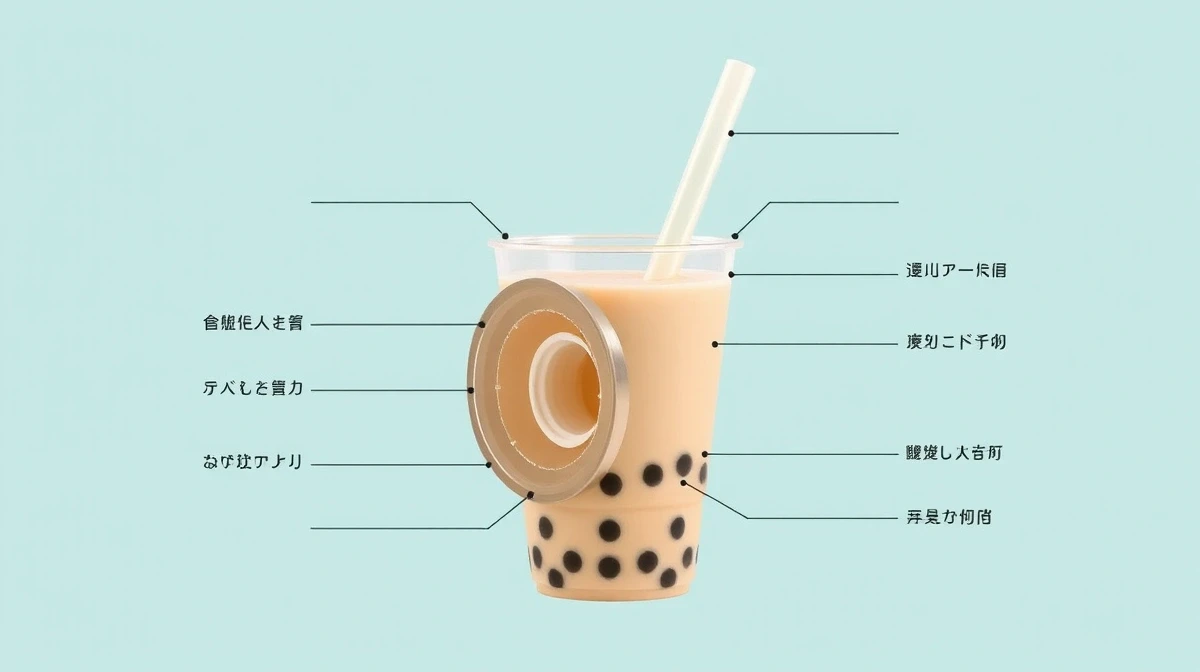
Bubble tea cups offer high brand visibility due to customer photo-sharing:
Printing Format Comparison:
Design Considerations:
•Color gradients work well on glossy PLA-coated cups
•High-contrast text ensures readability even when cup is held
•QR codes for social media linking (place at mid-height, not near rim)
Don’t overlook the sealing film as branding real estate:
Film Printing Options:
> 🎯 Marketing Insight: Shops using custom-printed sealing film report 40% higher social media shares compared to generic transparent film, as customers are more likely to photograph aesthetically branded packaging.

Best Practice: If your market has industrial composting infrastructure, choose PLA. If curbside recycling is prioritized, use water-based coating with clear customer instructions.
Emerging options to replace plastic sealing film:
1.Paper-based sealing lids: Fiber-based films with moisture barrier (15-20% cost premium)
2.Snap-on paper lids: Require cup design modification (not compatible with standard sealing machines)
3.Compostable PLA film: Certified for industrial composting alongside cup
Challenge: No perfect drop-in replacement yet exists. Paper films struggle with moisture resistance; PLA films require separate waste streams.
Seasonal Planning:
•Order 6-8 weeks before peak seasons (summer, festival periods)
•Maintain 3-4 weeks safety stock for custom printed cups
When receiving bulk orders, inspect:
✅ Rim flatness: Use caliper to verify ±0.2mm tolerance
✅ Sealing test: Sample 10 cups with your sealing machine
✅ Print registration: Check alignment on 20+ consecutive cups
✅ Coating integrity: No visible gaps or bubbling
✅ Stacking stability: Cups should nest without jamming
❌ Mistake #1: Ordering coffee cups for bubble tea
✅ Correct Approach: Specify “flat rim for sealing film” and confirm with supplier samples before bulk order
❌ Mistake #2: Using undersized cups for promotional drinks
✅ Correct Approach: For “buy one get one” deals, use 20-24oz cups to avoid overflow and maintain profit margins on ice/pearls
❌ Mistake #3: Ignoring straw puncture testing
✅ Correct Approach: Test 50+ cups with your actual straw type and sealing film before approving production
❌ Mistake #4: Over-customizing for initial launch
✅ Correct Approach: Start with single-panel printing (lower MOQ) and scale to full-wrap once volume justifies investment
Paper cups for bubble tea are beverage containers with flat rims designed for heat-sealed film closures, wider openings for thick straws, and moisture-resistant coatings to prevent leaks from ice and condensation. They differ from coffee cups in rim structure and coating requirements.
No. Regular hot drink cups have rolled rims incompatible with sealing machines. Bubble tea requires flat-rimmed cups with precise tolerances (±0.2mm) for airtight film sealing. Using incorrect cups causes leaks and customer complaints.
16-20oz (450-550ml) is standard for most bubble tea drinks. This allows 70-100g cooked tapioca pearls, 12-14oz liquid, ice, and 0.5-inch headspace for sealing. Larger sizes (20-24oz) work for premium or sharing formats.
It depends on coating. PLA-coated cups are compostable in industrial facilities but contaminate paper recycling. Water-based coating cups are curbside recyclable. Check local waste infrastructure to choose the most sustainable option for your market.
Minimum order quantities vary: 3,000-5,000 pieces for single-panel printing, 10,000-20,000 for full-wrap designs. Some suppliers offer lower MOQs (1,000 pcs) for digital printing at higher unit costs ($0.18-0.25 per cup).
Yes. Sealing films can be printed with logos, drink names, or full CMYK designs. MOQs typically start at 10,000-20,000 films. Full-color printed films cost 15-30% more than transparent but significantly increase brand visibility.
PLA coating offers the best balance for cold drinks: excellent moisture resistance, heat-sealing compatibility (160-180°C), and positive customer perception. PE coating has slightly better performance but faces consumer pushback as “plastic-lined.”
Choosing the right paper cups for bubble tea goes beyond basic beverage packaging. The unique requirements of sealing film compatibility, straw accommodation, and moisture resistance demand specialized cup designs that balance functionality with branding potential.
Key Takeaways:
1.Specify flat rims (±0.2mm tolerance) for reliable heat-sealing with automated machines
2.Match coating to market priorities: PLA for compostability, water-based for recyclability
3.Size correctly: 16-20oz handles standard bubble tea formats with proper headspace
4.Leverage branding opportunities: Full-wrap printing and custom sealing films drive social sharing
5.Test rigorously: Sample cups with your sealing machine and straw types before bulk orders
Whether you’re launching a new bubble tea shop or scaling an established brand, investing in purpose-designed paper cups with proper sealing compatibility ensures consistent customer experience and supports your sustainability commitments.
Papacko specializes in manufacturing high-quality paper cups designed specifically for bubble tea and milk tea operations. Our cups feature precision-engineered flat rims for perfect sealing, moisture-resistant PLA or water-based coatings, and customization options starting at 3,000 pieces.
Bubble tea packaging usually overlaps three decisions: taller cup sizing, cold-drink material choice, sealing and rim accuracy, and branded presentation for high-visibility drinks. The links below extend that path without repeating this page.
Get in touch:
Last Updated: November 2025