Ready to create your own branded paper cups or packaging?
Tell us your requirements — size, coating, printing, and destination — and our team will prepare a detailed quotation within 24 hours.

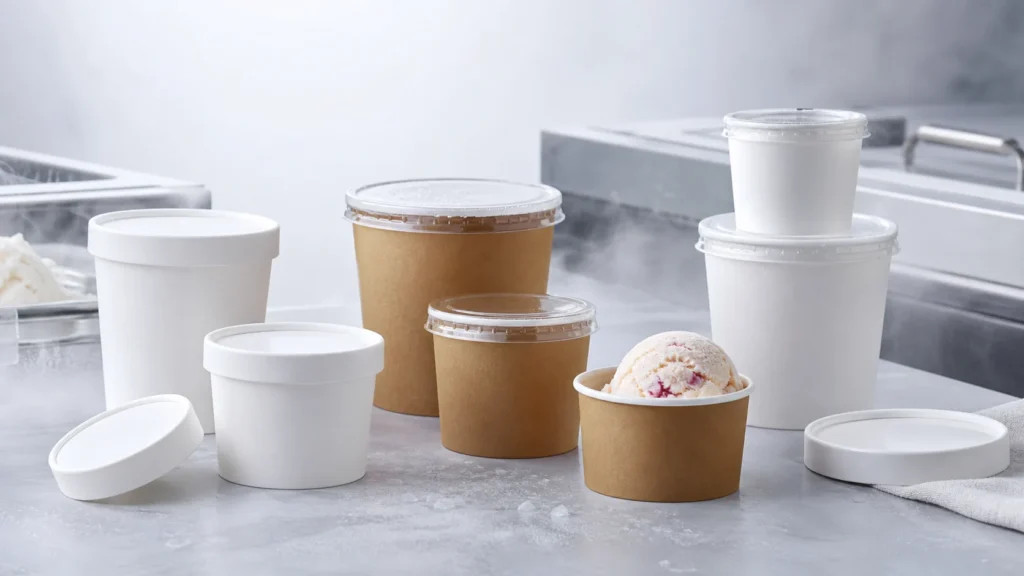
A B2B buyer guide for ice-cream and frozen-dessert operators, distributors and packaging teams
Before selecting a cup material or lid style, define the complete service system: the dessert type, fill temperature, dwell time in the cup, display environment, and the consumer’s end-use moment. Every downstream decision—material, coating, lid geometry, print process—follows from that system definition, not from the cup alone.
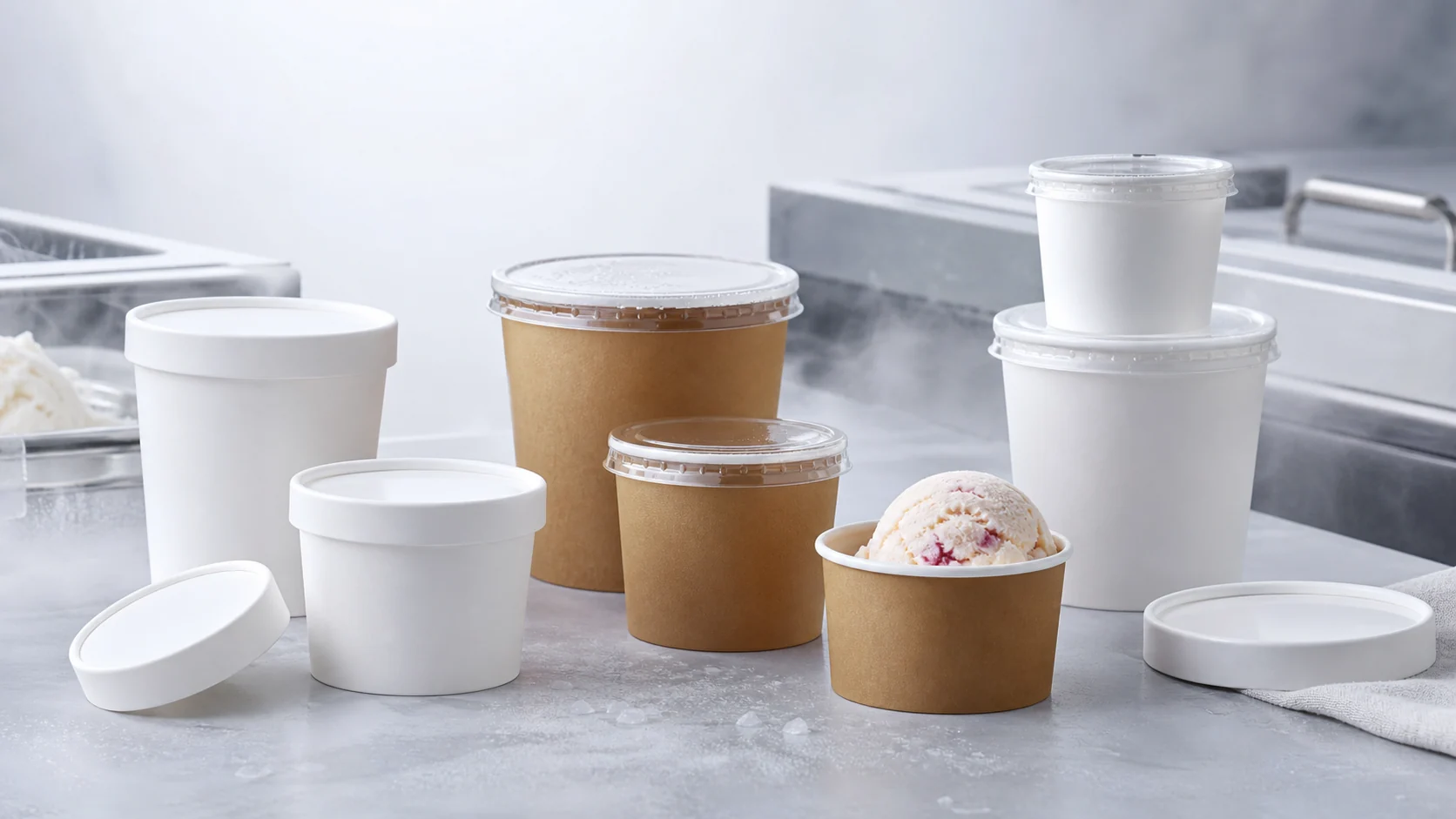
Packaging procurement for ice cream and frozen desserts is rarely a single-SKU decision. A gelato bar serving hand-scooped portions at a festival operates under entirely different constraints than a co-packer filling single-serve cups destined for a retail freezer aisle. Conflating those contexts produces mismatched specifications, failed seals, and costly reprints. The first discipline of responsible procurement is to map the menu and the service route with precision before a single sample is requested.
Dessert type and fill state. Hard-pack ice cream, soft-serve, gelato, sorbet, frozen yoghurt, mousse-style desserts, and layered parfaits each carry different fill temperatures, viscosities, and moisture migration profiles. A cup that performs well holding a firm scoop may behave differently when filled with a high-moisture sorbet or a warm-then-frozen layered product. Document the fill state—whether the product enters the cup frozen, semi-frozen, or at ambient temperature before being chilled—because that sequence affects how the cup material and any interior coating are stressed.
Service environment and dwell time. Consider where the cup will spend most of its life: a blast freezer immediately after filling, a display cabinet at a controlled temperature, a grab-and-go refrigerator, or a consumer’s hand during a ten-minute outdoor event. Each environment creates different condensation, mechanical stress, and structural load conditions. Dwell time matters too. A cup held for thirty seconds at a scoop counter is not the same engineering problem as a cup stored for several weeks in a distribution freezer.
Handling chain and stacking loads. Cups moving through a commercial cold chain are stacked, palletised, transported over variable distances, and handled by automated filling equipment, by staff, and ultimately by consumers. Rim integrity, sidewall rigidity, and base stability all need to be evaluated against the actual handling chain, not an idealised one. Request samples and test them through your specific process before committing to a production run.
Regulatory and commercial context. Operators selling into retail channels face different labelling, traceability, and food-contact documentation requirements than those serving directly to consumers at point of sale. Distributors supplying multiple operators may need a cup system flexible enough to accommodate varied filling equipment and branding requirements. Establish the regulatory and commercial context early so that supplier conversations are grounded in the right framework from the outset.
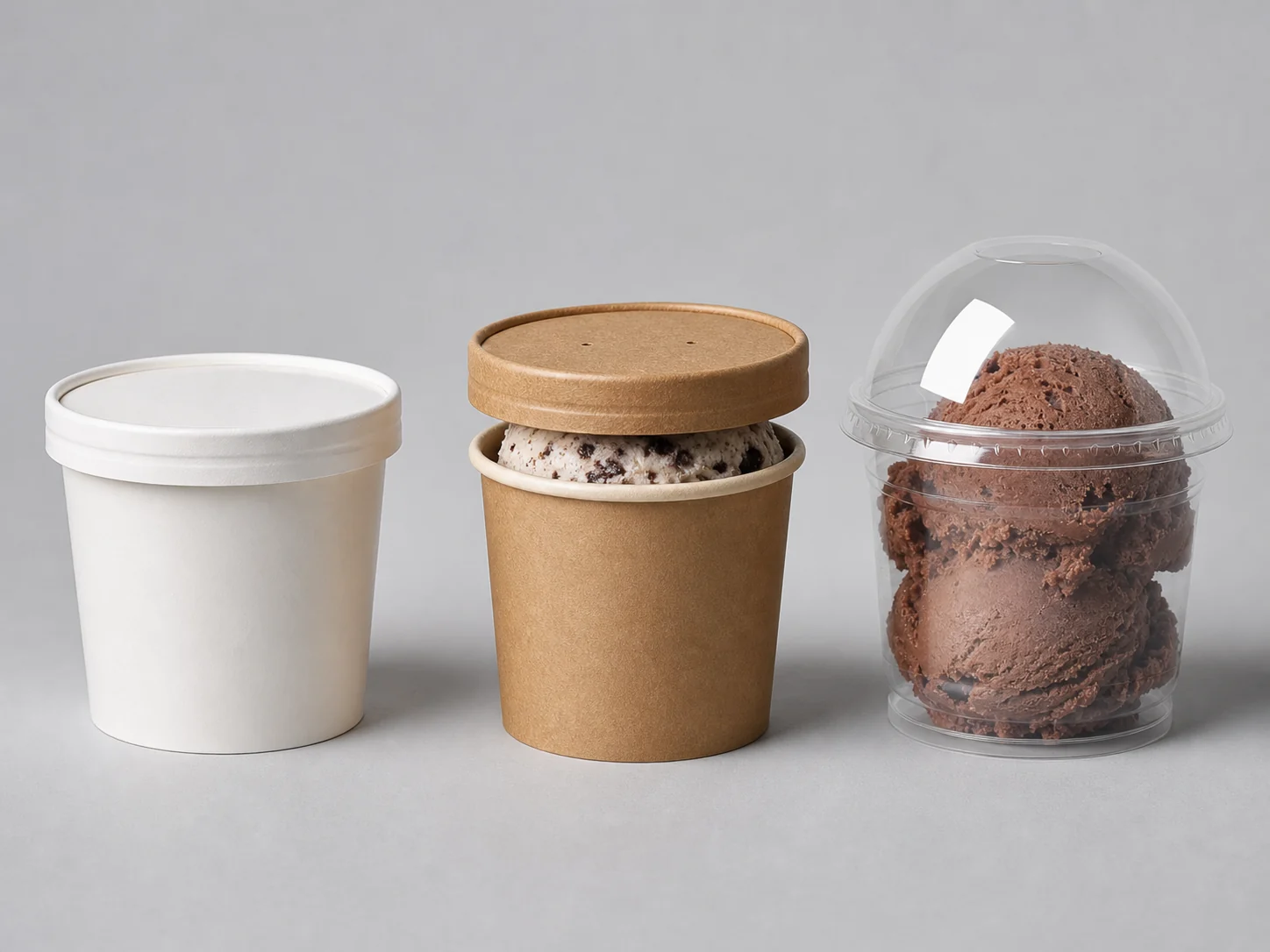
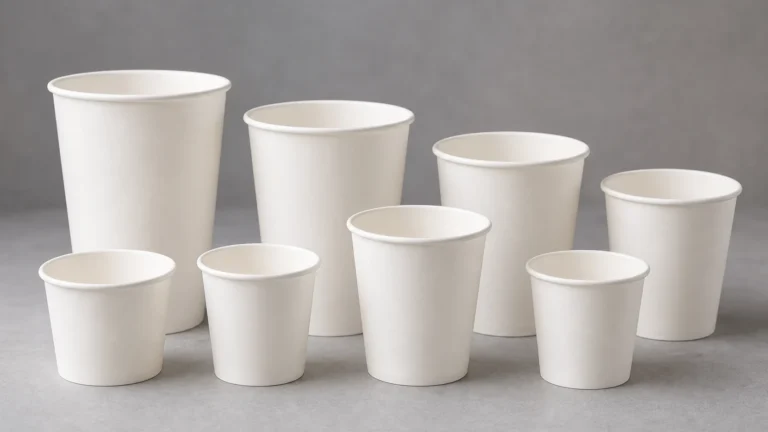
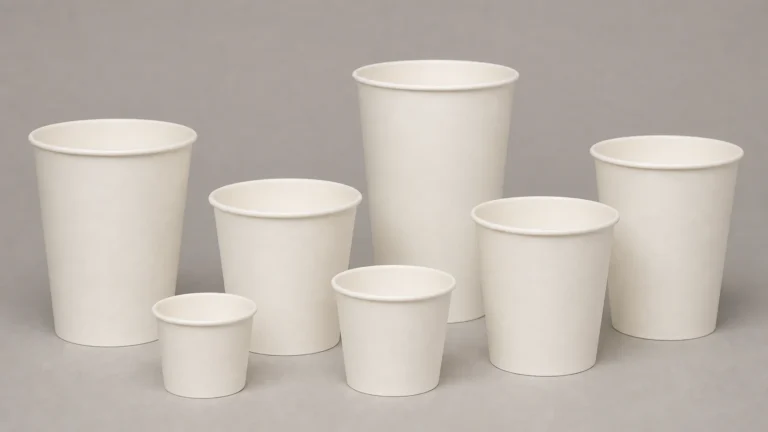
Paper cups for frozen desserts are typically constructed from a food-grade paperboard substrate with an interior coating or laminate intended to manage moisture and product contact. The specific coating type, weight, and application method vary by manufacturer and product line. Buyers should request documentation confirming that the interior coating is appropriate for the intended food type, fill temperature, and contact duration—these are not interchangeable assumptions. The paper cup range covers a variety of formats relevant to dessert service, and buyers should cross-reference specific cup constructions against their fill conditions.
Single-wall paper cups offer a lighter, lower-material construction suited to shorter dwell times and ambient or mildly chilled service. Double-wall constructions add an insulating air gap between the inner and outer walls, which can affect how the cup feels in the consumer’s hand and how heat transfer occurs between the dessert and the environment. Neither construction is universally superior; the right choice depends on the service scenario.
Paper cups are generally considered more compatible with sustainability commitments than conventional plastic alternatives, but buyers should scrutinise specific claims. Recyclability and compostability depend on the coating type, the local waste infrastructure, and whether the cup is contaminated with food residue. Do not accept broad environmental claims without reviewing the specific cup’s material composition and the applicable disposal pathway in your market.
Plastic cups for frozen desserts are available in a range of polymer types, wall thicknesses, and forming methods. Injection-moulded, thermoformed, and blow-moulded formats each offer different dimensional tolerances, surface finishes, and compatibility with filling and sealing equipment. Clarity, colour, and structural rigidity vary significantly across formats.
Plastic cups are often selected for their dimensional consistency, which can be important for automated filling lines and for achieving reliable lid seals. However, the specific polymer, any additives, and the processing history of the material all affect food-contact suitability. Buyers should not assume that all plastic cups are equivalent for frozen food contact; verify the specific material against the intended use condition and request supplier documentation accordingly.
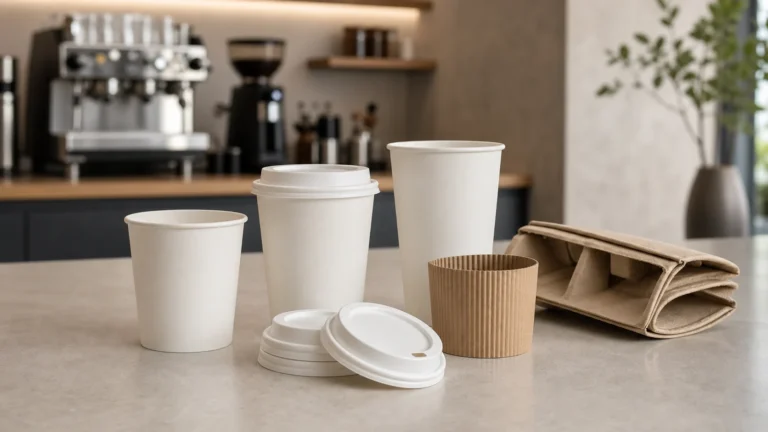
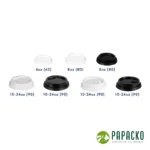
Lid selection is inseparable from cup selection. A lid that does not engage the rim geometry of the cup reliably will fail in the field regardless of how well the cup itself performs. The paper cup lid options available for dessert service include dome lids, flat lids, and spoon-slot variants, each suited to different dessert presentations and consumer use moments.
Dome lids accommodate toppings and garnishes that extend above the rim. Flat or recessed lids suit stacked storage and transport. Spoon-slot or perforated lids offer consumer convenience for eat-in service. In every case, the lid-to-cup interface must be validated physically: request matched samples of the cup and lid together, fill them with the actual product or a representative simulant, and subject them to the actual handling and temperature conditions of your service chain. Do not validate the cup and lid separately and assume the combination will perform.
Heat-sealed lids and snap-fit lids present different operational requirements. Heat sealing requires compatible sealing equipment, a seal layer on the lid material, and validated sealing parameters. Snap-fit lids require consistent rim geometry and sufficient engagement depth. Both closure types require ongoing process monitoring to confirm seal integrity in production conditions.
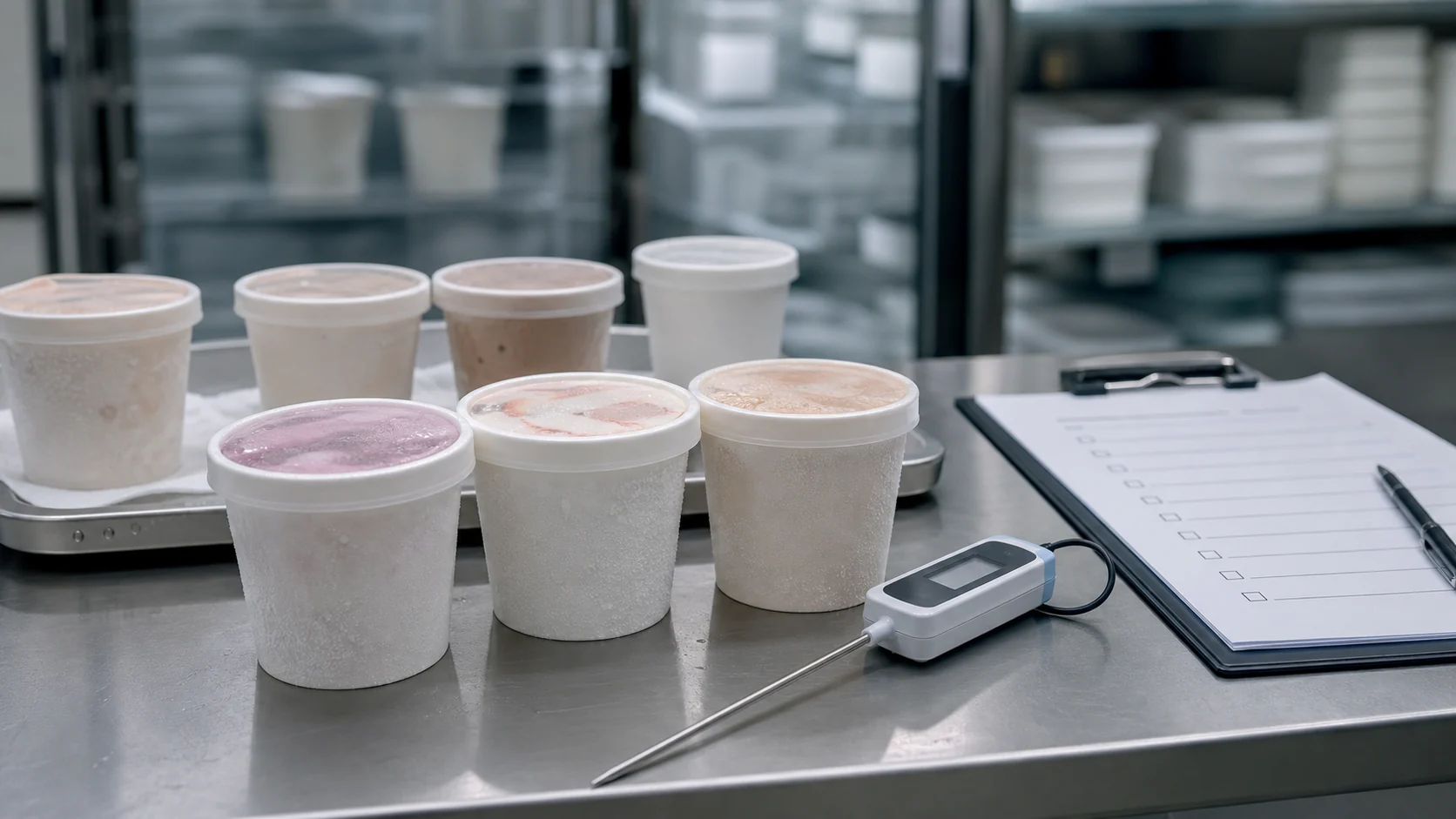
Cold-chain performance for ice cream cups is not a single property; it is a composite of structural, barrier, and interface behaviours across a temperature and time profile. Buyers should define the performance criteria relevant to their specific chain before evaluating materials.
Structural integrity under cold and condensation. Paper-based cups exposed to repeated freeze-thaw cycles or high-humidity environments may soften, delaminate, or lose rim integrity if the construction is not appropriate for those conditions. Plastic cups may become brittle at very low temperatures depending on the polymer. Neither category is inherently superior; the question is whether the specific cup construction has been validated for the specific temperature range and humidity profile of your chain. Request evidence of testing under conditions that match your use case, not generalised claims.
Moisture barrier performance. The interior coating of a paper cup serves in part as a moisture barrier between the product and the paperboard substrate. If that barrier is compromised—by an incompatible food type, an elevated fill temperature, extended contact time, or mechanical damage—the structural properties of the cup may degrade. Understand what the coating is designed to resist and for how long, and verify that your product and process fall within those parameters.
Display cabinet behaviour. Cups displayed in open-front or glass-door freezer cabinets are subject to condensation cycles as the cabinet door opens and closes. Condensation on the exterior of a paper cup can affect printability, structural integrity, and consumer perception. If display presentation is important to your brand, test the cup in a representative display environment before finalising the specification.
Lid seal retention under temperature variation. Lids that are applied at one temperature and then moved through a cold chain may experience differential expansion and contraction between the cup and lid materials. This can affect snap-fit engagement or heat-seal integrity. Validate lid retention across the full temperature range of your chain, including any warm-to-cold transition that occurs at the point of filling.
Buyers seeking broader context on container system performance should review the food packaging container systems resource for format and application guidance.
| Material / System | Best-Fit Dessert | Lid / Closure Check | Cold-Chain Question | Printing Consideration | Buyer Validation Question |
|---|---|---|---|---|---|
| Single-wall paper cup with interior coating | Hand-scooped or soft-serve at point of sale; short dwell time | Confirm dome or flat lid rim engagement matches cup diameter; test snap-fit retention | Verify coating suitability for your fill temperature and contact duration; do not assume cold-chain depth | Flexo or digital print on outer wall; confirm ink adhesion on coated stock before production | Has the specific cup-and-lid combination been tested with your actual product at your fill temperature? |
| Double-wall paper cup with interior coating | Hand-scooped gelato or premium dessert; eat-in or take-away service | Same rim engagement validation required; double-wall rim profile may differ from single-wall equivalent | Confirm the air-gap construction does not affect lid seating; test under your humidity conditions | Outer wall offers larger printable area; confirm registration accuracy on double-wall forming | Does the double-wall construction maintain rim geometry consistently enough for your lid supplier’s tolerances? |
| Plastic cup (thermoformed, clear or printed) | Single-serve retail or foodservice; layered or visible-product presentations | Confirm heat-seal or snap-fit lid compatibility with your filling line; validate sealing parameters | Confirm polymer suitability for your freezer temperature range; check for brittleness risk | In-mould labelling or sleeve labelling; confirm label adhesion at low temperature | Has the polymer been confirmed food-contact suitable for your specific product and storage temperature by the supplier? |
| Plastic cup (injection-moulded, rigid) | Portion-control or premium single-serve; automated filling lines | Dimensional consistency supports reliable lid engagement; validate with your actual lid | Confirm polymer and wall thickness for your freezer depth; request supplier cold-chain evidence | Pad printing or sleeve; confirm sleeve adhesion and legibility at display temperature | Does the cup’s dimensional tolerance meet your filling equipment’s specification sheet? |
| Composite or coated board tub | Bulk or multi-serve retail; take-home format | Confirm lid or overwrap seal method; heat-seal requires compatible equipment | Confirm board weight and coating for extended freezer storage; request evidence for your dwell time | Large panel area for retail branding; confirm print process compatibility with board surface | Has the tub-and-closure system been validated for your full distribution chain, including transport vibration? |
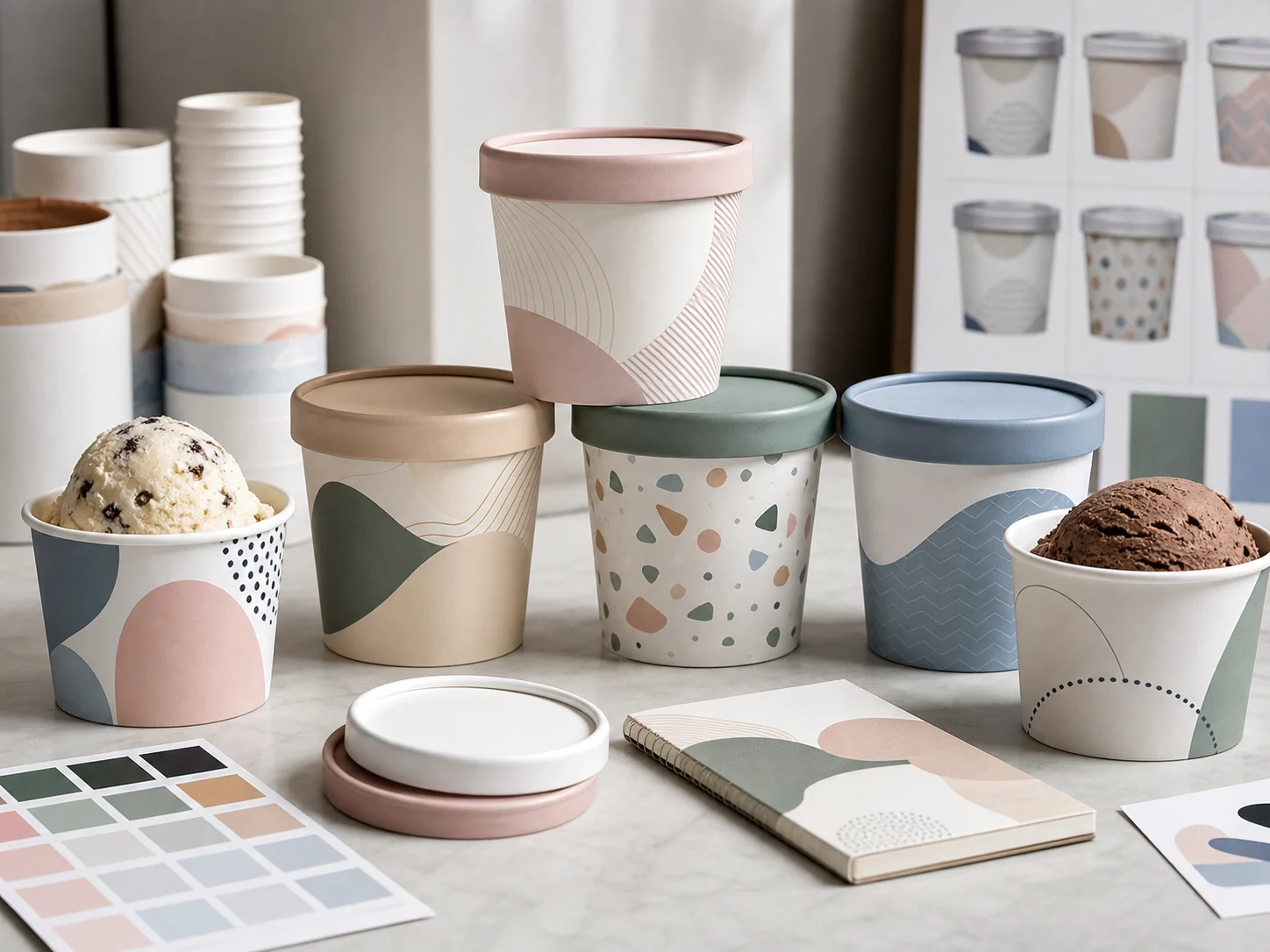
Brand presentation on ice cream cups operates under constraints that ambient-temperature packaging does not. Inks, coatings, and adhesives that perform reliably at room temperature may behave differently when subjected to freezer storage, condensation, or the mechanical stress of automated filling. Buyers who treat frozen-dessert cup printing as equivalent to standard cup printing risk visible quality failures at the point of consumer contact.
Print process selection. Flexographic printing is widely used for paper cup production and offers good colour consistency at volume. Digital printing offers shorter run flexibility and variable data capability but requires confirmation that the digital ink system is compatible with the cup substrate and any post-print coating or lamination. Offset lithography is used for label and sleeve production. In every case, confirm the print process with your cup supplier before artwork finalisation, not after.
Ink and coating compatibility at low temperature. Request confirmation from your supplier that the ink system and any overprint varnish or coating are suitable for the temperature range your cups will experience. Cracking, flaking, or colour shift at low temperatures are not theoretical risks; they are documented failure modes in poorly specified systems. Ask for evidence of low-temperature performance, not assurances.
Artwork and colour management. Ice cream and frozen dessert brands often rely on vivid, high-contrast colour to communicate flavour and premium positioning. Achieving consistent colour across print runs, across different cup formats, and across different production batches requires disciplined colour management: defined colour standards, approved proofs, and in-production measurement. Establish these controls before the first production run, not after a colour complaint from a retail buyer.
Rollout sequencing and version control. Operators running multiple SKUs or seasonal flavours need a clear version-control process for artwork files, approved samples, and production sign-offs. A single mislabelled cup in a multi-flavour display creates a compliance risk and a consumer trust problem. Define the approval workflow, the sample retention protocol, and the change-management process as part of the packaging specification, not as an afterthought.
The paper cup resource library and the food packaging resource library contain additional format and application references that may support print specification decisions.
Use this checklist as a structured prompt for internal alignment and supplier conversations. It is not a substitute for your own technical validation or regulatory review.
1. System definition complete. Confirm that dessert type, fill temperature, fill state, dwell time, service environment, and handling chain have been documented in writing before any sample is requested.
2. Matched cup-and-lid samples received. Confirm that samples represent the exact production specification—material, coating, dimensions, print process—not a generic approximation. Request samples of the cup and lid together, not separately.
3. Product-contact validation initiated. Confirm that the supplier has provided food-contact documentation for the specific cup construction, coating, and intended use condition. Do not proceed to filling trials without this documentation in hand.
4. Filling trial conducted under production conditions. Fill the sample cups with the actual product at the actual fill temperature using the actual filling equipment. Evaluate rim integrity, lid engagement, base stability, and any visible deformation or coating behaviour.
5. Cold-chain simulation completed. Subject filled and lidded cups to the temperature profile of your actual chain—including any freeze-thaw cycles, transport vibration, and display conditions. Evaluate structural integrity, lid retention, print condition, and condensation behaviour.
6. Print quality confirmed on production substrate. Confirm that approved artwork has been proofed on the actual production substrate using the actual print process. Obtain a signed-off colour standard before authorising the production run.
7. First-production release inspection defined. Establish the inspection criteria, sample size, and acceptance standards for the first production release before the run begins. Define what constitutes a hold condition and who has authority to release or reject.
Papacko works with ice-cream operators, frozen-dessert brands, co-packers, and distributors to develop cup systems that are matched to the dessert, the service environment, and the brand. Whether you are specifying a single hand-scoop format or a multi-SKU retail range, the conversation starts with your system requirements—not with a catalogue.
Contact the Papacko team to discuss your dessert type, fill conditions, volume requirements, and branding objectives. Bring your service-route map and your cold-chain profile. The more precisely you can describe the system, the more useful the specification conversation will be.
Request a cup system consultation with Papacko.
Experience and sourcing context. This guide is produced by Papacko, a packaging supplier with direct experience in paper cup, lid, and food packaging container sourcing and specification for foodservice and retail operators. The content reflects practical sourcing and specification knowledge accumulated through supplier engagement, buyer consultation, and product development work across multiple dessert and frozen food formats. It does not represent independent laboratory testing, third-party certification, or regulatory legal advice.
Technical and authority basis. The technical framing in this guide is grounded in publicly available food-contact materials guidance, packaging industry specification practice, and the operational realities of cold-chain dessert service. Where food-contact suitability is discussed, buyers are directed to verify claims against the specific finished cup, the specific food, and the specific contact condition—because FDA food-contact conditions of use establish that use conditions are material to any food-contact assessment. No temperatures, dimensions, material grades, certifications, test results, pricing, MOQ, lead times, or performance guarantees have been stated in this guide, because those parameters are specific to individual products and must be confirmed with the supplier against your exact use case.
How to apply this guide. Use this guide as a structured framework for internal alignment and supplier conversations, not as a substitute for your own technical validation. The checklist, comparison table, and decision sequence are prompts, not specifications. Every claim made by a supplier—including claims made by Papacko—should be verified against documentation specific to the finished cup, the finished lid, the food product, and the service conditions of your operation. Engage your food safety, regulatory, and technical teams before finalising any packaging specification for a product that will be sold or served to consumers.
No. Paper cups vary significantly in substrate weight, interior coating type, and construction method. A cup designed for hot beverages may have a coating optimised for heat resistance rather than cold-food contact or moisture barrier performance under freezer conditions. Always confirm with the supplier that the specific cup construction is appropriate for your dessert type, fill temperature, and contact duration. Request documentation rather than relying on general category descriptions.
Lid retention through a cold chain depends on the dimensional match between the cup rim and the lid engagement geometry, the materials used in both components, and the temperature range they will experience together. Snap-fit lids can loosen if differential thermal contraction reduces engagement depth. Heat-sealed lids require validated sealing parameters and compatible materials. The only reliable answer is physical validation: fill and seal cups with your actual product, subject them to your actual temperature profile, and evaluate retention at each stage.
Flexographic printing is the most common process for paper cup production and is generally well-suited to frozen dessert applications when the ink system and any overprint coating are confirmed compatible with low-temperature exposure. Digital printing offers run flexibility but requires substrate and ink compatibility confirmation. Sleeve labelling and in-mould labelling are options for plastic cups. In every case, confirm low-temperature ink and coating performance with your supplier before finalising artwork and authorising production.
Not necessarily. Double-wall construction adds an insulating air gap that affects hand-feel and heat transfer, which may be desirable for some service scenarios and irrelevant or counterproductive for others. Double-wall cups also have a different rim profile than single-wall equivalents, which affects lid compatibility. The right construction depends on your dessert type, service environment, dwell time, and lid system. Evaluate both options against your specific requirements rather than defaulting to one as universally superior.
At minimum, request documentation confirming the food-contact suitability of the interior coating or material for your specific food type, fill temperature, and contact duration. Depending on your market and channel, you may also need migration testing data, declarations of compliance with applicable regulations, and traceability documentation for the material supply chain. The specific documentation required varies by jurisdiction and by the nature of the food product. Engage your regulatory and food safety teams to define the documentation standard before entering supplier conversations.
Establish a documented artwork management process before the first production run. This should include a master artwork file repository with version numbering, a defined approval workflow that specifies who can authorise changes, a physical approved-sample archive for each SKU, and a change-management protocol that triggers re-approval when any element of the cup specification changes—including substrate, coating, or print process. For multi-flavour ranges, colour differentiation between SKUs should be confirmed on the actual production substrate, not on screen proofs alone, to avoid consumer confusion or mislabelling risk at the point of sale.