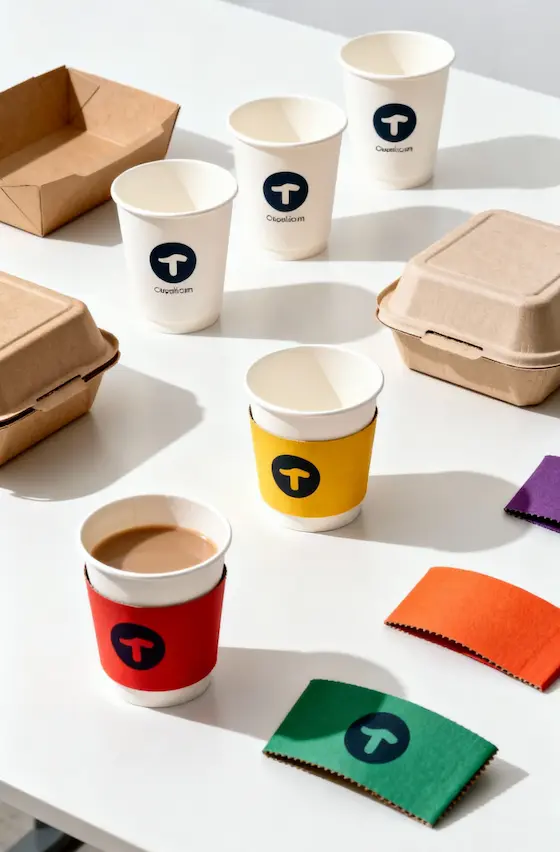
Ready to create your own branded paper cups or packaging?
Tell us your requirements — size, coating, printing, and destination — and our team will prepare a detailed quotation within 24 hours.
Last Updated: December 2025
Reading Time: 14 minutes
Author: Papacko Content Team
Your restaurant serves 250 takeaway orders daily in plain white cups and generic kraft boxes—completely unbranded packaging that customers photograph for Instagram, toss in recycling bins, and carry through busy streets offering zero brand visibility. Understanding custom food packaging helps.Meanwhile, the burger shop three blocks away uses custom-printed packaging with bold logo, vibrant colors, and witty messaging—their customers become mobile billboards, social media posts feature recognizable branding, and first-time visitors mention “I kept seeing your cups everywhere” as the discovery source that drove 15-20% of new customer traffic.
Custom food packaging isn’t just containers—it’s a marketing channel delivering 500-3,000 brand impressions per order (customer, coworkers, pedestrians, social shares), with cost premium of $0.02-0.08 per unit vs plain packaging. The ROI calculation: If custom packaging costs $5,000 more annually but generates just 10 new customers/month ($30 average order value × 10 × 12 months = $3,600), you’re still behind. But generate 25 new customers/month (documented through “how did you hear about us” tracking at high-visibility locations), and custom packaging pays for itself 3-4× over while building lasting brand recognition.
In this guide, you’ll learn:
•Custom packaging design best practices for maximum brand impact
•Printing methods comparison: Flexographic vs offset vs digital
•MOQ (Minimum Order Quantity) requirements and cost implications
•Color matching systems: Pantone vs CMYK for brand consistency
•Turnaround times and production planning for custom orders
•Material selection for custom printing: GSM, coatings, surface preparation
•Cost optimization strategies to reduce custom packaging expenses
Quick Takeaway: Custom food packaging costs: Plain packaging $0.045-0.065 (12oz cup) vs custom 1-2 color $0.065-0.090 vs full-color $0.095-0.140. MOQ requirements: 50,000-100,000 units (1-2 color), 100,000-200,000 units (full-color), negotiable to 30,000-50,000 with 12-18% premium for trial orders. Printing methods: Flexographic (90% of commercial), offset (high-detail graphics), digital (small runs, no plates). Lead time: Plain stock 20-30 days, custom 1-color 30-40 days, full-color 40-50 days (includes 7-10 day design approval). Best ROI: High-visibility businesses (coffee shops, juice bars, food trucks) with 150+ daily takeaway orders. Design rules: 3-4 colors maximum (cost control), 8pt+ font size (legibility), 5mm bleed (print area), vector graphics (scaling quality). Cost offset: 85-90% of restaurants pass custom packaging cost through pricing (+$0.10-0.25 per item).
The key to choosing custom food containers depends on:
What is Flexographic Printing?
•Technology: Raised relief printing plates (similar to stamps)
•Ink transfer: Flexible rubber/polymer plates roll against substrate
•Speed: 8,000-15,000 impressions per hour (very fast, high-volume efficient)
•Application: 90% of custom paper cups, bowls, food containers
Flexographic Process:
1.Understanding custom food containers helps.Design to plate: Artwork converted to printing plates (one plate per color)
2.Plate mounting: Plates mounted on rotating cylinder
3.Ink application: Anilox roller transfers ink to plate
4.Printing: Rotating plate presses ink onto moving paper substrate
5.Drying: Rapid air or UV drying (prevents smudging)
Flexographic Strengths:
•✅ Cost-effective at volume (50,000+ units, setup cost amortized)
•✅ Fast production (15,000+ impressions/hour = 120,000 cups/8-hour shift)
•✅ Excellent for solid colors, text, simple graphics (logos, typography)
•✅ Durable ink (water-resistant, abrasion-resistant for handling)
•✅ Food-safe inks (FDA-approved for direct food contact)
Flexographic Limitations:
•❌ Limited color gradient quality (not ideal for photographic images)
•❌ Fine detail challenges (minimum line width 0.25-0.3mm, smaller may not reproduce)
•❌ Plate cost: $150-400 per color (one-time setup for each design)
•❌ Color count affects cost: Each color = separate plate + press setup
Cost Structure (12oz cups, 100,000 units):
•Base cup: $6,000 (100K × $0.06)
•1-color printing: +$800 ($150 plate + $650 printing) = $6,800 total ($0.068/cup)
•2-color printing: +$1,400 ($300 plates + $1,100 printing) = $7,400 total ($0.074/cup)
•4-color printing: +$2,600 ($600 plates + $2,000 printing) = $8,600 total ($0.086/cup)
When to Use Flexographic:
•Order volumes: 50,000+ units (setup cost justified)
•Design: Solid colors, logos, text-based graphics
•Budget: Cost-sensitive, want lowest per-unit cost at volume
•Timeline: 30-45 days acceptable (standard commercial lead time)
Understanding eco-friendly custom food packaging requires attention to these factors:
What is Offset Printing?
•Technology: Lithographic process using ink transfer from plate to rubber blanket to paper
•Quality: Superior detail, smooth gradients, photographic reproduction
•Application: Premium packaging, high-detail graphics, brand-critical projects
Offset Advantages vs Flexographic:
•✅ Exceptional print quality (0.05mm line detail vs 0.25mm flexo)
•✅ Smooth color gradients (photographic images, complex designs)
•✅ Consistent color reproduction (tighter tolerances, Pantone matching)
•✅ Fine typography (6pt fonts legible vs 8-10pt minimum flexo)
Offset Disadvantages:
•❌ Higher cost: 30-50% more expensive than flexographic for same quantity
•❌ Slower production: 5,000-8,000 impressions/hour (vs 15,000 flexo)
•❌ Higher MOQ: 100,000-200,000 minimum (vs 50,000 flexo)
•❌ Lead time: 45-60 days (longer setup, slower printing)
Cost Comparison (100,000 units, 4-color):
•Flexographic: $0.086 per cup
•Offset: $0.115-0.130 per cup (+33-51% premium)
When to Use Offset:
•Premium branding: High-end restaurants, specialty coffee brands
•Complex graphics: Photographic images, intricate illustrations, detailed patterns
•Brand-critical consistency: Exact Pantone matching essential (corporate brand standards)
•Budget allows: Willing to pay 30-50% premium for superior quality
Understanding quality custom food packaging requires attention to these factors:
What is Digital Printing?
•Technology: Inkjet or toner-based printing (like large office printer)
•Process: Direct-to-substrate printing, no plates required
•Application: Prototypes, small batches, limited edition, event-specific packaging
Digital Printing Advantages:
•✅ No plate costs: Eliminates $150-600 plate setup fees
•✅ Low MOQ: Viable for 1,000-10,000 units (vs 50,000+ flexo/offset)
•✅ Fast turnaround: 5-10 days (no plate creation, immediate printing)
•✅ Variable data: Can print different designs in same batch (personalization)
•✅ Cost-effective for small quantities: Break-even vs flexo at 5,000-15,000 units
Digital Printing Disadvantages:
•❌ High per-unit cost at volume: $0.15-0.25 per cup (vs $0.07-0.09 flexo at 100K)
•❌ Slower production: 500-2,000 impressions/hour (vs 15,000 flexo)
•❌ Durability concerns: Ink may scratch or fade more than flexo/offset inks
•❌ Limited substrate compatibility: Not all paper coatings accept digital inks well
Cost Comparison by Volume:
Break-even point: ~8,000-12,000 units (depends on design complexity, number of colors)
When to Use Digital:
•Small orders: <15,000 units (setup cost prohibitive for flexo)
•Prototyping: Test designs before committing to 100K flexo order
•Limited editions: Seasonal designs, event-specific packaging (festival, grand opening)
•Personalization: Variable data (customer names, unique codes, QR codes)
The key to choosing sustainable custom food packaging depends on:
Color Psychology for Food Packaging:
Color Strategy Tips:
Limit Color Count (Cost control):
•1-2 colors: Most cost-effective ($0.065-0.075 per cup)
– Example: Black logo on white cup (classic, timeless)
– Use: Budget-conscious businesses, simple branding
•3 colors: Balanced cost/impact ($0.078-0.088 per cup)
– Example: Logo (2 colors) + accent color
– Use: Most common choice (brand personality + cost management)
•4+ colors: Premium cost ($0.095-0.140 per cup)
– Example: Full-color logo, background graphics, multiple elements
– Use: Premium brands where packaging is marketing centerpiece
Pantone vs CMYK Color Systems:
Pantone (PMS – Pantone Matching System):
•Definition: Standardized color reproduction system with 1,900+ specific colors
•Printing: Each Pantone color requires separate ink and plate
•Advantage: Exact color consistency across production runs (brand standard colors)
•Cost: One plate per Pantone color ($150-400 each)
•Example: “PMS 185 Red” prints identically whether in China, US, or Europe
CMYK (Cyan, Magenta, Yellow, Black):
•Definition: Four-color process mixing to create full spectrum
•Printing: Four plates standard (all designs use same four inks)
•Advantage: Photographic images, gradients, unlimited colors from four inks
•Limitation: Color variation 5-10% between runs (less precise than Pantone)
•Cost: Four-plate setup ($600-800) regardless of color count in design
Recommendation:
•Brand logo colors: Specify Pantone (ensures consistency, “Coca-Cola Red” must be exact)
•Secondary graphics: CMYK acceptable if exact match not critical
•Best of both: 2 Pantone colors (logo, brand color) + CMYK for images/backgrounds
The key to choosing custom food packaging depends on:
Font Size Minimums:
Flexographic Printing Constraints:
•Minimum legible size: 8pt for simple fonts (Arial, Helvetica)
•Recommended minimum: 10-12pt for decorative fonts
•Headline/logo text: 16pt+ (ensures readability at distance)
•Fine print (ingredients, disclaimer): 6pt absolute minimum, oftensometimesgible below 7pt
Font Selection:
•✅ Sans-serif fonts: Arial, Helvetica, Futura (clean, modern, highly legible)
•✅ Bold weights: Medium to Bold weights print more reliably than Thin/Light
•⚠️ Serif fonts: Times New Roman, Georgia (acceptable at 10pt+, avoid thin serifs)
•❌ Script/handwritten fonts: Oproblematic below 14pt (fine details lost in printing)
•❌ Condensed fonts: Narrow letters may close up (e.g., “a” becomes “o”)
Contrast for Readability:
•High contrast: Black text on white background (most legible)
•Adequate: Dark blue on white, white on black (good readability)
•Marginal: Gray on white, yellow on white (legibility issues)
•❌ Poor contrast: Light gray on white, yellow on light green (avoid)
Testing for Legibility:
•Print sample at actual size
•View from 3-5 feet away (typical reading distance for held cup)
•Test in dim lighting (restaurant/cafe ambient lighting, not just bright office)
•If any text unreadable in these conditions, increase size or contrast
The key to choosing quality custom food packaging depends on:
Optimal Logo Placement (Paper cups):
Front and center (Primary visibility):
•Position: Centered on cup, 1-2 inches from top
•Size: 30-40% of cup circumference width
•Reason: Most visible when customer holds cup (thumb/fingers frame logo)
Wraparound design (Premium option):
•Coverage: Logo repeats 2-4× around cup circumference
•Benefit: Visible from any angle, maximizes brand exposure
•Cost: +10-15% vs single-sided printing (more ink coverage, longer press time)
Bottom placement (Secondary branding):
•Position: Near base of cup (visible when cup set on table)
•Use: Website URL, tagline, social media handles
•Size: 10-15% of circumference (smaller, secondary information)
Inside rim (Premium detail):
•Position: Inside cup edge (visible when drinking)
•Use: “Thank you” message, witty quote, brand personality
•Cost: Additional pass through printer (+$0.01-0.02 per cup)
•Impact: Delights customers, Instagram-worthy detail
Size Guidelines for 12oz Cup:
•Cup circumference: ~260mm (10.2 inches)
•Primary logo: 80-100mm wide (3-4 inches)
•Secondary elements: 30-50mm wide (1.2-2 inches)
•Minimum logo size: 40mm wide (1.6 inches) for recognition
Logo File Requirements:
•Format: Vector (AI, EPS, PDF) preferred over raster (JPG, PNG)
•Resolution (if raster): Minimum 300 DPI at print size
•Color mode: Pantone or CMYK (not RGB, which won’t print accurately)
•Outline fonts: Convert text to outlines/curves (prevents font substitution issues)
The key to choosing eco-friendly custom food packaging depends on:
Common Design Mistakes (That increase cost or reduce quality):
Mistake 1: Too Many Colors (Cost multiplier)
•Problem: Each color = separate plate + press setup + ink cost
•Example: 6-color design costs 50-80% more than 3-color
•Solution: Simplify to 2-3 core brand colors, use shading/tints of same colors
Mistake 2: Tiny Text (Illegible when printed)
•Problem: Text <7pt often dable after printing
•Example: Website URL at 5pt looks fine on screen, disappears on cup
•Solution: Minimum 8pt for all text, 10pt recommended for body text
Mistake 3: Low-Contrast Elements (Poor visibility)
•Problem: Light colors on white, pastels on kraft paper
•Example: Light yellow text on white cup invisible in most lighting
•Solution: Use dark colors (black, navy, dark green) on light substrates
Mistake 4: Photographic Backgrounds (Expensive, often unnecsometimesy)
•Problem: Full-bleed photos require CMYK 4-color process + high ink coverage
•Cost: 2-3× more expensive than solid color backgrounds
•Solution: Use solid colors or simple patterns (geometric shapes, textures)
Mistake 5: Insufficient Bleed (White edges after trimming)
•Problem: Design ends exactly at cup edge → white border appears after production
•Technical: Cups trimmed with ±2mm tolerance, need 3-5mm bleed
•Solution: Extend all background colors/images 5mm beyond trim line
Mistake 6: Complex Gradients (Print quality issues)
•Problem: Flexographic struggles with smooth gradients (banding visible)
•Example: Logo with gradient from dark blue to light blue shows stripes
•Solution: Use solid colors or limit gradients to <25% color change
Mistake 7: Reversed-Out Fine Details (White on dark background)
•Problem: Tiny white text or details on dark background fill in during printing
•Example: White 7pt text on black background → letters merge together
•Solution: Minimum 9-10pt for reversed text, use medium/bold weights
Understanding custom food containers requires attention to these factors:
Why MOQs Exist:
•Setup costs: Plate creation, press calibration, color matching, waste during setup
•Economic threshold: Manufacturers need minimum quantity to cover setup + make profit
•Production efficiency: Short runs disrupt schedule, reduce overall factory productivity
Standard MOQs by Printing Method:
MOQ Negotiation Strategies:
Strategy 1: Trial Order Premium
•Request: 30,000 units instead of 50,000 standard MOQ
•Offer: Accept 15-20% price premium for smaller first order
•Reasoning: Manufacturer gets higher margin to offset lower volume
•Example: Standard 50K @ $0.070 = $3,500; Trial 30K @ $0.082 = $2,460 (manufacturer nets similar margin)
Strategy 2: Multi-Product Order
•Approach: Combine multiple products to reach MOQ
•Example: 25K cups + 20K bowls + 20K lids = 65K combined (meets 50-80K tier)
•Caveat: Each product still needs separate plates/setup (may have product-specific MOQs)
Strategy 3: Split Designs
•Approach: Order 50K cups split into two designs (25K each)
•Cost: Each design needs separate plates (double setup cost)
•Benefit: Test two designs without full 50K commitment to one
•Example: 25K summer design + 25K year-round design = 50K total, $600 setup (vs $300 for single design)
Strategy 4: Commit to Future Volume
•Negotiate: “Start with 40K units, commit to 120K total over 12 months”
•Supplier benefit: Guaranteed future business = justify lower first MOQ
•Your benefit: Test market with smaller batch before scaling
The key to choosing quality custom food packaging depends on:
Price Curves by Quantity (12oz cups, 2-color printing):
Key Insights:
•Largest price drop: 30K → 50K (21% reduction as setup cost spreads)
•Diminishing returns: 100K → 500K (18% reduction over 5× volume increase)
•Sweet spot: 100-200K for most businesses (good pricing without excessive inventory)
Setup Cost Impact on Small Orders:
50,000 units:
•Base cup cost: $3,000 (50K × $0.06)
•Setup cost: $400 (plates, calibration)
•Total: $3,400 ($0.068 per cup)
•Setup as % of total: 11.8%
200,000 units:
•Base cup cost: $12,000 (200K × $0.06)
•Setup cost: $400 (same as 50K)
•Total: $12,400 ($0.062 per cup)
•Setup as % of total: 3.2%
Conclusion: Setup cost negligible at 200K+ volumes, but significant at 50K (11.8% of total cost).
For the custom food packaging, focus on:
Custom Packaging ROI Calculation:
Scenario: Coffee shop serving 300 cups/day, considering custom branding
Option A: Plain Cups
•Cost: $0.055 per cup
•Annual: 109,500 cups × $0.055 = $6,023
•Brand visibility: Zero (generic white cups)
Option B: Custom 2-Color Cups
•Cost: $0.075 per cup (includes printing)
•Annual: 109,500 cups × $0.075 = $8,213
•Additional cost: $2,190/year (+36%)
ROI Requirements:
•Additional cost: $2,190/year = $183/month = $6/day
•Average order value: $4.50
•New customers needed: $6 ÷ $4.50 = 1.3 customers per day to break even
Is this realistic?
•Visibility: 300 cups/day carried through public = 900-1,500 brand impressions daily
•Social media: 10-15% of customers photograph branded cups (30-45 posts/week = organic marketing)
•Word of mouth: Branded packaging increases perceived quality (customers talk about “that cafe with cool cups”)
•Documented data: High-visibility food businesses (downtown, high foot traffic) report 8-15% of new customers cite “saw your cup/bag” as discovery method
Conservative estimate: 5% of new customers (not 10%) = 0.15 new customers/day
•0.15 customers/day × 365 days × $4.50 = $246 annual revenue
•Break-even: Need 1.3 new customers/day; 5% attribution gets 0.15/day
•Conclusion: Requires ~2-3% new customer attribution rate (realistic for high-visibility locations)
Where Custom Packaging ROI Works:
•✅ High foot traffic: Downtown, business districts (cups seen by 1,000+ people daily)
•✅ Social media-friendly: Photogenic products (specialty coffee, smoothie bowls, artisan foods)
•✅ Takeaway-focused: >70% to-go orders (maximizes mobile billboard effect)
•❌ Low visibility: Suburban, delivery-only (cups not seen publicly)
•❌ Dine-in majority: <30% takeaway (limited external brand exposure)
When evaluating eco-friendly custom food packaging, consider the following:
Complete Timeline (100,000 units, 2-color flexographic):
Week 1: Design Phase
•Days 1-3: Initial design creation (internal or designer)
•Day 4: Submit artwork to manufacturer for review
•Day 5: Manufacturer provides technical feedback (print feasibility, color adjustments)
•Days 6-7: Revisions and final approval
Week 2: Pre-Production
•Days 8-10: Printing plates manufactured (one per color)
•Day 11-12: Color matching (inks mixed to Pantone specifications)
•Day 13: Press setup and calibration
•Day 14: Test run (50-100 samples printed, quality check)
Week 3-4: Production
•Days 15-24: Mass production (15,000 cups/day = 7 days for 100K)
•Days 25-26: Quality inspection (random sampling, defect check)
•Day 27: Packing and palletizing
Week 5: Shipping Preparation
•Days 28-30: Export documentation (if international)
•Days 31-32: Pickup and inland freight to port
•Day 33-35: Port handling and customs export
Week 6-9: Ocean Freight (If international)
•Days 36-55: Sailing time (Asia to US: 14-22 days typical)
•Days 56-60: Destination port, customs import clearance
•Days 61-63: Final delivery to warehouse
Total Lead Time:
•Domestic (manufacturer in same country): 35-45 days
•International (e.g., China to US): 60-75 days
Rush Production Options:
Expedited Timeline (50,000 units, +25-35% cost premium):
•Week 1: Design compressed to 3-4 days (priority review)
•Week 2: Plates manufactured in 5 days (vs 7 standard), immediate production start
•Week 3: Production + packing (10 days total)
•Week 4: Air freight (3-7 days vs 14-22 ocean)
•Total: 21-28 days (vs 60-75 standard international)
Cost of Rush:
•Expedited setup: +$200-400 (priority scheduling)
•Air freight premium: $8-12 per kg vs $1-2 ocean (600% increase)
•Example: 100K cups = 800 kg; Ocean $1,600 vs Air $8,000 = +$6,400 for air freight alone
•Total rush premium: +25-35% of total order cost
When Rush Justified:
•Grand opening: Need branded packaging before launch date
•Seasonal event: Limited-time design for holiday, festival
•Reorder emergency: Ran out of stock unexpectedly
•Cost-benefit: Rush premium $6,000 vs losing $15,000+ revenue from event/launch delay
When evaluating quality custom food packaging, consider the following:
Typical Approval Workflow:
Stage 1: Concept Approval
•What: Submit design concept, color scheme, overall layout
•Turnaround: 1-2 business days (manufacturer reviews feasibility)
•Common issues: Too many colors, design too complex, font too small
•Action: Revise based on feedback
Stage 2: Detailed Artwork Approval
•What: Submit final artwork files (vector AI/EPS or high-res PDF)
•Review: Manufacturer checks colors (Pantone), dimensions, bleeds, file quality
•Proof: Digital proof provided (PDF showing how design will print)
•Turnaround: 2-3 business days
•Action: Approve proof or request revisions (color adjustments, element repositioning)
Stage 3: Pre-Production Sample (Physical proof)
•What: 10-20 cups printed using actual plates and production process
•Purpose: Final verification before mass production (see actual colors, print quality)
•Timing: After plates made, before full production run
•Turnaround: 5-7 days (includes shipping samples to you)
•Decision: Approve production or request plate adjustments
Stage 4: First-Production Approval (Optional)
•What: Review first 500-1,000 cups from production run before continuing
•Purpose: Catch any issues early (color drift, print misalignment)
•Timing: During production (first day of printing)
•Note: Requires real-time communication with factory (time zone challenges if international)
Revision Limits and Costs:
•Revisions before plate creation: unlimited, no charge (digital adjustments)
•Revisions after plates made: $150-400 per plate to remake (expensive, avoid if possible)
•Color adjustments during production: Minor tweaks free, major changes require stopping production (costly)
Approval Best Practices:
•✅ Thorough review at Stage 2 (detailed artwork): Catch all issues before plates made
•✅ Request physical samples (Stage 3): Digital proofs don’t show actual print quality
•✅ Check colors in person: Monitor colors vary from printed colors, verify Pantone match with physical samples
•❌ Avoid: Multiple revisions after plate creation (expensive, delays timeline)
For sustainable custom food packaging, focus on:
Paperboard GSM for Print Quality:
Why GSM Matters for Printing:
•Ink absorption: Thin paperboard (200 GSM) absorbs ink deeply → fuzzy edges, color bleed
•Surface smoothness: Heavier GSM often ssometimeser surface → sharper print reproduction
•Structural: During printing process, paper travels through press at high speed → heavier stock less prone to warping/wrinkling
Coating Type and Print Compatibility:
PE (Polyethylene) Coated Interior:
•Print surface: Uncoated exterior (paper surface)
•Ink adhesion: Excellent (flexographic and offset inks bond well to paper)
•Standard: 95% of custom printed cups use PE-coated + uncoated exterior
PLA (Polylactic Acid) Coated:
•Print surface: Uncoated exterior (same as PE)
•Ink adhesion: Excellent (identical print performance to PE)
•Note: PLA coating inside only, exterior paper surface unchanged
Water-Based Barrier:
•Print surface: May be coated exterior (depends on formulation)
•Ink adhesion: Good (requires compatible inks, verify with manufacturer)
•Emerging technology: Limited suppliers, test print quality before bulk order
Fully Coated Exterior (Glossy or matte):
•Print surface: Plastic or laminate coating
•Ink adhesion: Requires special inks (UV-cured or solvent-based)
•Cost: +15-25% vs uncoated exterior
•Benefit: Vibrant colors, moisture-resistant (print won’t smudge if wet)
•Use: Premium brands, outdoor/moisture exposure
Surface Treatment for Enhanced Print:
Clay Coating (Premium option):
•What: Thin clay layer applied to paperboard surface
•Benefit: Ultra-smooth surface, superior ink holdout (sharp details, vibrant colors)
•Cost: +8-12% vs uncoated
•Application: High-detail logos, photographic images, premium branding
Calendering (Mechanical smoothing):
•What: Paper run through heated rollers to compress fibers (smoother surface)
•Benefit: Improved print quality at lower cost than clay coating
•Cost: +3-5% vs uncalendered
•Application: Standard custom printing where budget tight but quality important
Understanding sustainable custom food packaging requires attention to these factors:
Pantone Matching System (PMS):
Why Pantone for Brand Colors?
•Standardization: PMS 185 (Coca-Cola Red) identical worldwide
•Consistency: Same Pantone color prints identically across production runs, factories, years
•Brand protection: Corporate brand guidelines specify Pantone colors (ensure compliance)
Pantone Color Specification:
•Format: “PMS 185 C” (Pantone 185 Coated stock)
– “C” = Coated paper (smooth surface)
– “U” = Uncoated paper (rougher, more absorbent)
– “M” = Matte (between coated and uncoated)
•Important: Specify “C” or “U” based on your cup substrate (most food packaging = uncoated = “U”)
Pantone Matching Process:
1.Brand specifies: “Logo must be PMS 185 U”
2.Manufacturer mixes ink: Combines base inks to match PMS 185
3.Draw-down test: Apply ink to paper sample, compare to Pantone swatch book
4.Adjust: Fine-tune ink formula until visual match achieved
5.Production: Mixed ink used throughout run (consistency guaranteed)
Tolerance: ±5% variation acceptable (human eye detects 10%+ variation)
CMYK Process Color:
How CMYK Works:
•Four inks: Cyan, Magenta, Yellow, Black (CMYK)
•Color mixing: Dots of four inks printed in varying percentages create illusion of any color
•Example: “Orange” = 0% Cyan + 60% Magenta + 100% Yellow + 0% Black
CMYK vs Pantone:
•CMYK advantage: Photographic images, gradients, unlimited color range from four inks
•CMYK limitation: Color variation 5-10% between runs (less precise than Pantone)
•Pantone advantage: Exact color consistency (brand-critical colors)
•Pantone limitation: Each color requires separate ink and plate (cost increases with color count)
Best Practice: Hybrid Approach
•Logo: 2 Pantone colors (brand-critical consistency)
•Background/images: CMYK (cost-effective for non-critical elements)
•Example: Starbucks logo uses PMS 3425 (green) + black (Pantone), background images CMYK
Color Proofing:
Digital Proof (PDF on screen):
•Limitation: Screen colors (RGB) don’t match print colors (CMYK/Pantone)
•Use: Check layout, positioning, text legibility (not accurate for color)
Physical Proof (Printed sample):
•Types:
– Digital proof on paper: Inkjet/laser printed on similar stock (80-90% accurate)
– Press proof: Actual production press, real inks and substrate (95-99% accurate)
•Recommendation: Always request physical proof before 50K+ unit order
Color Variation Factors:
•Substrate: Color appears different on white vs kraft paper (test on actual cup stock)
•Lighting: Colors look different under fluorescent vs natural light (view proofs in multiple lighting)
•Humidity: Affects ink drying, can shift colors slightly (5-7% in humid conditions)
When evaluating quality custom food packaging, consider the following:
Strategy 1: Simplify Design (Biggest cost lever)
Color Reduction:
•4-color design → 2-color simplified version = Save $0.015-0.025 per cup
•Example: Full-color logo (4 colors) → Two-tone version (2 colors)
•Annual savings: 100,000 cups × $0.020 = $2,000
Eliminate Backgrounds:
•Full-bleed color background = High ink coverage = +$0.008-0.015 per cup
•Alternative: Logo only on white background = Minimal ink = Lower cost
•Savings: 100,000 cups × $0.012 = $1,200
Strategy 2: Optimize Order Timing
Consolidate Orders:
•Instead of: 50K cups every 6 months (2× setup costs)
•Do: 100K cups annually (1× setup cost)
•Savings: $400-800 setup cost eliminated + volume tier pricing
Off-Peak Production:
•Slow seasons: Manufacturers offer 8-15% discounts (post-Chinese New Year, summer)
•Negotiate: “Can you produce during February slow period for 10% discount?”
•Savings: $7,000 order × 10% = $700
Strategy 3: Multi-Location Sharing (Franchise/Multi-Unit)
Shared Plate Costs:
•5 franchise locations each need 30K cups = 150K combined
•Single design: Share $400 plate cost = $80 per location (vs $400 each individual)
•Volume pricing: 150K tier vs 30K tier = 18% per-unit savings
•Total savings: ($0.085 – $0.068) × 30K × 5 locations = $2,550
Strategy 4: Reuse Plates for Reorders
Plate Storage:
•Initial order: $400 plate cost
•Reorder: Manufacturer stores plates, $0 setup cost for subsequent orders
•Caveat: Verify plate storage policy (some charge $50-100/year storage, others free)
•Savings: $400 every reorder (if plates stored)
Design Longevity:
•Timeless design: Logo + brand colors (reusable for years)
•Avoid: Dated designs (year-specific, seasonal graphics) requiring new plates annually
Strategy 5: Partner with Designer for Print-Optimized Design
Print-Ready Design:
•Designer experienced with packaging: Designs within flexographic constraints (appropriate font sizes, color count, detail levels)
•Generic designer: Creates design that looks good on screen but problematic to print (requires revisions = delays + cost)
•Investment: $500-1,000 for packaging-experienced designer vs $200-400 generic
•Savings: Avoid $1,000-2,000 in production issues (reprints, plate remakes, delays)
Strategy 6: Consider Stickers/Labels (For very small volumes)
When Stickers Make Sense:
•Volume: <15,000 units (custom printing not economical)
•Approach: Order plain stock cups + custom printed stickers
•Sticker cost: $0.08-0.15 per sticker
•Total: $0.055 plain cup + $0.12 sticker = $0.175 (expensive per-unit but no MOQ)
Labor Consideration:
•Staff must apply stickers to each cup (5-8 seconds per cup)
•15,000 cups × 7 seconds = 29 hours labor = $435-580 at $15-20/hour
•Total: ($0.175 × 15,000) + $500 labor = $3,125
Compare to Custom Printing:
•Digital printing 15K cups at $0.18/cup = $2,700
•Conclusion: Digital printing cheaper than stickers when factoring labor (and faster)
When evaluating the custom food packaging, consider the following:
Price Increase Strategies:
Option 1: Direct Price Increase (Transparent)
•Approach: Increase menu prices to cover custom packaging cost
•Amount: +$0.10-0.20 per item (covers $0.02-0.04 packaging premium + margin)
•Customer perception: Most customers don’t notice $0.10 price increases (especially if gradual)
•Example: $3.50 coffee → $3.60 coffee (+$0.10)
Option 2: Size-Based Pricing (Optimize margins)
•Approach: Increase prices on high-margin items more, low-margin items less
•Example: Large $4.00 → $4.20 (+5%), Small $2.50 → $2.55 (+2%)
•Logic: Customers ordering large sizes less price-sensitive (willing to pay premium)
Option 3: Premium Brand Positioning (Justify with value)
•Approach: Frame custom packaging as quality indicator (“we invest in details”)
•Communication: Social media post showcasing new branded packaging (“excited to launch our custom cups!”)
•Customer psychology: Premium packaging = premium product perception (customers expect higher prices)
Industry Data:
•Survey of 200 food businesses: 87% passed custom packaging cost to customers
•Price increase range: +2.5% to +8% on menu prices
•Customer complaints: <3% of businesses reported customer pushback on prices after branded packaging launch
•Conclusion: Custom packaging cost easily absorbed through modest pricing adjustments
Cost-Neutral Approach (For budget-conscious operations):
•Accept lower margin temporarily: Absorb $2,000/year custom packaging premium
•Offset through increased volume: Brand visibility generates +5-10 new customers/month = $1,800-3,600 incremental revenue
•Break-even timeline: 6-12 months (increased customer base covers packaging premium)
Business Profile:
•Name: Roast & Grind (independent specialty coffee)
•Location: Downtown business district, high foot traffic
•Volume: 400 cups/day (146,000 cups/year)
•Service: 80% takeaway, 20% dine-in
•Previous packaging: Plain white cups ($0.055/cup) + generic sleeves ($0.02)
Decision: Switch to custom branded ripple-wall cups (eliminate sleeves)
Design Approach:
•Design: 2-color logo (black + signature orange)
•Typography: Brand name + tagline in bold sans-serif
•Placement: Front-center logo (40% of cup circumference)
•Additional: Social media handles at base
•Material: Ripple-wall 12oz, 260 GSM, PE-coated
Cost Analysis:
Option A: Continue Plain Cups + Sleeves
•Cost: $0.055 cup + $0.02 sleeve = $0.075 per serving
•Annual: 146,000 × $0.075 = $10,950
Option B: Custom 2-Color Ripple-Wall
•Cost: $0.095 per cup (custom ripple-wall, 100K MOQ)
•No sleeve needed: $0 (ripple-wall eliminates sleeve for 90%)
•Annual: 146,000 × $0.095 = $13,870
•Additional cost: $2,920/year (+27%)
Implementation:
•Order: 150,000 cups (12-month supply at projected growth)
•Lead time: 45 days (international flexographic)
•Design: In-house using Canva, finalized with manufacturer
•Approval: 3 rounds of revisions, physical samples shipped (approved on 2nd sample)
Results After 12 Months:
Customer Acquisition:
•New customer source tracking: “How did you hear about us?” survey at checkout
•“Saw your cup” responses: 38 customers (2.6% of 1,460 new customers that year)
•Revenue from attributed customers: 38 customers × $4.50 avg order × 12 visits/year = $2,052
Social Media Impact:
•Instagram mentions: +60% increase (customers tagging shop with branded cup photos)
•Posts featuring cups: 180 posts over 12 months (organic user-generated content)
•Estimated reach: 180 posts × 400 avg followers = 72,000 impressions (free marketing)
Brand Perception:
•Customer survey: 68% noticed branded cups, 54% said it made business “feel more professional”
•Competitor differentiation: Recognized as “that orange cup place” vs generic competitor packaging
Operational Impact:
•Eliminated sleeves: Saved 4-5 seconds per transaction × 400 cups/day = 27 minutes daily = $6,300/year labor savings
•Inventory simplification: One SKU (custom cups) vs two SKUs (plain cups + sleeves)
Financial Outcome:
•Additional packaging cost: $2,920/year
•Labor savings: $6,300/year (sleeve elimination)
•Net savings: $3,380/year (custom cups actually cheaper when factoring labor)
•New customer revenue: $2,052 (attributed to cup visibility)
•Total ROI: $5,432/year positive ($3,380 net savings + $2,052 revenue)
Key Success Factors:
1.Understanding eco-friendly custom food packaging helps.High visibility location (downtown, 2,000+ pedestrians/day seeing customers with cups)
2.Strong design (bold orange + black = recognizable from distance)
3.Social media-friendly product (specialty coffee = Instagram culture)
4.Tracked attribution (survey data proves cup-driven customer acquisition)
Lessons Learned:
•Test first: Ordered 100K initial (not full 150K) to validate before committing
•Simple design = cost control: 2-color design kept costs manageable vs 4-color ($0.095 vs $0.115+)
•Ripple-wall choice: Provided dual benefit (custom branding + eliminated sleeves for labor savings)
Q1: What’s the minimum order quantity for custom printed paper cups?
Typical MOQs by printing type:
•1-color: 30,000-50,000 units (simplest printing, lowest MOQ)
•2-color: 50,000-80,000 units (most common custom packaging)
•3-4 color: 80,000-120,000 units (more colors = higher MOQ)
•Full-color CMYK: 100,000-200,000 units (4-color process, highest MOQ)
Can you negotiate lower?
•Yes, with 15-20% price premium: Many manufacturers accept 30,000-40,000 units for first “trial order”
•Strategy: “Start with 40K, commit to 150K total over 12 months” (supplier sees long-term value)
Why MOQs exist:
•Setup costs: $400-1,200 for plates, press setup, color matching (must spread across enough units to be economical)
Alternatives for lower quantities:
•Digital printing: 1,000-10,000 MOQ (no plates, but 2-3× higher per-unit cost)
•Stickers/labels: No MOQ, apply to plain stock cups (labor-intensive, expensive at volume)
Q2: How much does custom printing add to the cost per cup?
Cost comparison (12oz cups, 100,000 units):
Factors affecting cost:
•Volume: Higher volume = lower per-unit cost (setup spread across more units)
•Color count: Each additional color +$0.008-0.015 per cup
•Ink coverage: Full-bleed backgrounds use more ink = +$0.008-0.012 per cup
Per-serving impact:
•Custom 2-color: +$0.020-0.035 per cup
•Menu price increase to cover: +$0.10-0.20 per drink (customer rarely notices)
Q3: How long does it take to produce custom printed food packaging?
Complete timeline (100,000 units, 2-color flexographic):
•Design + approval: 5-10 days
•Plate creation: 5-7 days
•Production: 7-10 days
•Packing + prep: 2-3 days
•Domestic production: 25-35 days total
•International (shipping from Asia): Add 25-40 days = 50-75 days total
Expedited options:
•Rush production: 18-25 days possible (25-35% cost premium)
•Air freight: Cuts shipping from 25-40 days to 5-7 days (5-8× shipping cost increase)
•Total rush cost: +30-50% of order total
Planning recommendation:
•First order: Allow 60-90 days (includes design iterations, sample approvals, shipping)
•Reorders: 30-45 days (design/plates already approved, faster turnaround)
Q4: Can I print photographic images on paper cups?
Yes, but with considerations:
Printing method:
•CMYK 4-color process: Required for photographs (full color spectrum)
•Flexographic CMYK: Adequate quality for most applications (not ultra-high-resolution)
•Offset CMYK: Premium quality for photographic reproduction (30-50% more expensive)
Cost:
•CMYK flexographic: $0.095-0.120 per cup (100K units)
•MOQ: 100,000-150,000 units (higher than solid color designs)
Design considerations:
•Image resolution: 300 DPI minimum at print size (avoid pixelation)
•Contrast: High-contrast images print better than low-contrast/subtle tones
•Lighting: Well-lit photos with defined subjects work best (dark/muddy images problematic)
Limitations:
•Flexographic quality: 85-90% of photographic quality (some gradient banding visible)
•Curved surface: Images distort slightly on curved cup (test with mock-up)
Alternative approaches:
•Illustrated graphics: Oftsometimesre cost-effective and print-friendly than photos
•Simplified photos: High-contrast, posterized treatment (fewer tones = better flexo reproduction)
Recommendation: Test with physical samples before 100K+ order (screen proof doesn’t show actual print quality).
Q5: How do I ensure my brand colors print correctly?
Use Pantone Matching System (PMS):
Step 1: Specify Pantone Colors
•Look up brand colors: “Starbucks Green = PMS 3425”
•Specify coating: “PMS 3425 U” (U = uncoated paper, C = coated paper)
•Most food packaging uses uncoated exterior = specify “U” colors
Step 2: Provide Pantone to Manufacturer
•Design files: Include Pantone color callouts in artwork
•Physical swatches: Send Pantone swatch book reference if available
•Communication: Clearly state “Logo must be PMS 3425 U, exact match critical”
Step 3: Request Physical Proofs
•Pre-production samples: 10-20 cups printed with actual plates and inks
•Compare: Hold proof next to Pantone swatch book (check color accuracy)
•Lighting: View in natural daylight (colors appear different under artificial light)
Step 4: Approve or Adjust
•If colors off: Request ink adjustment before mass production
•Tolerance: ±5% variation acceptable (human eye threshold ~10%)
•Document: Take photos of approved samples (reference for future reorders)
Common mistakes:
•❌ Providing RGB or CMYK colors only (not Pantone) = color variation batch-to-batch
•❌ Approving digital proofs only (screen colors don’t match printed)
•❌ Not specifying coated vs uncoated (“PMS 185” without “C” or “U” = ambiguous)
Best practice: Invest in Pantone swatch book ($100-150) if brand consistency critical—allows in-house verification of proof colors.
Q6: Can I test custom packaging designs before ordering 50,000 units?
Yes, several options:
Option 1: Digital Printing Sample Batch
•Quantity: 500-2,000 cups
•Cost: $0.18-0.25 per cup (high per-unit, but low total: 1,000 × $0.22 = $220)
•Quality: 90-95% of flexographic (colors slightly different, but close enough for testing)
•Timeline: 7-14 days (no plates, fast turnaround)
•Use: Test design with customers, gauge feedback before large flexo order
Option 2: Pre-Production Samples from Manufacturer
•Quantity: 10-50 cups
•Cost: $50-150 total (sometimes free if ordering 100K+ units)
•Quality: Exact production quality (actual plates, inks, substrate)
•Timeline: 10-14 days (after design approved, plates made)
•Use: Final approval before mass production starts
Option 3: Mock-ups and Virtual Proofs
•Tools: Photoshop, online cup mock-up generators
•Cost: Free or $10-30 for template
•Limitation: Shows design concept but not actual print quality (colors, detail reproduction)
•Use: Internal review, stakeholder approval before sending to manufacturer
Recommended approach:
1.Create digital mock-up (stakeholder buy-in)
2.Order 1,000 digital print samples (real-world customer testing)
3.Request pre-production flexo samples (final approval)
4.Place 50-100K flexographic order (confident after testing)
Cost: $220 digital samples + $100 pre-production = $320 testing investment to de-risk $7,000-12,000 bulk order.
Q7: Should I use a designer or create custom packaging design myself?
DIY Design (Canva, Adobe Illustrator):
•Pros:
– Cost: Free (Canva) or $20-50/month (Adobe subscription)
– Control: Direct control over design, fast iterations
– Simple designs: Adequate for basic logos, text layouts
•Cons:
– Print knowledge gap: May create designs that look good on screen but don’t print well (color issues, resolution problems, font sizes)
– Time investment: Learning curve for design software
– Risk: Mistakes caught after plates made = expensive reprints
Hire Designer ($300-1,500):
•Pros:
– Print expertise: Designer experienced with packaging knows flexographic constraints (appropriate detail levels, bleed areas, color choices)
– Professional result: Polished design that maximizes brand impact
– File preparation: Provides print-ready files (correct format, resolution, color mode)
•Cons:
– Cost: $300-800 for simple designs, $1,000-1,500 for complex
– Timeline: 1-2 weeks for design process
Recommendation:
•DIY if: Simple design (1-color logo + text), experienced with design software, ordering <30K units (low risk if design suboptimal)
•Hire designer if: Complex design (3-4 colors, graphics, intricate layout), ordering 100K+ units (design quality critical at this investment), no design experience
Best value: Hire designer for initial design ($500-800), learn from their files, modify for future iterations yourself (get print-ready template to work from).
Red flags for DIY designs:
•Using RGB colors (should be CMYK or Pantone)
•Low-resolution images (<300 DPI)
•Text <8pt font size (illegible when printed)
•No bleed area (design will have white borders after production)
If any of these apply, consult with designer or manufacturer before ordering.
Papacko offers complete custom printing services for paper cups, bowls, and food containers with flexible MOQs and fast turnaround times.
Our Custom Printing Capabilities:
•1-4 color flexographic: $0.065-0.110 per cup (12oz, 100K MOQ)
•Full-color CMYK: $0.110-0.140 per cup (photographic quality)
•Products: Cups (8-24oz), bowls, food boxes, takeout containers, lids
•MOQ: 30,000 units minimum (negotiable for trial orders)
•Lead time: 35-45 days (domestic), 50-65 days (international)
•Free design review: Technical feasibility check before plate creation
•Physical samples: Pre-production samples included for orders 50K+ units
Design Support Services:
•Free design consultation (print feasibility, color recommendations)
•Pantone color matching guaranteed (±5% tolerance)
•Design template library (starting points for common layouts)
•Revision support (2-3 rounds included before plate creation)
Get Started:
•Upload your design or logo for free review
•Request pricing quote based on your volume and color count
•Order sample pack of plain cups to test product quality
Custom packaging programs usually connect branding work, print execution, structural packaging choice, and the product categories a restaurant actually needs to launch coherently.