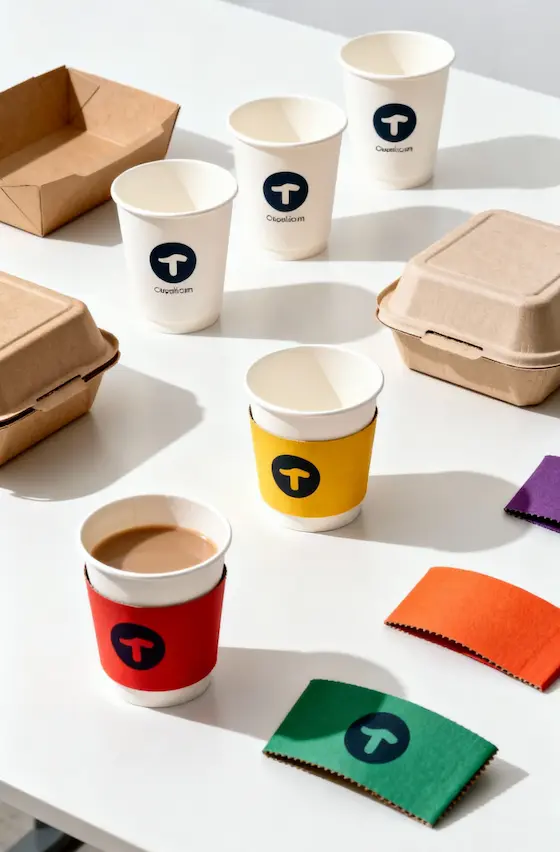
Ready to create your own branded paper cups or packaging?
Tell us your requirements — size, coating, printing, and destination — and our team will prepare a detailed quotation within 24 hours.
Last Updated: July 2026
Reading Time: 8-10 minutes
Author: Papacko Content Team
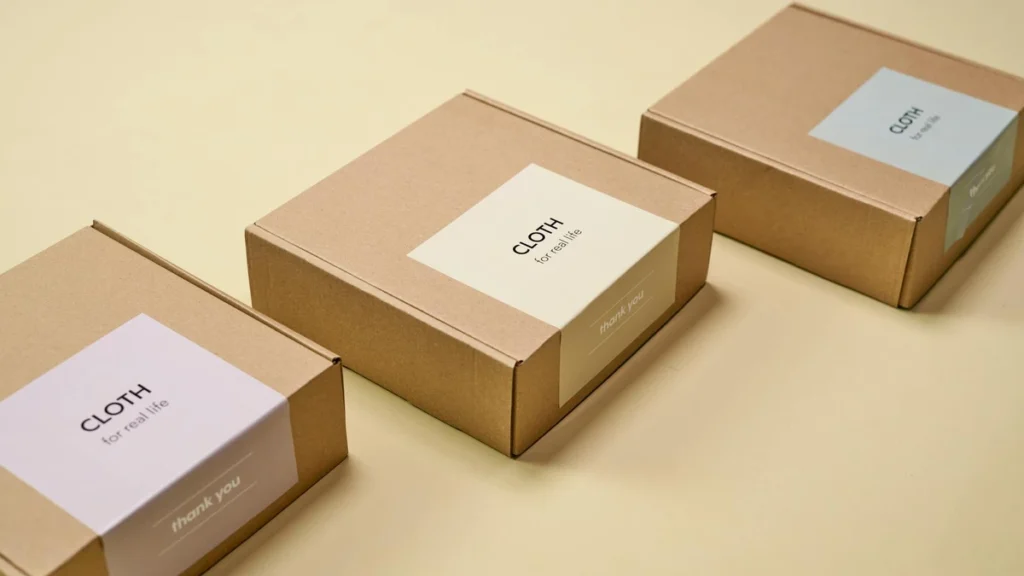
Takeout packaging has evolved from generic white boxes to branded marketing tools that extend restaurant identities beyond their walls. Understanding the custom printed lunch boxes helps.A custom printed lunch box transforms every delivery into a brand touchpoint—generating social media shares (32% of consumers photograph visually appealing packaging), creating word-of-mouth marketing (branded boxes travel through offices, parks, public spaces), and signaling quality through professional presentation.
This comprehensive guide covers custom printed paper lunch box strategies for restaurants, food trucks, catering services, and meal prep businesses. Understanding custom printed lunch boxes helps.You’ll learn printing method comparisons (flexographic vs digital vs offset), design guidelines optimizing artwork for folded box structures, file specification requirements, branding best practices that maximize visibility, cost-performance analysis across order volumes, and MOQ navigation for businesses from startups to established chains.
💡 Quick Takeaway: Custom printed lunch boxes require artwork adapted for 3D folded structures (not flat designs), printing methods matched to order volume (digital for 1,000-5,000 units at $0.45-0.85 each, flexo for 10,000+ at $0.30-0.55), high-contrast branding on top and front panels, and food-safe water-based or UV inks compliant with FDA/EU regulations.
Understanding the custom printed lunch boxes requires attention to these factors:
Market differentiation:
•Generic white boxes: “This is food from somewhere”
•Custom branded boxes: “This is [Restaurant Name]’s signature dish”
•Perception gap: 67% of consumers associate custom packaging with higher quality food (2025 packaging psychology study)
Marketing reach beyond the transaction:
•Average lunch box visibility: 20-50 people during transport, consumption, disposal
•Office lunch scenario: Branded box on desk = 8-15 coworker views over 30-minute meal
•Social media: 32% of consumers photograph aesthetically designed food packaging (Instagram, TikTok)
•Word-of-mouth trigger: “Where’s that from?” conversations driven by distinctive packaging
ROI calculation:
•Custom box premium: $0.25-0.45 per box vs generic
•Monthly volume: 2,000 takeout orders
•Monthly investment: $500-900
•Brand impressions generated: 2,000 boxes × 35 average views = 70,000 monthly impressions
•Cost per impression: $0.007-0.013 (vs $0.08-0.15 for social media ads)
🎯 Industry Insight: A 2025 restaurant branding study tracking 5,000 delivery orders found that restaurants using custom printed packaging experienced 22% higher repeat order rates and 18% increase in social media tags (@mentions, location tags) compared to generic packaging—with customer acquisition cost dropping 12-15% due to organic word-of-mouth marketing.
For custom printed lunch boxes, focus on:
Process: Raised rubber/polymer plates transfer ink to paperboard (similar to stamping)
Specifications:
Cost breakdown example (8×6×3″ lunch box, 2-color design):
•Setup: $1,800 (plates)
•Printing: $0.42/box × 15,000 = $6,300
•Boxes (blank paperboard): $0.18/box × 15,000 = $2,700
•Total: $10,800 for 15,000 boxes = $0.72/box
Reorder advantage: Subsequent orders use existing plates
•No setup fee (plates already made)
•Printing: $0.42/box × 15,000 = $6,300
•Boxes: $2,700
•Reorder total: $9,000 = $0.60/box (17% savings)
When evaluating custom printed lunch boxes, consider the following:
Process: Inkjet/laser directly prints designs onto paperboard (no plates required)
Specifications:
Cost breakdown example (8×6×3″ lunch box, full-color photo design):
•Setup: $200 (file prep)
•Printing: $0.65/box × 3,000 = $1,950
•Boxes (blank): $0.22/box × 3,000 = $660
•Total: $2,810 for 3,000 boxes = $0.94/box
Advantages:
•Low MOQ enables testing designs before large commitments
•Design changes cost-effective (only digital files, no plate remakes)
•Full-color photography capability (showcase actual dishes)
•Faster market entry (2-3 weeks vs 4-6 for flexo)
Limitations:
•Higher per-unit cost (2-3x flexo at high volumes)
•Some digital inks less food-safe compliant (verify FDA/EU certification)
•Lower abrasion resistance (can scratch during shipping/handling)
For custom printed lunch boxes, focus on:
Standard lunch box structure (8×6×3″ dimensions):
Panels requiring design consideration:
1.Understanding custom printed lunch boxes helps.Top panel (8×6″): Highest visibility when box closed, prime logo placement
2.Front panel (8×3″): Visible when box held, secondary branding
3.Side panels (6×3″ each): Repeat logo or pattern for 360° branding
4.Bottom panel (8×6″): Least visible, frequently blank or minimal design
5.Interior: most times unprinted (food contact concerns, cost savings)
Flat die-cut template: Box is printed flat, then folded
•Total printable area: ~350-400 sq cm (depending on box size)
•Design must account for fold lines, glue tabs, die-cut edges
For custom printed lunch boxes, focus on:
Visual hierarchy:
Artwork specifications:
•File format: Vector preferred (AI, EPS, PDF), high-res raster acceptable (300 DPI minimum PNG/TIFF)
•Color mode: CMYK for printing (not RGB which produces color shifts)
•Fonts: Convert to outlines/paths (prevents font substitution errors)
•Bleed: 3-5mm beyond trim line (ensures no white edges after cutting)
•Safe zone: Keep critical elements 5mm inside fold lines (prevents logo distortion at creases)
Color selection:
•High contrast: Logo and text should contrast 70%+ with background (legibility from 3-5 meters)
•Pantone matching: Specify exact PMS colors for brand consistency (not CMYK approximations)
•Food photography: Use vibrant, appetizing images (increase perceived value by 28% in consumer testing)
Direct food contact restrictions:
•Interior printing: most times avoided (inks should not contact food directly)
•Exterior printing: Ink migration concerns—must use approved food-safe inks
•Barrier requirements: If printing interior, must use FDA-approved barrier coating separating ink from food
Approved ink types:
•Water-based inks: Low VOC, food-safe compliant (most common for paper packaging)
•UV-curable inks: Instant curing, no solvent off-gassing, FDA compliant
•Vegetable-based inks: Soy, linseed oil-based (eco-friendly, food-safe)
Prohibited substances:
•Heavy metals: Lead, mercury, cadmium (strict limits <100 ppm)
•Phthalates: Banned in food contact materials (EU regulation, California Prop 65)
•Mineral oils: MOSH/MOAH migration concerns (restricted in EU)
Certification verification:
•Request supplier’s Certificate of Compliance (confirms inks meet FDA 21 CFR 175.300 or EU 10/2011)
•Third-party testing: Independent lab verification of ink safety
•Migration testing: Simulates food contact conditions, measures ink substance transfer (<0.01 mg/kg threshold)
Scenario: 8×6×3″ lunch box, 2-color design
Break-even point: ~8,000-10,000 units (where flexo setup cost is offset by lower per-unit pricing)
Decision guidelines:
•<5,000 units: Digital printing (no choice—flexo MOQ too high)
•5,000-10,000 units: Digital (flexibility, design testing) or flexo if committed to design
•10,000-25,000 units: Flexo (23-29% savings justify setup investment)
•25,000+ units: Flexo or offset lithography (maximum quality + cost efficiency)
Typical volume: 500-2,000 boxes/month
Strategy:
•Initial order: 1,000-3,000 units via digital printing
•Purpose: Test design, gauge customer response, validate branding
•Cost: $0.85-0.94 per box
•Timeline: 2-3 weeks (fast market entry)
Testing checklist before scaling:
•Customer feedback: Do customers comment positively on packaging?
•Social media: Are customers photographing/tagging your branded boxes?
•Structural performance: Does box hold up during delivery, stacking, handling?
•Design effectiveness: Is logo legible, colors accurate, branding clear?
Scale-up trigger: After 3-6 months and 5,000+ boxes distributed, if branding proves effective, transition to flexo for cost savings.
Typical volume: 3,000-10,000 boxes/month
Strategy:
•Quarterly orders: 15,000-30,000 units via flexographic printing
•Cost: $0.60-0.72 per box (40-50% savings vs digital)
•Design commitment: Lock in design for 3-6 months (allows seasonal updates)
Inventory management:
•3-month supply balances cost savings with flexibility
•Storage: 15,000 boxes (nested) = 6-8 cubic meters
•Cash flow: ~$10,000-12,000 per quarterly order
Hybrid approach:
•Core brand design (80%): 24,000 units flexo = $0.65/box
•Holiday/special edition (20%): 6,000 units digital = $0.90/box
•Blended cost: $0.70/box with seasonal variety
❌ Mistake #1: Designing box artwork as flat 2D image without using supplier’s die-cut template
✅ Correct Approach: Always request die-cut template showing fold lines, glue tabs, cut edges. Understanding the custom printed lunch boxes helps.Place logo/text on flat panel areas (not spanning folds). Test by printing template, folding by hand, checking if design elements align properly on assembled box.
❌ Mistake #2: Using RGB color mode for print files, causing drastic color shifts in production
✅ Correct Approach: Convert all artwork to CMYK color mode before sending to printer. Understanding the custom printed lunch boxes helps.For brand colors, specify exact Pantone PMS codes (e.g., PMS 485 Red, not “red”). Request color proof samples before full production—$50-150 proof prevents $5,000+ printing mistakes.
❌ Mistake #3: Ordering 30,000 units to maximize pricing without testing design or market response
✅ Correct Approach: Start with 1,000-3,000 digital printed boxes to test design, structural performance, customer reception. Understanding the custom printed lunch boxes helps.After validation (3-6 months, positive feedback), scale to flexo 15,000-30,000 units for cost savings. Bad design at $0.60/box wastes more money than good design at $0.94/box.
❌ Mistake #4: Using non-food-safe inks without verifying FDA/EU compliance for food packaging
✅ Correct Approach: Request supplier’s Certificate of Compliance (FDA 21 CFR 175.300 or EU 10/2011), the custom printed lunch boxes matter.Specify water-based, UV-curable, or vegetable-based inks only. Verify migration testing results (<0.01 mg/kg threshold). Non-compliant inks risk health violations, recalls, legal liability.
Custom printed lunch boxes are food packaging containers made from paperboard or molded fiber with personalized branding—logos, restaurant names, colors, patterns, and artwork—printed directly onto the box surface. Available in flexographic printing (bold designs, 10,000+ MOQ, $0.30-0.55/box), digital printing (photo-quality, 1,000-5,000 MOQ, $0.45-0.85/box), or offset lithography (premium, 20,000+ MOQ, $0.35-0.60/box). Custom printing transforms functional packaging into marketing tools generating brand visibility and social media engagement.
Costs vary by printing method and volume: Digital printing costs $0.45-0.85 per box with minimal setup ($0-300), suitable for 1,000-5,000 units and testing designs. Understanding the custom printed lunch boxes helps.Flexographic printing costs $0.30-0.55 per box but requires $1,200-3,500 setup fees, economical at 10,000+ units. Offset lithography costs $0.35-0.60 per box with $2,500-5,000 setup, best for 20,000+ unit premium applications. Break-even between digital and flexo occurs at 8 —000-10,000 units. Volume pricing delivers 40-50% savings at 25,000+ units.
MOQs depend on printing method: Digital printing allows 1 —000-5,000 unit MOQs ideal for startups, food trucks, and design testing. Understanding the custom printed lunch boxes helps.Flexographic printing requires 10,000-30,000 unit MOQs to justify $1,200-3,500 plate setup costs. Offset lithography needs 20,000-50,000 units for premium finishes. Custom structural designs (non-standard sizes — shapes) require 25,000-50,000 units plus $800-2,500 tooling fees. Small businesses start with digital printing, then transition to flexo after validating designs.
Request supplier’s die-cut template showing fold lines, panels, and glue tabs. Understanding custom printed lunch boxes helps.Design in CMYK color mode (not RGB), use vector files (AI, EPS, PDF) or 300+ DPI raster images, convert fonts to outlines, include 3-5mm bleed beyond trim lines, and keep critical elements 5mm inside fold lines. Place large logo on top panel (50-70mm width), medium logo on front (35-50mm), and patterns/repeated logos on sides. Test design in grayscale—70%+ contrast ensures legibility. Order 100-500 sample boxes before 10,000+ production runs.
Yes, when using compliant inks and coatings, the custom printed lunch boxes matter.Specify water-based, UV-curable, or vegetable-based inks meeting FDA 21 CFR 175.300 (US) or EU Regulation 10/2011 (Europe). Avoid interior printing (direct food contact) or use FDA-approved barrier coatings. Request Certificate of Compliance from supplier verifying ink safety. Migration testing ensures <0.01 mg/kg substance transfer. Prohibited substances include heavy metals (lead, mercury), phthalates, and certain mineral oils. Non-compliant inks risk health violations and legal liability.
Choose digital printing if: ordering <8,000 units, testing new designs, creating seasonal variations, or operating small food business with 1,000-3,000 monthly box usage, the custom printed lunch boxes matter.Digital costs $0.45-0.85/box but has minimal setup fees and 2-3 week turnaround. Choose flexographic if: ordering 10,000+ units, committed to established design you’ll reorder, or using 5,000+ boxes monthly. Flexo costs $0.30-0.55/box but requires $1,200-3,500 setup. Break-even at 8,000-10,000 units. Hybrid approach: flexo for core brand (70% volume), digital for seasonal editions (30%).
Digital printing requires 2-3 weeks from approved artwork to delivery—ideal for quick launches or seasonal designs. Understanding the custom printed lunch boxes helps.Flexographic printing takes 4-6 weeks: 1-2 weeks for plate/cylinder production, then 2-4 weeks for printing and shipping. Offset lithography takes 5-8 weeks including metal plate creation. Add 1 week for design revisions and artwork approval before production starts. Reorders with existing plates reduce to 3-4 weeks (flexo) or 4-5 weeks (offset). Always order color proof samples (adds 1 week) before 10 —000+ unit production runs—prevents costly mistakes.
Custom printed lunch boxes transform functional food packaging into powerful branding tools that extend restaurant identity beyond physical locations. Strategic printing method selection—digital for testing and flexibility, flexographic for volume cost efficiency—matched with food-safe compliant inks and thoughtful design execution delivers marketing ROI far exceeding the $0.25-0.45 per-box premium.
Key Takeaways:
1.Understanding the custom printed lunch boxes helps.Start with digital printing (1,000-3,000 units) to test designs before committing to flexo volumes (10,000+)
2.Understanding custom printed lunch boxes helps.Design for 3D structures—use die-cut templates, avoid fold lines, maintain 70%+ contrast for legibility
3.Understanding custom printed lunch boxes helps.Verify food-safety compliance—request Certificate of Compliance (FDA 21 CFR 175.300 or EU 10/2011)
4.Understanding custom printed lunch boxes helps.Calculate break-even at 8,000-10,000 units—flexo becomes cost-effective vs digital at this volume
5.Understanding the custom printed lunch boxes helps.Order samples before production—$50-150 proof prevents $5,000+ mistakes on large runs
Papacko supplies restaurants, food trucks, and catering services with custom printed lunch boxes using digital printing (MOQ 1,000 units) and flexographic printing (MOQ 10,000 units). Our design team provides free die-cut templates, artwork consultation, food-safe ink certification, and sampling services—ensuring your branded packaging delivers maximum visibility and marketing impact.
Printed lunch-box projects usually connect structural packaging choices with brand systems, takeaway container selection, and rollout planning across different menu formats.
Get in touch: