Ready to create your own branded paper cups or packaging?
Tell us your requirements — size, coating, printing, and destination — and our team will prepare a detailed quotation within 24 hours.

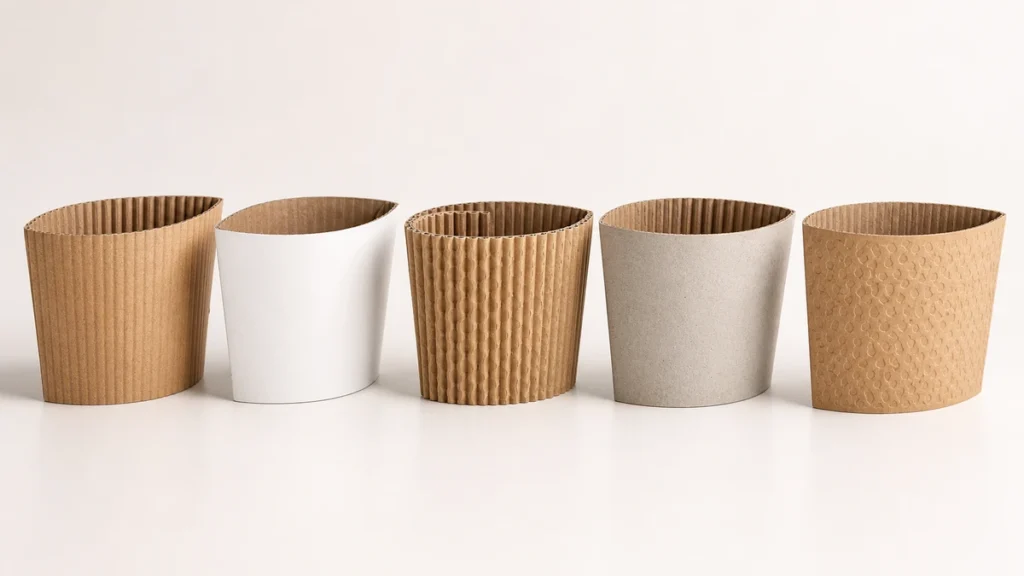
Paper cup sleeves do more than decorate a takeaway cup. For hot drink service, paper cup sleeves add grip, improve hand comfort, and create a visible brand panel that customers keep in hand from counter to consumption. For B2B buyers, the best sleeve is not simply the cheapest or the most attractive. It is the one that fits the cup correctly, matches the drink temperature, supports your print goals, and arrives with the documentation your procurement or compliance team needs.

A sleeve that looks fine in a sample photo can still fail in real service. Poor fit can lead to slipping, buckling, or awkward handling. The wrong material can reduce insulation or complicate recycling claims. And a beautiful print result may not be practical if your MOQ, lead time, or storage capacity do not match the program. That is why sleeve selection should be treated as part of the full beverage packaging system, not as an afterthought.
Paper cup sleeves are die-cut paperboard bands formed to fit around the outer wall of a hot drink cup. Most are tapered to match cup geometry and rely on friction fit rather than adhesive attachment during use. In practice, they solve two commercial needs at once: customer comfort and brand visibility.
For insulation, sleeves create a buffer between the hot cup wall and the hand. Corrugated structures add a small air gap, while heavier board adds extra material between the cup and the user. This matters most on single-wall cups used for coffee, tea, hot chocolate, and other takeaway beverages.
For branding, sleeves often become the most visible printed part of the pack. Once a lid is in place, the sleeve is the area customers see first. That makes it useful for logos, seasonal campaigns, product codes, or limited-run promotions. If you are standardizing cups across multiple stores, it is often easier to update sleeve artwork than to replace the full cup program. Buyers aligning sleeves with paper cups and coffee cup lids usually get a cleaner packaging system and fewer fit surprises.
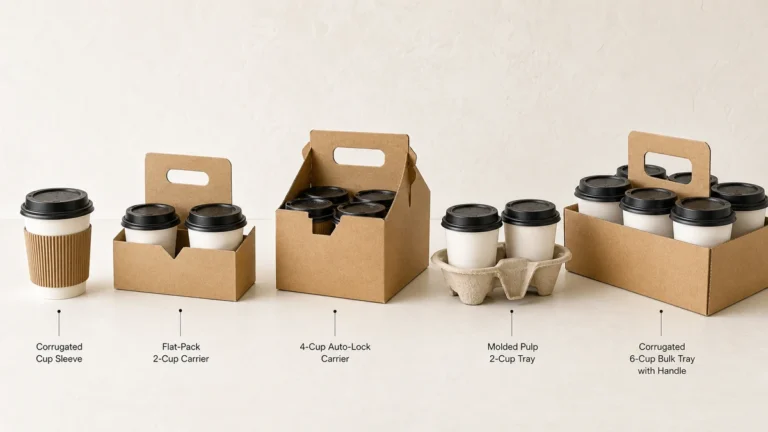
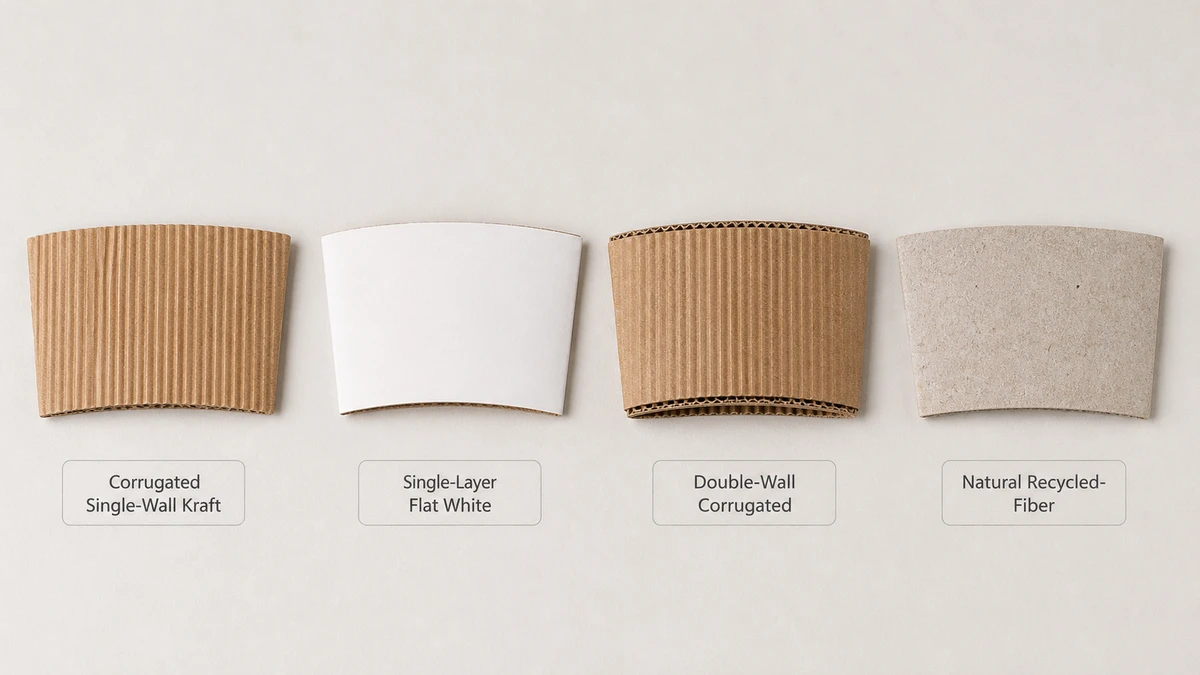
The main sleeve constructions used in foodservice are:
Each option has trade-offs in insulation, print sharpness, cost, and storage footprint.
Choosing between sleeve types is mainly about function. A premium finish is not useful if the sleeve does not protect the hand well enough for your drink temperature or hold time.
Corrugated single-wall sleeves are the standard choice for most cafes and quick service operators. They provide reliable insulation, ship flat, and usually offer the best balance between cost and thermal performance. Their main limitation is print precision. Fine text and detailed gradients can soften slightly on the flute structure.
Flat sleeves made from solid board give a smoother print surface and are better for crisp graphics, small typography, and cleaner color blocks. However, they offer less insulation. In most hot drink programs, they work better as a branding sleeve than as a full comfort solution.
Double-wall corrugated sleeves increase thickness and improve heat protection for very hot fills, outdoor service, or situations where customers hold the cup longer. The trade-off is more bulk, higher cost, and potentially more storage pressure.
Kraft and recycled-fiber sleeves suit brands that want a natural look or simpler sustainability messaging. Color appearance can shift on darker or textured substrates, so artwork approval on the actual stock is important.
Specialty embossed or coated sleeves can create a premium presentation, but they usually bring higher setup costs and longer lead times. They are often better for planned campaigns than for routine replenishment.
| Sleeve Type | Insulation | Print Surface | Relative Cost | Typical Use |
|---|---|---|---|---|
| Corrugated single-wall | High | Moderate | Low | Everyday hot drinks |
| Flat solid-board | Low to moderate | High | Low to medium | Branding-led programs |
| Double-wall corrugated | Very high | Moderate | Medium to high | Extended hold time |
| Kraft or recycled-content | Moderate to high | Moderate | Low to medium | Natural brand look |
| Embossed specialty | Moderate | Very high | High | Premium promotions |
If your wider packaging brief includes sustainability positioning, it helps to compare sleeve choice with your cup program and broader material claims. Papacko’s eco paper cups and compostable food packaging categories are useful reference points when you want end-of-life claims and appearance to stay consistent across the range.
Fit is one of the most common sourcing failure points for paper cup sleeves. A sleeve does not fit by ounce size alone. Two cups both labeled 12 oz may have different diameters, taper angles, and wall profiles. That means one sleeve can fit one supplier’s cup and fail on another.
The most important measurements are:
If the fit is too loose, the sleeve may slide down or rotate. If too tight, it can buckle or be difficult for staff to apply quickly. In high-volume service, even a small fit issue creates delays and waste.
A practical fit-check process should include actual cup samples from every cup source you use. Do not approve based only on drawings. Ask the supplier to confirm the fit dimensions in writing and test the sleeve with your real fill temperatures and your chosen lid. Lid fit matters because the point where customers grip the cup often shifts depending on how the top feels in hand. When the cup, lid, and sleeve are all sourced separately, the risk of mismatch increases.
If you manage multiple beverage sizes, map the sleeve SKUs carefully. A standardized size plan reduces line confusion and makes inventory more manageable. The Papacko paper cup sizes guide can help buyers cross-check format planning from 8 oz through larger takeaway sizes.
Custom tooling can be worth the cost if your cup profile is non-standard or if you have a stable reorder program. For short campaigns or variable sourcing, a more forgiving stock fit may be safer than a highly specific custom die line.
The best print method depends on run size, artwork complexity, and reorder frequency. It also affects MOQ and lead time, so print decisions should be made with procurement realities in mind.
Flexographic printing is commonly used for larger sleeve runs. It works well for logos, simple spot colors, and repeat orders where setup cost can be spread over volume. Offset printing is better for sharper detail and more complex artwork. Digital printing is often the practical option for short runs because it avoids plate costs, though unit pricing is typically higher at scale.
Material choice influences both print and performance. Corrugated kraft is practical and widely used, but fine artwork may not reproduce as cleanly as it would on a smooth white board. White solid-board gives a cleaner print face but less thermal protection. Recycled-fiber stock can support a natural visual identity, though colors may appear less vivid than on bright white material.
When reviewing a quote, buyers should ask for more than just unit price. Important specification points include:
MOQ varies by print method and level of customization. Stock or lightly customized sleeves may be available at lower volumes, while fully printed sleeves often require a higher commitment. Lead time will depend on tooling, artwork approval, production slot, and shipping method. A buyer should always request pre-production samples or fit samples before mass production, especially when changing cup suppliers or launching new artwork.
For repeat accounts, ask whether the supplier keeps tooling on file, whether color standards are documented, and whether reorder lead time differs from first-order lead time. Those details matter when your sleeve is part of an ongoing retail or chain rollout.
Paper cup sleeves are normally indirect food-contact packaging because they touch the outside of the cup rather than the beverage itself. Even so, compliance should not be assumed. Buyers should request clear supplier documentation covering the whole material system, not only the paperboard.
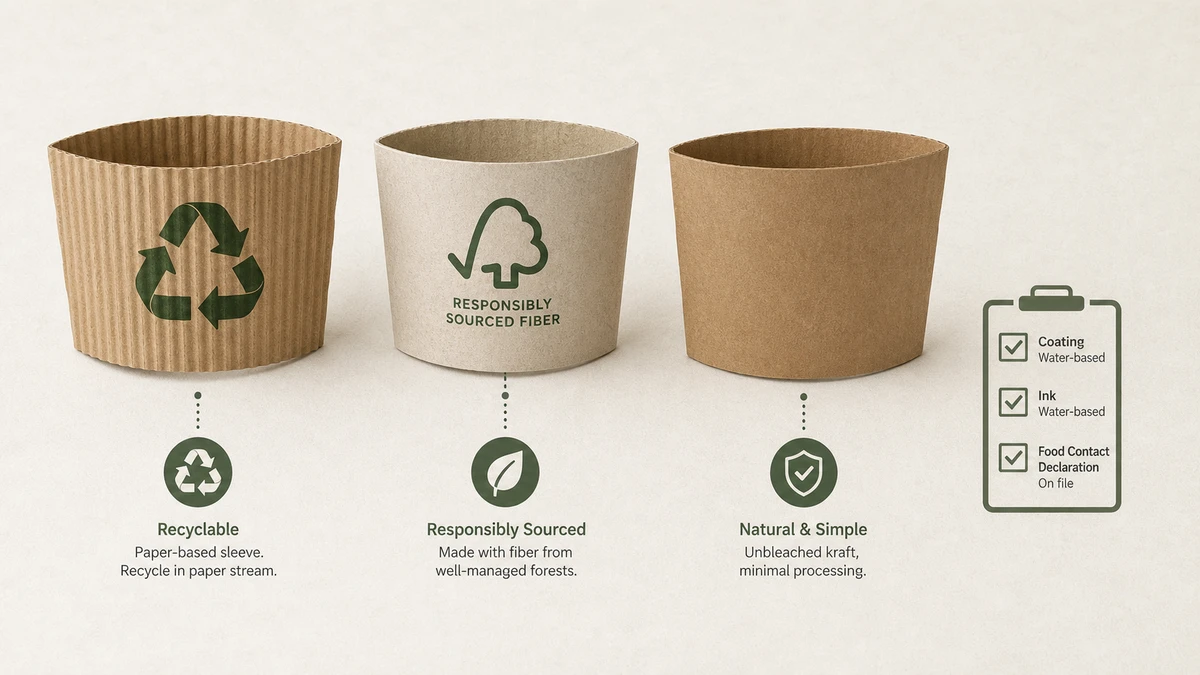
Useful documentation typically includes:
For U.S. buyers, the FDA framework on food-contact substances is the key authority for evaluating packaging material suitability: FDA Food Contact Substances.
Environmental claims also need careful handling. A kraft sleeve may look recyclable, but the final claim depends on the full build, including coating and print treatment, plus local collection rules. Recycled content and responsible fiber sourcing are useful claims, but they are not the same as recyclability or compostability. Buyers should match marketing language to what the supplier can document.
In many commercial programs, the simplest compliant build is the most practical. Natural kraft, standard inks, and straightforward construction are often easier for procurement and compliance teams to approve than heavily coated or specialty-finished alternatives.
Commercial sleeve buying works best when ordering decisions reflect both factory constraints and on-site operations. A low unit price can still become an expensive purchase if the MOQ is too high for your turnover or if bulky cartons strain your storage space.
For MOQ, expect printed sleeves to require more volume than plain stock sleeves. Digital printing may support shorter runs, while flexo or offset usually becomes more economical when reorder volume is higher. If your branding need is temporary, compare a short digital run with a neutral stock sleeve before locking into a large custom order.
Lead time should be checked at the quote stage and again at artwork approval. Initial orders usually take longer than repeats because die lines, color approval, and production planning need to be established. Seasonal campaigns need extra buffer, especially if they involve custom finishes or imported stock.
Samples are essential. Request at least three kinds when possible:
Do not approve based only on screen artwork. Board color, flute texture, and print process all affect the final result.
Inventory planning matters because sleeves are lightweight but space-consuming. Storage should be dry, clean, and away from steam or moisture. Cases should be rotated using FIFO so older stock is used first. If you carry multiple cup sizes, separate sleeve inventory by size and label clearly to reduce service errors.
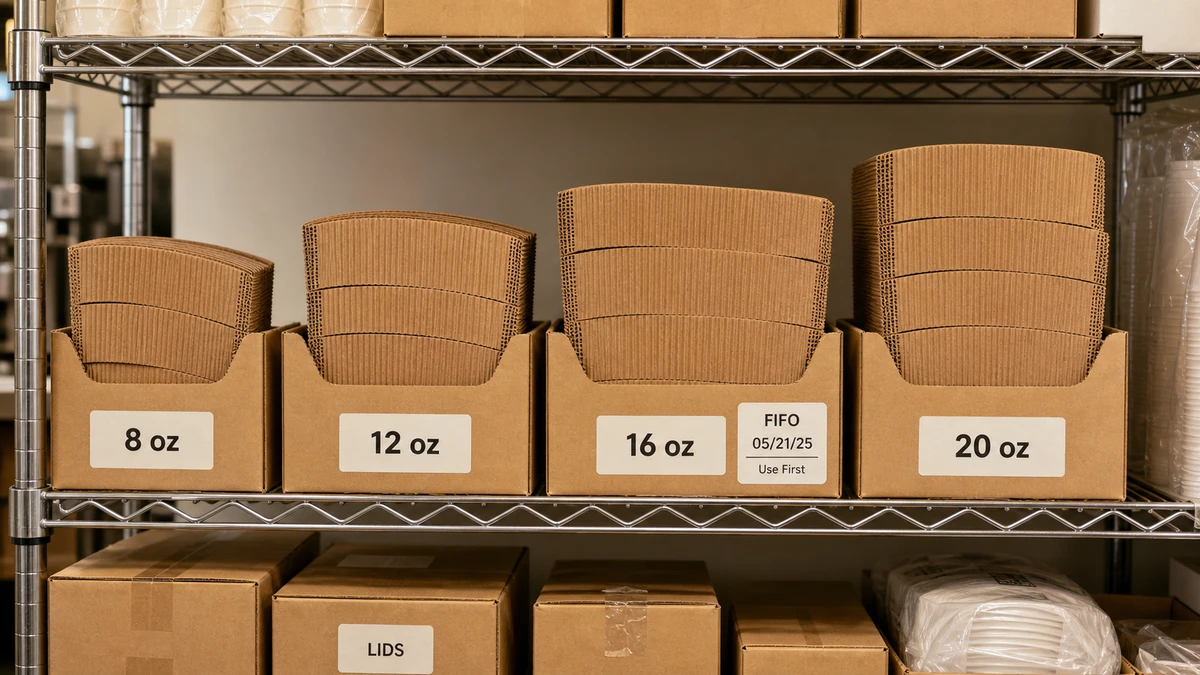
For many branded programs, holding about 30 days of sleeve inventory is a practical starting point, adjusted for your lead time, seasonality, and service volume. If your cup source or lid source changes, review sleeve fit again before placing the next reorder.
No. Fit depends on the cup’s real diameter, taper, and wall profile, not only the nominal ounce size. Always test the sleeve on the actual cup you will use.
Usually yes for hot drinks. Corrugated paper cup sleeves generally provide better insulation, while flat sleeves are stronger on print appearance than on heat protection.
Sometimes, but only when the cup geometry is close enough. Small differences in taper or diameter can cause slipping or buckling, so physical testing is necessary.
Digital printing is usually the most practical for a short run because it avoids plate costs. For repeat volume orders, flexo or offset often becomes more cost-effective.
Ask for MOQ, lead time, sample options, exact fit dimensions, coating or material choice, print method, food-contact documentation, and defect policy. Those details determine whether the sleeve will work in your operation.
Yes. End-of-life claims depend on the board, coating, ink, and local waste system. A plain paper-based sleeve is often easier to position than a laminated or heavily finished one, but claims still need documentation.
Because the cup, lid, and sleeve work as one handling system. The way customers hold the cup can change depending on lid design, so sleeve position and grip comfort should be tested with the final cup and lid combination.