Ready to create your own branded paper cups or packaging?
Tell us your requirements — size, coating, printing, and destination — and our team will prepare a detailed quotation within 24 hours.

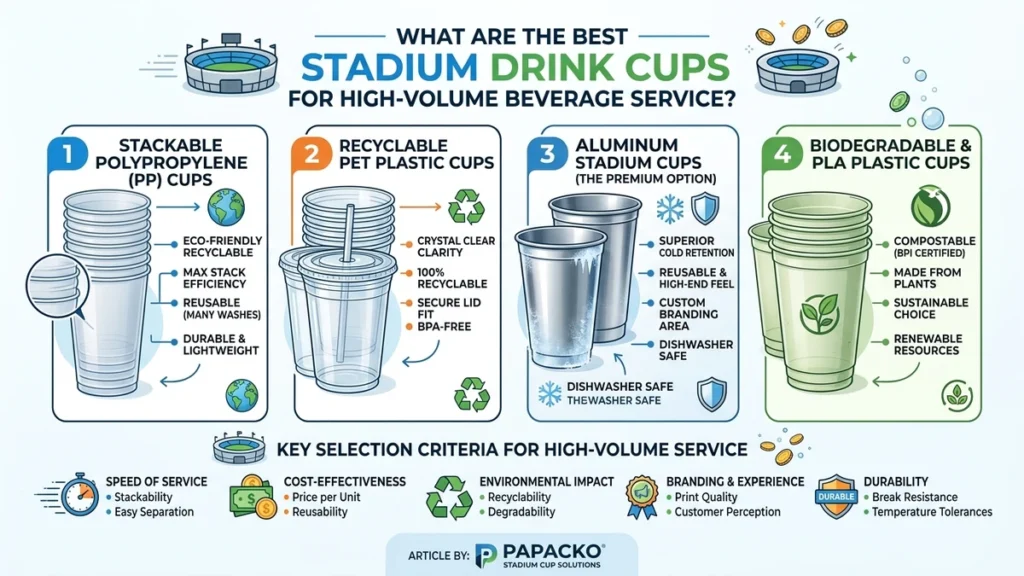
For high-volume stadium beverage service, the best drink cups are usually PET clear cups for beer and premium cold drinks, PP cups when rough handling and crack resistance matter more than clarity, and paper cups for fountain beverages and branded concession programs. The right choice depends on line speed, lid fit, de-nesting, case-pack efficiency, and waste-stream requirements, not just unit price.
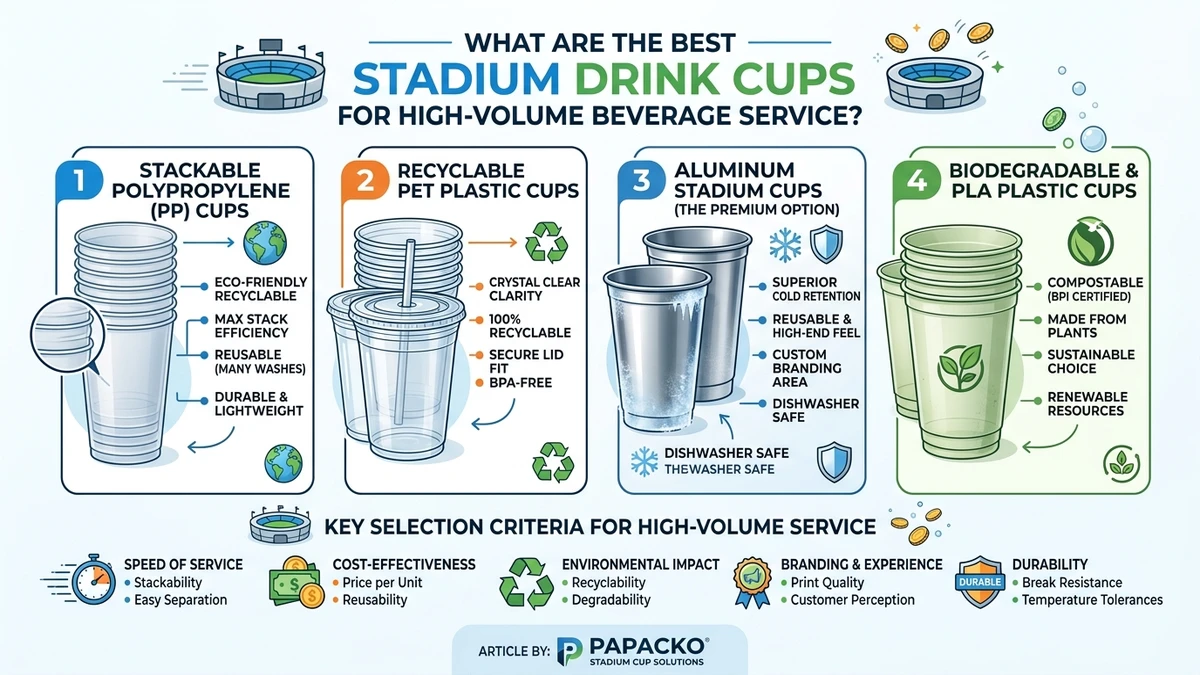
Stadium buyers usually standardize around 12 oz, 16 oz, 20 oz, and 24 oz first, then choose materials based on performance during rush periods: clean release from dispensers, quick filling, reliable lidding, and survival through warehouse-to-concourse distribution.
PET is usually the strongest option when beverage visibility supports sales and quick order verification. It works well for cold-fill beer and premium drinks in 12-24 oz sizes, but buyers should still confirm rim consistency and stack release to avoid dispenser slowdowns.
PP is often selected when cups crack during transport, restock, or heavy contact handling. It gives up some clarity, but its better abuse tolerance can make it a better utility choice for cold-drink programs.
Paper cups remain practical for fountain soda, combo meals, and sponsor-led concession programs because they provide strong print coverage and compatibility with common lid systems. Buyers should match board weight and coating to actual hold time so the cup does not soften during service.
Choose PET if your priority is beverage presentation, visual order confirmation, or a clear-cup standard for beer and premium cold drinks.
Choose PP if your priority is reducing cracked cups during transport and rough internal handling.
Choose paper if your priority is fountain-driven service, branded print area, or established quick-service lid systems.
In stadium purchasing, cup failures usually appear as line failures, not lab failures. The most useful checks are stack release, rim consistency, case and pallet efficiency, carton strength, print lead time, and SKU discipline so stands do not receive incompatible cups and lids.
A common approach is to run one clear cold-cup family for alcohol and premium cold drinks and one paper platform for fountain beverages. That reduces lid confusion and simplifies replenishment.
In stadium service, the cup is part of the throughput system. If it sticks in the dispenser, deforms during filling, or needs extra force to lid, even a 1-2 second delay per order can noticeably lengthen halftime lines.
Beer stands, fountain lanes, and cocktail bars fail in different ways, so one cup family is not always ideal. High-volume lanes usually need consistent rim diameter, easy one-hand de-nesting, enough stiffness, and obvious size identification.
The operational target is one pull, one pour, one handoff. Before rollout, confirm the cup releases cleanly, stays rigid during filling, and accepts lids without rework.
Many disruptions come from cup-lid mismatch, especially when venues mix suppliers or carry too many diameters. In many stadiums, 16 oz, 20 oz, and 24 oz can cover most demand while reducing mismatch risk.
Cups should be tested under actual event conditions, not just in sample reviews. Check hand de-nesting, dispenser performance, cold-fill stability, and lid application after exposure to humid back-of-house areas or mixed hardware.
[Expert Insight]
– Test cups after they have sat overnight in venue back-of-house conditions, not just at room temperature.
– If one stand uses a different dispenser model, test there too; mixed hardware often reveals hidden de-nesting problems.
– Track errors by stand during pilot events. The issue is often location-specific, not venue-wide.
Extra sizes can add flexibility but often slow concession service. A tighter ladder with one small, one core, and one large format usually improves speed, forecasting, and restocking.
Cup performance is also a logistics issue. Review sleeve counts, case dimensions for under-counter storage, and clear labeling so staff can restock quickly in cramped concession areas.
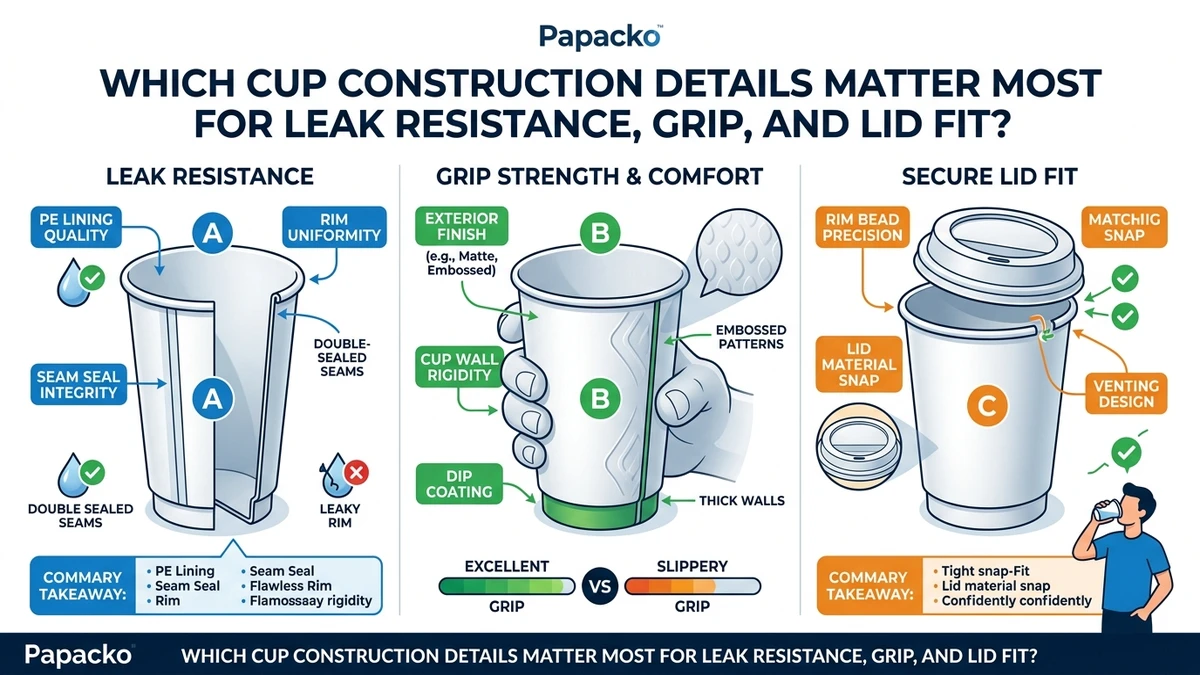
For stadium beverage service, the key spec is not just material type. Most failures begin at the side seam, bottom seal, rim, or sidewall, especially under carbonation, ice load, and crowd movement.
Look for a continuous heat-sealed or ultrasonic-bonded seam with even overlap. Weak seam points can leak under carbonation, ice impact, and hand pressure.
Specify a well-formed bottom curl with consistent compression into the sidewall. Poor base seals may not fail immediately but can start weeping after several minutes of carrying.
Wall stiffness should match drink weight, hold time, and hand pressure. If the sidewall deforms, the lid seat can distort and leak risk rises.
For paper cups, confirm full liquid-contact coating coverage, especially through the seam area. FDA food-contact guidance explains why packaging substances must match intended use and exposure conditions: https://www.fda.gov/food/food-ingredients-packaging/food-contact-substances-fcs.
Ask for testing with ice-first fills, carbonated beverages, and 20-60 minute hold times. Static water holds are usually not enough for stadium approval.
Glossy finishes may look better but can become slippery with condensation or foam. Matte or lightly textured surfaces usually improve one-hand handling.
Good hoop strength helps the cup keep shape, limit splash loss, and maintain lid engagement. In live service, weak stiffness often shows up before true leakage.
Plastic cups usually show more external condensation than paper, which can affect grip. Heavier or insulated paper can improve hand feel, but with cost and storage trade-offs.
Cup taper and center of gravity matter in aisles and stair traffic. Tall narrow cups can feel less stable even when they meet capacity targets.
[Expert Insight]
– Lid complaints are frequently traced back to cup rim variation, not the lid itself.
– A glossy finish may test well visually but still underperform in rain, condensation, or foam-heavy beer service.
– If fans carry drinks through aisles or stairs, stability geometry matters almost as much as leak resistance.
Uniform rim curl is the foundation of lid retention. If the rim varies around the circumference, one side may snap while the other lifts during movement.
Cup top diameter must stay within the lid supplier’s fit window batch to batch. Mixed sourcing often creates tolerance stack-up that leads to loose fits or excessive force.
The lid should seat securely without heavy thumb pressure. Too much force slows assembly and can deform the cup; too little force increases pop-off risk.
Beer and soft drinks stress lids differently than still beverages because foam and carbonation affect the interface. Fill-line discipline matters as much as lid spec.
Limitation: poor specs can soften on long hold times
Double-wall or insulated paper cups
Trade-off: higher cost, lower nesting efficiency, more storage cube
PET or PP clear cups
Trade-off: condensation management and lid mismatch require closer validation
Foam constructions
Before approving a stadium cup, confirm in writing:
– material and wall construction
– side seam seal method
– bottom seal design and leak test method
– rim profile and tolerance
– compatible lid SKUs
– cold and carbonated beverage hold-time performance
– grip under condensation
– stackability and de-nesting speed
– print finish versus slip risk
– case pack, pallet density, and crush resistance
A stadium cup should be approved as a system: cup body, rim, lid, and logistics format together.
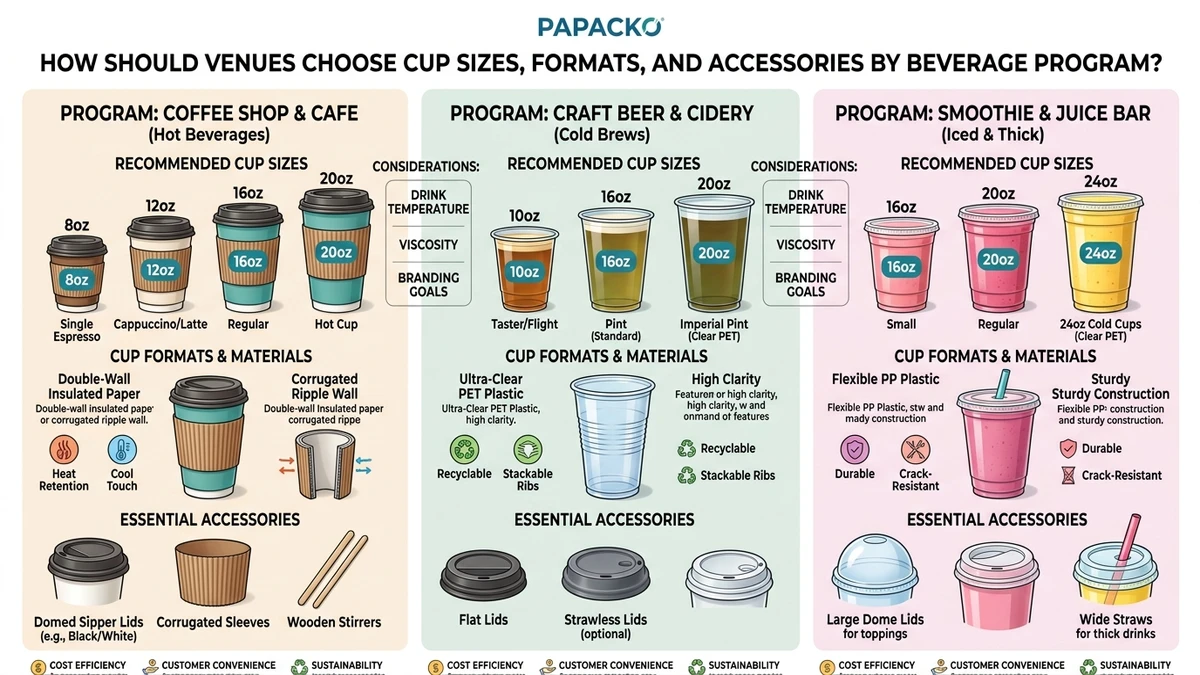
Venues should choose cup sizes and accessories from the beverage backward. The strongest programs usually separate core fountain, alcohol or specialty cold, and hot beverage families instead of forcing one standard cup across the building.
Nominal capacity is only part of the decision because real fill level changes with foam, ice, garnish, and safe-carry headspace. Two cups with the same ounce rating can perform differently depending on diameter, height, and fill speed.
| Beverage program | Typical size range | Best-fit cup format | Accessory needs | Where it wins | Where it becomes a poor fit |
|---|---|---|---|---|---|
| Fountain soda | 16-32 oz | Cold cup with secure flat or straw-slot lid | Lid, straw where needed, carrier for multi-buy | Fast throughput, clean upsell ladder | Oversized cups increase ice use, waste, and refill congestion |
| Draft beer | 12-24 oz | Clear cold cup or other beer-suitable format with stable sidewall | Often no lid; optional by movement zone | Fast pour verification, visible presentation | Under-rigid cups handle foam poorly |
| Cocktails | 12-20 oz | Cold cup with lid option based on mobility | Lid, sip opening or straw depending recipe | Controlled portioning, easier concourse mobility | Too-large cups dilute presentation |
| Frozen drinks | 12-24 oz | Wider-mouth cup with stronger sidewall | Dome lid, straw/spoon straw | Better for viscous product and toppings | Thin walls deform during dispensing |
| Water | 9-24 oz | Economical cold cup | Optional lid in premium settings | Low-cost hydration service | Basic formats may under-present in clubs |
| Coffee/tea | 8-20 oz | Single-wall or double-wall hot cup | Hot lid, sleeve if single-wall | Safe handling, flexible menu use | Cold-cup substitutions create burn and leak risk |
| Premium suites/hospitality | 9-16 oz | More rigid, presentation-focused formats | Matching lids, stirrers, napkins | Better guest perception | Too many specialty SKUs complicate replenishment |
Most venues perform better with tight ladders such as small/medium/large for fountain, one standard plus one premium beer size, and two hot-drink sizes. This simplifies POS mapping, staff training, and inventory balance; see paper cup sizes.
Lids should be assigned by spill exposure, not used automatically. They make more sense for stairs, long walks, and ice-heavy drinks, but often add unnecessary assembly time where drinks are consumed near the stand.
Accessories should solve a service problem without creating avoidable SKU burden. Relevant product families include food packaging containers and packaging accessories.
A stadium rarely needs one cup spec everywhere. General concessions prioritize speed and standardization, while clubs and suites often need better presentation, covered service, and broader beverage compatibility.
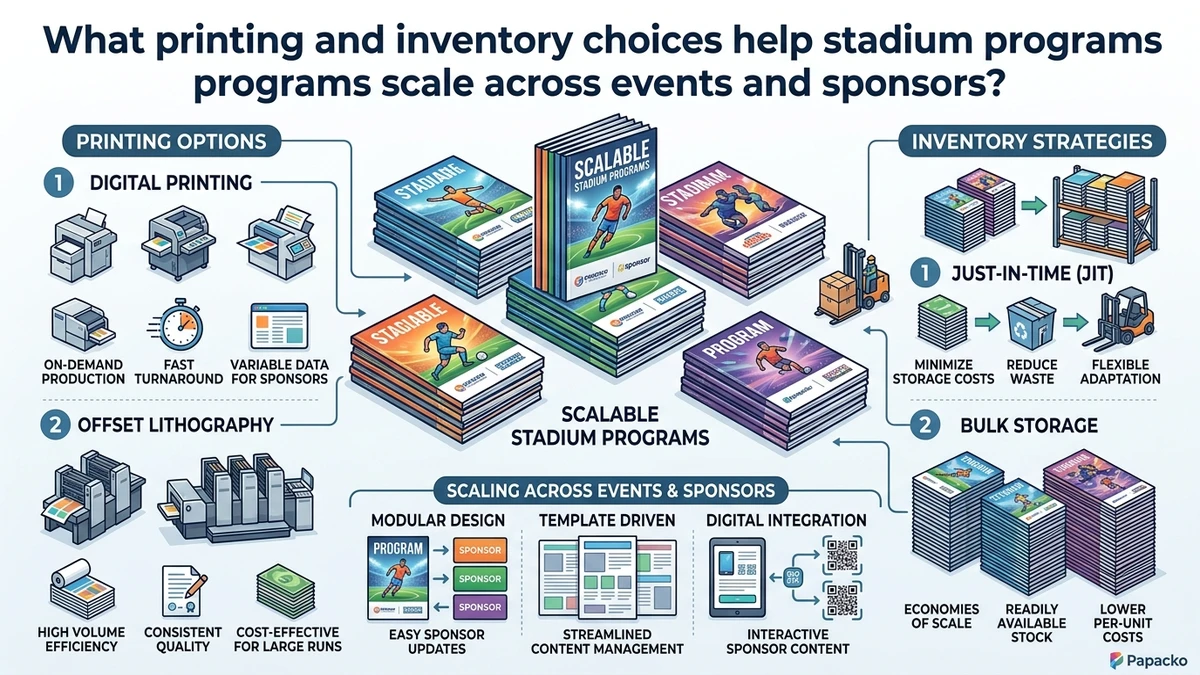
Printing strategy affects more than appearance. It also drives MOQ, replenishment speed, sponsor flexibility, storage burden, and obsolete-stock risk, so scalable programs separate evergreen volume from short-window graphics.
The most workable print plans divide artwork into three layers: core venue identity, event or seasonal content, and sponsor content. Keeping high-volume SKUs on stable artwork reduces write-off risk, while short-run customs can be reserved for events where the marketing value justifies added complexity. Similar logic applies in minimal packaging design.
These fit venues with changing event mixes or unsettled sponsor plans. Their main advantage is lower forecast risk and easier redistribution across events.
These make sense when sponsor value is clear, artwork is locked early, and demand is concentrated. The trade-off is higher lead-time sensitivity and greater obsolete inventory risk.
For many stadiums, the strongest approach is an evergreen base plus targeted custom runs for marquee games, sponsor activations, and premium areas. This protects service while limiting write-offs.
Not every size should be customized equally. High-velocity sizes usually justify custom graphics first, while low-volume specialty formats carry more cash and obsolescence risk.
For long seasons or mixed-use venues, staged procurement often works better than one large buy. A practical structure is a preseason base order, a midseason correction order, and event-specific customs only for confirmed demand.
The more printed variants a venue carries, the more carton discipline matters. Cartons should clearly show size, artwork code, lot, and case quantity so crews can restock correctly and avoid sending the wrong sponsor cup to the wrong stand.
For broader guidance on balancing branded supply with practical sustainability and stock control, see sustainable paper packaging.
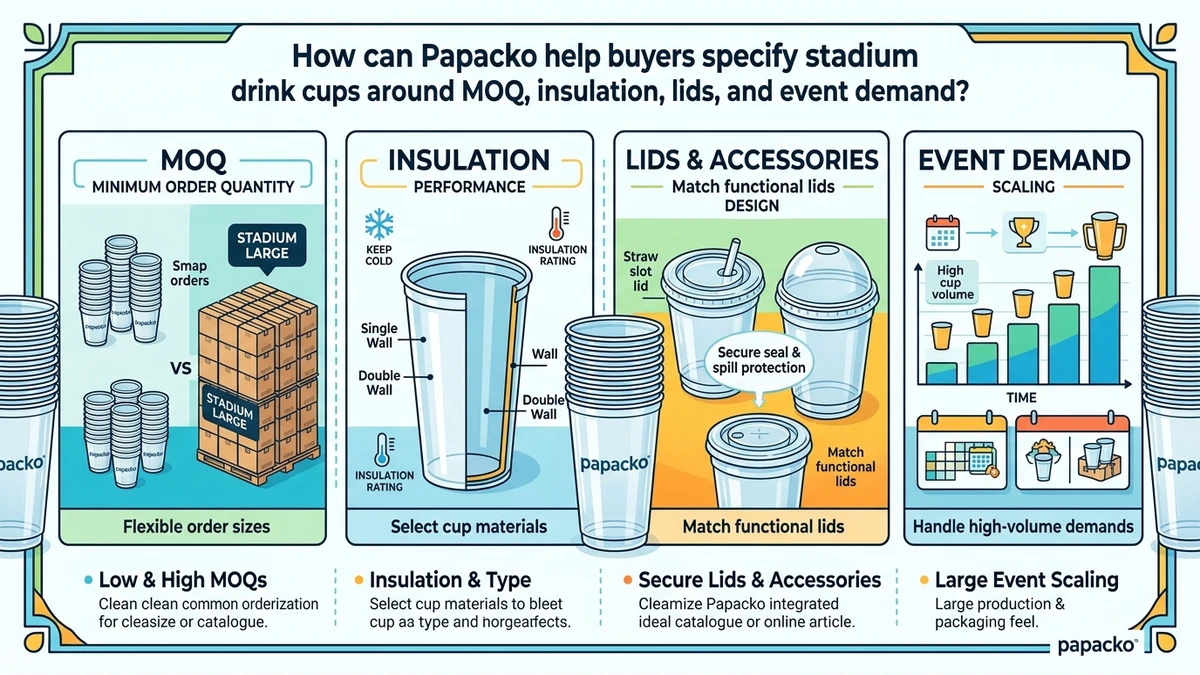
For stadium operators, concession contractors, and beverage distributors, the real decision is not just paper versus plastic. It is how to match cup format, insulation, lid fit, MOQ, and event demand to a program that can be validated, standardized, and replenished without tying up cash in slow-moving stock.
The fastest way to build a workable cup brief is to define beverage types, actual sizes sold, service style, event concentration, storage constraints, and branding requirements. That usually shows whether the venue needs one generalized cold-cup family or separate families for fountain, beer, and hot beverages.
For buyers reviewing paper-based options, it helps to compare both broad and format-specific ranges such as paper cups and eco paper cups.
MOQ should be evaluated against real consumption patterns, not just annual estimates. In practice, customizing the top one or two velocity sizes first often gives the best return with lower leftover risk.
For hot drinks, single-wall paper cups suit short holds when sleeves are acceptable, while double-wall or ripple-wall cups fit winter service or premium coffee. For cold drinks, the main issue is usually condensation and rigidity over time rather than thermal retention alone.
A common mistake is approving the cup first and checking lids later. In high-volume stadium service, the brief should confirm rim profile, lid family, lid style, carry security, and de-nesting speed before approval.
Stadium demand spikes before kickoff, during halftime, and between innings or periods, so cup choices should be tested against peak cups per minute and active sizes by stand. For many venues, the best compromise is one high-volume fountain family, one beer or specialty cold format where needed, and one insulated hot family.
To accelerate quoting and sampling, buyers should prepare:
– cup use: hot, cold, or dual
– target sizes and annual volume by size
– stock or custom print requirement
– artwork count and coverage
– lid types by size
– wall construction or insulation expectation
– event calendar and demand peaks
– carton and pallet constraints
– shipping terms
– sample and trial timeline
That level of detail usually reduces lid-fit issues, obsolete custom stock, and event-day handling failures.
PET is often the first choice when visibility and fast pour verification matter, while PP can be a better fit if the operation has had cracking issues during rough handling. The better option depends on whether merchandising or durability is the bigger operational priority.
Yes, paper cups are commonly well suited to fountain programs because they support strong print coverage, familiar lids, and comfortable handling. The cup spec still needs to match ice load and expected hold time.
Most high-volume venues perform better with a tight ladder of core sizes rather than a broad assortment. Fewer sizes usually reduce lid mismatches, simplify restocking, and improve forecasting.
The usual causes are rim variation, tolerance stack-up, excessive application force, or poor performance under carbonation and movement. That is why cup-lid systems should be tested together under realistic service conditions.
Custom printing is usually most effective on high-velocity sizes tied to stable branding or sponsor-funded campaigns. It becomes riskier when artwork changes quickly or demand is uncertain.
At minimum, test de-nesting, dispenser performance, fill stability, lid fit, carry security, and hold-time performance with the actual beverages served. Case-opening and restocking trials are also worth doing before a full rollout.
Keep evergreen stock for baseline demand, reserve custom runs for confirmed high-value events, and stage purchases across the season rather than buying everything at once. That usually lowers write-offs and improves storage flexibility.