Ready to create your own branded paper cups or packaging?
Tell us your requirements — size, coating, printing, and destination — and our team will prepare a detailed quotation within 24 hours.

Last Updated: January 2026
Reading Time: 8-10 minutes
Author: Papacko Content Team
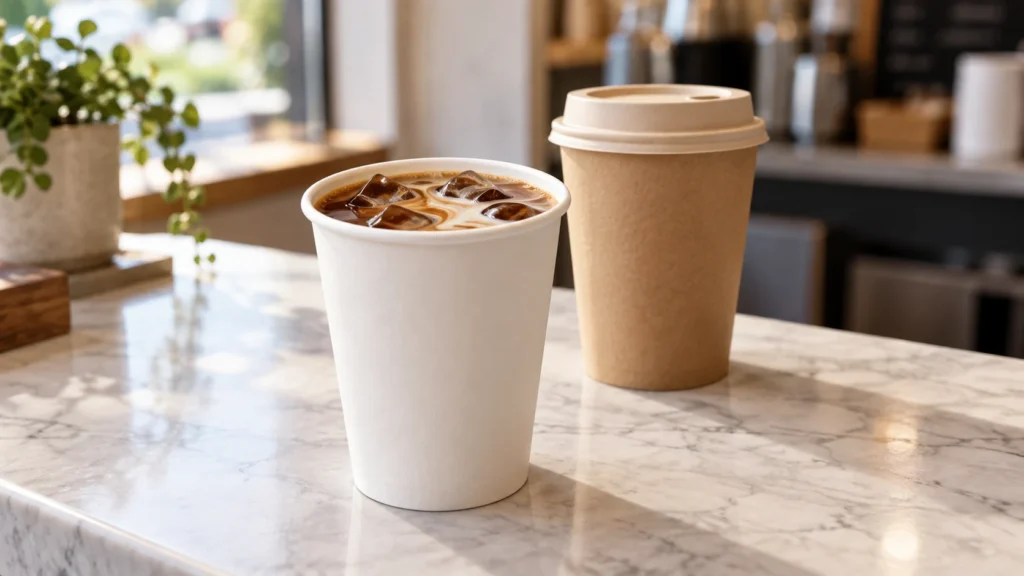
Cold beverages present unique challenges: condensation on cold cup surfaces, extended contact with moisture, and visual presentation expectations (Instagram-worthy aesthetics matter).
This guide covers paper cup selection specifically for iced coffee and cold beverages: moisture barrier requirements, structural reinforcement, condensation management, size optimization for ice + liquid, lid compatibility, and design elements that enhance brand perception. You’ll learn how to balance performance, cost, and visual appeal for cold beverage programs.
Illustrative cold-drink conditions:
•Ice temperature: 0°C
•Beverage temperature: 2-8°C
•Ambient air: 25-35°C (typical cafe/outdoor)
•Humidity: 40-80% relative humidity
Moisture formation: Water vapor can condense when the cup surface is below the surrounding air’s dew point
Without exterior protection: Uncoated paperboard absorbs condensation → can lose strength → cup becomes soggy, collapses, or leaves wet ring on surfaces.
Factors to assess in a cold cup:
•Ice load: Compare actual filled weight rather than assuming ice requires heavier board
•Extended hold: Assess rigidity over the intended serving time
•Condensation resilience: Moisture resistance depends on the board, barrier and finished construction
•Straw insertion: Customers stabbing straws through lids puts lateral stress on cup walls
Single-wall (standard for cold beverages):
•Structure: One layer of paperboard + interior coating
•Advantages: Lower cost, performance depends on the finished-cup construction
•Condensation handling: A suitable exterior barrier helps limit moisture absorption
•Best for: Most iced coffee, cold brew, iced tea applications
Double-wall (premium cold beverage option):
•Structure: Inner cup + outer sleeve with an air gap
•Advantages:
– An air gap reduces heat transfer
– Premium hand feel
•Cost: +45-65% vs single-wall
•Best for: Premium cold brew bars, specialty drinks, luxury coffee brands
Air-insulated cups (rare for cold):
•Marketed for “keeps drinks cold longer”
•Reality: Insulation can reduce heat transfer into the drink and slow ice melting; performance depends on the finished cup and lid
Application: 18-25 gsm coating on exterior surface (plus 20-30 gsm interior)
Performance:
•Condensation resistance: Depends on coating coverage, joints and the finished cup
•Durability: Verify integrity over the intended serving time
•Printability: Excellent ink adhesion with proper surface treatment
•Cost: Baseline for coated cold cups
•Limitations: Recycling depends on the local cup collection and processing system
Best for: High-volume coffee shops, cost-focused operations, maximum performance priority.
Application: 12-20 gsm aqueous dispersion coating
Performance:
•Condensation resistance: Depends on the coating formulation and finished cup
•Recyclability: Verify acceptance of the finished cup with the local program
•Compostability: Confirm finished-cup certification and acceptance by the intended composting facility
•Cost: +15-25% vs PE coating
•Limitations: Include humidity and serving duration in product testing
Best for: Eco-conscious brands, markets with strong recycling infrastructure, buyers seeking documented end-of-life options.
Application: Paraffin or vegetable-based wax layer
Performance:
•Condensation resistance: Depends on wax formulation and serving conditions
•Cost: -10 to -15% vs PE coating
•Eco-profile: Check the finished cup’s accepted disposal route
•Limitations:
– Feels slightly greasy
– Can transfer to hands/surfaces
– Not suitable for high-end specialty coffee brands
Best for: Budget cold beverage applications, food trucks, casual service.
Application: PLA lining inside for food contact + PE outside for condensation
Trade-off analysis:
•PLA content alone does not certify the whole cup
•Recycling depends on acceptance of this mixed-coating cup
•Cost: +20-30% vs full PE
Reality: The whole cup, including both coatings, must be assessed for its intended disposal route.

Illustrative iced coffee composition:
Customer perception challenge: In this example, a 16 oz cup contains about 320 ml of liquid before the ice melts. Customers may feel short-changed if not communicated clearly.
Solutions:
•Offer “light ice” or “extra ice” options
•Use clear cups for cold brew (customers see liquid level)
•Size naming focuses on cup volume, not liquid volume
Why cold cups run larger:
•12 oz is a nominal cup size; actual serving fill depends on the cup and headspace
•The illustrated 12 oz iced recipe uses 230-250 ml of liquid before the ice melts
Standard cold beverage size range: 16-24 oz most popular (vs 12-16 oz for hot)
Inventory optimization: Many cafes stock separate hot and cold cup SKUs
•Hot: 8, 12, 16, 20 oz
•Cold: 12, 16, 20, 24 oz
•Use a cup for both hot and cold drinks only when the supplier rates that cup for both and confirms compatible lids
Paper straws (eco trend):
•Cost: $0.02-0.04 per straw (vs $0.005-0.01 for plastic)
•Performance issue: Performance varies with construction and exposure time
•Solution: Choose a straw tested for the intended drink and serving time
PLA straws:
•Cost: $0.015-0.025 per straw
•Performance: Depends on the finished straw and serving conditions
•Challenge: Check finished-straw certification and acceptance by a local composting facility
Reusable straw programs:
•Offer metal/silicone straws for sale
•Discount for customers who bring own straws
Challenge: Condensation can cause ink running if not properly formulated
Moisture-resistant inks (essential for cold cups):
•UV-cured inks: Performance depends on formulation and proper curing
•Solvent-based inks: Good resistance, lower cost than UV
•Water-based inks: Select a formulation with appropriate water and rub resistance; an additional coating is not always required
Example screening check: Fill cup with ice water, expose to 30°C/80% humidity for 60 minutes, wipe exterior with wet cloth
•✅ Pass: No ink transfer, colors remain vibrant
•❌ Fail: Ink smudges, color bleeding
Social media optimization:
•Design should be:
– High contrast (pops in photos)
– Minimal but distinctive (recognizable brand mark)
– Works with condensation (droplets can enhance aesthetic)
Color psychology for cold drinks:
•Blues/teals: Convey coldness, refreshment
•Bright colors: Energy, summer vibes (oranges, yellows, pinks)
•Natural kraft: Organic, artisanal cold brew positioning
•White: Clean, premium specialty coffee
Clear windows (with opaque printing):
•Allow customers to see cold brew gradient or layered drinks
•Requires precise registration in printing process
Grip enhancement:
•Vertical ribbing or dot pattern
•Assess grip on the finished cup when wet
•Cost: +$0.008-0.015 per cup
Brand texture:
•Debossed logo (pressed into paperboard)
•Subtle, premium feel
•Works well with natural kraft cups
•Cost: +$0.012-0.025 per cup (custom tooling required)
Challenge: Paper-cup recycling acceptance varies by collection and processing system
Alternatives:
1. Water-based barrier coated cups:
•Check whether the local paper collection accepts the finished cup
•Performance: Depends on the finished cup and the test conditions
•Cost: +15-25%
•Best for: Eco-focused brands with educated customers
2. BioPBS or PLA-coated exterior + interior:
•Confirm the exact product’s certification and local acceptance; consult the BPI product directory for listed products
•Performance: Good, but requires proper end-of-life infrastructure
•Cost: +30-45%
•Best for: Venues with composting programs
30-50% PCW (post-consumer waste) paperboard:
•Select recycled-content cup stock that meets the finished-cup performance requirements
•Natural gray/brown tone (works with kraft aesthetic)
•Cost: -10 to -18% vs virgin fiber
•Environmental messaging: Strong appeal to conscious consumers
Considerations:
•Print appearance: Slightly less vibrant on recycled base (use opaque inks)
❌ Mistake #1: Using a cup that is not rated for iced drinks
✅ Correct Approach: Choose a finished cup intended for cold drinks and check moisture resistance over the serving time.
❌ Mistake #2: Filling cups to 100% capacity with ice + liquid
✅ Correct Approach: Follow the supplier’s serving fill line and leave clearance for lid fitting and handling. Train baristas on proper fill lines.
❌ Mistake #3: Using cheap paper straws that disintegrate quickly
✅ Correct Approach: If using paper straws, choose finished straws with documented food-contact compliance and performance for the intended serving time. Alternatively, use PLA straws or offer reusable straw sales/discounts.
❌ Mistake #4: Assuming all “compostable” coatings are recyclable
✅ Correct Approach: Material names alone do not establish finished-cup compostability or local recycling acceptance. Understand the difference and label cups correctly to avoid customer confusion.
Paper cups for iced coffee are cold beverage containers designed with exterior moisture barriers (PE, water-based, or wax coatings) to resist condensation-induced sogginess, paperboard suited to the finished cup’s intended use, and compatible lids/straws for the intended serving time.
A suitable exterior barrier helps limit moisture absorption. Condensation depends on surface temperature, the surrounding air’s dew point and exposure conditions. Uncoated paperboard absorbs moisture, which can weaken the cup—causing sogginess, collapse, and wet surfaces.
The illustrated 16 oz (475 ml) recipe contains ~140-160ml ice + 315-335ml liquid. 20 oz (590ml) for large sizes, 12 oz (350ml) for small. Cold cups run larger than hot (16-24 oz vs 12-16 oz) because the serving recipe includes both ice and liquid.
Depends on the finished cup and local collection and processing. Some programs accept poly-coated paper cups. Water-based barrier coated cups ARE potentially recyclable (check local capability). For composting, check finished-cup certification and facility acceptance. Always verify with local facilities before making recycling claims.
Hot cups: selected for rated temperature, serving duration and handling conditions. Cold cups: selected for moisture resistance, the actual ice-and-liquid recipe and lid fit. Some products are rated for both hot and cold drinks.
Double-wall cups can reduce heat transfer, but exterior condensation depends on the cup and serving conditions.
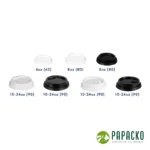
Flat lids with X-slot straw openings are most common ($0.03-0.05, tight seal, minimal spills). Clear dome lids are premium for showcasing drinks ($0.05-0.08, provides room for toppings). Strawless sippers can avoid a separate straw ($0.08-0.12, eliminate straw waste). Choose based on brand positioning and sustainability priorities.
Selecting paper cups for iced coffee requires addressing condensation management, structural integrity, and visual appeal. Prioritize paperboard suited to the finished cup with full exterior moisture barrier coating (PE or water-based), proper volume sizing (16-24 oz range accounting for ice), moisture-resistant inks for printing, and compatible lid systems.
Key Takeaways:
1.Moisture resistance matters—Assess the finished barrier and cup over the intended serving time
2.Assess finished-cup strength—Check the actual filled load and service conditions; GSM alone does not establish performance
3.Size up for ice—Choose cup size from the actual ice-and-liquid recipe and serving fill
4.Design for social media—Use a legible, distinctive design
5.Match sustainability to infrastructure—Check the complete cup and the local recycling or composting service’s acceptance criteria
•Cold Beverage Packaging Solutions
•Compostable Paper Cup Options
Papacko supplies coffee shops, cafes, and cold beverage brands with iced coffee cups featuring PE or water-based exterior coatings, moisture-resistant printing, and compatible lid systems. Our range includes 12-24 oz sizes, custom branding options, and other material options.
Iced-coffee cups sit at the intersection of cold-drink performance, visible branding, print durability, and the cup formats a growing beverage menu needs overall.
Get in touch: