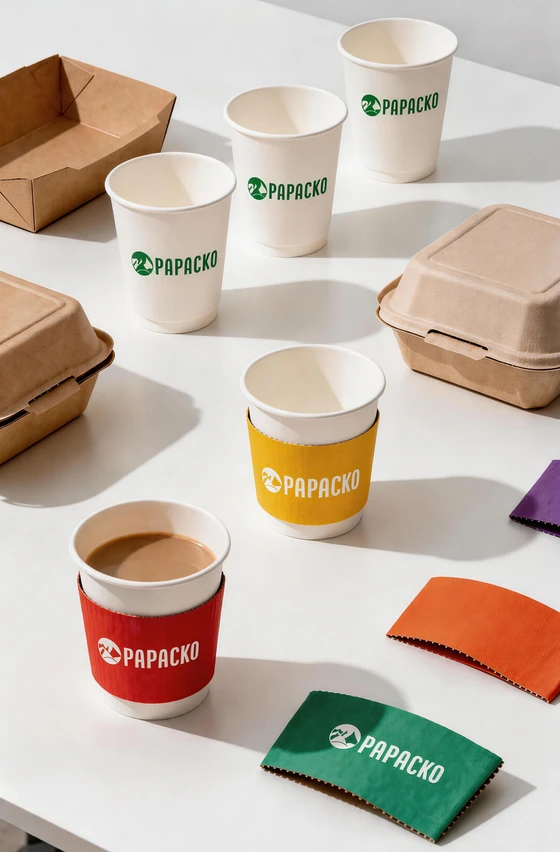
Ready to create your own branded paper cups or packaging?
Tell us your requirements — size, coating, printing, and destination — and our team will prepare a detailed quotation within 24 hours.

Paper cup holders and drink carriers solve different problems in takeaway service. A sleeve helps a customer hold one hot cup comfortably. A carrier keeps multiple drinks stable from counter to car, office, or delivery bag. If you buy them as if they are interchangeable, you usually end up with poor fit, weak handling, or wasted packaging cost.
For most B2B buyers, the right specification comes down to five practical factors: cup diameter, loaded weight, moisture exposure, service speed, and transport distance. A busy cafe with mostly single hot coffees needs a different solution from a chain outlet sending four iced drinks through third-party delivery. The best purchasing decision starts by separating hand-comfort needs from transport-stability needs.
A paper cup holder in the sleeve sense usually wraps one cup and creates a grip layer. A drink carrier groups two, four, six, or more cups and must support weight without deforming. Both can be made from paper-based materials, but they fail in different ways and should be tested differently.
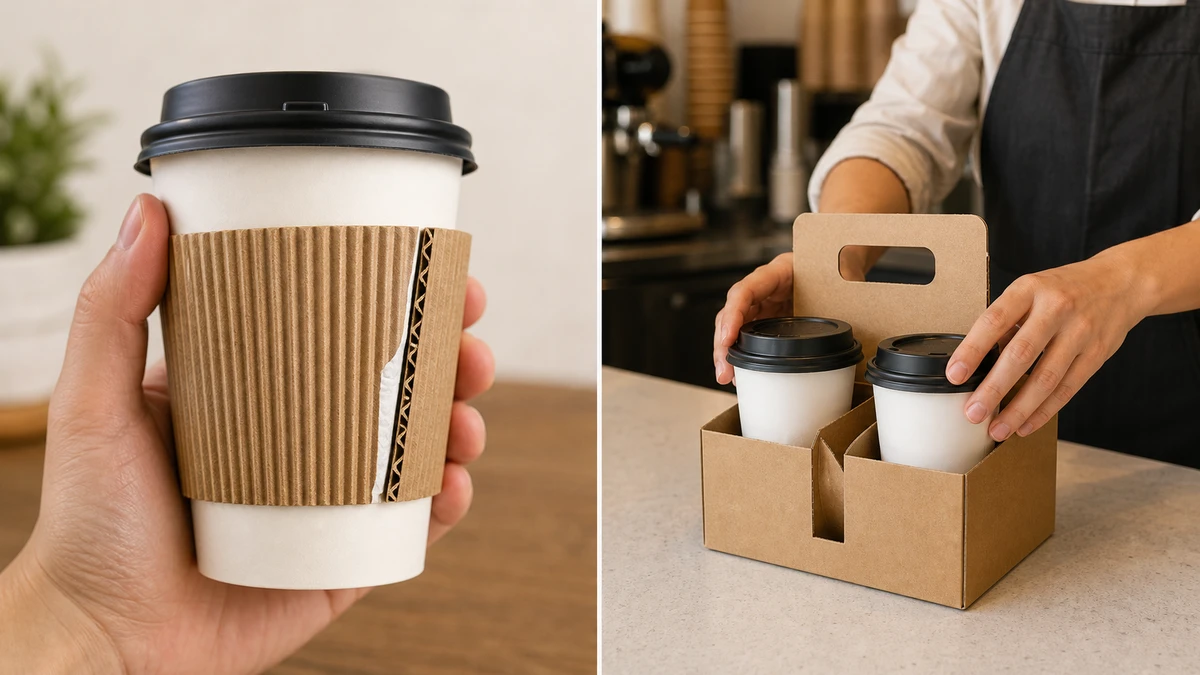
When reviewing options, it helps to assess the full beverage pack as one system. Cup wall construction, lid security, and carrier fit all interact. Buyers comparing formats should review compatible paper cups and coffee cup lids alongside carrier choices before locking a final specification.
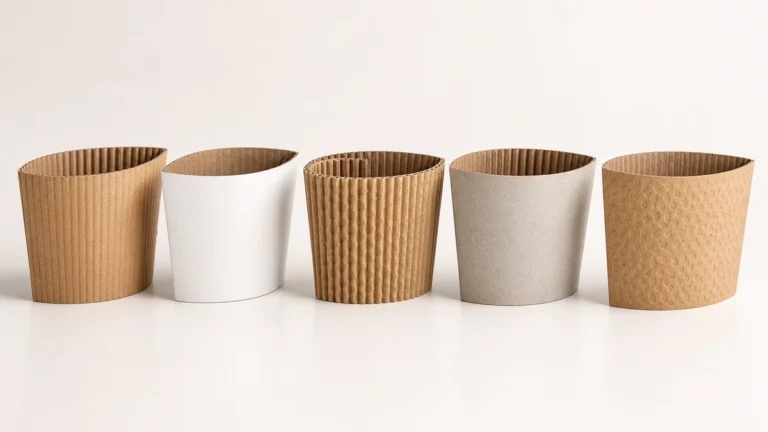
A sleeve is mainly an insulation and grip accessory. It is most useful when the cup itself is single-wall and the main complaint is heat transfer to the hand. Corrugated sleeves are common because the flute structure creates an air gap without adding much material weight. They store flat, run efficiently at volume, and can reduce the need for double-cupping.
A drink carrier is a transport tool. Its performance depends on aperture size, base support, board stiffness, fold geometry, and handle strength where applicable. If a customer is carrying two to four filled drinks for more than a few steps, stability matters more than insulation. A sleeve cannot stop a cup from tilting, and a carrier cannot correct a poorly fitting lid.
In practice, buyers typically use this rule:
This distinction also affects procurement. Sleeves are usually simpler to standardize by cup size family. Carriers require more exact matching because small differences in cup taper or rim diameter can create wobble, lid stress, or difficult loading for staff.
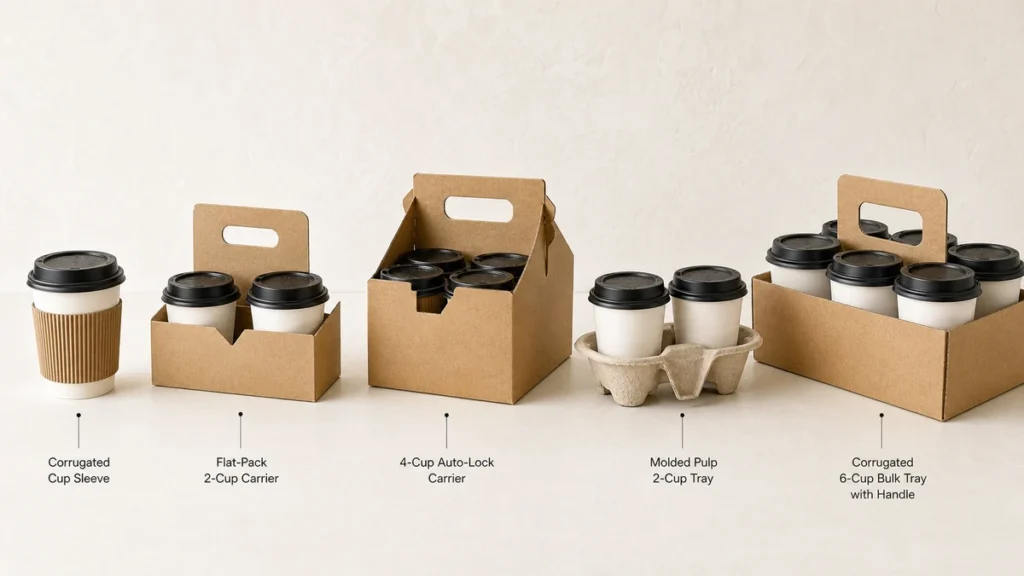
Most commercial sourcing teams compare five basic formats. Each has a valid use case, but each also has limits that should be understood before placing a bulk order.
These are die-cut sleeves for one hot cup. They are usually made from kraft corrugated board and sized for standard hot-drink diameters. Their advantages are low storage footprint, simple branding, and improved hand comfort. Their main limitation is that they provide no multi-drink support and are not ideal for condensation-heavy cold cups.
This is one of the most common options for two-cup and four-cup takeaway service. They ship flat, save warehouse space, and are assembled at point of use. They offer a good balance of cost, freight efficiency, and printable area. The main concern is wet strength, especially when cold drinks sit in a sealed bag or humid holding zone.
Molded pulp trays are pre-formed and usually provide deeper cup cavities than flat paperboard designs. That often gives better lateral stability and better tolerance to short-term moisture. The trade-offs are larger storage volume, tighter fit requirements, and often a higher unit price.
Handled carriers are useful when one-handed transport matters, such as curbside pickup, office coffee runs, or drive-through handoff. They can improve convenience, but only if the board grade and handle reinforcement are sufficient for the real loaded weight. Weak handle zones are a common failure point on under-specified products.
These are used for larger orders such as six to twelve drinks in catering or office delivery. They are more robust and usually easier to carry under load, but they take significant storage space and are usually unnecessary for ordinary cafe takeaway.
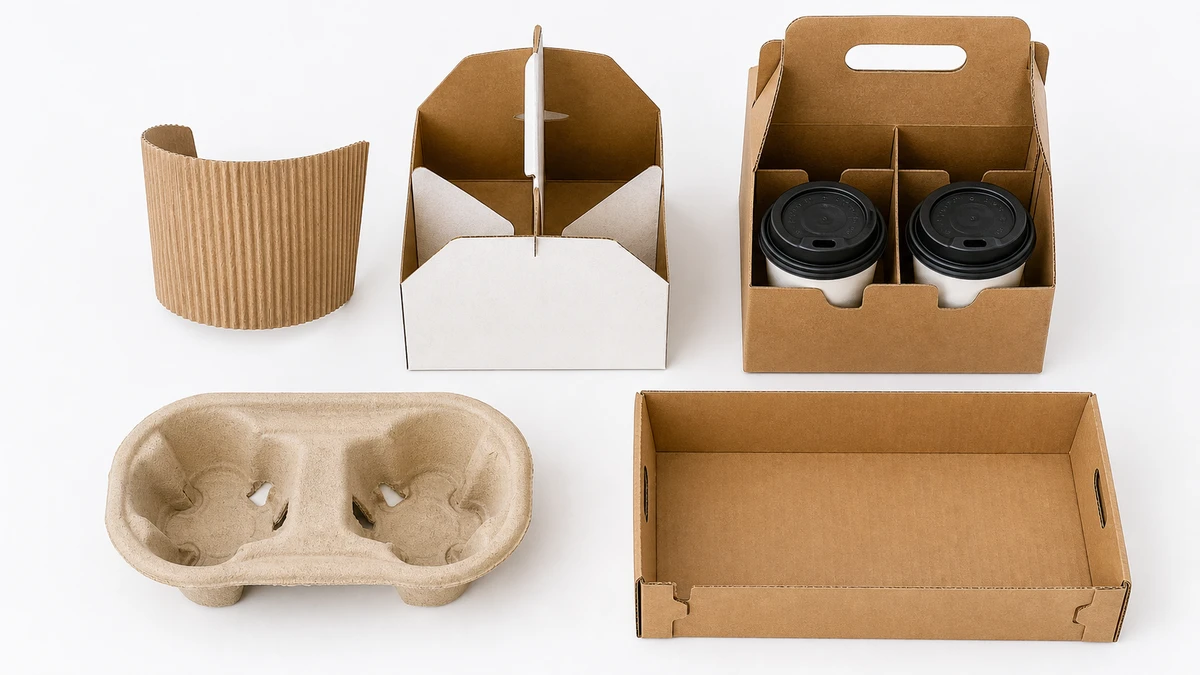
A strong buying decision is based less on brochure features and more on likely failure modes in your operation. The following checkpoints are the most important.
Do not specify by ounce size alone. Two 16 oz cups from different cup lines can have different top diameters and different taper. Measure the actual outer diameter just below the rim bead and compare it to the carrier aperture specification. If the opening is too loose, the cup tilts and puts stress on the lid seal. If it is too tight, staff force the cup into place and slow service.
A four-cup order with iced drinks can be much heavier than many buyers expect. Weight affects board selection, crease design, and handle reinforcement. A carrier that is fine for two hot coffees may fail when loaded with large cold beverages and ice.
As a practical guide:
Many paper-based carriers fail from moisture before they fail from dry-load stress. Short walk-out service with hot drinks is usually forgiving. Delivery bags, iced beverages, and long hold times are not. If your service includes condensation, ask about coated board, moisture-resistant treatment, or molded pulp alternatives.
Flat-pack carriers save space, but they also require assembly. In low-volume operations that may not matter. In high-throughput takeaway, even a few seconds per order can affect labor flow. If assembly speed is critical, ask suppliers whether the structure is manual-fold, snap-lock, or auto-lock.
Pre-formed formats consume more back-of-house space. Flat formats generally reduce inbound freight volume and storage footprint. This matters for distributors, chain stores with limited stock rooms, and urban outlets where every shelf position counts.
For buyers balancing thermal comfort and sustainability goals together, it may also make sense to compare sleeves with insulated cup options such as eco paper cups, especially when deciding whether to add a separate paper cup holder or upgrade the cup wall structure itself.
Material choice affects not only cost, but also moisture resistance, branding quality, and compliance confidence. For that reason, carrier sourcing should include a documentation review, not just a physical sample review.
Uncoated paperboard is often sufficient for dry, short-distance takeaway. It is widely used and generally cost effective. Coated or moisture-resistant constructions are usually the safer choice when the order mix includes iced drinks, longer delivery windows, or humid holding. Molded pulp can perform well where support and short-term damp resistance are priorities, but it requires careful cup-fit testing.
For supplier qualification, buyers should request documentation covering:
If products are intended for foodservice use, buyers should verify that materials are suitable for the target market and application. The FDA guidance on food contact substances is a useful starting reference for review processes: FDA food contact substances guidance.
Commercial terms are just as important as technical data. Before approving a vendor, confirm MOQ, sample policy, and production timing in writing. Many B2B programs start with plain samples for fit checks, then pre-production printed samples for artwork approval. Typical questions to settle early include:
For most buyers, avoiding rework is worth more than chasing the lowest quoted unit price. Reliable documentation and consistent fit reduce the risk of service failure later.
Branding matters, but structural function comes first. A well-printed carrier that does not fit the cup properly will create more customer complaints than an unprinted one that performs well. Keep graphics aligned with the board type and production method. Simple branding on kraft often works better commercially than trying to force highly detailed artwork onto a disposable carrier substrate.
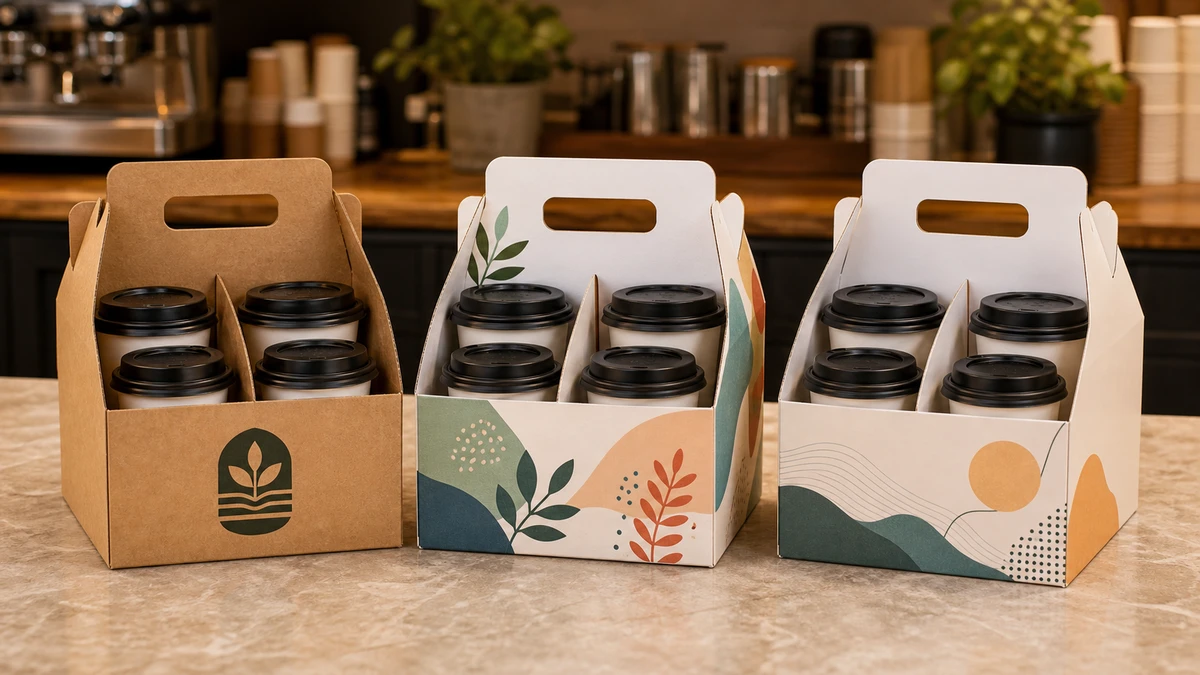
Print method should match order volume and visual need:
Many buyers also want packaging consistency across cups, sleeves, and related accessories. If that is part of your program, it helps to align artwork and specification with the broader packaging accessories range rather than treating drink carriers as an isolated SKU.
Testing should always use real filled cups under real service conditions. Empty sample fitting is not enough. A practical approval checklist should include:
Lid fit deserves special attention. A carrier can hold a cup correctly and still produce leaks if the cup opening is tilted or the lid bead is stressed during loading. That is why cup, lid, and carrier should be approved together as one system rather than as separate purchases. Buyers managing a wider beverage or foodservice range often also review related food packaging containers so packing formats, case handling, and branding stay consistent across SKUs.
Different service models usually point to different paper cup holder choices.
For an independent cafe with mostly one- and two-drink takeaway, corrugated sleeves plus a simple two-cup flat-pack carrier are often enough. This keeps cost and storage demands reasonable while covering the most common order patterns.
For high-throughput QSR or chain takeaway, a fast-assembling four-cup format is often the better choice. Mixed drink sizes should be tested carefully, especially if one carrier is expected to cover both hot and cold cup families.
For third-party delivery, moisture resistance and transport stability matter more than counter appearance. Deeper support structures, coated board, or molded pulp often justify the extra cost if delivery complaints are a recurring issue.
For office coffee runs or catering, handled and reinforced formats are usually worth considering. The priority is not shelf efficiency but safe transport under heavier loads.
For distributors or wholesalers, a small but practical range often works best: one sleeve SKU family, one two-cup carrier, one four-cup general takeaway carrier, and one delivery or bulk option. That gives enough coverage without creating unnecessary complexity.
Whatever the format, finalize the commercial details before issuing a production order: MOQ, plain and printed sample process, artwork approval timing, lead time, and reorder planning. These points often determine whether a launch runs smoothly more than the nominal unit price does.
A cup sleeve wraps one cup to improve grip and reduce surface heat transfer. A drink carrier holds multiple cups together for transport and is chosen mainly for stability and load support.
Measure the cup outer diameter just below the rim bead and compare it with the supplier’s aperture specification. Do not rely only on ounce size, because cups with the same printed volume can have different diameters and tapers.
They can be better for stability and short-term moisture exposure, especially with cold drinks. The trade-offs are higher storage volume, tighter fit requirements, and often higher unit cost.
Uncoated board is often fine for dry, short-distance takeaway. If your operation includes iced drinks, humid holding, or longer delivery windows, coated or moisture-resistant options are generally safer.
Sometimes, but not always. If your menu includes multiple cup diameters or both hot and cold ranges, one carrier may create fit compromises that lead to wobble, lid stress, or slower loading by staff.
Test real filled cups under actual service conditions. Check fit, handle strength, condensation response, carry stability, and performance inside your actual delivery bag, tray, or transit crate.