Ready to create your own branded paper cups or packaging?
Tell us your requirements — size, coating, printing, and destination — and our team will prepare a detailed quotation within 24 hours.

Before evaluating any cup material, a foodservice operator or packaging buyer must answer one question: where does this cup go after the guest sets it down? PLA cups exist at the intersection of material science and infrastructure, and the infrastructure side of that equation varies by city, county, contract, and season. A cup that performs beautifully in one service environment can create contamination problems or landfill liability in another.
Start by mapping your service route in full:
Only after confirming each link in that chain does it make sense to evaluate whether a PLA cup and its matched lid are the right fit for your operation. Skipping this step is the single most common reason PLA programs fail to deliver on their sustainability promise.
Polylactic acid (PLA) is a bioplastic derived from fermented plant sugars, most commonly corn starch. It is designed to break down under specific managed conditions — typically the elevated temperatures, moisture levels, and microbial activity found in industrial composting environments. It is not the same as conventional petroleum-based plastic, and it is not interchangeable with paper, glass, or aluminum in sorting systems.
Key distinctions buyers should hold clearly:
The EPA’s guidance on identifying sustainable food-service ware encourages operators to look beyond material labels and evaluate the full end-of-life pathway before selecting packaging.
A PLA cup is only as effective as its matched lid. Mismatched combinations — a PLA cup with a conventional plastic lid, or a paper cup with a PLA lid — can disqualify the entire assembly from an industrial composting stream, depending on facility rules. Some facilities require that every component of a cup assembly appear on their accepted-materials list independently.
What to verify for cup-and-lid fit:
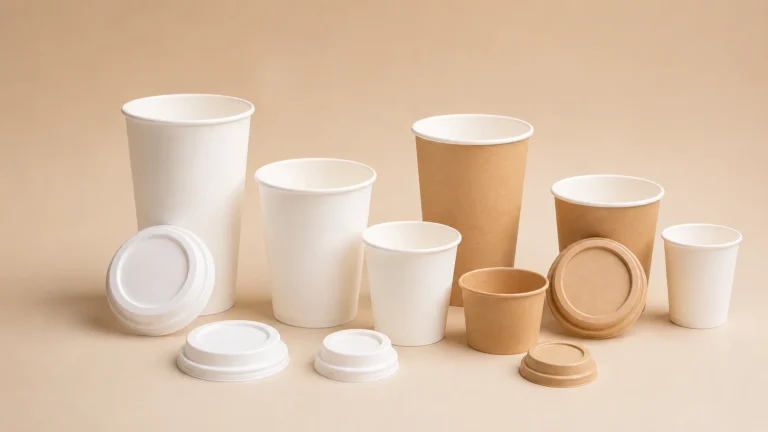
Papacko’s paper cup lids and paper cups are designed to be evaluated as a system. Buyers should request documentation for the matched cup-and-lid combination as a unit, not as separate items, and then sample the matched assembly under actual service conditions before committing to volume.
PLA has a well-documented sensitivity to heat that distinguishes it sharply from conventional plastics. This is not a defect — it is a property that enables composting — but it has direct operational implications for beverage service.
Cold applications are where PLA cups are most commonly deployed. For iced beverages, smoothies, cold brew, and similar applications, PLA’s thermal characteristics are generally well-suited to the service window. However, “cold” covers a wide range of actual temperatures, and condensation, extended dwell time in a guest’s hand, and ambient temperature in the service environment all interact with cup performance.
Hot applications require careful validation. PLA softens at temperatures that conventional plastic or paper cups handle without deformation. If your menu includes hot coffee, tea, soups, or other high-temperature items, do not assume a PLA cup rated for cold service will perform adequately. Sample the matched cup and lid under actual service conditions — including the hottest beverage you serve, the longest realistic dwell time a guest might hold the cup, and the ambient temperature of your service environment.
Validation steps before deployment:
Do not rely on general material specifications alone. Request performance data for the exact cup construction you are purchasing, and conduct your own validation under your actual conditions.
These are two different things, and conflating them is a significant operational risk.
Certification means a third-party organization has tested the product against a defined standard and determined that it meets the criteria for compostability under controlled laboratory or pilot conditions. In North America, the most widely referenced certifications for food-service ware come from organizations such as the Biodegradable Products Institute (BPI). BPI’s field validation program works to bridge the gap between laboratory certification and real-world facility acceptance — but field validation is ongoing, and not every certified product has been validated at every facility type.
Local acceptance means the specific industrial composting facility serving your area has reviewed the product and agreed to accept it in their process. Facilities make independent decisions based on their equipment, processing time, contamination tolerance, and end-market requirements for finished compost. A product certified by a national body may still be rejected by a local facility, and a facility’s acceptance list can change with contract cycles, equipment upgrades, or market conditions.
What this means for buyers:
The EPA’s composting resources provide context on how industrial composting works and why facility-level acceptance is the operative variable for operators.
Even a perfectly matched, certified, locally accepted PLA cup system will fail if the collection design at the point of service does not work. Contamination — the wrong items entering the compostables stream — is the primary reason industrial composting facilities reject loads or revise their acceptance policies.
Collection design principles:
Signage clarity. Guests cannot sort correctly if they cannot identify which bin accepts which item. Signage must be specific to your cup and lid combination, not generic. Avoid language like “compostable” without specifying the bin it belongs in, because guests may interpret this as permission to place it in any green or organics bin.
Bin placement. Compostables bins should be co-located with trash and recycling at every disposal station. Isolated compostables bins without adjacent alternatives increase contamination because guests default to the nearest available bin.
Staff training. Front-of-house staff should be able to answer basic guest questions about disposal. Back-of-house staff handling bin consolidation must know which bags go to which hauler stream.
Contamination monitoring. Establish a regular visual audit of compostables bins before pickup. Common contaminants include conventional plastic lids, straws, napkins with non-compostable coatings, and food waste from non-compostable packaging.
Hauler communication. Maintain an open line with your hauler. If your menu changes and you introduce a new cup or lid, notify your hauler and confirm continued acceptance before the new item enters service.
Purchasing decisions for compostable food-service ware should be supported by a documentation package that covers the specific product construction you are buying. General category claims are not sufficient for operational or compliance purposes.
Request the following from any supplier:
| Document | What It Covers |
|---|---|
| Third-party certification certificate | Certifying body, standard tested against, certificate number, expiration date |
| Certificate of conformance | Confirmation that the specific SKU matches the certified construction |
| Material safety data / composition disclosure | Full material composition including liners, coatings, and adhesives |
| Field validation records (if available) | Facility types and conditions where the product has been validated |
| Matched lid documentation | Separate documentation for the lid if it is a different material or construction |
| Country of origin and manufacturing site | Relevant for import compliance and supply chain due diligence |
Keep this documentation on file and update it whenever you change suppliers, SKUs, or product constructions. If a facility or regulator asks for evidence of compostability claims, this package is your first line of support.
Papacko’s compostable food packaging and food packaging containers pages provide a starting point for product exploration, but buyers should always request the full documentation package for the specific items under consideration before placing orders.
Use this checklist as a structured pre-launch review before deploying a PLA cup system. It is not a substitute for professional legal, regulatory, or waste-management advice, but it organizes the key decision points into a sequential workflow.
Phase 1: Infrastructure Confirmation
– [ ] Identify the industrial composting facility serving your area
– [ ] Obtain and review the facility’s current accepted-materials list
– [ ] Confirm PLA cups and lids appear on the accepted-materials list by name or certification type
– [ ] Confirm with your hauler that compostables will be collected separately from trash and recycling
– [ ] Document hauler and facility contact information for ongoing communication
Phase 2: Product Selection and Validation
– [ ] Select a cup and lid combination from a supplier who can provide full documentation
– [ ] Request the complete documentation package (see table above) for both cup and lid
– [ ] Sample the matched cup and lid under your actual service conditions
– [ ] Validate performance across your full beverage menu, including hottest and coldest items
– [ ] Validate performance across your expected dwell-time range
Phase 3: Collection System Design
– [ ] Design bin stations with co-located compostables, trash, and recycling
– [ ] Develop signage specific to your cup and lid combination
– [ ] Train front-of-house and back-of-house staff on sorting protocols
– [ ] Establish a contamination monitoring schedule
Phase 4: Claims and Communication
– [ ] Review all guest-facing language with your facility’s acceptance confirmation in hand
– [ ] Avoid making compostability claims that exceed what your local infrastructure supports
– [ ] Establish a review schedule to re-confirm acceptance annually
Phase 5: Ongoing Management
– [ ] Monitor facility acceptance list for changes
– [ ] Notify hauler of any menu or packaging changes before they enter service
– [ ] Maintain documentation package and update when products change
Papacko offers a range of cup formats and lid options for operators evaluating compostable packaging systems. Browse the full paper cups category to compare formats, sizes, and construction options relevant to your service environment.
As you evaluate options, apply the documentation and validation framework outlined in this guide. Request product-specific documentation, sample matched cup-and-lid combinations under your actual conditions, and confirm local acceptance with your hauler and composting facility before finalizing your selection.
Papacko’s team can assist with product questions and documentation requests. Contact Papacko directly to discuss your specific service route, volume requirements, and timeline.
About this guide. This article is produced by Papacko for informational purposes to help foodservice operators and packaging buyers understand the key decision factors in evaluating PLA cup systems. It reflects general industry knowledge and is intended as a starting framework, not as legal, regulatory, or waste-management advice.
Papacko’s role. Papacko is a packaging supplier. Papacko is not a waste hauler, industrial composting facility, certification body, or regulatory authority. Papacko cannot confirm whether any product will be accepted by a specific local composting facility, whether compostability claims are permissible under local regulations, or whether a specific product will perform adequately in a specific service environment.
Buyer responsibility. Buyers are responsible for confirming local infrastructure acceptance with their hauler and composting facility, validating product performance under their actual service conditions, reviewing all applicable local and federal regulations regarding compostability claims, and maintaining current documentation for any products they purchase and deploy.
No universal claims. Nothing in this guide constitutes a universal claim of compostability, recyclability, home-compostability, local acceptance, certification status, temperature performance, pricing, minimum order quantity, lead time, or any other performance characteristic. All such factors are product-specific, facility-specific, and subject to change. Confirm with the local collector or processor. Request documents for the exact construction. Sample the matched cup and lid under actual conditions.
Source currency. External sources cited in this guide were reviewed at time of writing. Regulatory guidance, certification standards, and facility acceptance policies change. Verify current information directly with the relevant authority.
Start by identifying which industrial composting facility receives material from your hauler. Most facilities publish an accepted-materials list on their website, or you can request it directly. When you contact the facility, ask specifically whether PLA food-service cups and lids are accepted, whether acceptance depends on a specific certification (such as BPI certification), and whether there are any size, coating, or construction restrictions. Do not rely on a general “compostables accepted” statement — confirm that PLA cups specifically appear on the list. Facility acceptance policies can change, so re-confirm at least annually and whenever your hauler contract renews. Confirm with the local collector or processor before making any guest-facing compostability claims.
PLA has thermal properties that differ significantly from conventional plastics, and some PLA cup constructions are not designed for sustained contact with hot liquids. Whether a specific PLA cup is suitable for hot beverages depends on the exact construction, the temperature of the beverage, and the dwell time the cup will be in use. Do not assume a cup marketed for cold beverages will perform adequately for hot applications. Sample the matched cup and lid under your actual service conditions — using the hottest beverage on your menu, held for the longest realistic guest dwell time — before deploying for hot beverage service. Request performance data for the exact construction from your supplier, and conduct your own validation rather than relying on general material specifications.
PLA is generally not compatible with conventional plastics recycling streams. When PLA enters a plastics recycling stream, it can contaminate the batch and reduce the quality or marketability of the recycled output. This is one of the primary reasons collection system design and guest communication are so important in a PLA cup program. Clear, specific signage at every disposal station — not generic “compostable” language, but specific direction to the compostables bin — reduces the likelihood of missorting. Staff training and regular contamination audits also help. If your service environment has a high rate of guest missorting and no reliable mechanism to correct it, that is a meaningful signal about whether a PLA cup system is the right fit for that specific location.
This depends on the specific requirements of your industrial composting facility. Many facilities require that every component of a cup assembly — cup body, lid, sleeve if applicable, and straw if applicable — appear on their accepted-materials list independently. A certified compostable cup paired with a conventional plastic lid may disqualify the entire assembly from the compostables stream at some facilities, or may require the lid to be removed and sorted separately before disposal. Confirm the facility’s policy on mixed-material assemblies before finalizing your cup-and-lid combination. Request documentation for both the cup and the lid as separate items, and then confirm with your facility whether the combination is accepted as an assembly or requires component-level sorting.
Third-party certifications for compostable food-service ware are issued by independent organizations that test products against defined standards for compostability under controlled conditions. In North America, BPI (Biodegradable Products Institute) is among the most widely referenced certification bodies for food-service ware, and their field validation program works to connect laboratory certification with real-world facility performance. However, certification by any body does not guarantee acceptance at your specific local facility. Certification tells you the product has been tested against a standard; local acceptance tells you the facility serving your area will process it. Both matter, and they must be confirmed independently. When reviewing certification documents, check the certifying body, the standard the product was tested against, the certificate number, and the expiration date — and verify that the certificate applies to the exact SKU you are purchasing, not a similar product.
Guest communication about compostability should be accurate, specific, and tied to the infrastructure you have actually confirmed. Avoid broad claims like “this cup is compostable” without qualification, because guests may interpret this as meaning the cup will compost in any environment, including home compost piles or general organics bins, which may not be accurate. More defensible language directs guests to a specific action: “Place this cup in the green compostables bin” is more useful and less likely to create false expectations than “this cup is compostable.” If your program only covers specific locations — for example, a stadium venue with a dedicated compostables stream — make that scope clear rather than implying the cup can be composted anywhere. The EPA’s guidance on sustainable food-service ware encourages operators to evaluate the full end-of-life pathway, and that same rigor should inform how you describe the pathway to guests. When in doubt, err toward specificity and understatement rather than broad environmental claims you cannot fully support.