Ready to create your own branded paper cups or packaging?
Tell us your requirements — size, coating, printing, and destination — and our team will prepare a detailed quotation within 24 hours.

The packaging a hotel places beside a kettle, at a breakfast station, or on a conference banquet table is rarely the first thing a guest consciously notices—yet it shapes every impression around comfort, cleanliness, brand quality, and sustainability commitment. For procurement teams and F&B managers, the challenge is not simply choosing a cup or a lid. It is selecting a coordinated system of components that performs across wildly different service environments, satisfies increasingly strict food-contact regulations, aligns with ownership-group sustainability targets, and arrives reliably under the pressures of seasonal demand spikes and last-minute event bookings.
This guide works through each major hospitality beverage service context in turn, examines how component systems interact, addresses storage and pre-service handling, explains how to structure a sample-approval process, and sets clear boundaries around sustainability claims and re-approval triggers. It is written for professionals who already understand the basics of hotel operations and who need decision-quality information rather than introductory definitions.
Hotel beverage packaging should be approved by service context: in-room, breakfast and events. Confirm the exact cup, lid, carrier and storage system with representative samples, retain supplier documentation for the intended market, and repeat approval when the SKU, supplier, materials or workflow changes.
Hotels rarely have a single beverage packaging need. Three operationally distinct contexts generate different performance requirements, and conflating them is the most common source of procurement error.
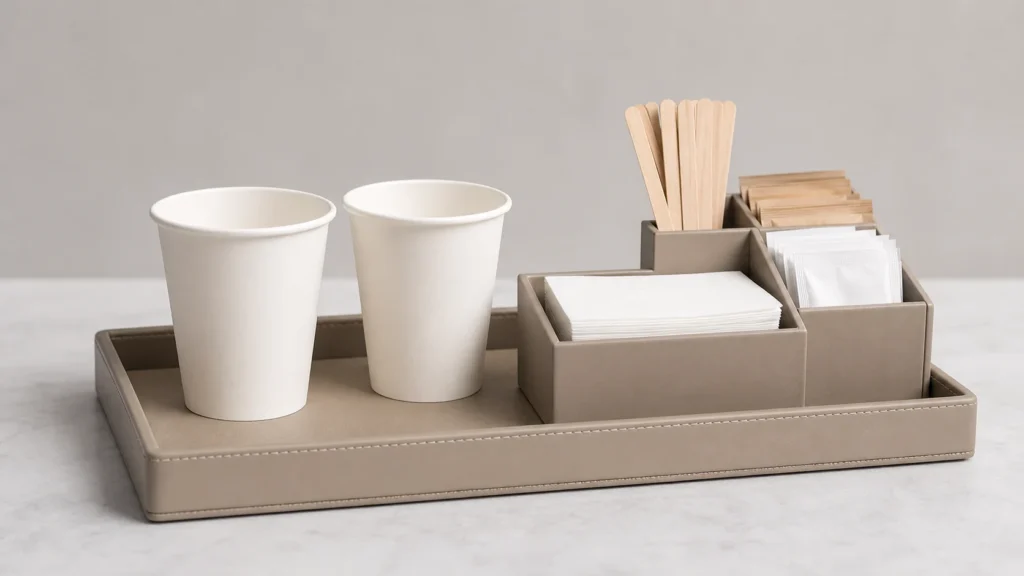
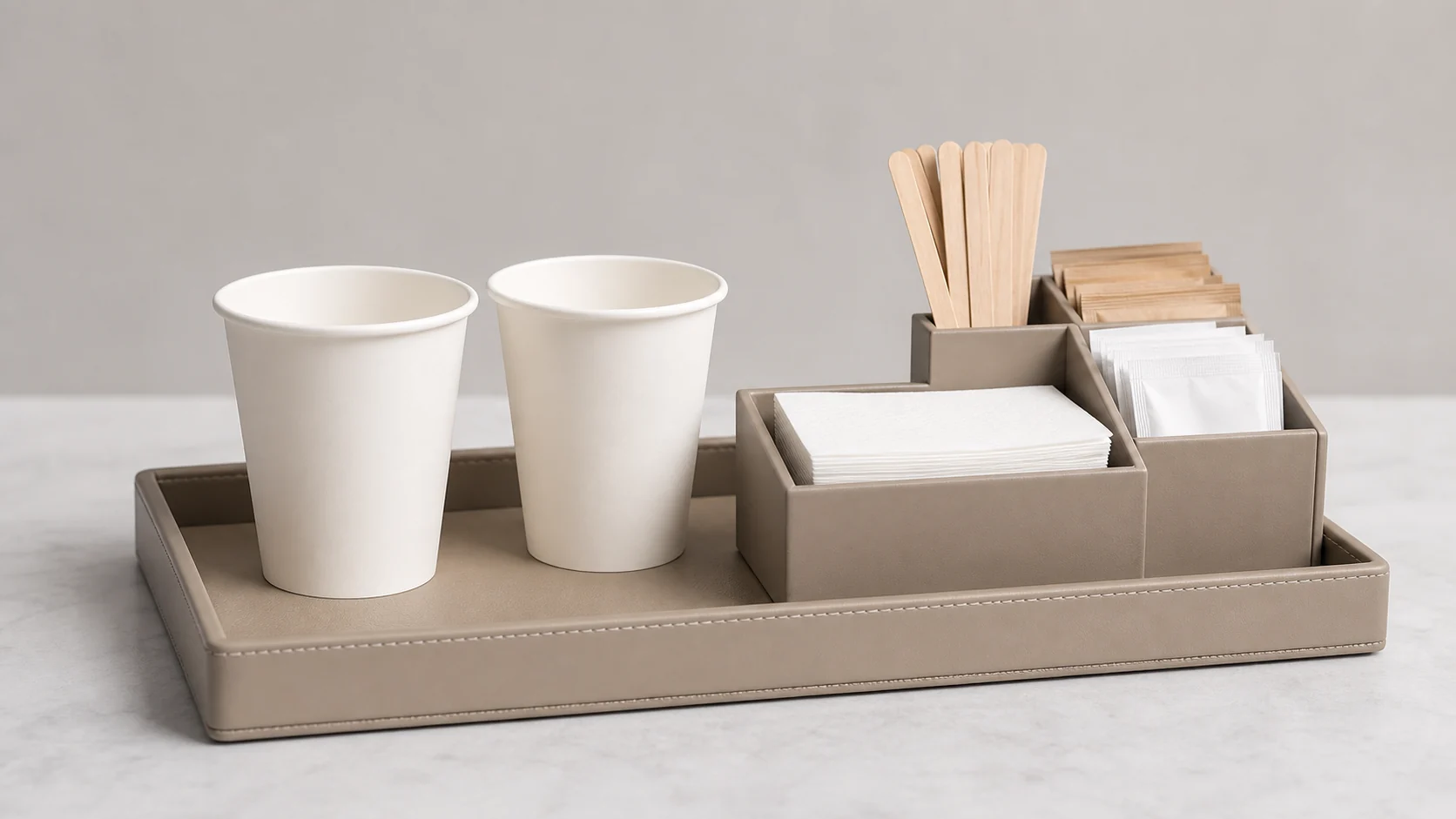
In-room service centers on individual portions, minimal staff interaction, and an expectation of hygiene theater—the guest must feel that everything they touch has been untouched by anyone else. Packaging in this context is typically placed on a tray or kettle station and must remain stable, sealed or easily sealable, and presentable without any last-minute assembly by housekeeping.
Breakfast and buffet service involves high-turnover, self-service scenarios where guests collect and carry beverages themselves. Cups must be easy to extract from dispensers, lids must seat quickly under time pressure, and the overall construction must tolerate the brief but real thermal stress of hot beverages dispensed at serving temperature without deforming or transmitting heat uncomfortably to the guest’s hand.
Event and banquet service introduces volume and logistics complexity that neither of the above contexts requires. A conference break for 400 delegates must be ready within a narrow window, which means packaging components need to be pre-staged, handled efficiently by banquet staff under time pressure, and compatible with the quantities a hotel can realistically store and rotate.
Each context demands not just the right product but the right combination of products configured as a functioning system.
The in-room beverage station—whether a simple kettle tray with sachets or a more elaborate minibar and pod-coffee setup—is a high-scrutiny touchpoint. Guests have time, privacy, and proximity to examine everything closely in a way they rarely do in a restaurant or buffet line.
Several operational principles apply here. First, portions should be individually wrapped or sealed in a way that communicates integrity without requiring guests to fight with packaging. Second, any cup or receptacle provided for hot beverages must be clearly food-contact safe; this is not optional or optional-seeming—it is a baseline regulatory expectation in every major hospitality market. Third, the format should be consistent across room categories unless the hotel is deliberately differentiating its premium tiers, in which case the differentiation should be legible and intentional, not accidental variation caused by mixed supplier sourcing.
For properties that provide disposable cups alongside kettles or pod machines, single-wall paper cups in appropriate sizes are the standard starting point. The specific capacity, board weight, and coating type should be confirmed against the manufacturer’s product sheets rather than assumed from visual inspection. A cup that feels robust may or may not retain its structural integrity at the temperatures a pod machine or kettle delivers; only documented material specifications answer that question definitively. Procurement teams reviewing options from the Papacko paper cups range should request technical data sheets for whichever SKUs are under consideration and cross-reference them against actual in-room dispensing temperatures before committing to volume orders.
Sustainability optics also matter in the in-room context, perhaps more than anywhere else in the hotel, because guests photograph their room environments and share them. Packaging that signals compostability or recycled content communicates a brand value that is increasingly expected, particularly in markets served by ESG-conscious corporate accounts. However, sustainability claims on packaging must reflect what is actually true about the material, the certifications held, and the waste infrastructure available at the property—points addressed in detail later in this guide.
The breakfast environment is operationally unforgiving. It concentrates the highest number of beverage service transactions into the narrowest window of the day, with staffing levels that are typically lower per guest than at other meal periods. Packaging must enable self-service without confusion, dispensing equipment failure, or bottlenecks.
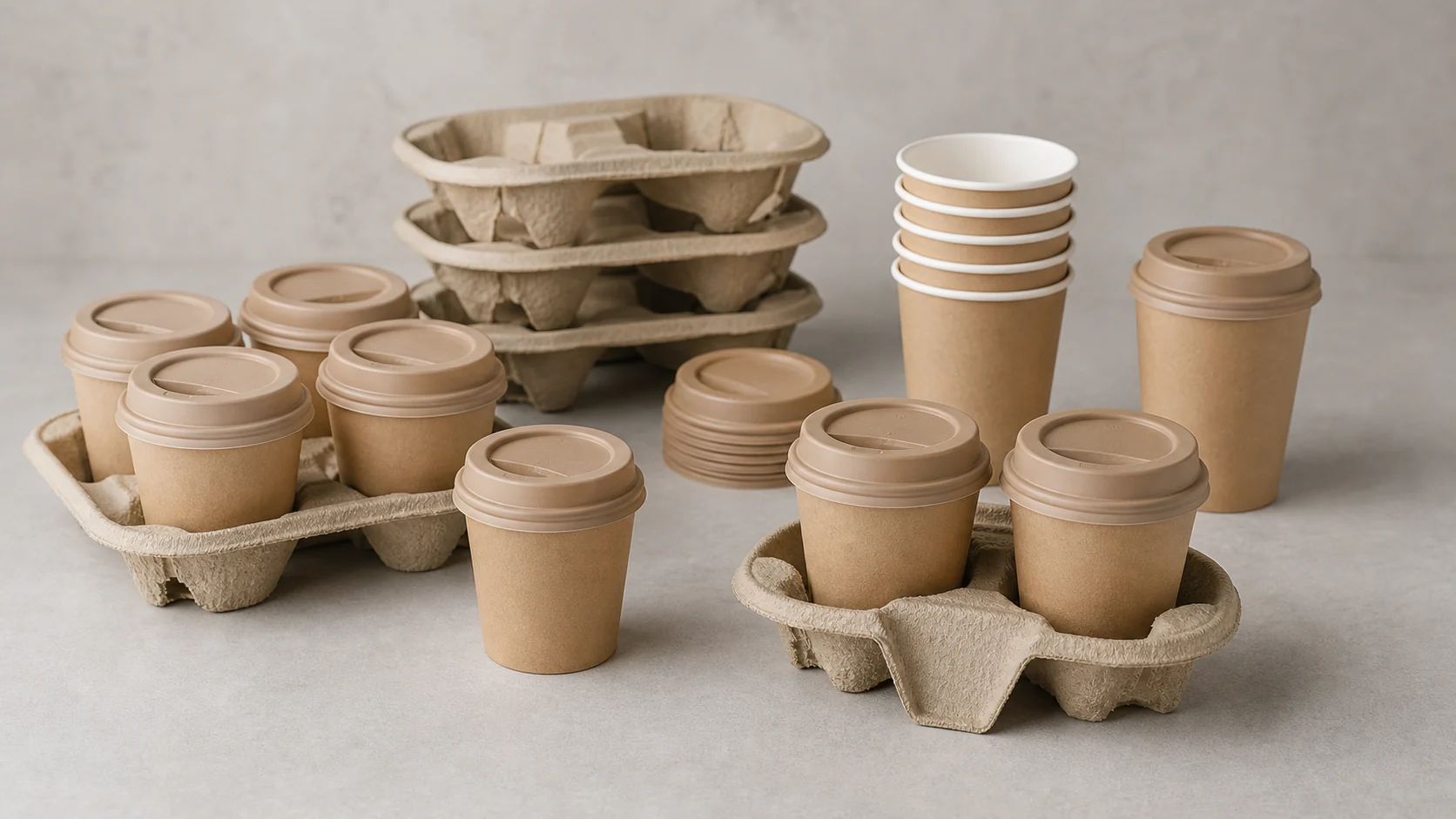
Cup dispensers are the typical delivery mechanism at a breakfast buffet, and cup compatibility with those dispensers is a practical constraint that should be established before any sourcing decision is finalized. Cup diameter tolerances matter; a cup that is even marginally outside the dispenser’s range will jam, frustrate guests, and require staff intervention that the team cannot provide during peak service.
Hot beverage cups for breakfast service need to accommodate a realistic range of beverages—drip coffee, hot water for tea, and increasingly, hot chocolate or specialty beverages from self-service machines. The Papacko coffee cups collection represents one category to evaluate for this context, with the caveat that actual suitability should be confirmed through product documentation and physical trial before operational rollout.
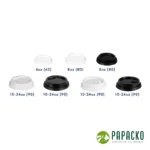
Lids are where breakfast service packaging most visibly succeeds or fails. Guests in a hurry—heading to meetings, managing children, returning to rooms—will attempt to lid their own beverages with varying degrees of care. A lid that does not seat securely with a single firm press, or that requires precise alignment to seal, will produce spills. The Papacko paper cup lids page illustrates the range of lid formats available and is a useful starting point for understanding fit compatibility, though formal fit confirmation requires physical testing against the specific cup SKU being ordered.
Beyond cups and lids, breakfast service often involves packaging for juice, water, and cold beverages alongside hot options. Coordinating these into a visually coherent system—consistent branding, complementary materials, unified color language—requires working with a supplier who can deliver across format categories or coordinating intentionally across multiple suppliers with a clear design brief.
Conference and event beverage service sits at the intersection of hospitality and logistics. A hotel’s events team may need to support a morning break for 80 delegates and an evening gala for 600 on the same day, each with its own beverage format, branding requirement, and timeline.
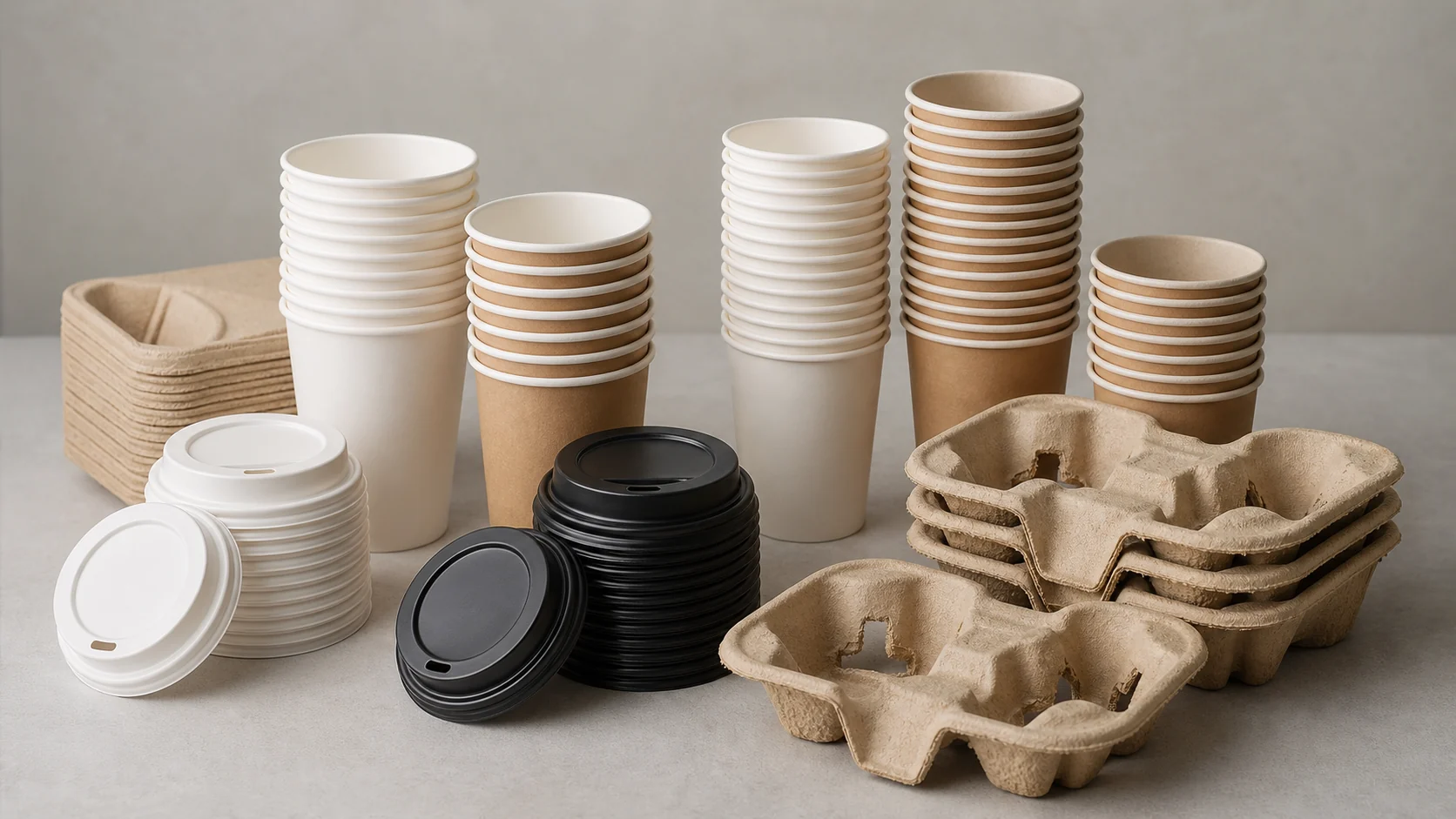
The packaging implications are significant. Volume requirements for events can dwarf those of in-room or breakfast service combined. This creates storage pressure, particularly in hotels that run busy conference programs and need to carry meaningful stock across multiple event configurations simultaneously.
Component compatibility becomes critical at scale. When thousands of cups and lids must be assembled rapidly by banquet staff who may not have handled this particular configuration before, the margin for assembly error must be designed out of the system rather than managed through training. Lid formats that seat audibly and visibly—providing clear tactile and auditory feedback when sealed—reduce spill incidents and speed service without requiring individual staff oversight.
For event service extending beyond the property—off-site dinners, outdoor events, break services in adjacent conference spaces—packaging needs to withstand transportation without compromising presentation. A broader look at disposable food packaging options from Papacko provides context for the range of formats available, some of which combine beverage and food service functionality for break-service trays or grab-and-go stations.
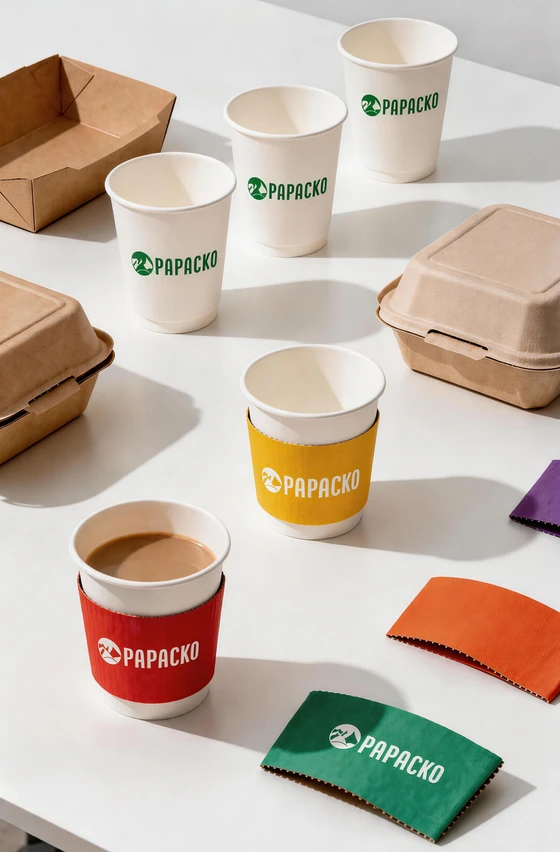
Custom printing on event cups is a recurring question from procurement teams managing branded conferences or corporate events. Most manufacturers offer custom printing at minimum order quantities that vary by format and print complexity. Lead times for custom printed orders are substantially longer than for stock products—often measured in weeks rather than days—which means custom formats need to be planned into event calendars well in advance and should not be treated as a routine reorder category.
Treating cups, lids, and carriers as independent purchasing decisions is a structurally sound approach to unit-cost reduction and a practically weak approach to operational performance. Components that are sourced separately without formal compatibility testing regularly produce assembly problems, guest complaints, and waste from discarded mismatched items.
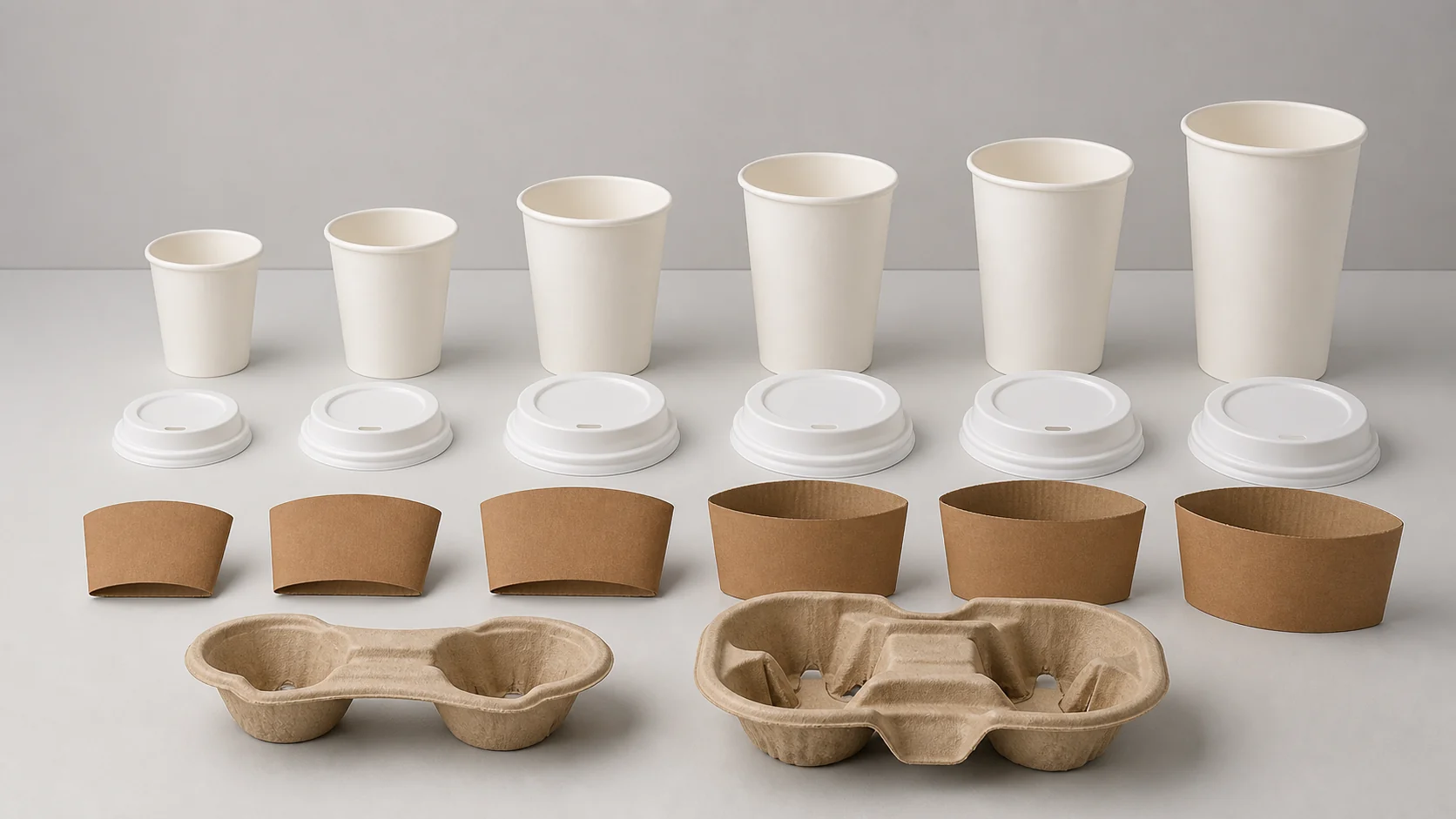
The principles of a well-designed component system are straightforward. First, cup and lid compatibility should be confirmed by manufacturer documentation before any volume purchase, not inferred from rim diameter alone. Different manufacturers apply different tolerances and rim profiles, and a lid that fits one 12 oz cup may not fit a dimensionally similar 12 oz cup from a different supplier. Second, the system should cover the full range of sizes used across service contexts—a hotel that uses three cup sizes across in-room, breakfast, and event service needs lid SKUs confirmed for all three, not just the most common. Third, carriers and sleeves, where used, should be selected with reference to the cup’s exterior diameter and should accommodate the lid when fitted, since carrying a lidded cup in an undersized sleeve defeats the purpose of either component.
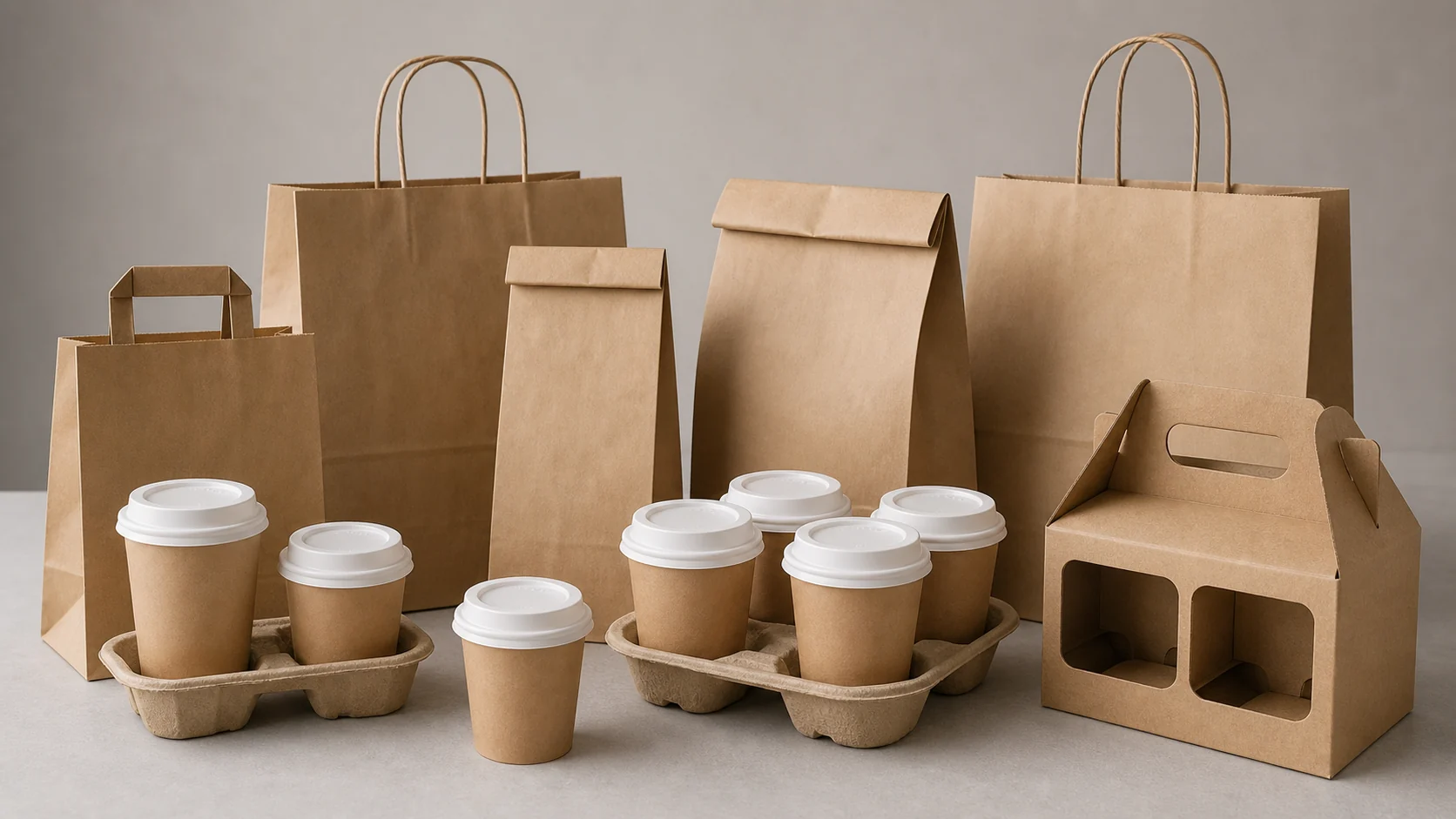
For hotels that provide takeaway-formatted beverages—checkout morning coffees, pool-side service, conference break bags—the packaging component system extends further. The Papacko takeaway packaging range addresses this extended use case and is worth reviewing in parallel with core cup and lid selection if the property operates any mobile or carry-out beverage service.
Sustainability commitments in hotel procurement are no longer optional features; they are central to ESG reporting, ownership-group targets, and an expanding body of guest and corporate client expectations. Packaging is a visible and measurable part of that commitment.
However, packaging sustainability involves several distinct claims that are not interchangeable and should not be treated as synonymous.
Recyclability means a product can be accepted by a recycling stream in a given geography. Paper cups with conventional PE linings are recyclable in specialist facilities but not in standard curbside streams in most markets. Cups with water-based barrier coatings may have broader recyclability but require confirmation against local infrastructure. Stating that a cup is recyclable without specifying the applicable stream and infrastructure is a claim that may not survive scrutiny.
Compostability is governed by certification standards that specify conditions—typically industrial composting at defined temperatures and time periods. A cup certified to a relevant industrial composting standard can legitimately be described as compostable under those conditions. Home compostability is a separate and more stringent certification. Neither claim is valid without the underlying certification documentation.
Recycled content describes the proportion of post-consumer or post-industrial recycled material in the packaging. This is a manufacturing-side claim and should be supported by the supplier’s material declarations.
Hotels making any of these claims in guest communications, sustainability reports, or procurement policies should hold the supporting documentation from their packaging suppliers and should be aware that the regulatory environment around environmental claims is tightening in multiple jurisdictions. Procurement teams should build documentation requirements into supplier contracts from the outset rather than requesting them reactively when claims are challenged.
Beverage packaging that contacts food or drink is subject to food-contact material regulations in every market where hospitality businesses operate. In the United States, the relevant regulatory framework is maintained by the FDA, and the starting point for understanding food-contact substance requirements is the agency’s food contact substances resource. European and other markets have parallel frameworks. Procurement teams sourcing packaging from suppliers outside their primary operating market should verify compliance with the regulations applicable in the jurisdiction where the packaging will be used, not only those of the country of manufacture.
Storage conditions affect packaging performance in ways that are easy to overlook when sourcing decisions are made at a desk rather than in a storeroom. Paper-based packaging absorbs moisture, which can affect structural integrity, print quality, and—in extreme cases—food-contact compliance if storage conditions allow contamination. Packaging should be stored in clean, dry conditions, away from food odors and chemicals, and ideally on racking that keeps product off the floor and away from exterior walls subject to condensation. Rotation discipline matters: first-in, first-out practice ensures that stock does not age beyond the supplier’s stated shelf life, which should be confirmed and documented at the point of purchase.
Pre-service handling protocols should specify that packaging is not inspected or sorted using bare hands in food-service areas without appropriate hygiene controls. Staff handling cups and lids for line setup should follow the same hygiene standards applied to other food-contact materials.
Formalizing the sample approval process is one of the highest-leverage steps a procurement team can take to reduce operational problems from packaging. An informal approach—receiving samples, looking at them, approving them—misses the performance dimensions that only emerge under service conditions.
A structured sample approval process for beverage packaging in a hotel context should include, at minimum: confirmation of cup-to-lid fit under realistic assembly speed conditions; hot-fill testing at the temperatures the property’s equipment actually delivers; a brief hold test with filled and lidded cups to check for lid dislodgement or cup deformation; and an assessment of how the packaging looks and feels from a guest perspective at the point of use. For in-room packaging, this means placing samples on an actual kettle tray in a representative room. For breakfast service, this means running samples through the dispenser and beside the coffee equipment. For events, this means testing assembly speed under simulated banquet setup conditions.
Supplier management beyond sample approval should include documented lead times for both standard and custom orders, confirmed minimum order quantities, stated shelf life and storage conditions, and a clear understanding of how the supplier handles supply disruptions. Hotels that have experienced packaging shortfalls during peak demand—because a supplier had a production delay or a shipping disruption—know that the cost of a stockout in event service can exceed the cost of carrying additional safety stock by a significant margin.
Packaging approval is not a one-time event. Several categories of change should trigger re-approval before the affected packaging reaches service.
Supplier formulation or material changes occur more frequently than many buyers expect, particularly as suppliers adapt to changing raw material availability or regulatory requirements. A cup that was approved for a particular service temperature may have different performance characteristics if the manufacturer has changed its board weight, coating type, or lamination process without explicit notification. Contracts with packaging suppliers should require formal notification of material changes as a condition of supply.
Regulatory updates in food-contact material standards can affect the compliance status of packaging already in use. In markets with active regulatory evolution—including both the US and EU—procurement teams should maintain awareness of developments affecting food-contact substances and should confirm with suppliers that existing product lines remain compliant as the regulatory landscape changes.
Brand or sustainability policy changes within the hotel or ownership group may create alignment requirements that affect existing approved packaging. An ownership group that adopts a new sustainability framework midway through a supply contract may require a review of packaging against the updated criteria.
Supplier changes, whether voluntary or necessitated by supply disruption, require full re-approval of the new source against the same criteria applied to the original, including food-contact compliance documentation, performance testing, and compatibility confirmation.
The operational context informing this guide draws on the realities faced by hotel procurement teams managing multi-property portfolios, single-asset F&B managers who are simultaneously responsible for in-room, restaurant, and event service, and event operators who need reliable stock availability across unpredictable booking patterns. The sourcing recommendations reflect the practical need to balance unit-cost discipline against system compatibility and operational reliability—a balance that frequently argues for consolidating supplier relationships rather than optimizing individual line items in isolation.
The technical framing in this guide rests on documented industry practice for food-contact packaging selection, the regulatory frameworks applicable in the primary markets where hospitality businesses operate, and the performance logic of component systems as described by packaging manufacturers and tested in service environments. No specific performance figures—temperatures, capacities, material retention rates, or certifications—have been stated without a basis in documentation available from manufacturers or regulators. Where specific SKU performance matters, the guide consistently directs readers to confirm against product documentation rather than accepting general descriptions as operational specifications.
Procurement teams and F&B managers should use this guide as a structured checklist for reviewing existing packaging decisions and identifying gaps, rather than as a prescriptive specification. Begin by mapping your actual service contexts against the three categories described—in-room, breakfast, and events—and identify where component compatibility has or has not been formally confirmed. Use the sustainability boundaries section to audit any claims currently being made in guest communications or procurement documentation. Apply the sample approval framework to any new supplier relationship or formulation change. Build re-approval triggers into supplier contracts as standing commercial terms rather than ad hoc requirements.
The single most important compatibility check is physical fit confirmation between the specific cup SKU and the specific lid SKU under realistic assembly conditions—not just a visual assessment or a diameter comparison. Rim profiles vary between manufacturers and even between product lines from the same manufacturer, so a lid that fits one cup may not seat securely on a dimensionally similar cup from a different range. This check should be conducted as part of formal sample approval, with staff assembling lidded cups at the speed they would realistically work during a banquet break or breakfast peak, and the results documented before volume orders are placed.
Custom-printed cups carry substantially longer lead times than stock products—timelines vary by manufacturer and print specification, but planning horizons measured in weeks rather than days are standard. Hotels running branded conference programs should build custom packaging into event planning calendars at the earliest contracting stage, treat it as a category requiring its own procurement timeline rather than an add-on to standard F&B ordering, and carry a buffer of approved stock product that can substitute if a custom order is delayed. Dependency on custom-printed cups for events with fixed dates and no lead time flexibility is a supply-chain risk that should be explicitly managed.
For each claim being made, the underlying certification or material declaration should be in the procurement team’s possession before the claim appears in any guest communication, sustainability report, or procurement policy. Compostability claims require current certification documentation from the manufacturer against an applicable standard. Recyclability claims should be supported by a clear statement of the recycling stream and geographic infrastructure for which the claim is valid. Recycled content claims require the supplier’s material declaration specifying the percentage and source of recycled content. Regulatory scrutiny of environmental claims is increasing in most hospitality markets, and documentation held retrospectively carries far less weight than documentation obtained at the time of procurement.
Re-approval is warranted any time the manufacturer notifies a change in materials, coatings, or production process for an approved SKU; when the regulatory framework for food-contact materials in the applicable jurisdiction is updated in a way that may affect the product’s compliance status; when the hotel’s own brand standards or ownership-group sustainability policy changes in a way that creates new criteria the existing packaging must meet; or when operational evidence—guest complaints, structural failures, or observed performance changes—suggests that the packaging is no longer behaving as it did when originally approved.
The appropriate safety stock level depends on the predictability of demand, the supplier’s confirmed lead time for replenishment, and the operational cost of a stockout in the most critical service context. For hotels with high conference volume, the cost of being unable to service a contracted event break because of a packaging shortage is typically large enough to justify carrying more stock than a pure inventory-cost calculation would suggest. A practical starting point is to calculate the maximum volume required for the property’s highest-demand event period, then add a buffer based on the supplier’s stated lead time—if replenishment takes two weeks and peak demand lasts four weeks, a two-week buffer provides meaningful protection. Safety stock should be rotated actively to avoid aging product approaching its shelf life.
Suppliers who proactively communicate material changes, provide updated compliance documentation when regulations in key markets are revised, and can demonstrate familiarity with the food-contact regulatory frameworks applicable to the hotel’s operating geographies are substantively different from suppliers who provide documentation only on initial request. Procurement contracts should require written notification of any material or formulation change before that change is implemented in supply, with a specified notice period that allows the hotel to conduct re-approval testing before the modified product enters service. Hotels sourcing from suppliers operating under different national regulatory frameworks should confirm compliance with the regulations of the jurisdiction where the packaging will be used, not only those of the country of manufacture.