Ready to create your own branded paper cups or packaging?
Tell us your requirements — size, coating, printing, and destination — and our team will prepare a detailed quotation within 24 hours.

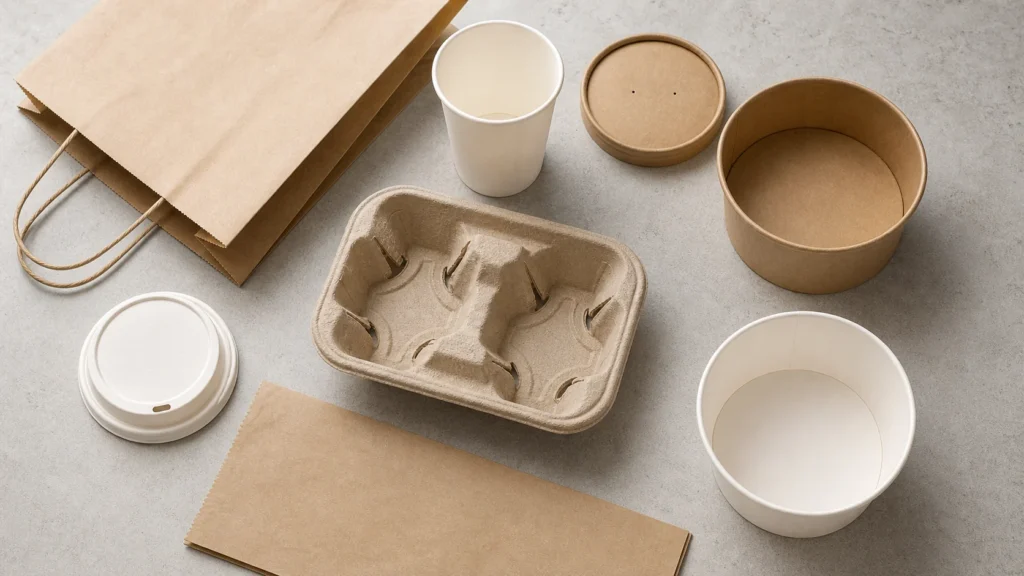
Managing packaging end of life is one of the least standardised operational challenges in foodservice procurement. Infrastructure, facility acceptance, collection contracts, contamination rates, and product-specific material composition all interact to determine what actually happens to a unit after a customer finishes a meal. This guide gives foodservice operators, procurement teams, multi-site brands, and distributors a structured, material-by-material framework for verifying realistic disposal routes — before purchasing at scale — and for building operational systems that support the route your local infrastructure can actually accommodate.

A recycling symbol, a compostable leaf logo, or a “made from recycled content” claim printed on packaging tells you something about material composition or manufacturing. It does not tell you whether a given item will be accepted by your local collector, processed at a nearby facility, or successfully recovered at the end of its use.
Disposal outcomes depend on a chain of conditions: the exact SKU and all of its components, the level of food residue present at time of disposal, the collection infrastructure serving your specific site, and the technical capability of the facility that ultimately receives the material. Every link in that chain must be verified independently.
Start with your waste hauler or municipal collection service and ask specifically which materials they accept, in what form, and at what contamination threshold. Then work backward to assess whether your current packaging portfolio aligns with that infrastructure. If it does not, the gap is operational — and requires either a packaging change, a collection change, or a managed residual disposal route.
Recycling is a mechanical, chemical, or biological process by which a used material is converted into feedstock for new products. For a material to be recycled in practice, it must be collected, sorted, cleaned to an acceptable contamination level, and accepted by a reprocessor that has a current market for the output. The existence of recycling technology for a material does not mean recycling is available or accessible for your specific product at your specific location.
Composting is the biological decomposition of organic material into a stable end product (compost). Industrial composting operates at higher temperatures and throughput than home composting and can process a wider range of materials. However, “compostable” certification on a product indicates that the material has been tested under defined laboratory conditions — it does not guarantee that your local facility accepts that item, processes it at the conditions required, or has a collection programme that reaches your site.
Landfill and incineration (residual disposal) remain the default for materials that are not collected, not accepted at recovery facilities, or that arrive too contaminated to be processed. These are legitimate operational outcomes in many service environments, not failures — but they should be planned for honestly rather than obscured by aspirational labelling language.
Biodegradable is not a defined end-of-life route. It describes a property of certain materials under certain conditions, but does not indicate a specific recovery pathway. Do not use it as a procurement proxy for recyclability or compostability.
Any claim used in procurement documentation, customer communications, or on-pack labelling should be supported by current facility acceptance and verified collection access, not by material composition alone.
Use the following sequence to evaluate each packaging item before committing to procurement or making disposal claims to staff or customers.
Step 1 — Identify the exact SKU and all components.
A container may be mono-material or may include a lid, film seal, label, sleeve, or adhesive. Each component may have a different end-of-life route. Request a full component map from your supplier before proceeding.
Step 2 — Confirm food contamination profile.
Will this item typically be returned with significant food residue? Residue thresholds vary by material and facility. Heavily soiled items are frequently rejected even when the base material is otherwise accepted. Rinse expectations must be operationally realistic for your service format.
Step 3 — Contact your site’s collector or hauler.
Ask specifically: Do you accept this material type? Do you accept it with this component configuration? What is your contamination tolerance? Do you collect organics or compostables separately? What bin stream does this item belong to?
Step 4 — Contact the receiving facility directly if possible.
Collectors do not always process materials themselves. The facility that receives sorted materials may have acceptance criteria that differ from the collector’s stated guidelines. For compostables especially, industrial composting facility acceptance must be confirmed independently.
Step 5 — Evaluate separation feasibility at point of use.
If a container requires component separation (e.g., removing a lid before disposal), determine whether that separation is realistic in your service environment. High-volume quick-service environments have different operational constraints than low-volume catered settings.
Step 6 — Assign a verified route or a managed residual route.
If Steps 1иC5 confirm acceptance, document the route and the conditions attached to it. If no recovery route is confirmed, assign the item to residual disposal honestly and revisit during your next packaging review cycle.
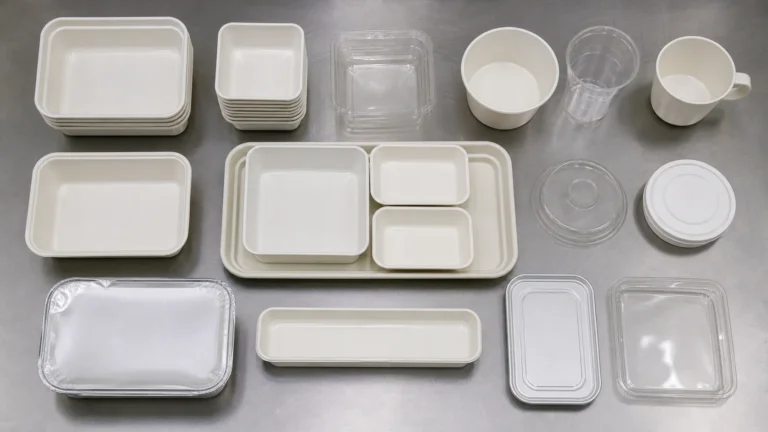
For a full view of container types and material configurations available for review, see food packaging containers.

Paper-based foodservice packaging — cups, sleeves, plates, bags, and wraps — is often assumed to follow a straightforward recycling or composting route. The reality is more nuanced and depends heavily on the specific coating or lining applied to the paperboard substrate.
Coatings and liners. Many foodservice paper products, particularly hot and cold cups, include a polyethylene (PE) or other polymer coating to provide moisture resistance. Some more recent products use water-based barrier coatings or alternative lining systems. The coating type determines whether the item is accepted in paper recycling streams (which generally require the paper fibre to be separable), compost streams (which require the coating to break down within the process window), or neither.
Contamination. Food residue — grease, sauce, liquids — can interfere with paper fibre recovery even when a cup or container would otherwise be accepted. The degree of soiling that disqualifies a paper item varies by facility.
Local acceptance. Paper cup recycling, in particular, requires a specialist reprocessing facility capable of separating the lining from the fibre. These facilities are not universally available. Before specifying any paper cup product as “recyclable” in customer-facing or operational communications, confirm that a facility accepting that specific product type operates within your collection chain.
Lids. Paper cup lids are frequently made from a different material (commonly plastic, sometimes moulded fibre) and may belong to a different bin stream than the cup body. Treat lid end-of-life as a separate verification.
For SKU-level detail on cup formats and material configurations, see paper cups.
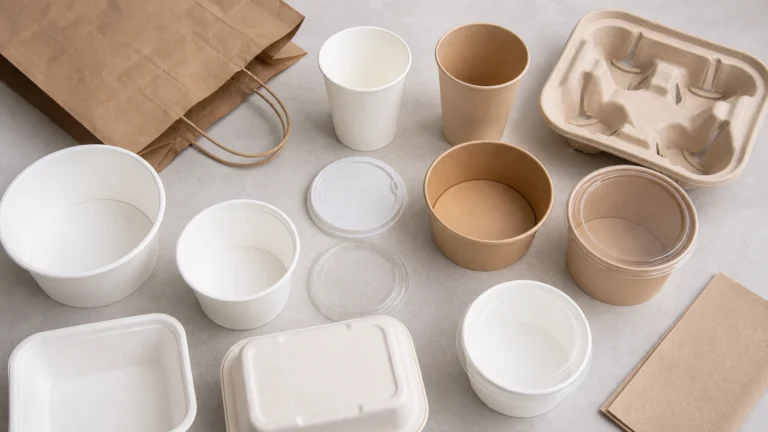
Moulded fibre and pulp-based bowls, trays, and clamshells are produced from recycled or virgin plant-based fibres formed into rigid shapes. Their end-of-life routes are subject to the same verification requirements as other paper-based packaging.
System completeness. A moulded pulp bowl may be sold and used with a separate lid — which could be a separate moulded fibre component, a polypropylene lid, or a film seal. The bowl and the lid are different items with potentially different disposal routes. Buyers should map every component in the serving system, not just the primary container.
Food residue thresholds. Moulded pulp has a porous surface that can absorb fats and proteins from food. Some composting facilities accept food-soiled fibre as part of an organics stream; others do not. Paper recycling facilities typically require fibre to be relatively clean. Confirm with your specific collector and facility what residue level is acceptable and whether that threshold is achievable in your kitchen and service flow.
Collection stream. Depending on the configuration, a moulded fibre item may be directed toward paper recycling, organics or composting collection, or residual disposal. This is determined by facility acceptance, not by the material itself. Blanket claims that all moulded pulp is compostable or recyclable are not operationally reliable without facility confirmation.
For current product and component options in bowl formats, see paper bowls.

Plastic foodservice packaging covers a wide range of resin types — polypropylene (PP), polyethylene terephthalate (PET), polystyrene (PS), polylactic acid (PLA), and others — each with distinct physical properties, recycling infrastructure availability, and facility acceptance rates.
Resin code alone is not sufficient. A number printed inside a chasing-arrows symbol identifies the resin family; it does not confirm that your local facility accepts that item. Acceptance varies by region, by facility, and by the specific form of the item (rigid versus film, for example). Contact your collector with the specific item in hand, not just the resin number.
Multi-material configurations. A single-use container may combine multiple materials: a PP base with a PS lid, a PET cup with a paper sleeve and a film seal. Each material may have a different accepted route. Where components cannot be separated at point of use, the combined item may not be accepted in any single recovery stream.
Labels, inks, and adhesives. Labels applied to plastic containers can interfere with sortation equipment at materials recovery facilities. Some inks and adhesives are incompatible with certain reprocessing processes. This is a SKU-level detail that requires supplier documentation, not a general assumption.
Food contamination. As with all materials, food residue significantly affects plastics acceptance. The practical rinsing requirement at your service points is an operational constraint that must factor into route assessment.
Compostable foodservice packaging has grown significantly as a product category. The key operational principle is that certification and claims exist on a spectrum, and facility acceptance is a separate, independent question from whether a product carries a certification mark.
Industrial versus home composting. Products certified to industrial composting standards are designed to break down under the elevated temperature and controlled moisture conditions found in commercial composting operations. They may not break down comparably in home compost systems, garden piles, or in natural environments within any predictable timeframe. Do not conflate certification type with practical decomposition outcome.
Facility acceptance is not universal. Even where industrial composting facilities exist, they may not accept foodservice ware. Some facilities exclude packaging entirely to avoid contamination of the compost output with non-food-safe materials or slow-degrading components. Some accept only specific product types or certified materials from approved suppliers.
Collection is a prerequisite. Even if a local facility accepts compostable packaging, your site requires a collection contract that includes a separate organics or compostables stream. Compostable packaging placed in general recycling can contaminate plastics recovery. Compostable packaging in landfill does not compost.
Verification steps for buyers. Confirm certification status and conditions with the supplier. Identify and contact the composting facility serving your area. Ask specifically whether they accept foodservice ware in the format you are considering. Confirm that a collection programme links your site to that facility. For background on composting infrastructure and terminology, refer to EPA composting guidance.
Even the best-verified disposal route fails if waste is not correctly sorted at the point of generation. Operational design at the point of use is a critical and frequently underinvested element of packaging end-of-life management.
Bin configuration. Place the correct number of streams at each disposal point, labelled clearly for the verified routes available at your site. Do not add a stream for a route that is not confirmed — aspirational bin labelling increases contamination and undermines confirmed routes.
Product-specific signage. Generic recycling symbols are insufficient. Signs should reference the actual items your customers or staff are handling. “This cup goes here” is more actionable than a symbol alone. Update signage when packaging changes.
Staff training. Back-of-house and front-of-house staff need separate and specific guidance. Kitchen staff handling prep waste, portioning containers, and packaging offcuts face different sorting decisions than counter staff and customers. Training should include what to do when a packaging item is new or unrecognised.
Contamination monitoring. Establish a periodic review of your bin contents at the point of collection. Contamination rates can reveal whether signage is effective, whether items need to be reassigned to a different stream, or whether certain products should be reconsidered entirely.
Feedback loop with your collector. Ask your waste hauler for feedback on the quality of your sorted streams. Rejection rates, contamination flags, and material quality assessments are operational data that should inform ongoing packaging and sorting decisions.
Sorting infrastructure accessories — bin inserts, bag holders, and labelling supports — can help standardise your disposal station setup across sites. See packaging accessories for available options.
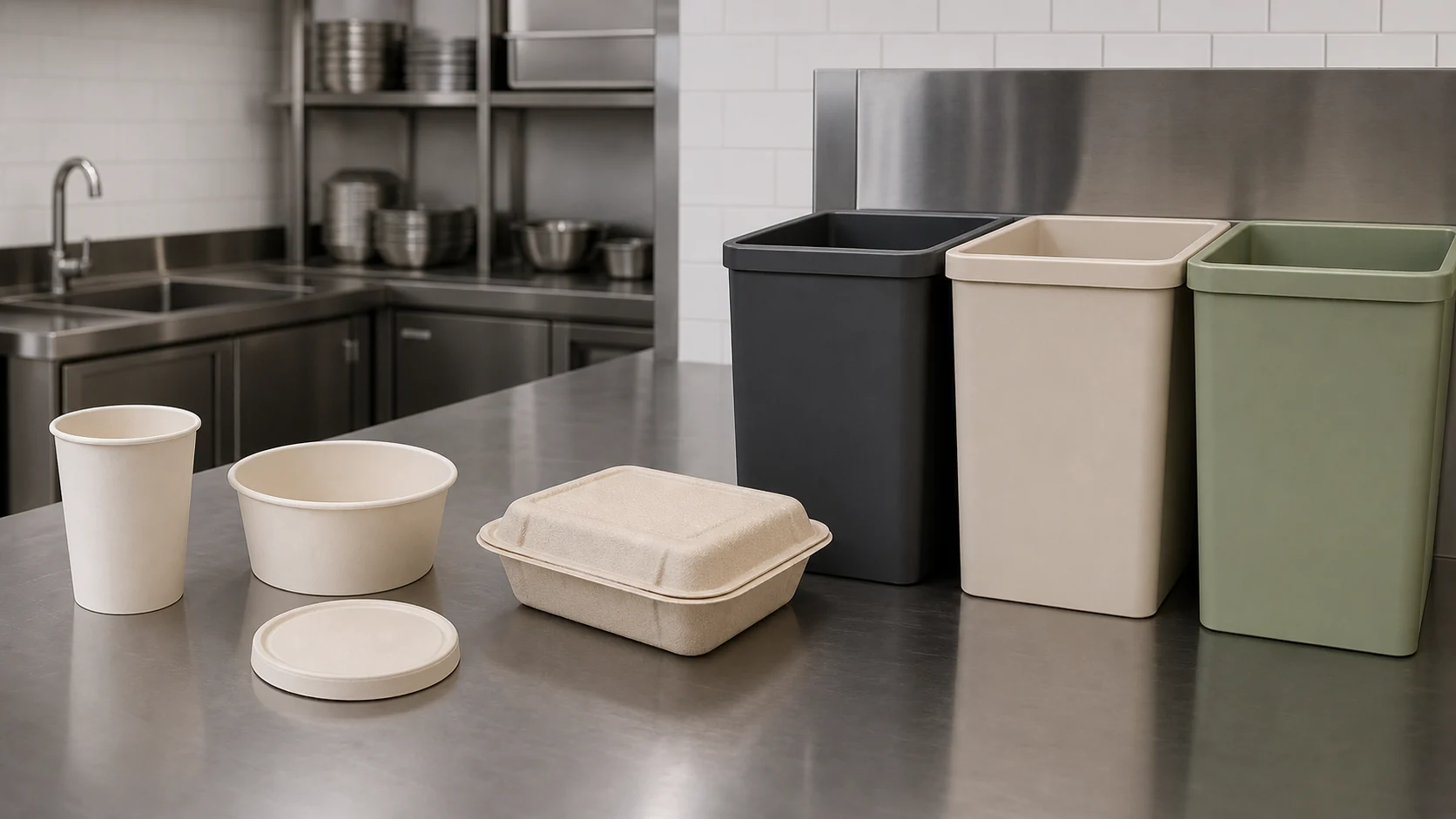
Use this checklist when evaluating a new packaging SKU, reviewing an existing product, or preparing to make any disposal claims in customer-facing communications.
For background on how material type affects performance and operational suitability across container formats, refer to the take-out container material guide.
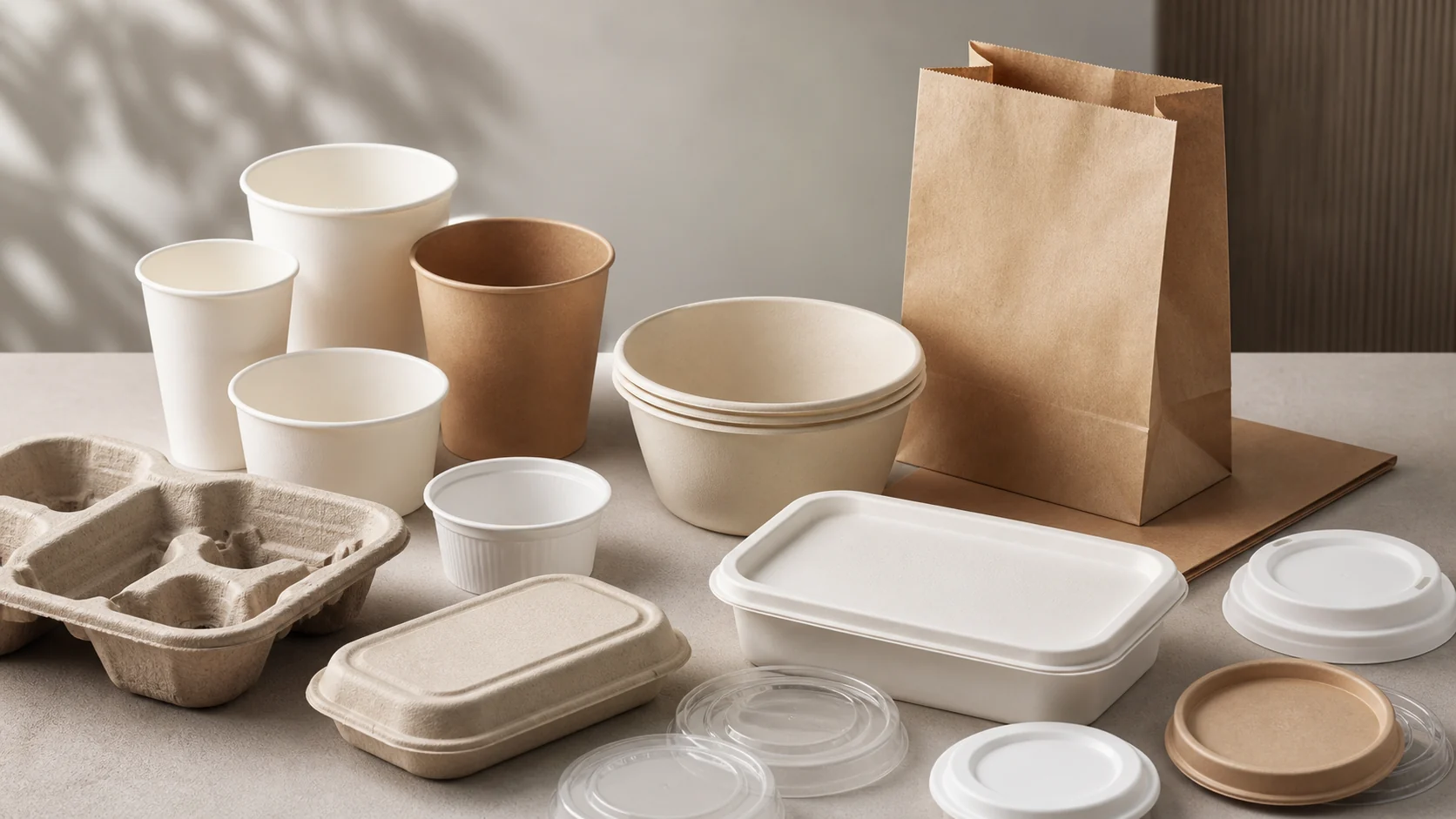
Not every packaging item used in foodservice has a confirmed recovery route available in every market. This is an infrastructure reality, not a compliance failure.
Residual disposal is a legitimate planned outcome. For sites operating in areas without organics collection, without specialist paper cup reprocessing, or without plastics recovery for the specific resin in use, directing those materials to residual waste (landfill or energy-from-waste) is operationally correct and honest. Routing materials into recovery streams where they are not accepted creates contamination that can disrupt the recovery of other materials and provides no environmental benefit.
Mixed multi-material items with no separation point often have no available recovery route regardless of component materials. Where a component map reveals this, document it and consider whether a different packaging specification serves both operational and end-of-life objectives more effectively.
Pilot programmes and emerging infrastructure may create new routes over time. Local authority collection expansions, new facility openings, and extended producer responsibility schemes can change what is available in a given area. Periodic review of both packaging specifications and local infrastructure is therefore operationally important, not optional.
Do not communicate routes that are not confirmed. Telling customers to recycle or compost an item that your local infrastructure does not process for that item creates contamination, undermines trust, and exposes your brand to scrutiny. If the route is not verified, communicate honestly or do not communicate a route at all.
If you are evaluating packaging specifications for a new site, reformatting a menu concept, entering a new distribution market, or preparing a procurement tender that includes end-of-life requirements, a structured packaging system review can clarify where your current portfolio aligns with available infrastructure and where gaps exist.
To support a useful review, share your intended application and service format, the markets and locations your sites operate in, the collection and hauling contracts currently in place, any existing disposal claims in use, and the specific products and component configurations you are assessing. This allows a material-level assessment rather than a generalised one. Contact the Papacko procurement and product team to begin that conversation.
Experience and sourcing context. This guide has been developed by the Papacko editorial and product team drawing on direct engagement with foodservice operators, procurement professionals, and distributors across multiple service formats and markets. It reflects the practical questions that arise during packaging specification and end-of-life planning, and the operational gaps that commonly appear between material claims and infrastructure reality.
Technical and authority basis. The information in this guide reflects general knowledge of packaging materials, end-of-life infrastructure categories, and procurement practice as of the date of publication. It does not constitute legal advice, regulatory compliance guidance, or a guarantee of any specific disposal outcome. Collection infrastructure, facility acceptance, and regulatory requirements vary significantly by geography and change over time. All claims and routes described here must be independently verified against your specific products, location, and collection contracts.
How to apply this guide. Use this guide as a structured starting framework for procurement due diligence, not as a final authority. Every step in the decision tree — SKU confirmation, component mapping, collector contact, facility verification — requires direct action by your procurement or operations team. The value of this guide is in structuring those steps systematically, so that disposal decisions are based on verified conditions rather than assumptions.
The first step is identifying the exact SKU and all of its components, then contacting your local waste collector or hauler with that specific information. Do not assume a disposal route based on a material label or a recycling symbol. The route depends on what your specific collector accepts, at what contamination threshold, and whether a facility that processes that material is accessible in your collection chain.
Paper cups may be accepted in paper recycling streams in some locations, but this requires a specialist reprocessing facility capable of separating the lining material from the paper fibre. That facility type is not universally available. Before directing cups to paper recycling, confirm with your specific collector that a capable reprocessor is active in your collection chain, and clarify whether the lid is included or excluded from that acceptance.
Verify in sequence: confirm the product’s certification type and scope with the supplier; identify and contact the industrial composting facility serving your area; ask directly whether they accept the specific product format; confirm a collection contract links your site to that facility. Certification alone does not confirm facility acceptance, and facility acceptance alone does not confirm that collection reaches your site.
Yes. Food residue — grease, sauces, liquids, and protein deposits — can affect the acceptability of paper, plastic, moulded fibre, and compostable items. Contamination thresholds vary by material and by facility. The degree of soiling typical in your service format should be assessed against the stated tolerance of the facility receiving your sorted materials before you confirm or communicate any recovery route.
Map each component separately: base, lid, label, film, sleeve, and any adhesive. Each may have a different verified route, and some components may have no available recovery route in your market. Assess whether point-of-use separation is operationally realistic, and whether each stream has confirmed collection and facility acceptance. Where separation is not feasible and routes differ, the combined item may default to residual disposal.
Review routes at a defined interval — annually is a reasonable minimum for most multi-site operators — and trigger an ad-hoc review whenever a packaging specification changes, a collection contract is renegotiated, a local facility opens or closes, or regulatory requirements in your operating markets are updated. Infrastructure availability changes, and routes confirmed two years ago may no longer be accurate for your current collection setup.