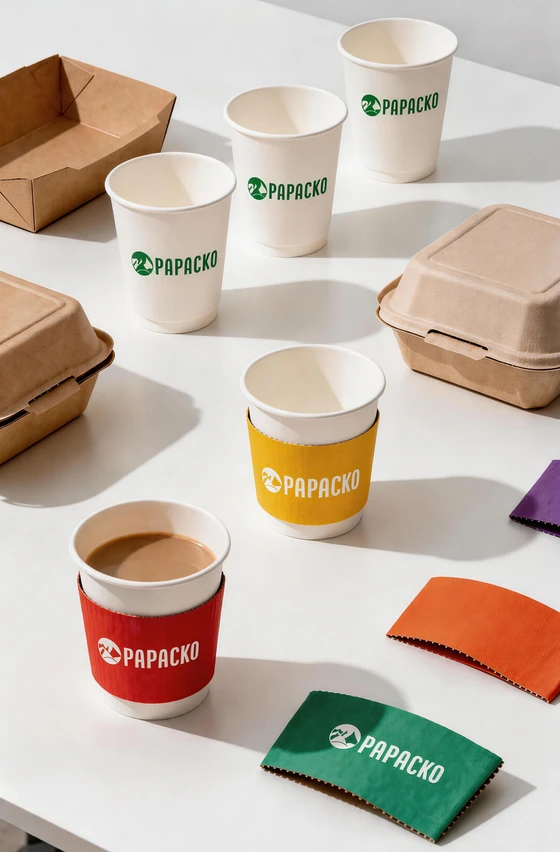
¿Está listo para crear sus propios vasos o envases de papel con su marca?
Díganos sus requisitos -tamaño, revestimiento, impresión y destino- y nuestro equipo le preparará un presupuesto detallado en 24 horas.


Una tapa etiquetada como «compostable» permanece en un vertedero durante 25 años, porque la planta de tratamiento de residuos local no la acepta. El mercado de las tapas compostables se ha disparado un 340% desde 2020, pero un 78% de estas tapas nunca llegan a ser compostadas.
Última actualización: abril de 2026
Tiempo de lectura9-11 minutos
Autor: Equipo de contenidos de Papacko
A lid stamped “compostable” sits in a landfill for 25 years—because the local waste facility doesn’t accept it. The compostable lid market has exploded 340% since 2020, but 78% of “compostable” lids never reach actual composting facilities due to infrastructure gaps, misleading certifications, and consumer confusion. The result: businesses pay 40-80% premiums for environmental benefits that never materialize.
This guide cuts through greenwashing to identify genuinely sustainable compostable cup lids: certification requirements (BPI vs TÜV vs OK Compost), material science (PLA vs CPLA vs fiber-based), performance testing (heat tolerance, seal strength, pressure resistance), and end-of-life infrastructure reality. You’ll learn how to select lids that deliver real environmental impact while meeting functional requirements for hot and cold beverages.
💡 Resumen rápido: Effective compostable cup lids require third-party certification (BPI, TÜV Austria, or CMA), PFAS-free materials, heat tolerance matched to beverage type (PLA ≤85°C, CPLA ≤95°C, fiber ≤100°C), proper fit testing (90mm, 80mm standard diameters), and verification of actual composting infrastructure in your service area.
The key to choosing secure compostable cup lids depends on:
Legal definition (ASTM D6400, EN 13432): Material must:
1. Biodegrade: ≥90% conversion to CO₂ within 180 days in composting conditions
2.Disintegrate: ≥90% passes through 2mm sieve within 90 days
3. Ecotoxicidad: Final compost supports plant growth (≥90% of control sample)
4.Metales pesados: Below thresholds for Pb, Cd, Hg, Cr VI (safe for soil)
Distinción crítica:
-❌ “Biodegradable” = breaks down eventually (no timeframe, conditions undefined)
-✅ “Compostable” = breaks down in 90-180 days under specific composting conditions
When evaluating the compostable cup lids, consider the following:
### Certification Verification
For secure compostable cup lids, focus on:
✅ What to check on lid packaging:
-Certification logo (BPI, TÜV Austria, etc.)
-Certificate number (verifiable on certifier’s website)
-Material specification (PLA, CPLA, fiber-based, etc.)
-Composting conditions (commercial vs home)
❌ Red flags indicating greenwashing:
-“Plant-based” without certification (many petroleum plastics contain plant fillers)
-“Biodegradable” without timeframe or standard reference
-Generic leaf symbols without certifier name
-“Compostable*” with fine print “in industrial facilities” (when local facilities don’t accept)
Verification method: Visit certifier websites (bpiworld.org, tuv-at.be) and search certificate number. Legitimate products are listed in publicly searchable databases.
🎯 Perspectiva del sector: Study by the Green Restaurant Association found that 34% of lids marketed as “eco-friendly” or “compostable” lacked any third-party certification, and 22% displayed expired certifications.
Always verify current certificate status before procurement.
The key to choosing secure compostable cup lids depends on:
Fuente del material: Fermented plant sugars (corn, sugarcane, cassava) converted to lactic acid, polymerized into plastic
Performance specifications:
Las mejores aplicaciones:
✅ Iced beverages (coffee, tea, smoothies, juice)
✅ Warm drinks ≤80°C (warm coffee, tea held at lower temps)
✅ Cold-focused cafes and smoothie bars
✅ Events with commercial composting collection
❌ Not suitable for:
-Freshly brewed coffee (90-95°C)—lid softens and deforms
-Very hot tea service
-Microwave reheating (warps immediately)
-Areas without commercial composting access
Material: PLA with crystallization treatment (controlled heating/cooling to create crystalline structure)
Key improvements over standard PLA:
Appearance trade-off: Crystallization process creates opaque, off-white color (loses PLA’s clear advantage). Many consumers mistake CPLA for conventional plastic.
Las mejores aplicaciones:
✅ Hot coffee service (90-95°C) in cafes committed to compostable packaging
✅ Hot tea service
✅ Businesses willing to educate customers on opaque = compostable
✅ Corporate/institutional settings with collection programs
Coste real: CPLA lids cost 60-85% more than conventional plastic lids, 15-25% more than standard PLA.

Material: Molded paper pulp (virgin or recycled), bamboo fiber, or bagasse (sugarcane) with water-based barrier coating
Performance specifications:
Critical coating consideration: Many fiber lids historically used PFAS (per- and polyfluoroalkyl substances) for grease/moisture resistance
-❌ PFAS = “forever chemicals” that persist in environment and bioaccumulate
-✅ Modern alternatives: Water-based dispersion coatings, PLA coatings, wax-based barriers
Advantages over PLA/CPLA:
1.Home-compostable (if PFAS-free coating)
2.Recyclable in paper streams (if coating breaks down in pulping)
3.Better heat tolerance than standard PLA
4.Natural, “eco” appearance aligns with sustainability messaging
Desventajas:
1.Lower moisture resistance (condensation can weaken structure)
2.Opaque appearance (can’t see beverage)
3.Slightly weaker seal strength (more lid pop-offs during transport)
4.Higher cost than PLA in most markets
Las mejores aplicaciones:
✅ Hot beverage service (coffee, tea, hot chocolate)
✅ Businesses with strong eco-branding and customer education
✅ Areas with home composting culture
✅ Operations able to collect lids separately for composting
### Critical Fit and Seal Requirements
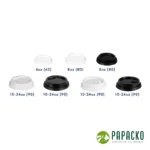
Standard cup rim diameters:
-80 mm: 8oz cups (small coffee, espresso drinks)
-90 mm: 12oz, 16oz, 20oz cups (most common—medium to large beverages)
-95 mm: 24oz+ cups (specialty sizes)
Fit testing protocol:
1.Diameter tolerance: Lid must fit ±0.5mm from specified cup rim diameter
– Too tight: Difficult to apply, rim cracks on PLA cups
– Too loose: Lid pops off during transport, spills
2.Seal band depth: 3-5mm compression zone
– Shallow (<3mm): Inadequate seal, leakage risk - Deep (>5mm): Difficult removal, customer frustration
3. Prueba de fugas: Fill cup 90% with water, apply lid, invert for 30 seconds, shake
– Pass: Zero drips
– Fail: Visible leakage or lid displacement
Material-specific fit considerations:
PLA lids:
-Brittle at cold temperatures (<10°C)—crack during application if stored in cold environments
-Pre-warm lids to 15-20°C before use in winter months
CPLA lids:
-Slightly more flexible than PLA—better cold-temperature performance
-Opaque appearance makes it harder to see if lid is properly seated
Fiber lids:
-Slightly variable diameter (±0.8mm) due to molding process
-Test multiple samples from batch to ensure consistent fit
US market reality (2026 data):
Key barriers:
1. Contamination concerns: Many facilities reject compostable packaging due to contamination with conventional plastics (visual similarity)
2. Tiempo de procesamiento: Compostable lids take 90-180 days vs 30-60 days for food scraps—creates inventory challenges
3. Economic model: Food scrap composting is profitable (sell finished compost); packaging composting adds cost without revenue
What this means: Even BPI-certified lids end up in landfills 60-75% of the time in most US markets.
Certificación OK Compost HOME requires breakdown in 180-365 days at 20-30°C (home compost pile temperatures)
Real-world challenges:
❌ PLA and CPLA: Nearly impossible to compost at home
-Require sustained 55-60°C temperatures
-Home piles rarely exceed 40-50°C consistently
-Will persist for years in backyard composters
✅ Fiber-based lids (PFAS-free): Genuinely home-compostable
-Break down in 90-180 days in active home composting
-Shred/tear lids into smaller pieces to accelerate breakdown
-Work best in hot composting systems (Berkeley method, tumbler composters)
Consumer behavior reality: <5% of consumers actively maintain home composting systems capable of breaking down even certified home-compostable materials.
### Scenarios Where Compostable Lids Deliver Value
✅ Scenario 1: Commercial composting infrastructure exists
-Location: San Francisco, Portland, Seattle, Boulder
-Collection: City-provided or private hauler with compostable packaging acceptance
-Impact: Real diversion from landfill (60-80% of lids actually composted)
-ROI: Environmental benefit justifies +80-140% cost premium
✅ Scenario 2: Premium brand positioning
-Business: High-end cafes, organic/health-focused brands
-Customer base: Willing to pay $0.25-0.50 premium for “100% compostable” cup+lid
-Impact: Brand differentiation, marketing advantage
-ROI: Premium pricing offsets +80-140% lid cost, generates profit
✅ Scenario 3: Regulatory compliance
-Location: Markets with single-use plastic bans (Berkeley CA, Seattle WA, EU markets)
-Requirement: Compostable or reusable lids mandated by law
-Impact: Compliance avoids fines, maintains market access
-ROI: Necessary cost of doing business
✅ Scenario 4: Corporate/institutional with closed-loop systems
-Setting: Corporate campuses, universities, hospitals with on-site composting
-Collection: Controlled waste streams, staff training
-Impact: 90%+ actual composting rate (highest diversion potential)
-ROI: Sustainability goals achieved with measurable impact
❌ Scenario 1: No composting infrastructure
-Location: Most US suburbs, rural areas, international markets without facilities
-End-of-life: Landfilled alongside conventional waste
-Impact: Zero environmental benefit vs conventional plastic
-Verdict: 80-140% cost premium wasted; consider recycled plastic lids instead
❌ Scenario 2: Contaminated waste streams
-Business: High-volume quick-service with limited staff control
-Reality: Compostable lids mixed with plastic straws, napkins, food wrappers
-Facility response: Entire load rejected, sent to landfill
-Verdict: Compostable benefit nullified by contamination; focus on customer education or skip compostables
❌ Scenario 3: Cost-sensitive operations
-Business: Budget cafes, food trucks, high-volume low-margin operations
-Customer base: Price-sensitive, not willing to pay eco-premium
-Impact: Reduced profit margins, no brand benefit
-Verdict: Conventional recycled plastic lids deliver better cost-performance balance
PFAS (per- and polyfluoroalkyl substances): Synthetic chemicals used for grease/water resistance
-Persist in environment for centuries (“forever chemicals”)
-Bioaccumulate in human tissue
-Linked to health concerns (immune system, thyroid, cancer risks)
-Increasingly regulated (EU bans, US state restrictions)
Historical use in compostable lids: Fiber-based lids used PFAS coatings for moisture resistance (2015-2022 peak usage)
Regulatory actions:
-UE: PFAS ban in food contact materials by 2026-2028 (proposal pending)
-US states: California, Maine, Washington restricting PFAS in foodware (2024-2026)
-Dinamarca: Already banned PFAS in food packaging (2020)
✅ Request third-party testing reports:
-EPA Method 537.1 (drinking water PFAS)
-Total Organic Fluorine (TOF) testing
-Certificate stating “No intentionally added PFAS”
✅ Check for PFAS-free certifications:
-Nordic Swan Ecolabel (requires PFAS-free)
-Cradle to Cradle Certified (Material Health assessment includes PFAS screening)
-” target=”_blank” rel=”noopener”>BPI certification alone does NOT verify PFAS-free status
✅ Supplier transparency:
-Ask: “What coating is used for moisture resistance?”
-Acceptable answers: “Water-based dispersion”, “PLA coating”, “Wax-based”, “Uncoated”
-Red flags: “Proprietary formula”, “Trade secret”, “Fluoropolymer” (likely PFAS)
Practical test: Total Organic Fluorine (TOF) screening
-Send lid samples to lab (Eurofins, SGS)
-Cost: $150-300 per sample
-Result: TOF <100 ppm = likely PFAS-free; >100 ppm = investigate further
❌ Error #1: Assuming “compostable” means “better for the environment” without infrastructure verification
✅ Enfoque correcto: Check if commercial composting exists in your service area (contact local waste haulers, municipality). If no composting access exists, compostable lids deliver zero environmental benefit vs conventional lids and waste 80-140% cost premium. Consider recycled plastic lids instead.
❌ Error #2: Using PLA lids for very hot beverages (90-95°C coffee)
✅ Enfoque correcto: PLA softens at 55-60°C and deforms with hot coffee. Use CPLA (heat-tolerant to 95°C) or fiber-based lids for hot beverages. Reserve standard PLA for iced drinks and warm beverages ≤80°C. Test with your actual beverage temperatures before bulk ordering.
❌ Error #3: Trusting “compostable” claims without third-party certification verification
✅ Enfoque correcto: Verify BPI, TÜV Austria, or CMA certification numbers on certifier websites before purchase. 34% of “compostable” lids lack legitimate certification. Reject products with only “biodegradable” claims or generic eco-symbols without certifier names.
❌ Error #4: Assuming fiber-based lids are automatically PFAS-free
✅ Enfoque correcto: Many fiber lids (especially 2018-2023 production) contain PFAS coatings. Request Total Organic Fluorine (TOF) test reports or “no intentionally added PFAS” certificates. Specify PFAS-free requirements in purchase orders.
Compostable cup lids are beverage container lids made from materials (PLA, CPLA, molded fiber) that biodegrade into compost within 90-180 days under commercial composting conditions (58°C). They must meet standards like ASTM D6400 (US) or EN 13432 (EU) and carry third-party certifications (BPI, TÜV Austria) to verify compostability claims.
Reality check: 60-75% of compostable lids are landfilled in most US markets due to lack of commercial composting infrastructure, facility contamination concerns, and consumer disposal errors. Only ~22-28% of US population has access to composting programs that accept compostable packaging. Infrastructure availability determines real-world environmental benefit.
PLA (polylactic acid) is clear, handles temperatures up to 85°C, and costs 40-60% more than plastic. CPLA (crystallized PLA) is opaque, heat-tolerant to 95°C (suitable for hot coffee), 25-30% more rigid, and costs 15-25% more than PLA. Choose PLA for cold drinks; CPLA for hot beverages.
PLA and CPLA lids: No—require 55-60°C sustained temperatures found only in commercial facilities. Will persist for years in home composters. Fiber-based lids with OK Compost HOME certification: Yes—break down in 90-180 days if shredded and placed in active hot composting systems (Berkeley method, tumblers). Cold compost piles may take 1-2 years.
Check for: (1) Third-party certification logo and number (BPI, TÜV Austria, CMA), (2) Verify certificate number on certifier’s website database, (3) Request test reports showing ASTM D6400 or EN 13432 compliance, (4) Reject products with only “biodegradable” claims or generic leaf symbols without certifier names. 34% of “eco-friendly” lids lack legitimate certification.
Not automatically. Many fiber-based lids (2018-2023 production) used PFAS coatings for moisture resistance. Modern alternatives use water-based or PLA coatings. Request Total Organic Fluorine (TOF) test reports (<100 ppm) or “no intentionally added PFAS” certificates. PLA and CPLA lids are inherently PFAS-free (made from plant sugars, not coated).
PLA lids: 80-100% more than conventional plastic ($0.045-0.065 vs $0.025-0.035 per unit). CPLA lids: 120-140% more ($0.055-0.085). Fiber-based lids: 140-170% more ($0.060-0.095). For 100 —000 annual lids, expect $2,000-6,000 additional cost. Premium justified only if composting infrastructure exists or brand positioning supports price pass-through to customers.
Selecting compostable cup lids requires cutting through marketing claims to verify genuine environmental benefit. Prioritize third-party certifications (BPI, TÜV Austria, CMA), match material heat tolerance to beverage type (PLA for cold, CPLA for hot, fiber for maximum heat), confirm PFAS-free status, and critically—verify actual composting infrastructure exists in your service area.
Principales conclusiones:
1. Certification verification is mandatory—34% of “compostable” products lack legitimate third-party certification
2. Infrastructure determines real-world impact—60-75% of compostable lids are landfilled without local composting access
3. Material selection must match beverage temperature—PLA fails above 85°C; use CPLA or fiber for hot coffee
4. PFAS-free verification protects health and compliance—request TOF test reports for fiber-based lids
5. Cost premium requires business justification—80-170% higher costs justified only with infrastructure, regulation, or brand premium
-“>Accesorios de embalaje
-“>Soluciones de embalaje sostenible
-“>Guía sobre envases compostables
Papacko supplies coffee shops, cafes, and foodservice operations with BPI and TÜV Austria certified compostable cup lids in PLA, CPLA, and PFAS-free fiber materials. Our range includes 80mm and 90mm standard sizes, dome and flat lid designs, and full documentation (certification numbers, TOF test reports, food safety compliance)—with MOQs starting from 10,000 units for stock sizes and 50,000 units for custom printing.
Póngase en contacto: