¿Está listo para crear sus propios vasos o envases de papel con su marca?
Díganos sus requisitos -tamaño, revestimiento, impresión y destino- y nuestro equipo le preparará un presupuesto detallado en 24 horas.

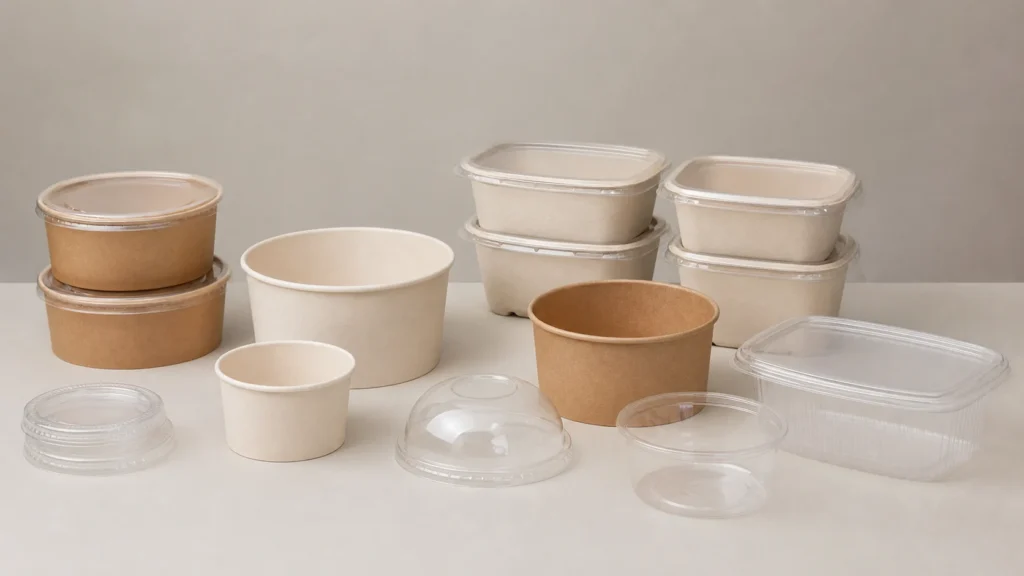
La adquisición de recipientes alimentarios con tapas a juego es una de las decisiones en materia de envases para el sector de la restauración que premia la disciplina en la compra y castiga las conjeturas. Una tapa que encaja el 99 % de las veces no es adecuada para una cocina profesional. Un cierre hermético que aguanta las ensaladas frías pero que falla ante la presión del vapor de un curry caliente es una decisión específica por referencia de producto (SKU), no una afirmación universal. Esta guía acompaña a los compradores B2B —operadores de catering, gestores de cocinas fantasma, empresas de catering por contrato, unidades de producción centralizadas y equipos de compras del sector hostelero— a lo largo de todas las etapas de esa decisión, desde el tipo de alimento y la temperatura de llenado hasta la mecánica de cierre y el muestreo previo al volumen de producción.
Echa un vistazo a toda la gama en Envases para alimentos Papacko Antes de seguir leyendo, vuelve a esta guía para aplicar el marco de evaluación a las referencias concretas que hayas preseleccionado.
Un recipiente sin tapa es un recipiente para servir. Un recipiente con tapa es un sistema de suministro. Esta distinción es importante porque todos los requisitos funcionales de la tapa se derivan de la función que el recipiente ya está destinado a cumplir.
Contención sin fugas. El requisito más básico es que el envase cerrado no presente fugas de su contenido principal —líquido, salsa, aceite o humedad— durante el proceso de manipulación, desde el punto de llenado hasta el consumidor. Entre los modos de fallo por fugas se incluyen una unión imperfecta entre el borde y la tapa, una tapa que se deforma bajo la presión interna y una bisagra o lengüeta que crea un microespacio cuando no está completamente encajada.
Gestión del ambiente. Dependiendo del alimento, la tapa debe permitir la salida de vapor (en el caso de alimentos calientes que, de lo contrario, provocarían la acumulación de condensación), retener la humedad (en el caso de alimentos que se secan) o mantener una atmósfera modificada (en el caso de componentes de comidas preparadas destinados a una vida útil prolongada). Estos tres requisitos son incompatibles entre sí en un mismo diseño de tapa, por lo que los compradores que ofrecen menús variados suelen disponer de más de un tipo de tapa, incluso cuando la base del envase es idéntica.
Integridad estructural bajo carga. En el ámbito de la entrega a domicilio y el catering, los envases se apilan, se transportan en contenedores y se colocan en bolsas isotérmicas. La tapa debe soportar la carga de compresión sin deformarse hasta el punto de presionar los alimentos o desprenderse del borde. La integridad estructural depende tanto del material como de la geometría: un perfil abovedado distribuye la carga de forma diferente a una tapa plana.
Posibilidad de apertura en el punto de consumo. Una tapa que cierra a la perfección, pero que requiere herramientas o fuerza con ambas manos para abrirla, genera una experiencia negativa para el consumidor. Para los compradores B2B que suministran a plataformas agregadoras, el proceso de desembalaje visible para el consumidor forma parte de la propuesta de servicio.
Eficiencia en el apilamiento en el almacén. Las pilas premontadas (con la tapa ya colocada en el envase) ocupan más espacio lineal en las estanterías que las pilas de envases anidados con las tapas guardadas por separado. Los compradores con espacio de almacenamiento limitado en la trastienda deben sopesar el coste de la mano de obra de montaje frente al espacio de almacenamiento que ocupan.
Compatibilidad con el etiquetado y la imagen de marca. Muchos operadores colocan etiquetas impresas térmicamente en la superficie plana de la tapa. La superficie de la tapa debe adherir bien el adhesivo de la etiqueta y presentar un área de impresión legible.
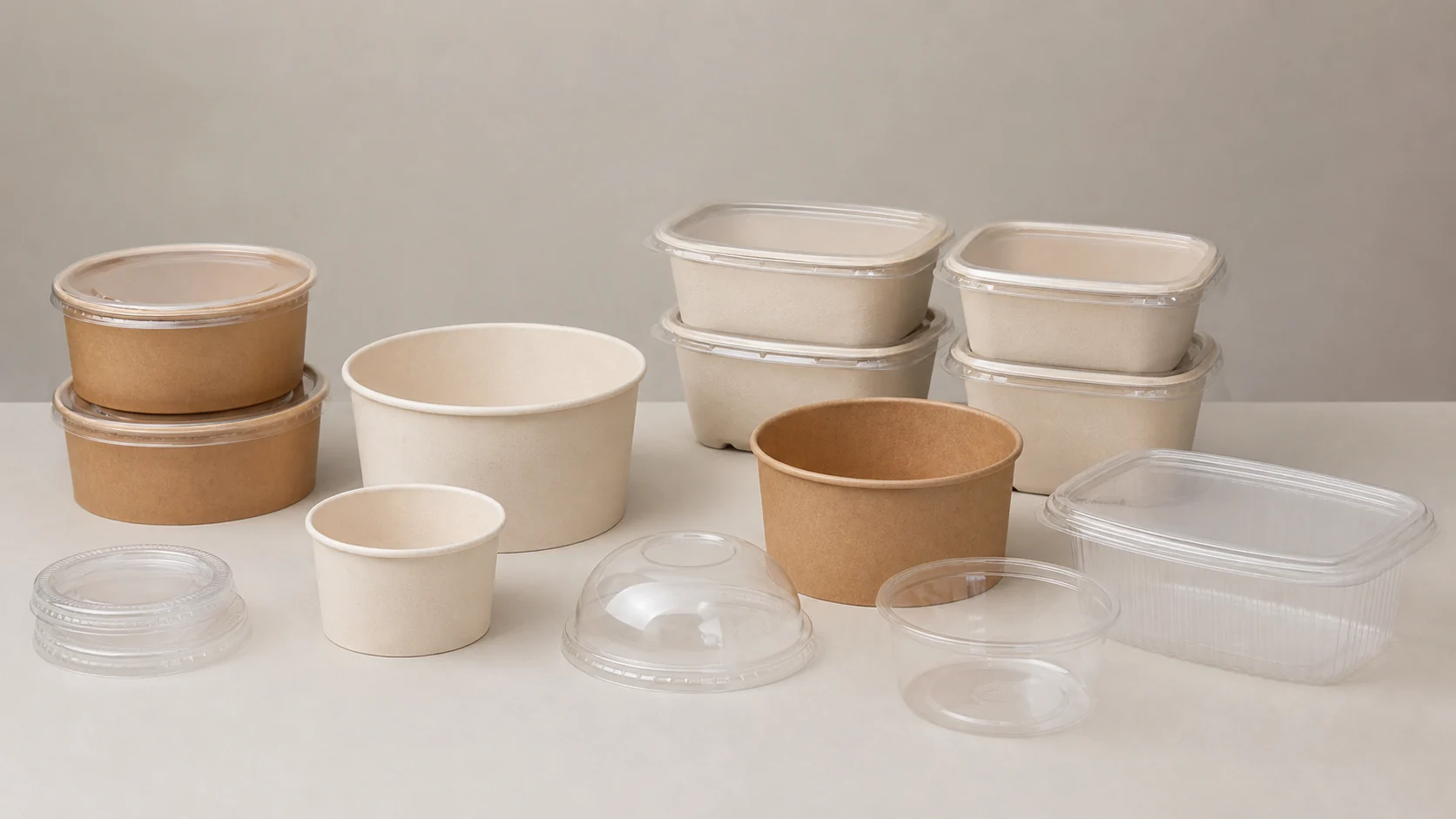
Antes de evaluar cualquier referencia de envase y tapa, documenta tres parámetros para cada plato del menú que vaya a contener el envase.
Clasifica cada producto: a temperatura ambiente, tibio, caliente en el momento del llenado, congelado o refrigerado tras el llenado. Esta única variable influye en la selección del material más que cualquier otro factor. Los envases de papel con revestimiento de PE o PLA se comportan de forma diferente ante una exposición prolongada al calor en comparación con los envases de polipropileno. Un envase apto para el llenado en caliente con un material determinado puede deformarse o que la tapa se suelte en las mismas condiciones de llenado si se utiliza otro material.
Clasifica cada producto según una escala práctica: seco o con baja humedad (bocadillos, bollería), humedad media (platos de cereales, pasta sin exceso de salsa), alta humedad (sopas, currys, proteínas estofadas, guisos) o líquido libre (bebidas, caldos). Esta clasificación se corresponde directamente con el tipo de cierre necesario. Un cierre por fricción o con lengüeta que funcione correctamente en un cuenco de humedad media no será adecuado para sopas con líquido libre. Las sopas requieren o bien una tapa totalmente empotrada con cierre seguro, o bien un recipiente para sopa independiente diseñado como una unidad.
Documenta el recorrido: llenado → control de calidad → bolsa o envase → transporte → entrega a la plataforma de reparto → consumidor. Anota cada punto de transferencia, ya que cada uno de ellos supone una oportunidad de que la tapa se suelte. Un conjunto de envase y tapa destinado a una entrega local de 10 minutos tiene unas especificaciones de resistencia diferentes a las de uno destinado a una ruta de un agregador de 45 minutos, en la que la bolsa se levanta, se deja en el suelo y se traslada varias veces.
FIG. 1 — Colocación recomendada: Un diagrama de flujo que relaciona el estado de los alimentos (calientes / templados / refrigerados / congelados) con la vía de distribución (servicio en mostrador / entrega a domicilio / traslado para catering), indicando el tipo de cierre de la tapa recomendado en cada intersección.
Para los operadores que trabajan en distintos segmentos del sector alimentario, el Envases alimentarios desechables Papacko Esta categoría ofrece un punto de partida útil para revisar qué familias de contenedores están disponibles antes de asignarlas a la matriz anterior.
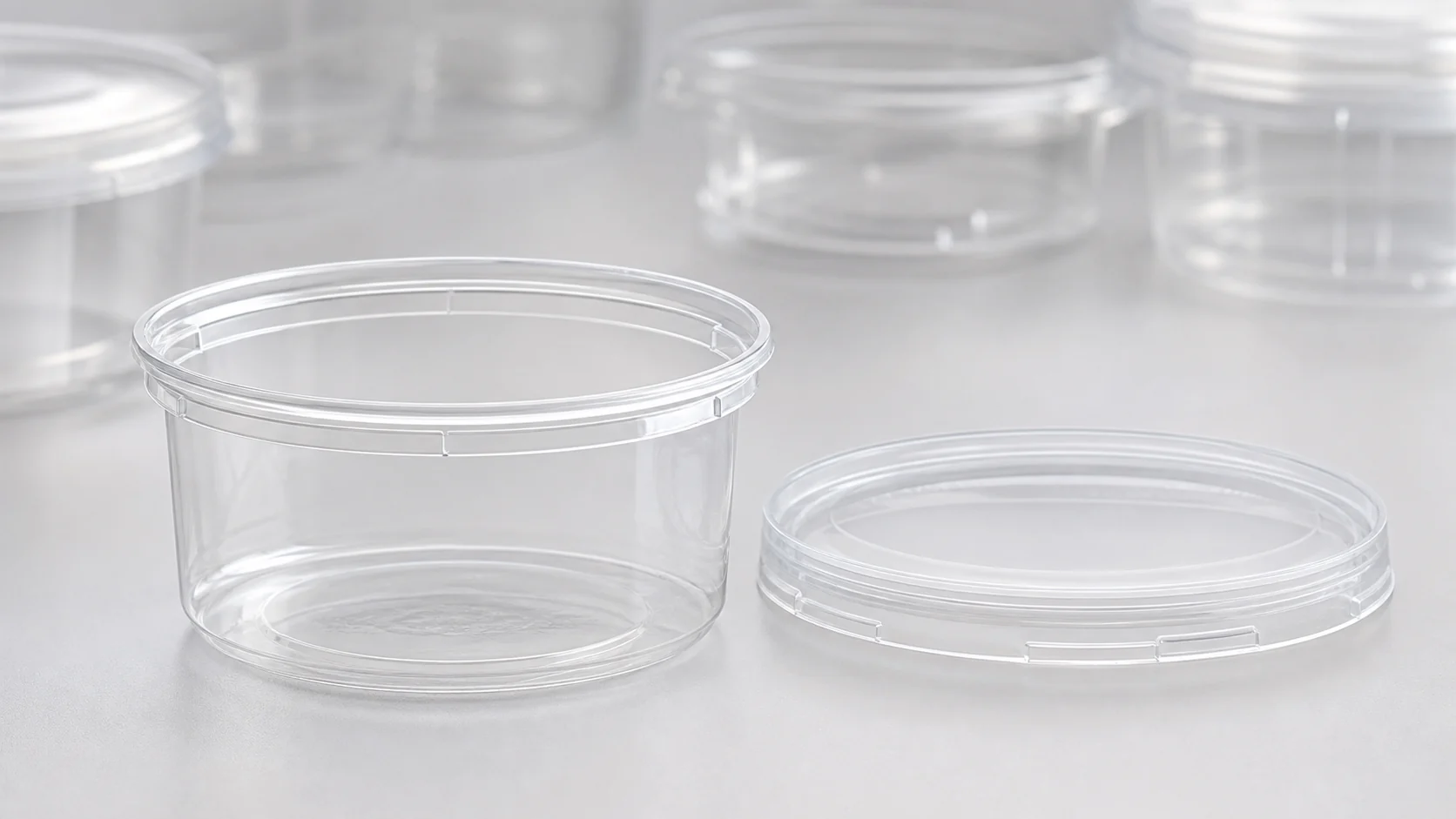
Esta es la sección que la mayoría de los compradores se saltan porque les parece obvia. No es obvia, y el precio que se paga por saltársela son devoluciones, reclamaciones y la búsqueda urgente de nuevos proveedores.
El ajuste no es una simple coincidencia visual. El ajuste significa que la tapa se asienta completamente sobre el borde del envase bajo la presión que ejerce un trabajador de cocina cualificado con un movimiento normal de montaje, que la tapa, una vez asentada, no se desprenda bajo las fuerzas de manipulación descritas en su mapa de ruta, y que se suelte sin problemas bajo la fuerza que un consumidor aplicaría razonablemente.
La geometría del borde es la variable determinante. Los envases del mismo diámetro nominal de dos fabricantes distintos pueden presentar perfiles de borde diferentes: el diámetro interior, el diámetro exterior, la altura del borde y el radio de curvatura del borde pueden variar en fracciones de milímetro, lo que marca la diferencia entre un ajuste seguro y una tapa que salta al someterse a presión lateral.
La norma es sencilla: la tapa y el envase deben validarse como un conjunto, no como referencias individuales. Esto significa que tu orden de compra hace referencia a ambos SKU a la vez, que en el control de entrada de mercancías se verifican ambos y que cualquier sustitución de uno de ellos a mitad de temporada conlleva una nueva validación del par.
Cierre por solape (por fricción). El faldón de la tapa se introduce por dentro o alrededor del borde del envase. Rápido de colocar, fácil de retirar y con un bajo coste de utillaje. El cierre se basa íntegramente en un ajuste por interferencia. Adecuado para alimentos a temperatura ambiente o con bajo contenido en humedad, con rutas de manipulación cortas.
Cierre con lengüeta. La tapa tiene una o varias lengüetas que se enganchan por encima o por debajo del borde. Proporciona un cierre más firme que el que se consigue solo con la fricción. Requiere una acción deliberada para abrirla. Es habitual en envases redondos para alimentos con un nivel de humedad medio.
Borde de cierre a presión o con bloqueo empotrado. El borde del envase cuenta con una ranura o reborde en el que encaja la tapa a presión. Esto garantiza el cierre más seguro para aplicaciones con alto contenido de humedad y llenado en caliente. Requiere una mayor fuerza de montaje y un desenganche deliberado. Es habitual en envases de sopa y en formatos de entrega de alta gama.
Cierres «fold-flat» y «tuck» en formatos de papel. Kraft and paper bowls often use a different lid geometry entirely—a paper lid that wraps over the bowl rim with a tuck tab. Evaluate these as a distinct category. The Papacko kraft paper bowls range illustrates how paper bowl and lid pairings work as an integrated format, and complementary lid options are detailed at Papacko paper bowl lids.
FIG 2 — Suggested placement: Cross-section diagram showing four closure types (tuck-under, tab-lock, recessed snap, paper tuck) with the interface geometry annotated for each.
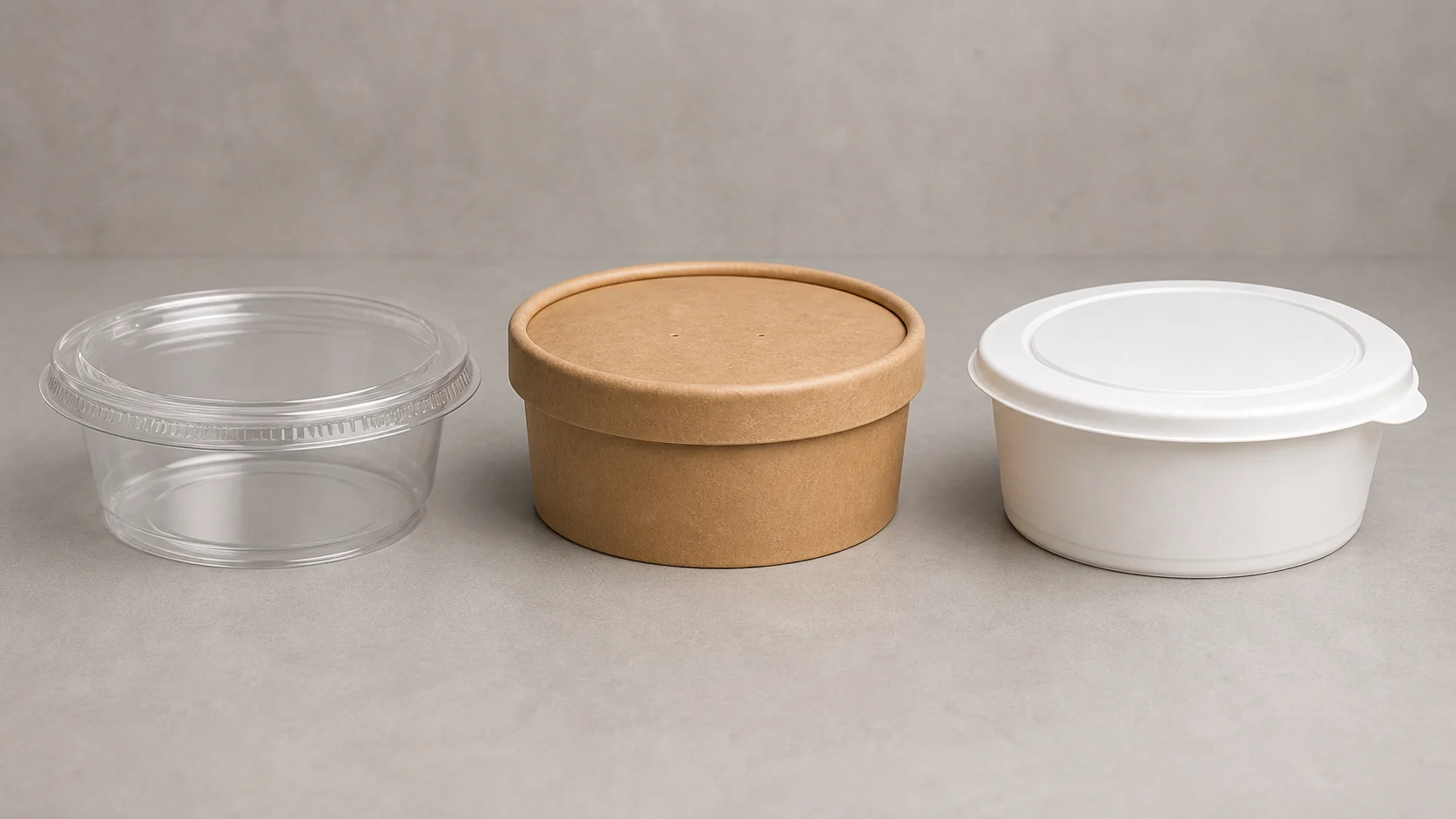
Seal quality and handling practicality sit in tension. Understanding the trade-offs explicitly allows buyers to make deliberate compromises rather than discovering them at the complaint stage.
A recessed snap closure provides the best moisture and vapour seal, but it requires more force and a two-handed or braced motion to engage fully. In a high-volume kitchen operating at cover speed, that extra second per unit accumulates. Buyers sourcing for central production units with packing lines accept that trade-off; buyers sourcing for table-service kitchens doing ad hoc takeaway orders may not.
Document your kitchen’s expected units-per-hour pack rate before specifying closure type.
Hot foods generate steam after lidding. If the lid seals completely, that steam condenses on the underside of the lid and drips back onto the food, softening bread, diluting sauces, and degrading presentation. Vented lids (with one or more small perforations or a structured vent tab) allow steam to escape but also allow the food to cool faster.
For hot foods on long delivery routes, buyers sometimes choose a vented lid and accept faster cooling rather than a sealed lid and condensation. Neither is universally correct. The choice depends on food type and route duration.
A high dome lid provides headroom for garnished dishes, assembled salads, or plated presentations. It also increases the stacked height per unit, reducing how many stacks fit in a delivery bag or insulated carrier. Flat or low-profile lids maximise carrier density but cannot accommodate tall food builds.
Calculate your carrier capacity with both lid profiles before ordering at volume.
Many operators face procurement requirements or local authority expectations regarding material sustainability or recyclability. Paper-lidded paper containers have a different end-of-life profile than clear PET lids on paper bases (which are typically non-recyclable as a composite). Buyers should review current guidance from regulators and their local waste infrastructure, and reference the FDA food contact materials guidance for any market where regulatory alignment is a purchasing requirement.
FIG 3 — Suggested placement: Trade-off matrix grid with seal tightness, assembly speed, venting, dome height, and material recyclability on one axis, and closure types on the other, showing relative performance without numerical scores.
No reputable packaging supplier—Papacko included—expects buyers to commit to volume without a sample stage. Formalising your sample review process protects both parties and reduces the risk of a large order arriving that fails your specific operational conditions.
Write a one-page brief before samples arrive. The brief should state: food types, fill temperatures expected, moisture classification, handling route, assembly method (manual or machine-assisted), closure force acceptable, and any label or print requirements. When samples arrive, review them against the brief—not against a general impression.
This means filling the container with your actual food at your actual fill temperature and lidding it as it would be in your kitchen. Then subject it to your actual handling route—including placing it in your carrier, simulating a transit period, and opening it as a consumer would. Do not test with water as a proxy for curry unless you have confirmed that water’s surface tension and viscosity are representative. Review the pair with the food it will carry.
The people who will lid 200 units per service know within five applications whether a closure is practical at cover speed. Their input is procurement data, not opinion.
Record: did the lid seat fully on every application attempt; did the sealed unit retain its contents through the transit simulation; did condensation form and in what quantity; did the lid release cleanly; was the label surface acceptable. Inferences about what would happen at volume are not sample review findings.
FIG 4 — Suggested placement: Sample review form template with rows for each review criterion and columns for pass, marginal, and fail, with a notes field per row.
The table below compares container-and-lid format types across procurement-relevant dimensions. No numerical claims are made about specific SKU performance. Use this as a framework to apply to the exact SKUs you are evaluating.
| Format Type | Typical Food Application | Closure Mechanism | Moisture Suitability | Venting Option | Material Recyclability Profile | Assembly Speed |
|---|---|---|---|---|---|---|
| Clear PET round with tab-lock lid | Cold salads, desserts, ambient prep | Tab-lock | Low to medium | Typically no | Check local infrastructure | Fast |
| Polypropylene round with snap lid | Hot meals, curries, soups | Recessed snap | Alto | Some SKUs offer vent | Generally recyclable where collected | Moderado |
| Kraft paper bowl with paper tuck lid | Soups, noodles, warm bowls | Paper tuck-tab | Medio | Partial venting inherent | Depends on lining; check SKU | Moderado |
| Rectangular PET with hinged lid | Sandwiches, cold platters, salads | Integrated hinge/friction | Bajo | No | Check local infrastructure | Very fast |
| Black PP base with clear PP dome lid | Hot meals, presentation delivery | Friction or tab | De medio a alto | Some SKUs | Generally recyclable where collected | Fast |
| Bagasse round with fibre lid | Hot foods, organic-certified menus | Friction or friction-tab | Medio | Partial venting inherent | Compostable where facility exists | Moderado |
| Aluminium foil tray with board lid | Oven-to-table, catering bulk | Friction/crimp | De medio a alto | No | Aluminium recyclable; board separate | Fast |
| Paper soup container with PE lid | Soups, broths, beverages | Recessed snap or push-on | Alto | Push-on lids may vent | Composite; check local guidance | Fast |
Table is a format comparison tool, not a performance ranking. Verify all material and recyclability claims with the specific SKU data sheet and your local waste authority.
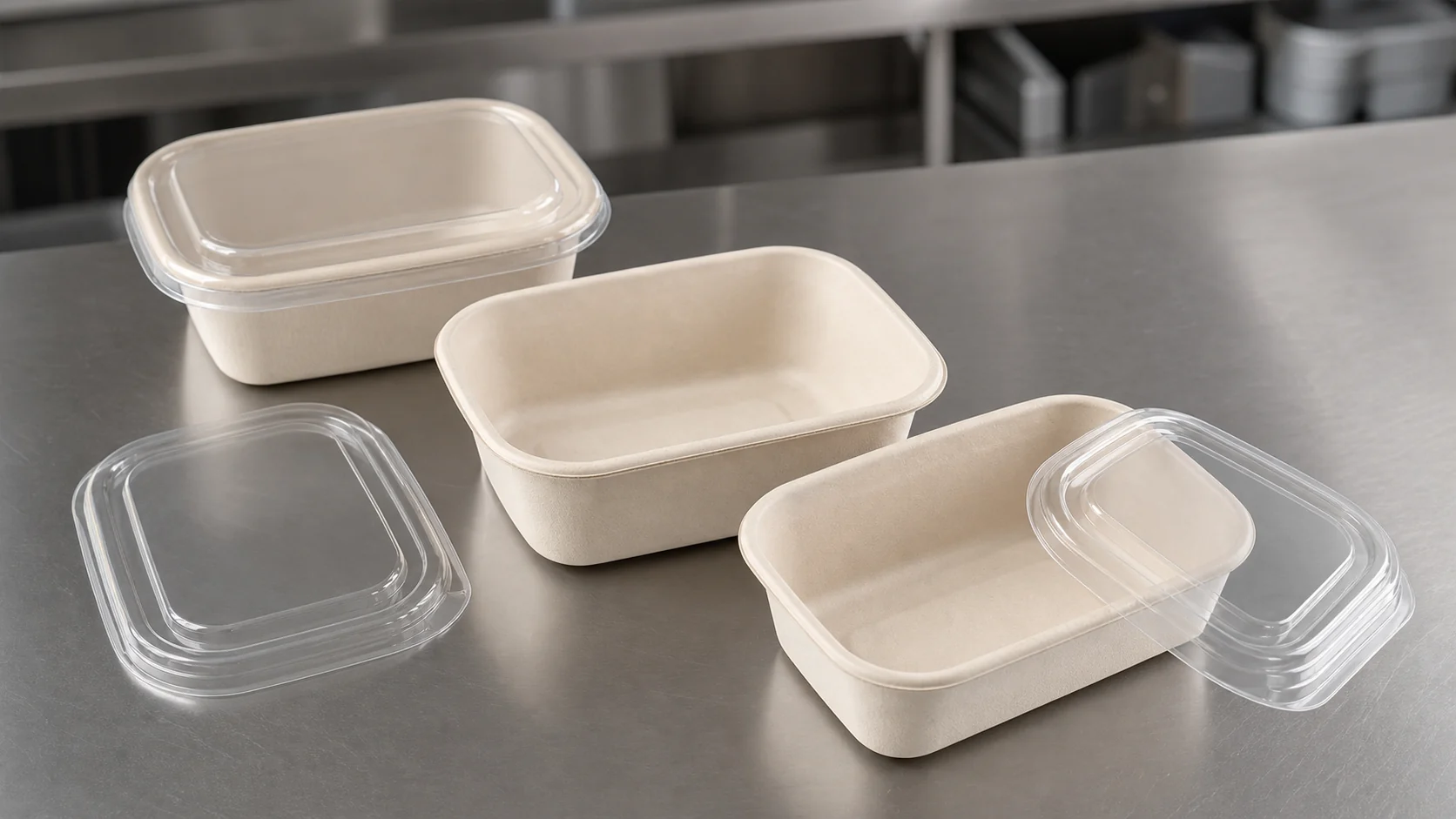
Use this checklist at the point of writing a purchase specification or placing a first order.
Food and fill
– [ ] Every menu item has been classified by food state at fill (hot / warm / ambient / chilled / frozen)
– [ ] Every menu item has been classified by moisture level (dry / medium / high / free liquid)
– [ ] Maximum expected fill temperature has been noted per food category
Route and handling
– [ ] Handling route has been documented with number of transfer points
– [ ] Estimated transit duration has been noted
– [ ] Carrier or bag type has been confirmed (insulated / ambient / open tray)
Fit and closure
– [ ] Container SKU and lid SKU have been confirmed as a validated pair from the same supplier range
– [ ] Closure type has been matched to moisture level and route duration
– [ ] Assembly motion has been reviewed with kitchen staff
Seal and venting
– [ ] Venting requirement has been confirmed for hot-fill applications
– [ ] Condensation impact on food quality has been assessed in sample review
Volume and supply
– [ ] Sample review has been completed against the actual food and fill conditions
– [ ] Minimum order quantity aligns with anticipated usage volume
– [ ] Lead time from order to delivery has been confirmed
Compliance and labelling
– [ ] Material food-contact compliance documentation has been requested from supplier
– [ ] Label adhesion on lid surface has been verified in sample stage
– [ ] End-of-life disposal route has been confirmed for each material in the pair
FIG 5 — Suggested placement: Printed version of this checklist formatted as an A4 PDF insert for procurement teams, with signature lines for buyer and kitchen manager sign-off at sample review stage.
Papacko works with B2B buyers across foodservice, contract catering, ghost kitchens, and hospitality procurement. The brief process described below is how experienced buyers structure their enquiry to get an accurate recommendation rather than a catalogue response.
Menu scope. List the food categories you are packaging, not just the container sizes. A supplier needs to know whether a 500 ml container will carry soup or salad because those are different lid specifications.
Volume and order cadence. State your estimated weekly or monthly unit requirement and whether demand is steady or seasonal. This affects whether you are buying from stock or discussing a dedicated supply arrangement.
Existing constraints. If you already have a container SKU in use that you are satisfied with and are looking only for a lid match, state this explicitly. If you are specifying both container and lid fresh, state that.
Operational constraints. Kitchen assembly method, storage space for packaging stock, and any existing label printer compatibility are relevant operational constraints that a supplier cannot infer from a menu list.
Sustainability or compliance requirements. If your procurement policy, client contract, or local authority requires specific material types or end-of-life profiles, state these at brief stage rather than after samples are agreed.
En Papacko takeaway packaging hub covers the full range of formats relevant to delivery and takeaway operations and is the recommended starting point for operators building a packaging brief for the first time.
A well-structured brief should generate a recommendation that references specific SKU pairs, not a general category. If the response you receive does not reference both the container SKU and the lid SKU as a pair, ask for clarification before proceeding to sample.
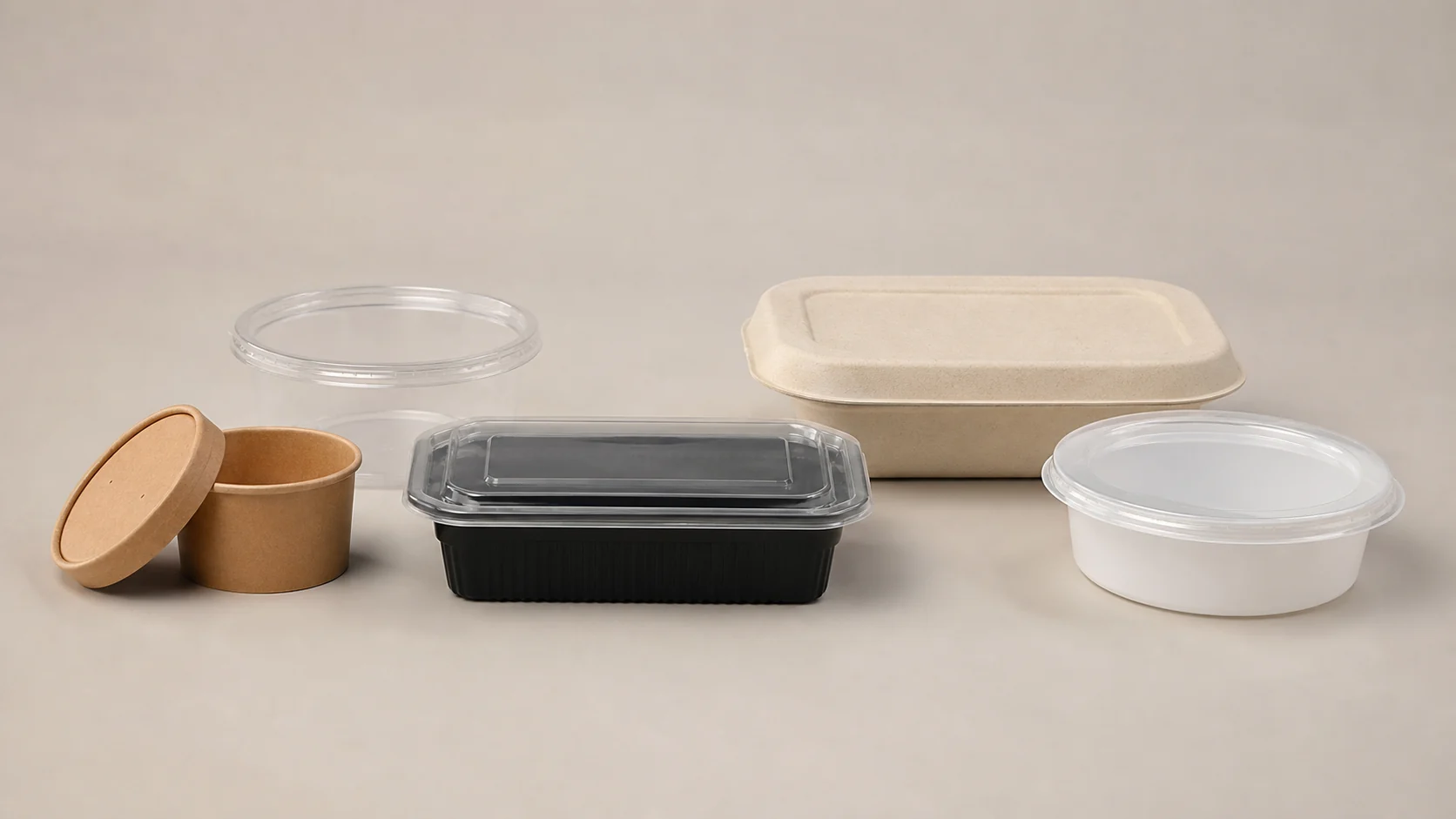
This guide was written for B2B buyers who are responsible for specifying and purchasing food packaging at commercial volumes. The frameworks, checklists, and comparison tools in this guide reflect the procurement questions that arise repeatedly in foodservice, ghost kitchen, contract catering, and hospitality procurement contexts. The guide does not address consumer retail packaging, pharmaceutical packaging, or industrial food processing formats.
The sourcing context assumed throughout is that buyers are purchasing from a commercial packaging supplier for operational deployment—not for regulatory submission, academic research, or compliance audit. Buyers in regulated markets should verify all compliance claims independently with their relevant authority.
No specific material performance figures, temperature ratings, transit time guarantees, or compliance certifications have been stated in this guide. Those figures are SKU-specific and must be sourced from the supplier’s data sheet for the exact SKU pair you are evaluating. The FDA link included in this guide points to the FDA’s food contact substances guidance page, which is a reference starting point for buyers in US-regulated markets. Buyers in other markets should consult the relevant national or regional food contact material authority.
The comparison table in this guide presents format types and procurement-relevant characteristics as a framework. It does not constitute a test report, performance guarantee, or ranking. All claims in the table should be verified against the specific SKU data sheet before purchase.
Use this guide sequentially. Start with the food, fill, and route section before evaluating any container. Apply the fit and closure section to specific SKU pairs, not to container categories in general. Run the sample review section with your actual food and fill conditions before committing to volume. Use the checklist as a sign-off tool before raising a purchase order, not as a retrospective audit tool after problems have emerged.
If your operation spans multiple food types, multiple fill temperatures, or multiple handling routes, you may need more than one container-and-lid pair. This guide supports that conclusion—it does not suggest that a single pair can serve all conditions.
You can attempt to, but you cannot assume compatibility without validating the specific pair under your operational conditions. Rim geometry—including inner diameter, outer diameter, rim height, and curl profile—varies between manufacturers even when nominal sizes appear to match. The only reliable validation is to fill your actual container with your actual food, apply the candidate lid under your assembly conditions, and subject the sealed unit to your handling route. If the pair performs acceptably across that sequence, it is a usable pair. If it does not, it is not—regardless of what the nominal dimensions suggest.
The decision point is whether the food generates steam after lidding under normal service conditions. Hot foods—soups, braised dishes, rice, pasta with sauce, steamed proteins—generate steam that will condense on an unvented lid and return as condensate to the food. If condensate on your specific food degrades presentation or eating quality within the timeframe of your route, a vented lid is preferable. If the food is at or near ambient temperature at fill, or if condensation does not affect the food type, a sealed lid is preferable. Review this with your sample under actual fill conditions rather than making an assumption by food category.
A friction fit lid relies on the interference between the lid skirt and the container rim to remain in place. Heat can soften some materials slightly, which may reduce the interference fit over time in a hot-fill application. A snap-lock or recessed-snap lid engages a positive mechanical feature—a bead, channel, or tab—that requires deliberate force to disengage. For hot, high-moisture foods on longer handling routes, a positive mechanical closure is generally more appropriate than a friction fit, but the correct specification depends on the exact material and rim geometry of the SKU pair you are evaluating. Request the supplier’s guidance on the heat tolerance of the specific closure mechanism before specifying.
Treat any change to either the container SKU or the lid SKU as a new pair requiring re-validation. This applies even if the supplier describes the change as a minor update, a formulation adjustment, or a tooling refresh. The rim geometry and closure mechanics of any changed component may have shifted in ways that affect the fit. Request samples of the new SKU before accepting delivery of a new batch, and run your standard sample review against the actual food and fill conditions before approving the change.
Paper-based formats with appropriate linings can perform well under hot-fill conditions for certain food types, but the performance is specific to the lining material, the paper weight, and the lid format. A paper tuck-tab lid on a PE-lined kraft bowl behaves differently from a push-on plastic lid on the same bowl. For paper formats under hot-fill conditions, pay particular attention to whether the lining maintains integrity at the rim—this is the interface point where steam and moisture most commonly stress paper-composite formats. Review the specific SKU data sheet and validate with your sample review.
Request enough units to cover at least three separate fill sessions under your actual kitchen conditions, with a minimum of five to ten units per session. This gives you data across different staff members applying the lid, different food temperatures within your normal service range, and different positions in a delivery bag or carrier. A single fill-and-check on two units is not a sample review—it is a visual inspection. The value of the sample stage is identifying failure modes that only appear under repetition or variation, and that requires a meaningful number of units across realistic conditions.
This guide is an editorial procurement resource. All SKU-specific performance, compliance, and material claims must be verified with the supplier data sheet for the exact products under evaluation. Papacko product links included in this guide are provided for navigation and reference. Regulatory guidance should be sourced from the relevant authority for your market.