¿Está listo para crear sus propios vasos o envases de papel con su marca?
Díganos sus requisitos -tamaño, revestimiento, impresión y destino- y nuestro equipo le preparará un presupuesto detallado en 24 horas.

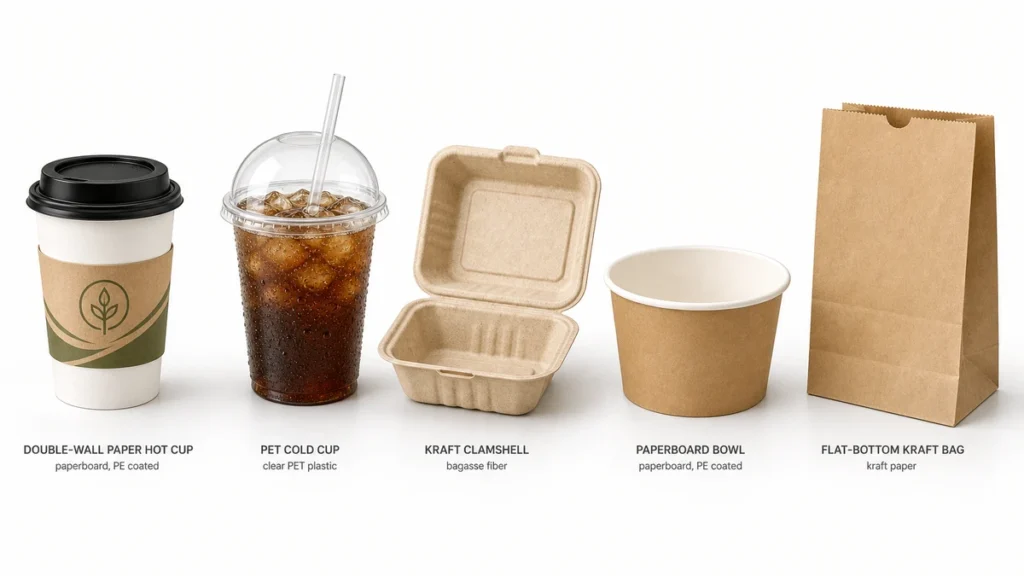
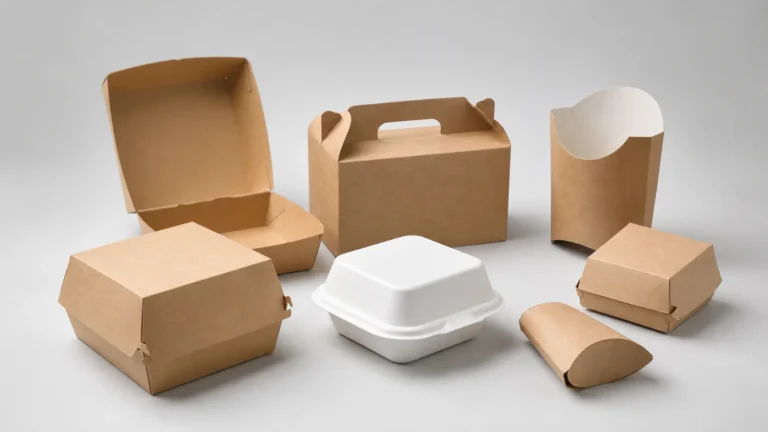
Wholesale food packaging is bulk packaging bought for foodservice or resale, usually by case or pallet. It includes cups, lids, bowls, trays, bags, wraps, and containers. For cafes, QSR operators, and distributors, the right choice is not just about price. It is about matching material, lid fit, compliance, storage, and replenishment speed to how the operation actually runs.
Retail packaging can be bought in small quantities and changed quickly. Wholesale food packaging is different because MOQs, case packs, and lead times affect every ordering decision. A lower unit price can be misleading if the stock sits too long, a custom run takes too long to arrive, or lids do not fit the cups you already use.
For most buyers, the first questions are practical: How much do I need, how fast can I get it, and can I prove it meets food-contact requirements? A good supplier should answer those questions with clear specifications, not just a catalog page.
The best assortment starts with the menu, then the container. That means choosing by use case first, then narrowing the material and finish.
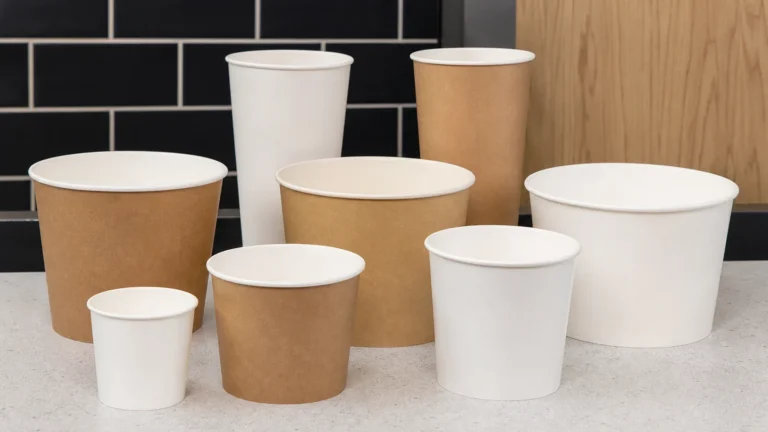
Hot cups are a core buying category for cafes and delivery-focused operators. Single-wall paper cups are often the lower-cost option, while double-wall cups improve hand comfort and can reduce sleeve use. For buyers comparing vasos de papel, the real variable is not only cup volume but rim diameter, lid style, and whether the coating suits the drink temperature.
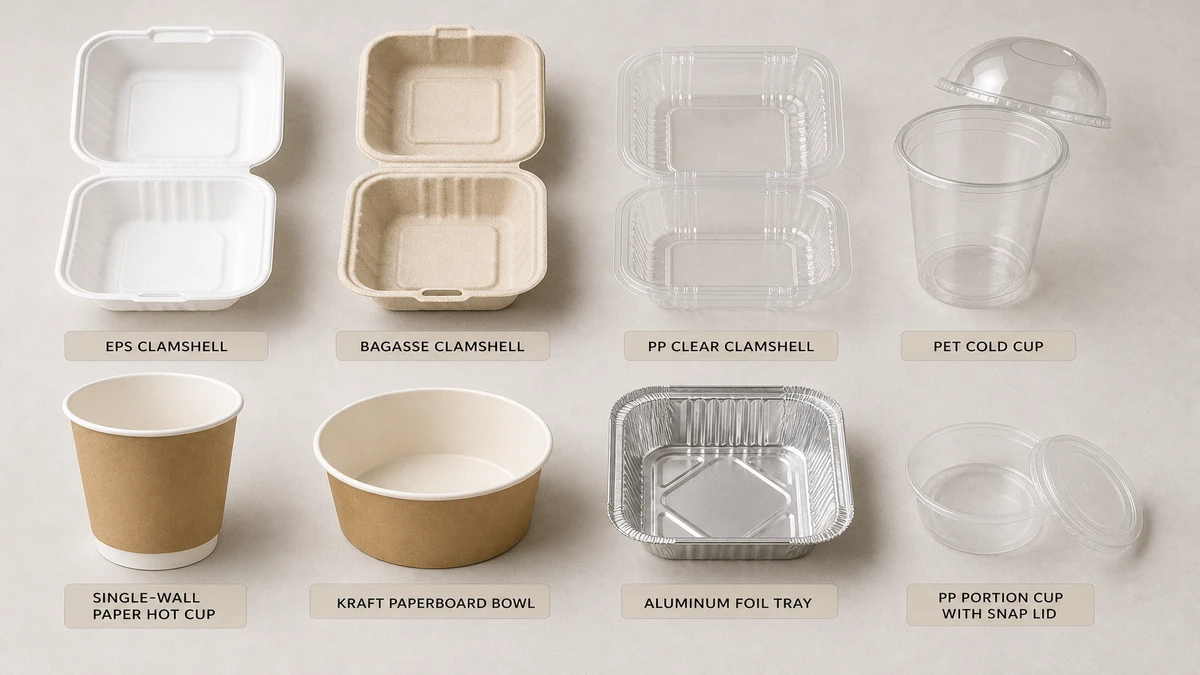
Cold drink programs need clarity, stacking stability, and reliable lid fit. PET often offers strong visibility for iced drinks and smoothies, while PP is often better for certain acidic beverages and higher temperature tolerance. Review compatible tapas para tazas de café when comparing cold-cup formats for cafes or QSR beverage menus.
Bowls and trays need a balance of grease resistance, rigidity, and heat performance. Kraft bowls work well for many dry or lightly sauced items, while PP portion cups are a dependable choice for condiments and sides. For buyers comparing envases para alimentos, lid fit and stacking strength should be checked before the order is approved.
Wraps and bags are easy to under-specify. A simple paper wrap may be fine for a dry item, but breakfast sandwiches, greasy burgers, or delivery-heavy menus often need more barrier performance. Greaseproof paper, foil-laminate wraps, and paper bags each serve a different operational need. Related accesorios de envasado should be reviewed at the same time so cups, lids, bags, and wraps work as one service system.
| Categoría | Best Fit Scenarios | Cost Position | Key Limitations |
|---|---|---|---|
| Single-wall hot cups | High-volume cafes with sleeves | Bajo | Needs sleeve for hotter drinks |
| Double-wall hot cups | Premium takeaway, hand comfort | Medium to High | Higher unit cost |
| PET cold cups | Iced beverages, clear presentation | Low to Medium | Recycling access varies |
| PP cold cups | Acidic drinks, temperature flexibility | Low to Medium | Less clarity than PET |
| Kraft bowls | Dry or lightly sauced foods | Low to Medium | Can soften with prolonged moisture |
| PP portion cups | Sauce, sides, condiments | Bajo | Not oven-safe |
| Greaseproof wraps | Sandwiches and burgers | Bajo | Limited insulation |
| Foil-laminate wraps | Hot wraps and breakfast items | Low to Medium | No compostable |
Each buyer type values different details. Cafes usually care about presentation and speed at handoff. QSR operators care about consistency across sites. Distributors care about documentation, reorder reliability, and resale readiness.
Cafes usually need a compact but flexible mix: hot cups, cold cups, lids, bags, and a few container families that cover the menu. Lid fit matters more than volume alone. If a cup and lid come from different suppliers, the rim profile should be tested on the exact SKU before any rollout.
QSR buyers usually focus on repeatability. The spec must work the same across every store, every week. That means confirming coating, venting, heat tolerance, grease resistance, and case pack before launch. It also means planning for speed at the counter and durability in delivery.
Distributors need products that are easy to store, pick, and resell. Standard carton sizes, stable supply, and complete documentation matter as much as the pack itself. A distributor should ask for food-contact declarations, material descriptions, and country-of-origin details for each SKU.
Before approving any wholesale food packaging order, confirm:
– MOQ per SKU or per case
– Lead time for stock and custom runs
– Sample availability
– Lid fit on the exact container
– Coating or lining type
– Food-contact compliance documents
– Case-pack count and carton size
– Reorder process and stock continuity
Material choice affects performance, waste handling, and customer experience. Coating choice affects heat resistance, grease resistance, and compliance documents. Lid fit affects everything from leak risk to service speed.
Single-wall paper cups are usually better when cost and storage efficiency matter most. Double-wall cups are better when hand comfort, premium presentation, or longer heat retention is important. The right answer depends on the menu and service style, not just the product name.
PE-lined board is common and performs well for many hot and cold applications. Other coatings may support different sustainability or waste-stream goals, but they can also change heat tolerance and certification requirements. Buyers should request the exact coating or lining specification, not a generic description like “paper cup.”
Lid fit problems are one of the most common causes of packaging failure. A lid may look correct on paper but still leak, pop off, or seat too tightly. Rim diameter, wall profile, and lid style must be matched and sample tested before a purchase order is finalized.
Samples are not optional when changing suppliers or moving to a new material. A physical sample helps confirm hand feel, stackability, lid seal, print quality, and fill performance. For menu-critical items, test samples with the actual beverage or food before ordering at scale.
Wholesale buying is often a logistics decision. A low unit price can be offset by slow dispatch, high freight cost, or excess stock that will not turn fast enough.
MOQ may be per SKU, per case, or per pallet. What matters is whether that quantity fits your usage rate. A cafe with steady daily sales may handle a higher MOQ, while a seasonal or low-volume account may need smaller case packs to avoid dead stock. Distributors should also check whether cartons are uniform enough for efficient storage and picking.
Lead time is not just production time. It includes order processing, dispatch, freight transit, and any reorder delay inside your own operation. Stock items are usually faster than custom printed items, while new tooling or special materials can add more time. Buyers should plan buffer stock for core SKUs, especially when a launch or promotion depends on on-time delivery.
A serious supplier should be able to provide samples, technical sheets, and guidance on the right material for the use case. If the supplier cannot explain the coating, lid profile, or food-contact document for the exact item, the risk is on the buyer.
Keep these documents on file:
– Food-contact declaration for the exact SKU
– Material and coating specification
– Test reports where relevant
– Compostability certificate, if claimed
– Country-of-origin details
– Print specification for branded items
– Any import paperwork required by your market
Compliance is part of the product spec, not an afterthought. A pack that looks right but lacks the right paperwork can stop a shipment or create problems during customer onboarding.
If packaging touches food, it must meet the rules for the market where it is sold. Buyers should ask for the declaration tied to the exact construction, including liner, coating, adhesive, and print layer where relevant.
For U.S. buyers, the FDA guidance on food-contact substances is a key reference point for food-contact materials.
A compostable claim only matters if the local waste stream can actually accept the product. Recyclability claims are also limited by local collection and sorting systems. If the market cannot process the item, the claim may not help the customer in practice.
Grease-resistant papers and wraps may require careful review because PFAS restrictions are changing in many markets. If your operation needs grease resistance, ask for written confirmation of the material approach and any relevant restrictions.
Branded packaging can support recognition and presentation, but print method should match order volume and artwork complexity.
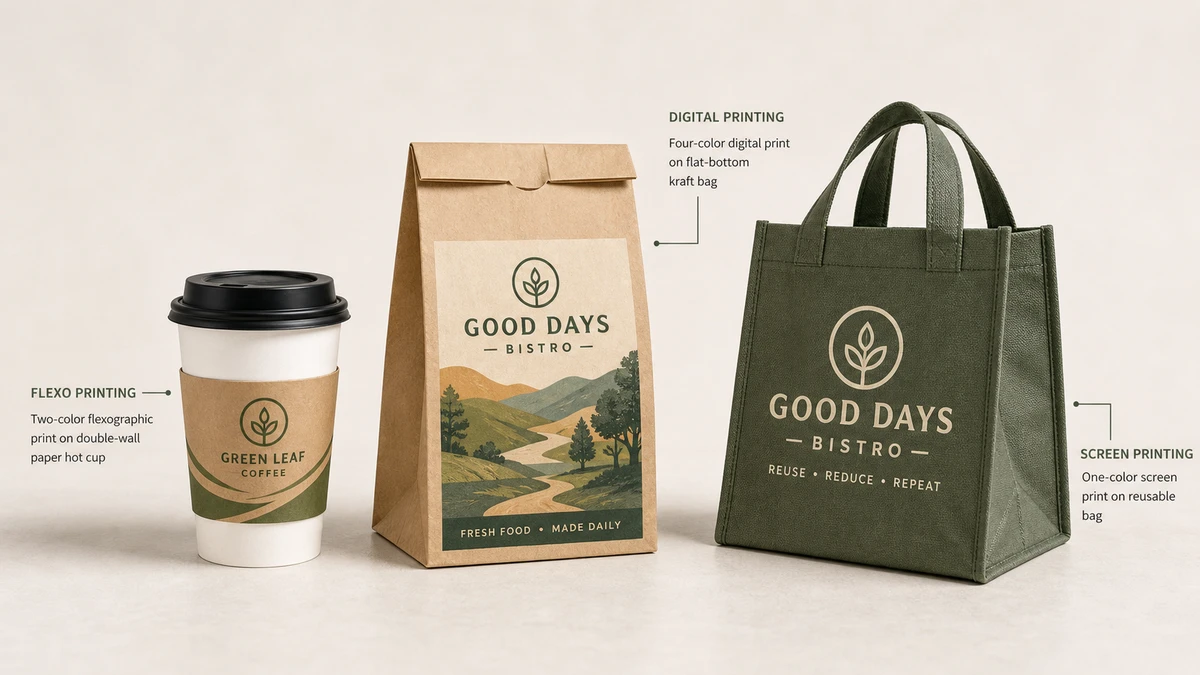
Flexo is usually the better fit for larger, stable orders. It works well for cups, bags, sleeves, and cartons at volume, but it may involve plate costs and setup time.
Digital printing suits shorter runs, seasonal artwork, and programs that change often. It reduces setup friction, but buyers should still confirm ink performance on the chosen substrate.
Screen printing is often used for simple logos on bags or reusable items. It is strong for one-color or two-color artwork, but it is not ideal for detailed multicolor graphics.
Before approval, request a proof and confirm the color mode, bleed, safe zone, and logo placement. Printed packaging should be checked on the actual material, because kraft, white board, and coated surfaces can all change how color appears. Buyers planning a cleaner brand system can use diseño de envases minimalista principles to reduce ink coverage while keeping the pack recognizable.
The fastest way to reduce packaging problems is to spec the order properly from the start.
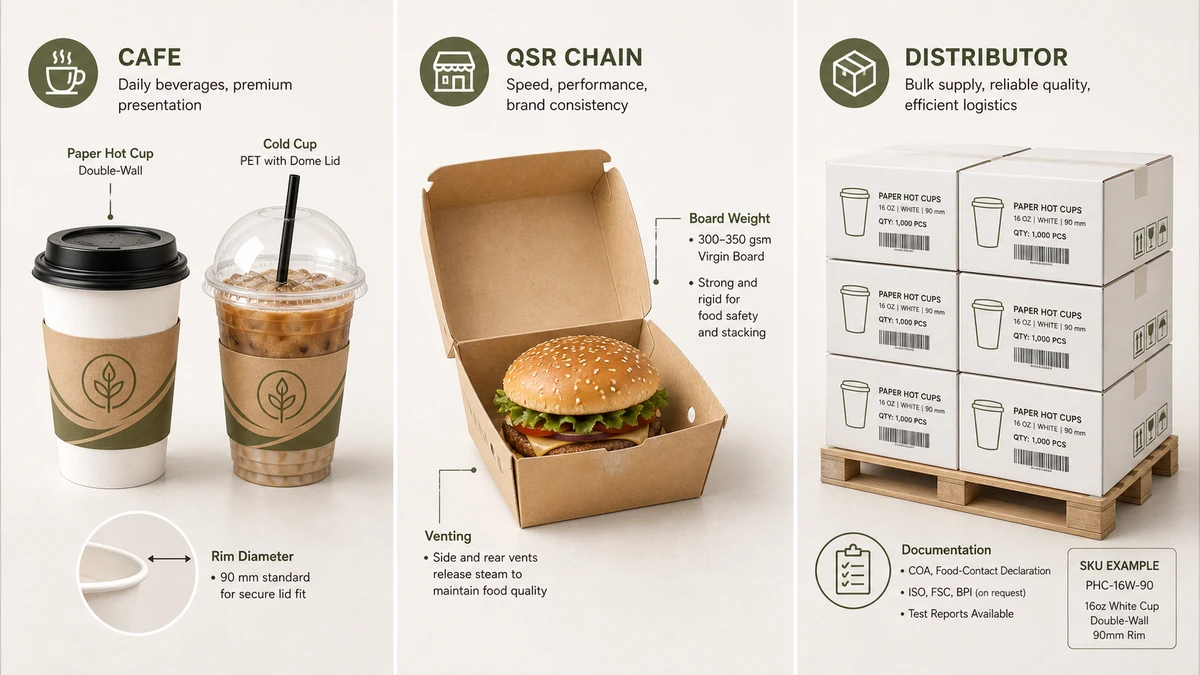
Cafes should prioritize cup comfort, lid fit, and compact storage. If the menu uses both hot and cold drinks, confirm that each cup family has the right lid profile and that the order mix matches weekly sales.
QSR operators should lock down board weight, coating, venting, grease resistance, and stack performance. Multi-site rollouts should also confirm the same SKU can be replenished consistently across all locations.
Distributors should focus on documentation, carton consistency, and SKU simplicity. Uniform case packs make warehousing and picking easier, while complete records make customer onboarding faster.
Wholesale food packaging is bulk packaging bought for foodservice or resale, usually by case or pallet. It includes cups, lids, bowls, trays, bags, wraps, and containers.
Choose single-wall cups when price matters and you can use sleeves or fast handoff. Choose double-wall cups when hand comfort and perceived quality matter more.
Confirm rim diameter, lid profile, and fit testing on the exact cup body. A small mismatch can cause leaking, loose lids, or a lid that is too tight.
Only if your waste stream can actually accept the product. A certified compostable pack is not useful if local collection or processing is unavailable.
Look at MOQ, lead time, case-pack size, compliance documentation, and stock reliability together. The cheapest unit price can become the most expensive option if it creates dead stock or service failures.
No. Digital printing can make short runs practical, while flexographic printing is usually better for larger, stable orders. The best choice depends on volume and artwork changes.
Keep food-contact declarations, test reports where relevant, compostability certificates if applicable, and country-of-origin details by SKU. That file helps with audits and customer onboarding.