Prêt à créer vos propres gobelets ou emballages en papier ?
Faites-nous part de vos exigences - taille, revêtement, impression et destination - et notre équipe établira un devis détaillé dans les 24 heures.


Dernière mise à jour: novembre 2025
Temps de lecture: 9 minutes
Auteur: Équipe de contenu de Papacko
Your festival promoted “100% compostable cups” attracting 5,000 eco-conscious attendees, only to discover the local waste management contractor sends everything to landfill because your region has no commercial composting facility—resulting in greenwashing accusations across social media, sponsor complaints, and a 15% drop in advance ticket sales for next year’s event. Meanwhile, the competitor festival uses verifiably compostable cups with on-site composting partner, generating positive press coverage and 28% year-over-year attendance growth from sustainability reputation.
Compostable “>paper cups require more than PLA coating labels—they need BPI/TÜV certification proving 90-180 day breakdown under specific conditions (55-60°C, controlled moisture, microbial activity), verified commercial composting infrastructure within 50 miles of event location, and proper waste stream segregation preventing contamination. The difference between authentic compostability and marketing claims can mean $8,000-15,000 in wasted procurement costs plus immeasurable brand damage when environmental promises don’t deliver.
Dans ce guide, vous apprendrez :
-BPI vs TÜV vs home compostable certifications and requirements
-Commercial composting infrastructure: availability and verification
-PLA vs water-based coatings for compostability
-Event-specific logistics: collection, transport, processing
-Cost comparison: compostable vs recyclable vs standard cups
-Common certification pitfalls that void composting claims
-Vérification des fournisseurs et points de contrôle de la qualité
💡 À emporter rapidement: Truly compostable cups require
(1) BPI or TÜV AUSTRIA certification (verifies 90-180 day breakdown at 55-60°C industrial facilities),
(2) PLA coating or water-based barriers (no PE petroleum plastic),
(3) commercial composting facility within reasonable distance (50-mile typical maximum for economic transport),
(4) segregated waste collection preventing contamination.
Cost: +25-40% vs standard PE-coated cups ($0.12-0.18 per 12oz vs $0.08-0.12 standard).
Critical: 73% of US lacks commercial composting access—verify infrastructure BEFORE procurement.
Best for: Large events with composting partnerships, California/Oregon/Washington (strong infrastructure), corporate events with sustainability reporting requirements.
Not all “compostable” claims are equal—specific certifications verify real breakdown performance under measurable conditions.
Issuer: Institut des produits biodégradables (US-based third-party)
Norme d'essai: ASTM D6400 (compostable plastics) + ASTM D6868 (paper with bioplastic coating)
Exigences:
-Désintégration: 90% of material breaks down into <2mm fragments within 180 days
-Biodégradation: 90% of organic carbon converts to CO2 within 180 days (proving biological consumption not just fragmentation)
-Ecotoxicity: Compost produced supports plant growth (no toxic residues)
-Métaux lourds: Regulated limits (prevents soil contamination)
Testing Conditions:
-Temperature: 55-60°C maintained (thermophilic composting phase)
-Moisture: 50-60% water content
-Oxygen: Aerobic conditions (oxygen present)
-Duration: 180 days maximum timeline
What It Guarantees:
-Product will fully break down IN COMMERCIAL COMPOSTING FACILITY
-Does NOT guarantee home compostability (different conditions)
-Does NOT guarantee local facility exists to accept product
Vérification: BPI provides online database of certified products—search by manufacturer or product name
Norme d'essai: EN 13432 (European harmonized standard)
Similar Requirements to BPI:
-90% disintegration in 12 weeks (faster than BPI’s 180 days)
-90% biodegradation within 6 months
-Ecotoxicity and heavy metal limits
Reconnaissance du marché: Required for “compostable” claims in EU markets
Variants:
-OK Compost INDUSTRIEL: Commercial facility required (equivalent to BPI)
-OK Compost ACCUEIL: Certifies home compostability (30°C ambient temperature, 12 months)
Normes: TÜV OK Compost HOME or Australian AS 5810
Testing Conditions:
-Temperature: 20-30°C (ambient outdoor conditions)
-Timeline: 12 months maximum
-No mechanical aeration required
Reality for Cups:
-Very few paper cups achieve home compostable certification
-PLA coatings generally require 55-60°C (not achievable in home compost)
-Water-based coatings sometimes qualify (but performance trade-offs)
Marketing Truth: If cups only certified to BPI/EN 13432 (commercial), they are NOT home compostable despite “compostable” label
#### Certification Comparison
Compostable cups mean nothing without facilities to process them—infrastructure availability varies drastically by region.
States with Strong Infrastructure:
-Californie: 200+ commercial composting facilities, SB 1383 mandate (organic waste diversion)
-Oregon: 50+ facilities, strong organics program
-Washington: 40+ facilities, commercial organics ban in urban areas
-Vermont: State-wide composting requirement since 2020
Couverture: These 4 states = 80% of US commercial composting capacity
Limited/No Infrastructure:
-Great Plains/Midwest: 73% of counties lack commercial composting access
-Southeast (except Florida): Minimal commercial capacity
-Zones rurales: Generally no access (population density too low for facility economics)
L'épreuve de vérité: Only 27% of US population has convenient access to commercial composting accepting food-service ware
Strong Infrastructure:
-Allemagne: 900+ biogas/composting plants, mandatory organics collection
-Pays-Bas: 50+ facilities, high diversion rates
-Austria: Comprehensive organics infrastructure
-Italie: Growing capacity, regional variation
Verification Required: EU member states vary—check specific region before event planning
What Facilities Typically Accept:
-Food scraps (primary feedstock)
-Yard waste (leaves, grass, branches)
-BPI/TÜV certified compostable food-service ware (cups, plates, utensils)
What Many Facilities Reject:
-“Biodegradable” items without certification (lack of verification)
-Mixed waste (contamination with plastic/metal/glass)
-Waxed paper cups (petroleum wax not compostable)
Contamination Tolerance:
-Most facilities: <5% contamination acceptable
-If event waste stream >5% non-compostable: Entire batch rejected → landfill
-Rejection = wasted procurement investment + broken environmental promise
Étape 1: Identify commercial composting facilities within 50 miles
-Search: BioCycle Organics Directory, state environmental agency databases
-Contact: Call facilities, ask “Do you accept BPI-certified food-service ware?”
Étape 2: Confirm Pickup/Transport Logistics
-Some facilities accept direct drop-off (event organizer responsibility)
-Some partner with haulers (coordinate in advance, may require contract)
-Transport cost: $0.50-2.00 per pound ($50-200 per ton, distance-dependent)
Étape 3: Get Written Acceptance
-Request facility letter confirming they will accept your specific volume and product type
-Prevents day-of-event surprise rejection
Étape 4: Plan Waste Segregation
-Clearly marked bins (“Compostables Only—Cups, Plates, Food Scraps”)
-Trained staff/volunteers monitoring bins (preventing contamination)
-Goal: <3% contamination rate ensures facility acceptance
Cup coatings determine whether “compostable” claims hold up under facility processing conditions.
Composition: Plant-derived bioplastic (corn or sugarcane starch)
Performances en matière de compostabilité:
-BPI/TÜV Certified: Yes (when properly formulated)
-Breakdown Timeline: 90-180 days at 55-60°C industrial composting
-Compost domestique: No (requires 55°C, not achievable at home)
-Material Fate: Converts to CO2, water, biomass (no microplastic residue)
Functional Performance:
-Moisture barrier: Excellent (prevents cup soaking/weakening)
-Temperature tolerance: Up to 85°C (suitable for hot beverages)
-Shelf life: 12-18 months if stored properly (avoid high humidity)
Coût: PLA-coated cups $0.12-0.18 per 12oz (+30-50% vs PE-coated)
Environmental Truth:
-Renewable feedstock (not petroleum)
-Requires industrial composting (not backyard)
-Contaminates recycling stream (cannot be recycled with paper)
Composition: Acrylic or starch-based polymer dispersion
Performances en matière de compostabilité:
-Certification: Some formulations BPI-certified, others not (verify per product)
-Breakdown Timeline: 90-180 days (similar to PLA when certified)
-Compost domestique: Some water-based coatings qualify (depends on formulation)
Functional Performance:
-Moisture barrier: Good (adequate for cold beverages, moderate for hot)
-Temperature tolerance: Up to 80°C (less than PLA)
-Performance trade-off: Slightly lower moisture resistance than PLA
Coût: Water-based coating $0.10-0.15 per 12oz (+20-40% vs PE-coated)
Environmental Positioning:
-Often “plastic-free” claim (no bioplastic, just paper + water-based barrier)
-Some formulations recyclable (infrastructure-dependent)
-Potential home compostability (verify certification)
L'épreuve de vérité: Traditional petroleum-based ” target=”_blank” rel=”noopener”>polyethylene coating
Compostabilité: None. Does not break down under composting conditions.
Problème: Many “paper cups” use PE coating—looks like paper, but plastic liner prevents composting
Market Confusion: Customers assume paper = compostable (false if PE-coated)
Vérification: Check material specifications—”PE coating” or “polyethylene” = NOT compostable
Successfully deploying compostable cups at events requires planning beyond procurement.
Three-Stream System (Optimal for Events):
-Stream 1: Compostables (BPI-certified cups, food scraps, wooden utensils)
-Stream 2: Recyclables (aluminum cans, glass bottles, cardboard)
-Stream 3: Landfill (contaminated items, non-recyclable waste)
Bin Placement Density:
-High-traffic events: 1 waste station per 50-100 attendees
-Each station: All three streams side-by-side with clear signage
-Signage: Visual graphics (photos of acceptable items) + text labels
Volunteer/Staff Monitoring:
-1 “Zero Waste Ambassador” per 3-5 waste stations
-Role: Answer questions, prevent contamination, remove misplaced items
-Impact: Monitoring reduces contamination from 15-20% to 3-5%
Compostable Cups Procurement:
-Quantity: 2,000 cups (2 per attendee—coffee + second beverage)
-Cost: $0.15 per cup × 2,000 = $300
-Comparison: PE-coated cups would cost $0.10 × 2,000 = $200 (save $100)
Waste Collection Infrastructure:
-Bins: 15 triple-stream stations @ $50 rental = $750
-Signage: Custom posters/graphics @ $200
-Compostable bin liners: $50
Travail:
-Zero Waste Ambassadors: 5 volunteers × 6 hours × $15/hr = $450 (or volunteer, $0)
Hauling and Processing:
-Compost hauling: 200 lbs waste × $1.50/lb = $300
-Facility tipping fee: $50-100
Total Incremental Cost: ~$1,650 for composting program vs standard waste (~$400)
Prime: $1,250 additional investment for 1,000-attendee event
Value Return:
-Marketing: “Zero waste event” drives 15-25% higher sponsor interest (+$3,000-8,000 sponsor value)
-Attendance: Sustainability reputation increases advance ticket sales 8-12% (+$2,000-5,000 revenue)
-Media: Positive press coverage (estimated $5,000-10,000 earned media value)
ROI: $1,250 investment → $10,000-23,000 value = 700-1,740% ROI
#### Event Composting Economics
## Common Certification Pitfalls and Greenwashing Risks
Avoid these mistakes that void compostability claims and damage brand credibility.
❌ Mistake #1: “Compostable” Cups Without BPI/TÜV Certification
Problème: Supplier claims cups are “compostable” or “biodegradable” but provides no certification. Commercial facilities reject due to lack of verification. Waste goes to landfill.
Approche correcte: Demand BPI or TÜV AUSTRIA certificate for specific product SKU. Verify certificate validity on BPI online database. No certification = no composting claim allowed.
❌ Mistake #2: Assuming Commercial Composting Exists Locally
Problème: Procuring 10,000 BPI-certified cups for event in region with no commercial composting within 100 miles. Cups end up in landfill despite certification (no processing option).
Approche correcte: Verify composting infrastructure BEFORE procurement. If no local facility, consider recyclable alternatives with water-based coating or honest “landfill-bound” waste plan (better than false environmental promise).
❌ Mistake #3: Marketing “Home Compostable” When Only Commercial Certified
Problème: Event promotes “home compostable cups” but cups only have ” target=”_blank” rel=”noopener”>BPI certification (requires 55-60°C industrial facility). Attendees try home composting, cups don’t break down in 12 months, greenwashing backlash.
Approche correcte: Marketing accuracy: BPI-certified = “commercially compostable” or “industrially compostable” ONLY. Never claim “home compostable” unless TÜV OK Compost HOME or equivalent certification provided.
❌ Mistake #4: Mixed Waste Contamination Voiding Composting
Problème: Event provides compostable cups but no waste segregation plan. Attendees throw cups into mixed trash with plastic bottles, aluminum cans. Facility rejects contaminated load, everything goes to landfill.
Approche correcte: Three-stream waste system with clear signage, volunteer monitoring, and pre-event attendee education. Target <3% contamination rate. Budget for monitoring labor—critical to program success.
❌ Mistake #5: PE-Coated Cups Labeled “Paper Cups” Misleading Customers
Problème: Serving beverages in PE-coated paper cups (not compostable) at event marketed as “eco-friendly.” Customers assume paper = compostable, throw cups in compost bins, contaminating stream.
Approche correcte: If budget constraints prevent compostable cups, be honest: use clear waste stream labels (“Landfill—PE-coated cups NOT compostable”). Transparency prevents contamination and greenwashing accusations.
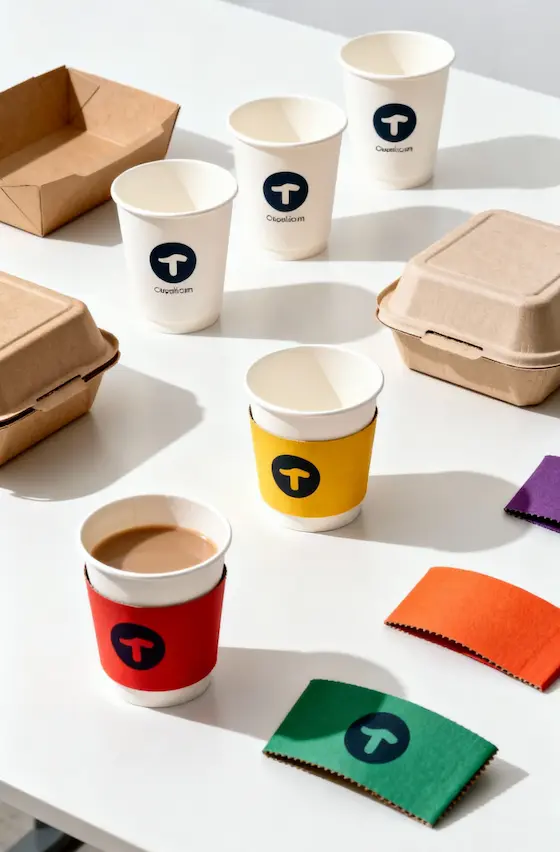
Compostable paper cups are beverage containers with paperboard + plant-based PLA or water-based coatings that biodegrade into CO2, water, and biomass within 90-180 days under industrial composting conditions (55-60°C). Require BPI (US/Canada) or TÜV AUSTRIA (EU) certification verifying ASTM D6400/EN 13432 standards. Cost: $0.12-0.18 per 12oz (+30-50% vs standard PE-coated cups). Critical requirement: commercial composting facility access within 50 miles. Best for events in California/Oregon/Washington/Vermont (strong infrastructure) or corporate events with composting partners.
Most cannot. BPI-certified “compostable” cups require industrial composting at 55-60°C (thermophilic phase)—home compost piles typically 20-30°C ambient. PLA coatings don’t break down at home temperatures, remaining intact 12+ months. Exception: Cups with TÜV OK Compost HOME certification verified for 20-30°C breakdown (rare, only some water-based coatings qualify). Reality: 95% of “compostable” cups on market require commercial facilities. Marketing accuracy critical: Label “commercially compostable” not “compostable” to avoid misleading customers attempting home composting.
Three-step verification: (1) Request BPI or TÜV certificate from supplier for specific product SKU, (2) Verify certificate authenticity on BPI online database (products.bpiworld.org) or TÜV AUSTRIA website, (3) Check certificate details match product specifications (material composition, coating type, size). Red flags: Supplier refuses to provide certificate, claims “biodegradable” without certification, or provides generic certificate not matching specific product. Facility acceptance: Contact local composting facility, confirm they accept BPI-certified cups before procurement.
Compostable = specific standards (BPI/TÜV) requiring 90% disintegration in 90-180 days under controlled conditions, converting to CO2/water/biomass with no toxic residue. Biodegradable = vague term, no standard timeline or conditions, often marketing claim without verification (could mean 500+ years breakdown in landfill). Legal reality: Many regions ban “biodegradable” claims without compostability certification due to greenwashing concerns. Always require certified compostable (BPI/TÜV), never accept “biodegradable” alone. Many “biodegradable” plastics still leave microplastic residues—certified compostable products must pass ecotoxicity testing.
Yes, +30-50% premium: Compostable PLA-coated 12oz cup $0.12-0.18 vs PE-coated standard $0.08-0.12. Water-based compostable coating $0.10-0.15 (moderate premium). Premium driven by: (1) PLA material cost (plant-based feedstock more expensive than petroleum PE), (2) Certification testing ($10,000-30,000 per product for BPI), (3) Lower production volumes (economy of scale disadvantage). However, event ROI justifies cost: $1,250 composting program investment yields $10,000-23,000 marketing/sponsor/attendance value (700-1,740% ROI) through sustainability positioning.
Strong US infrastructure: California (200+ facilities, SB 1383 mandate), Oregon (50+ facilities), Washington (40+ facilities, urban organics bans), Vermont (state-wide program). Limited/none: 73% of US counties lack access (Great Plains, Midwest, Southeast rural areas). EU leaders: Germany (900+ facilities, mandatory organics), Netherlands, Austria, Northern Italy. Verification: Search BioCycle directory, state environmental databases, or contact facilities directly confirming BPI food-service ware acceptance. If no facility within 50 miles, composting logistically/economically unfeasible—consider recyclable alternatives instead.
Five strategies: (1) Three-stream stations (compost/recycle/landfill side-by-side with clear signage), (2) Visual signage using photos not just text (shows exactly what goes where), (3) Zero Waste Ambassadors monitoring bins (1 per 3-5 stations, reduces contamination from 15-20% to 3-5%), (4) Pre-event education (attendee emails, social media explaining what’s compostable), (5) Bin liner color-coding (green=compost, blue=recycle, black=landfill). Target: <3% contamination rate. Above 5%, facilities often reject entire load sending everything to landfill—monitoring labor investment critical to program success.
Compostable paper cups deliver authentic environmental performance when paired with proper infrastructure and certification—BPI or TÜV AUSTRIA standards ensuring 90-180 day breakdown under industrial composting conditions (55-60°C), PLA or certified water-based coatings replacing petroleum-based PE, and verified facility partnerships within economically viable distance (50-mile typical maximum). The material premium (+30-50% procurement cost) returns measurable value through sustainability marketing (15-25% sponsor interest increase), attendance growth (8-12% from environmental reputation), and earned media coverage—delivering 700-1,740% ROI for events where composting logistics are feasible.
Principaux enseignements :
1.Certification non-negotiable: Only BPI (US/Canada) or TÜV AUSTRIA (EU) certification guarantees compostability. Reject “biodegradable” or uncertified “compostable” claims—these lack verification and facilities reject them. Verify on BPI database before procurement.
2.Infrastructure determines feasibility: 73% of US lacks commercial composting access. Verify facility within 50 miles accepts BPI food-service ware BEFORE procurement. California/Oregon/Washington/Vermont have strong infrastructure; Great Plains/Midwest/Southeast mostly lack access.
3.Home compostability rare: 95% of certified compostable cups require 55-60°C industrial facilities (NOT achievable in backyard piles). Marketing accuracy critical: “commercially compostable” not “compostable” to avoid misleading customers.
4.Waste segregation essential: <3% contamination rate required for facility acceptance. Zero Waste Ambassadors (1 per 3-5 stations) reduce contamination from 15-20% to 3-5%—monitoring labor investment necessary for program success, not optional.
5.Total event ROI justifies premium: $1,250 composting program investment (1,000 attendees) yields $10,000-23,000 value through sustainability positioning—sponsor attraction, attendance growth, media coverage worth 7-17x material cost premium.
For events, festivals, and catering operations in regions with commercial composting infrastructure, certified compostable cups transform waste from operational liability into brand differentiator and marketing asset—delivering measurable environmental impact and business returns that justify 30-50% material premiums. For regions lacking infrastructure, honest recyclable alternatives with water-based coatings prevent greenwashing while maintaining environmental responsibility.
Découvrez d'autres solutions d'emballage :
-“>Paper Cups & Coffee Packaging
-“>Sustainable Paper Packaging
-“>Event Catering Solutions
Papacko supplies BPI-certified compostable paper cups to events, festivals, and catering operations worldwide. We provide certification documentation, composting facility connection services, and waste management consultation to ensure your environmental commitments deliver measurable results.
Prenez contact avec nous :
Dernière mise à jour: novembre 2025
Équipe chargée du contenu: Papacko
Révisé par: Sustainability & Environmental Compliance Department