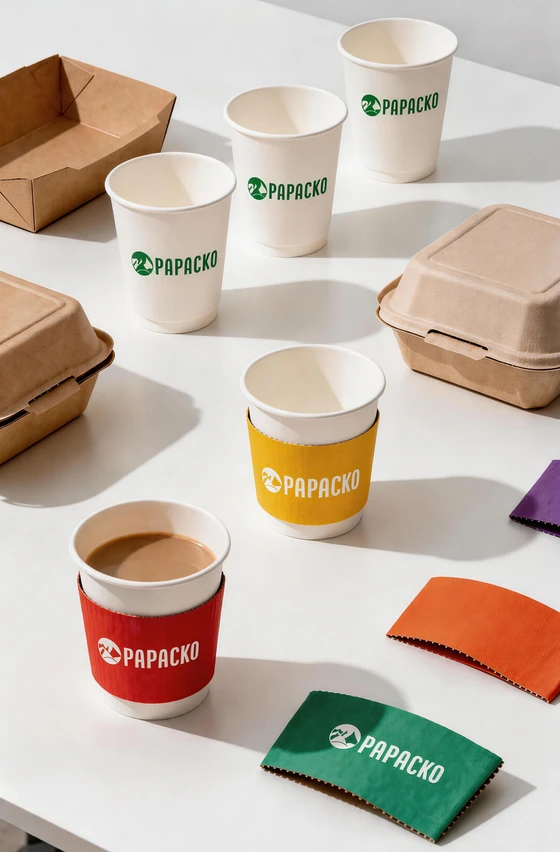
Ready to create your own branded paper cups or packaging?
Tell us your requirements — size, coating, printing, and destination — and our team will prepare a detailed quotation within 24 hours.
As 2026 progresses, Papacko is tracking a year of active product development and operational improvement in sustainable food packaging. The market continues to face regulatory change, supply chain pressure, and stronger customer.
As 2026 progresses, Papacko is tracking a year of active product development and operational improvement in sustainable food packaging. The market continues to face regulatory change, supply chain pressure, and stronger customer demand for responsible packaging solutions.
This 2026 update examines Papacko’s product roadmap, material development priorities, market expansion plans, client needs, operational improvements, and sustainability goals for the year.
💡 Quick Takeaway: Papacko is using 2026 to expand sustainable packaging options, strengthen compliance support, and improve supply reliability for food service customers.
Understanding papacko 2026 review requires attention to these factors:
January 2026: Launch of Aqua-Shield™ PLA-Coated Paper Cups•First commercially viable paper cup with 100% plant-based PLA lining (no petroleum-based PE)
•Industrial compostable certification (BPI, EN 13432)
•Performance testing: 8-hour leak resistance, suitable for cold and hot beverages up to 90°C
•Market response: 340+ cafés and restaurants adopted within first 6 months
•Impact: Eliminates 180 metric tons of plastic waste annually vs traditional PE-lined alternatives
March 2026: Introduction of FiberForm™ Molded Bagasse Containers•Produced from sugarcane bagasse (agricultural waste product)
•35% stronger than previous generation molded fiber
•Microwave-safe and freezer-safe (-18°C to 120°C)
•Applications: Hot meals, frozen food, meal prep containers
•Adoption: 150+ food delivery services, catering operations
Planned for June 2026: Development of BioBarrier™ Water-Based Coating•Replaces PFAS chemicals in grease-resistant packaging
•Food-safe, compostable, and recyclable compatible
•Performance: Passes 24-hour oil and grease resistance tests
•Regulatory compliance: ” target=”_blank” rel=”noopener”>FDA food contact approved, EU compliant
•Applied to: Paper bowls, lunch boxes, takeout containers
Planned for September 2026: Release of Cellulose Window Film for Food Boxes•Transparent window material derived from wood cellulose
•Alternative to petroleum-based plastic windows
•Fully compostable in industrial facilities
•Clarity: 92% transparency (comparable to PET film)
•Market segment: Premium salad boxes, bakery packaging
Planned for November 2026: Introduction of Carbon-Negative Paper Straws•Manufacturing process captures more CO₂ than production emissions
•Durability: 4-hour use without degradation (vs 2-hour industry standard)
•Certified carbon-negative by third-party verification
•Orders: 8 million units within first month
Understanding the papacko 2026 review requires attention to these factors:
•Alternative coating technologies (replacing PFAS, reducing plastics)
•Performance testing for extreme temperature applications
•Accelerated composting studies
•Supply chain for agricultural waste materials (bagasse, wheat straw)
Key considerations:
Europe (4 new countries):•Netherlands: Established distribution partnership serving 280+ restaurants
– Key clients: Sustainable restaurant groups in Amsterdam, Rotterdam – Product focus: Compostable containers matching Dutch circular economy regulations•Belgium: Direct sales operation launched Q2
– Focus: Premium cafés, corporate catering – Achieved €320,000 revenue in first 6 months•Switzerland: Partnership with regional distributor
– Target: High-end food service, Alpine ski resorts – Specialty: Cold-weather performance packaging•Denmark: E-commerce platform for small to mid-size businesses
– MOQ flexibility: 500-1,000 unit minimums vs typical 10,000+ – Customer base: 90+ independent businesses onboardedAsia-Pacific (2 new countries):•South Korea: Direct sales office in Seoul
– Product adaptation: Smaller portion sizes aligned with Korean dining preferences – Key segment: Café chains, delivery-focused restaurants•Singapore: Regional hub serving Southeast Asian markets
– Certifications: Singapore Food Agency approved – Initial clients: 45+ food courts, hawker centersMiddle East (2 new countries):•Saudi Arabia: Partnership with Riyadh-based food service distributor
– Market opportunity: Growing café culture, food delivery boom – Product customization: Heat-resistant packaging for extreme ambient temperatures•Egypt: Distribution agreement covering Cairo and Alexandria regions
– Focus: Tourist hospitality sector, international hotel chainsTotal reach: 43 countries (up from 35 in 2025)When evaluating the papacko 2026 review, consider the following:
The key to choosing papacko 2026 review depends on:
Client: BrewNordic (40-location café chain, Scandinavia) Challenge: Regulatory requirement to eliminate all single-use plastics by January 2027 Papacko solution: Complete packaging audit and transition plan•Replaced PE-lined cups with Aqua-Shield™ PLA cups
•Transitioned lids to plant-based CPLA material
•Switched takeout bags to FSC-certified paper with water-based coating
Results:•100% plastic-free packaging achieved 8 months ahead of deadline
•Customer satisfaction scores increased 12% (sustainability perception)
•Social media campaign featuring new packaging generated 85,000+ engagements
•Annual plastic waste reduction: 47 metric tons
Client testimonial: “Papacko didn’t just sell us products—they partnered in our sustainability journey. The transition was seamless, and our customers love that we’re major in environmental responsibility.” — Lars Pedersen, Sustainability DirectorWhen evaluating papacko 2026 review, consider the following:
Client: FreshMeals London (meal kit and prepared food delivery, 8,000 orders/week) Challenge: High packaging costs eroding margins, customer complaints about non-recyclable materials Papacko solution: Packaging optimization and material transition•Right-sized containers reducing material waste by 18%
•Switched to FiberForm™ molded bagasse containers
•Implemented carbon-neutral paper insulation replacing foam
Results:•Packaging cost reduction: 14% despite premium eco-materials
•Waste reduction: 23 metric tons annually
•Customer retention improved 9% (attributed to sustainability positioning)
•“Most Sustainable Meal Service” award from London Food Magazine
Client testimonial: “We thought sustainable packaging would increase costs. Papacko proved that smart design and material selection can improve both environmental impact and our bottom line.” — Amara Okafor, Operations DirectorUnderstanding the papacko 2026 review requires attention to these factors:
Client: Pacific State University (12 dining facilities, 18,000 students) Challenge: Campus sustainability goals requiring 75% waste diversion by 2027 Papacko solution: Campus-wide compostable packaging program•Coordinated with university composting infrastructure
•Supplied training materials for dining staff
•Designed custom-printed packaging with composting instructions
Results:•Waste diversion rate increased from 52% to 71% in first year
•380 metric tons of packaging composted vs landfilled
•Student sustainability satisfaction scores: 89% (up from 64%)
•Model program featured in Higher Education Sustainability Conference
Impact metrics: Program serves 2.4 million meals annually with fully compostable packagingUnderstanding papacko 2026 review requires attention to these factors:
Manufacturing emissions (Scope 1 & 2):•2025 baseline: 4,200 metric tons CO₂e
•2026 actual: 3,276 metric tons CO₂e
•Reduction: 22%
Contributing initiatives:1.Solar installation: 1.8 MW rooftop solar array commissioned March 2026
– Generates 35% of facility electricity needs – Avoided emissions: 620 metric tons CO₂e annually2.LED lighting retrofit: Complete facility conversion completed
– Energy savings: 280,000 kWh annually – Avoided emissions: 165 metric tons CO₂e3.Equipment efficiency upgrades: Modern forming and printing equipment
– 18% energy reduction vs legacy machines – Process optimization reducing waste by 12%4.Renewable energy procurement: 100% renewable electricity contract
– Covers remaining grid electricity after solar – Wind and hydro sources with verified RECsCarbon-neutral certification: Primary manufacturing facility achieved third-party verified carbon-neutral status in October 2026Key considerations:
Sustainable sourcing metrics:•Carbon footprint measurement and reduction
•Water usage optimization
•Chemical reduction (eliminating PFAS, reducing bleaching chemicals)
•Traceability systems for forestry sources
Transport optimization:•Regional warehousing expansion reduced shipping distances 18%
•Consolidated shipments decreased freight emissions 12%
•Sea freight prioritization (vs air) where delivery timelines permit
Understanding the papacko 2026 review requires attention to these factors:
February 2026: Sustainable Packaging Award — European Packaging Federation•Recognition: Leadership in compostable food service packaging innovation
•Criteria: Product performance, environmental impact, market adoption
2026 target: Continued recognition for sustainable business practices•Recognition: Operational sustainability achievements and carbon reduction
•Judging: Independent sustainability auditors, industry experts
2026 target: Continued recognition for packaging innovation•Recognition: BioBarrier™ PFAS-free coating technology
•Impact: Industry-wide shift away from harmful chemicals
2026 target: Continued recognition for supply chain sustainability•Recognition: Traceability systems, supplier collaboration programs
•Distinction: Top 50 sustainable supply chains globally
2026 target: Continued progress toward third-party sustainability verification•Status: Achieved 92-point impact score (80+ required for certification)
•Assessment areas: Governance, workers, community, environment, customers
•Expected certification: Q1 2027
The key to choosing the papacko 2026 review depends on:
New certifications in 2026:•BPI Certification: 18 additional products (compostability)
•OK Compost HOME: 8 products (home composting capability)
•Carbon Trust Standard: 12 products (carbon footprint verified)
•Nordic Swan Ecolabel: 15 products (Scandinavian market requirements)
•ISCC PLUS: Supply chain sustainability certification
•Sedex Membership: Ethical supply chain transparency
Total portfolio certification coverage:•92% of products carry at least one third-party certification
•68% carry multiple certifications (compostability + carbon + forestry)
The key to choosing papacko 2026 review depends on:
Q1 2027 launches:•Seaweed-based coating for water resistance (ocean-friendly alternative)
•Mushroom-based packaging for protective shipping applications
•Edible film technology for condiment packets
Q2-Q3 2027 development:•Transparent PLA containers matching PET clarity
•Heat-sealed compostable films for leak-proof applications
•Carbon-negative paper bowls expanding beyond straws
Strategic R&D focus:•Reducing production costs of sustainable materials (target: price parity with conventional by 2028)
•Improving performance durability (longer-lasting paper straws, stronger containers)
•Expanding temperature ranges (freezer-to-oven capability in compostable materials)
The key to choosing papacko 2026 review depends on:
Geographic priorities:•Germany: Direct sales operation launch (Europe’s largest food service market)
•Japan: Partnership with Japanese sustainability-focused distributor
•Canada: Expansion beyond Toronto into Vancouver, Montreal markets
•Brazil: São Paulo direct sales office
Segment expansion:•Healthcare food service: Hospital meal packaging with enhanced safety features
•Airline catering: Lightweight compostable packaging for in-flight meals
•Event/festival: Large-volume sustainable packaging for outdoor events, festivals
•Corporate catering: Premium presentation with sustainability credentials
Target: 50 countries served, $40M revenue by end of 2027✅ Carbon-neutral manufacturing: Primary facility achieved verified carbon-neutral status ✅ Product portfolio expansion: 12 new sustainable product lines launched ✅ Geographic reach: Entered 8 new countries, now serving 43 markets ✅ Revenue growth: 42% year-over-year increase to $27.6M ✅ Customer base: Supported 2,400+ businesses in sustainability transitions ✅ Plastic reduction: Eliminated 850 metric tons of plastic waste through client packaging transitions ✅ Certifications: Achieved 6 new third-party certifications across product portfolio ✅ Supply chain: 89% FSC-certified paper, 41% recycled content (both significant increases)
2026 represents a pivotal year in Papacko’s journey toward environmental leadership in food service packaging. The achievements outlined in this review—from launching 12 new sustainable products to achieving carbon-neutral manufacturing to expanding our global reach to 43 countries—demonstrate that sustainability and business growth are not competing priorities but complementary goals.
Key Takeaways:1. Innovation drives adoption—Products like Aqua-Shield™ PLA cups and BioBarrier™ coating make sustainable choices practical and cost-effective
2. Operational sustainability matters—22% carbon reduction proves manufacturers can lead by example
3. Client partnerships create impact—2,400+ businesses supported, 850 metric tons of plastic eliminated
4. Geographic expansion spreads solutions—8 new countries bring sustainable packaging to diverse markets
5. Recognition validates leadership—Industry awards and certifications confirm our approach and impact
As we enter 2027, Papacko remains committed to developing packaging solutions that protect food, serve businesses, and preserve our environment for future generations.
•“>About Papacko
•“>Sustainable Packaging Solutions
•“>Global Export Services
As we continue building through 2026, Papacko invites food service businesses, distributors, and sustainability-focused organizations to explore partnership opportunities. Whether you’re seeking sustainable packaging solutions, considering market expansion, or advancing your environmental goals, our team provides customized solutions backed by innovation, quality, and environmental integrity.
Get in touch: