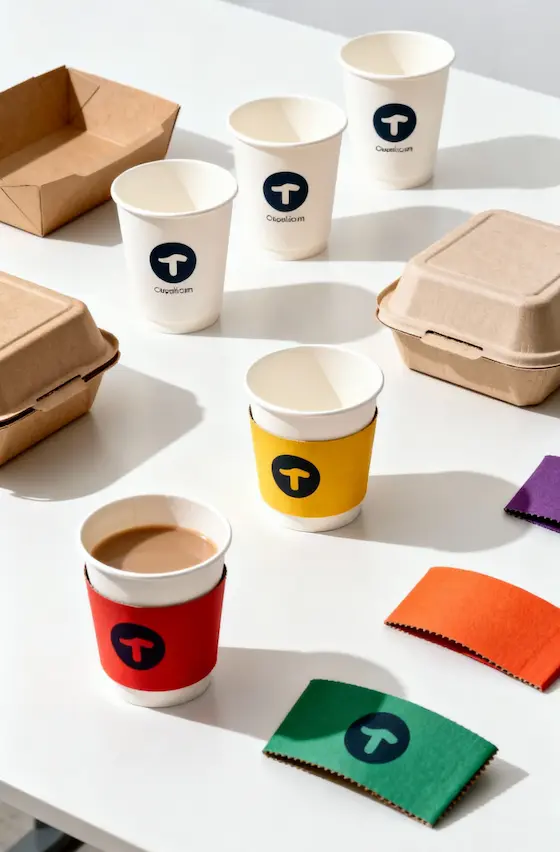
Ready to create your own branded paper cups or packaging?
Tell us your requirements — size, coating, printing, and destination — and our team will prepare a detailed quotation within 24 hours.

Last Updated: May 2026
Reading Time: 9-11 minutes
Author: Papacko Content Team
Ever wondered how your morning coffee cup goes from raw paper pulp to a finished, branded product ready for service. Understanding the papacko factory helps.At Papacko, we produce 500 million paper cups annually across two ISO-certified manufacturing facilities in Southeast Asia. Our production combines automated precision with human quality oversight at every stage.
This factory tour takes you through our complete manufacturing process: from FSC-certified paper sourcing to final packaging, the papacko factory matter.You’ll see our 12 automated production lines, witness our 7-stage quality control system, and understand why clients from 40+ countries trust Papacko for consistent quality and reliable delivery.
💡 Quick Takeaway: Papacko operates 15,000㎡ of production space with 12 high-speed paper cup forming machines (60-120 cups/min capacity), automated PE coating lines, and ISO 9001/14001/22000 certifications—producing 500M+ cups annually for cafés, restaurants, and distributors worldwide.
Location: Guangdong Province, China (primary facility) + Vietnam (secondary facility, opened 2024)
Strategic advantage: Dual-facility setup allows us to serve Asian markets with 3-7 day lead times while maintaining backup capacity during peak seasons (holiday periods see 40-60% volume spikes).
🎯 Industry Insight: Our Vietnam facility was established in 2024 specifically to support clients with ASEAN trade preferences and to provide redundancy—during Chinese New Year shutdowns, Vietnam maintains 60% production continuity.
We source from 3 tier-1 paper mills with strict sustainability credentials:
### Incoming Material Testing
Every paper roll undergoes 5-point inspection before production:
1.Basis weight verification: ±5 GSM tolerance (digital scale testing)
2.Understanding papacko factory helps.Moisture content: 5-8% optimal range (affects cup forming and PE adhesion)
3.Caliper (thickness) consistency: ±0.02mm across roll width
4.Tensile strength: Machine direction (MD) and cross direction (CD) testing
5.Visual inspection: No contamination, consistent color, no fiber clumps
Reject rate: <2% of incoming paper stock fails inspection (returned to supplier for credit).

•Equipment: Automatic roll unwinders with tension control
•Speed: Synchronized to downstream forming speed (60-120 meters/min)
•Function: Maintains consistent paper feed tension, prevents wrinkles and misalignment
Purpose: Apply food-grade polyethylene coating to create moisture barrier
Quality check: Peel strength testing every 30 minutes (target: ≥2.5 kg/cm adhesion force)
Alternative option: PLA (polylactic acid) coating line for compostable cups—separate equipment due to lower temperature requirements (180-220°C).
#### Stage 3: Printing (Flexographic or Offset)
Flexographic printing stations (6-color capacity):
•Speed: 80-150 meters/min
•Registration accuracy: ±0.3mm across all colors
•Drying: UV or hot-air ovens (30-50m drying tunnel)
Custom print workflow:
1.Client approves digital proof
2.Printing plates manufactured (2-3 day lead time)
3.First article inspection (FAI) prints checked against proof
4.Production run begins after client approval
Stock design alternative: We maintain 20+ pre-printed generic designs (geometric patterns, solid colors) available for immediate production.
•Equipment: Rotary die-cutters with precision steel-rule dies
•Output: Flat fan-shaped blanks (cup sidewalls before forming)
•Waste rate: 8-12% edge trim (recycled back to paper mill partners)
Die maintenance: Every 100,000 cuts, dies are inspected and sharpened—dull dies cause ragged edges that compromise seal quality.
High-speed cup forming machines (Japanese technology):
•Model: DEBAO DB-L16 series (primary equipment)
•Capacity: 60-120 cups/minute per machine
•Process: Ultrasonic welding of side seam + bottom attachment
•Cycle time: 0.5-1.0 seconds per cup
Critical parameters:
•Ultrasonic frequency: 20 kHz (standard for PE-coated paper)
•Weld pressure: 0.4-0.6 MPa
•Weld time: 0.15-0.25 seconds
•Bottom curl temperature: 150-180°C (knurling and sealing)
In-line quality checks (automated sensors):
•Side seam alignment (vision system)
•Bottom seal integrity (pressure testing)
•Cup height consistency (laser measurement)
Every 500 cups, QC staff manually inspect:
Total defect rate: <1.8% across all checkpoints (industry average: 2.5-4%) Failed units: Removed from production line, logged for root-cause analysis, recycled as scrap.
Automatic stacking and sleeving:
•Cups stacked in sleeves of 25, 50, or 100 (client preference)
•Shrink-wrap or paper band packaging
•Carton packing (frequently 1,000 or 2,000 cups per carton)
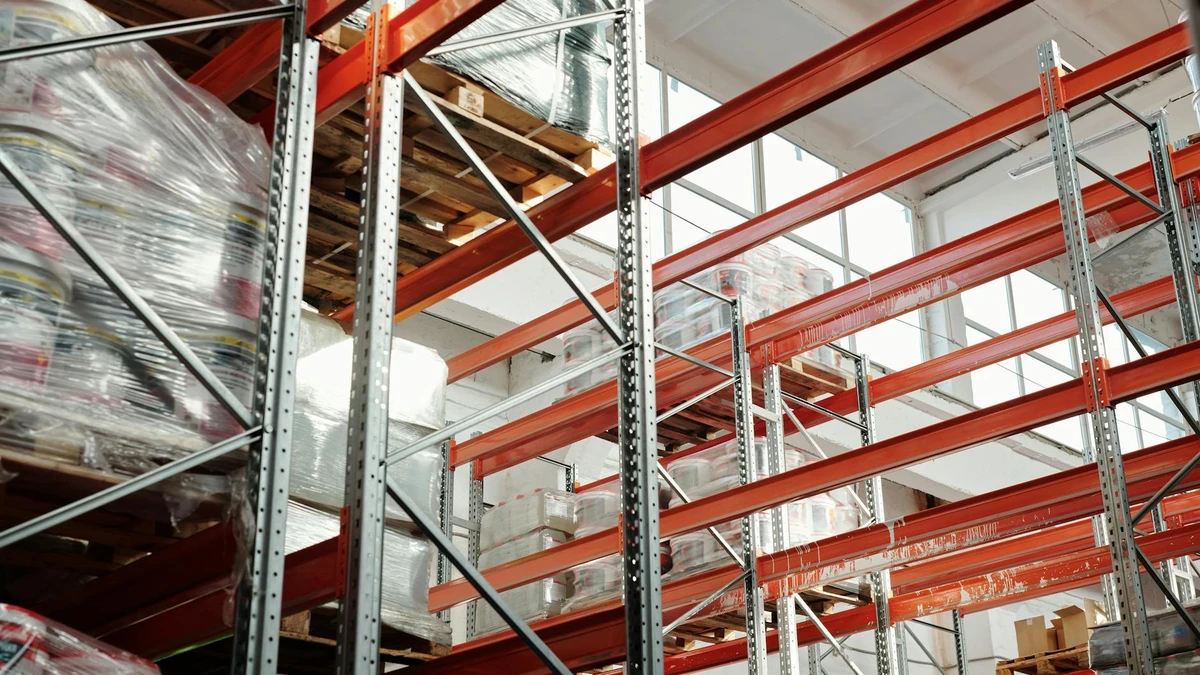
Warehouse management:
•Storage capacity: 12 million cups (finished goods inventory)
•Temperature control: 15-25°C, <60% humidity (prevents moisture absorption)
•First-in-first-out (FIFO): Automated tracking ensures no stock sits >90 days
•Location tracking: Barcode system for rapid order picking
Lead time from warehouse: Domestic orders ship within 24-48 hours; export orders within 3-5 days (customs documentation).
Net landfill contribution: <2 tons/month across both facilities (0.4% of total waste generated).
Initiatives implemented 2023-2024:
•LED lighting retrofit (40% energy reduction in factory floor lighting)
•Heat recovery from PE coating ovens (captures 60% waste heat for space heating)
•Solar panels (100 kW capacity, covers 15% of Guangdong facility power needs)
Carbon footprint: 0.18 kg CO₂e per 1,000 cups produced (industry average: 0.25-0.30 kg CO₂e).
Regulatory compliance: Our cups meet FDA food contact regulations (U.S.), EU 10/2011 (Europe), GB 4806.8 (China), and FSANZ (Australia/New Zealand).
Papacko operates two facilities with combined annual capacity of 500 million paper cups and bowls. Understanding the papacko factory helps.Our Guangdong facility produces 350M units/year across 9 cup-forming lines, while our Vietnam facility adds 150M units/year with 3 specialized export lines.
We employ a 7-stage quality system: incoming material testing, in-line automated sensors (seam alignment, pressure testing), manual inspection every 500 cups, and final random sampling before packaging. Understanding the papacko factory helps.Total defect rate is <1.8% (industry average: 2.5-4%).
We maintain ISO 9001 (quality), ISO 14001 (environmental), ISO 22000 (food safety), FSC Chain of Custody (sustainable paper sourcing), and BSCI (social compliance). Understanding the papacko factory helps.All certifications are audited annually by third-party bodies.
We partner with three FSC-certified paper mills: Nine Dragons Paper (China), APP (Indonesia), and SCG Packaging (Thailand), papacko factory matter.All paper stock undergoes 5-point incoming inspection including weight, moisture content, tensile strength, and visual checks.
Yes—we welcome client visits to our Guangdong facility with 1-week advance notice (required for security clearance). Understanding papacko factory helps.Vietnam facility visits available for large-volume clients or regional partners. Contact our team to schedule a factory tour.
Standard lead time: 15-20 days for custom-printed orders (includes printing plate manufacturing, production, QC, packaging). Understanding papacko factory helps.Stock design orders: 7-10 days. Rush production available at 20% premium for urgent orders (minimum 100,000 units).
Yes—we offer PLA-coated compostable cups (BPI-certified), recycled kraft paper options, and water-based coating alternatives, papacko factory matter.Our dedicated PLA coating line runs at lower temperatures (180-220°C vs 280°C for PE) to maintain biodegradability.
Papacko’s manufacturing success comes from balancing automation with human oversight, sustainable sourcing with production efficiency, and quality control with speed. Our dual-facility setup provides redundancy and regional flexibility — while ISO certifications ensure consistent standards across all production.
Key Takeaways:
1.500M annual capacity across Guangdong (China) and Vietnam facilities
2.7-stage quality control achieves <1.8% defect rate (better than industry average)
3.FSC-certified paper sourcing from 3 tier-1 mill partners
4.ISO 9001/14001/22000 certified with annual third-party audits
5.15-20 day lead time for custom orders, 7-10 days for stock designs
We supply cafés, restaurants, distributors, and brands across 40+ countries with reliable, certified paper cup solutions. Whether you need 50,000 cups or 5 million, our dual-facility production ensures consistent quality and on-time delivery.
Get in touch:
Last Updated: May 2026