Ready to create your own branded paper cups or packaging?
Tell us your requirements — size, coating, printing, and destination — and our team will prepare a detailed quotation within 24 hours.


Compare paper cup sizes from 4oz to 22oz with ml capacity, 80mm vs 90mm lid fit, fill volume, and best uses for coffee, iced drinks, smoothies, and cafes.
Last Updated: April 2026
Reading Time: 7 minutes
Author: Papacko Content Team
“Can I get a medium”” Your barista reaches for… which cup exactly”
Cup sizes are confusing because suppliers, cafes, and customers often use different naming systems. A 12oz cup may be sold as medium in one cafe and regular in another, while lid fit depends on rim diameter rather than volume alone.
If you’re setting up a new café or switching suppliers, getting cup sizes wrong means wasted inventory, confused staff, and disappointed customers who expected more (or less) coffee.
In this guide, you’ll learn:
•Standard cup sizes (4oz-22oz) and what drinks they’re best for
•Top diameter specs and lid compatibility (80mm vs 90mm)
•How to name your sizes for customer clarity
•Capacity vs actual fill volume (why a 12oz cup doesn’t hold 12oz of liquid)
💡 Quick Takeaway: Most cafés use 3 core sizes: 12oz (standard coffee), 16oz (large/iced drinks), and 8oz (kids/short drinks). The 80mm vs 90mm lid diameter matters more than ounce capacity for ordering supplies.
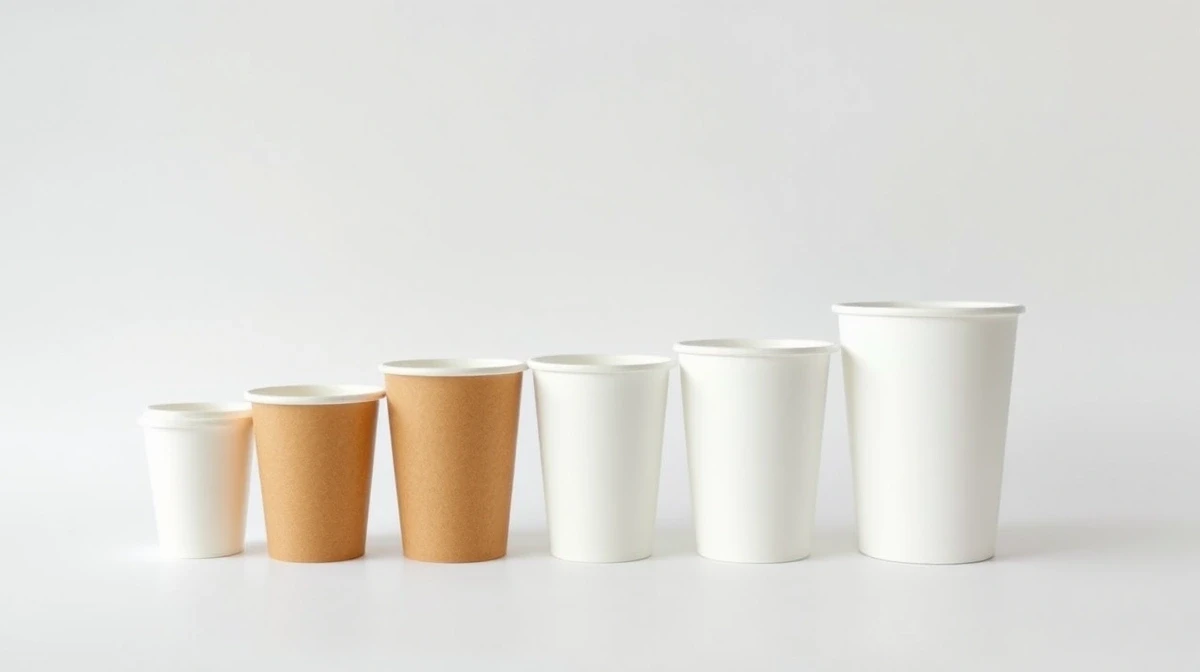
Choose cup sizes by drink type, target serving volume, lid diameter, and whether the beverage needs room for milk, foam, or ice. The chart below gives a practical starting point for cafes, roasters, and takeaway brands.
Typical Dimensions:
•Height: 2.4-2.6 inches (60-65mm)
•Top diameter: 2.4-2.6 inches (60-65mm)
•Bottom diameter: 1.8-2 inches (45-50mm)
•Lid size: 60-63mm ( proprietary)
Best For:
•Espresso shots (single or double)
•Cortado, macchiato
•Tasting samples
•Kids’ hot chocolate (small portions)
Customer Naming: “Espresso cup” or “Sample size”
Cost: $0.02-0.03 per cup
MOQ: often 50,000-100,000 (less common size)
Lid Availability: Limited options, often lids only

Show the actual ounce size on menu boards so staff and customers understand the serving volume.
Typical Dimensions:
•Height: 3.5-3.7 inches (90-95mm)
•Top diameter: 3.1-3.2 inches (80mm standard)
•Bottom diameter: 2.2-2.4 inches (55-60mm)
•Lid size: 80mm (standard)
Best For:
•Short coffee (traditional American coffee)
•Cappuccino (traditional 6oz + foam = fills 8oz cup)
•Kids’ drinks (hot chocolate, milk)
•Cortado or flat white (some cafés)
Customer Naming: “Small”, “Short”, “Regular” (varies by region)
Cost: $0.03-0.04 per cup
MOQ: 50,000-100,000 units
Market Share: 15-20% of typical café volume (declining as customers prefer larger sizes)
Typical Dimensions:
•Height: 4-4.2 inches (100-105mm)
•Top diameter: 3.5 inches (80mm or 90mm depending on manufacturer)
•Bottom diameter: 2.4-2.6 inches (60-65mm)
•Lid size: 80mm or 90mm (verify with supplier!)
Best For:
•Standard drip coffee (most popular size globally)
•Latte (small/medium in most cafés)
•Americano
•Traditional “medium” coffee
Customer Naming: “Medium”, “Regular”, “Standard”
Cost: $0.035-0.045 per cup
MOQ: 50,000-100,000 units (easiest size to source)
Market Share: 35-45% of café volume (most popular size)
Critical Note: Some manufacturers make 12oz with 80mm tops, others with 90mm. Always verify before ordering lids!

When evaluating standard paper cup sizes, consider the following:
Typical Dimensions:
•Height: 5-5.3 inches (127-135mm)
•Top diameter: 3.5 inches (90mm standard)
•Bottom diameter: 2.6-2.8 inches (65-70mm)
•Lid size: 90mm
Best For:
•Large coffee
•Standard iced coffee (with ice, yields ~12oz liquid)
•Latte (large size)
•Iced tea, cold brew
Customer Naming: “Large”, “Grande”, “Medium” (in shops where 20oz is “large”)
Cost: $0.04-0.05 per cup
MOQ: 50,000-100,000 units
Market Share: 30-40% of volume (growing, especially for iced drinks)
Understanding common paper cup sizes requires attention to these factors:
Typical Dimensions:
•Height: 6-6.3 inches (152-160mm)
•Top diameter: 3.5 inches (90mm)
•Bottom diameter: 2.8-3 inches (70-75mm)
•Lid size: 90mm
Best For:
•Extra large coffee
•Large iced coffee/cold brew
•Smoothies, milkshakes
•Iced tea (refill size)
Customer Naming: “XL”, “Venti”, “Large” (in shops with this as top size)
Cost: $0.045-0.055 per cup
MOQ: 50,000-100,000 units
Market Share: 10-15% of volume (niche but growing)
Understanding various paper cup sizes requires attention to these factors:
Typical Dimensions:
•Height: 6.5-7 inches (165-178mm)
•Top diameter: 3.5-4 inches (90-95mm)
•Bottom diameter: 3-3.2 inches (75-80mm)
•Lid size: 90mm or 95mm
Best For:
•Jumbo iced drinks
•XL smoothies
•Large bubble tea
•Value/promotional sizes
Customer Naming: “XXL”, “Trenta”, “Mega”
Cost: $0.05-0.06 per cup
MOQ: 100,000+ units (less common, higher MOQ)
Market Share: 5-10% (specialty/promotional use)
This is THE most critical spec when ordering cups and lids.
The Problem:
•Two different manufacturers’ “12oz cups” can have different top diameters
•One needs 80mm lids, one needs 90mm lids
•Using wrong lid = leaks, spills, customer complaints
Industry Standards:
•80mm diameter: 4oz, 8oz, 12oz cups (traditional sizing)
•90mm diameter: 12oz, 16oz, 20oz, 22oz cups (modern sizing)
•Overlap zone: 12oz cups exist in BOTH 80mm and 90mm versions
How to Verify:
1.Measure internal top diameter with caliper
2.Check supplier spec sheet (ask specifically: “80mm or 90mm top””)
3.Order lid samples with cup samples
4.Test fit before bulk ordering
Supplier Confusion:
•Some suppliers list “standard lid” without specifying diameter
•“Universal lid” marketing is misleading
•Always confirm exact millimeter measurement
A 12oz cup doesn’t actually hold 12oz of drinkable liquid. Here’s why:
Understanding paper cup sizes requires attention to these factors:
12oz Cup Example:
•Total capacity: 12oz (360ml) to the brim
•Maximum safe fill: 10-10.5oz (300-315ml)
•Reason: Need 15-20mm headroom for lid seal
Fill Level Guidelines:
•Hot drinks: Fill to 85-90% capacity (leave room for expansion)
•Iced drinks: Fill ice first, then liquid to 90% (ice takes volume)
•Drinks with foam: Account for foam height in total
Why This Matters:
•Customer expectations: “I ordered 12oz but got 10oz!”
•Portion control: Recipe yields must account for headroom
•Lid sealing: Overfilled cups won’t seal properly
Menu Pricing:
•Price based on liquid content, not cup size
•Example: 12oz cup with 10oz actual coffee = price for 10oz
•Or: Market as “12oz cup size” not “12oz of coffee”
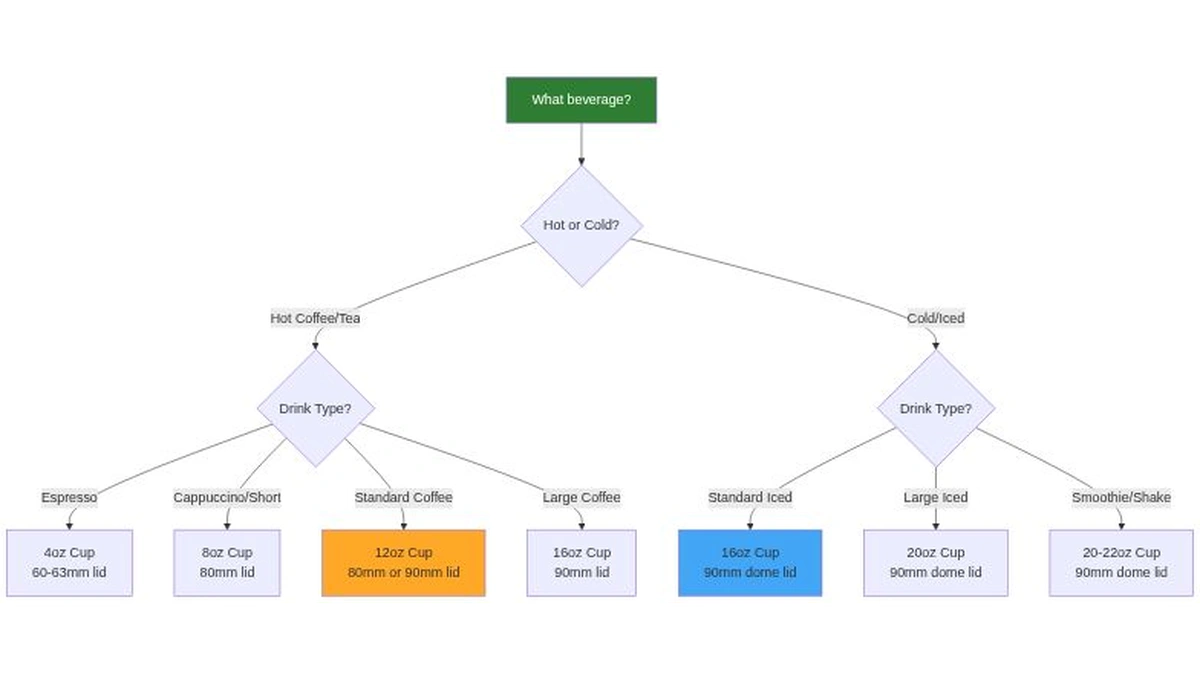
Alt Text: Decision tree for selecting paper cup sizes based on beverage type (hot vs cold) and drink style
Filename: blog_006_mermaid_01.png
Avoid confusion with clear, consistent naming.
Option 1: Traditional (S/M/L)
•Small = 8oz
•Medium/Regular = 12oz
•Large = 16oz
•Extra Large = 20oz
Pros: Simple, universally understood
Cons: Relative (your “large” vs Starbucks “grande”)
Option 2: Ounce-Based
•8oz, 12oz, 16oz, 20oz (exactly as is)
Pros: Transparent, no ambiguity
Cons: Less friendly, requires math for customers
Option 3: Branded Names
•Custom names (like Starbucks: Tall/Grande/Venti)
Pros: Brand differentiation, memorable
Cons: Requires customer education, confusing for first-timers
Option 4: Hybrid (Recommended)
•Small (8oz)
•Medium (12oz)
•Large (16oz)
Pros: Clear for customers, specific for operations
Cons: None (best of both worlds)
Show the actual ounce size on menu boards so staff and customers understand the serving volume.
Bad Example:
Coffee: $3 / $4 / $5
Better Example:
Coffee
Small (8oz) – $3
Medium (12oz) – $4
Large (16oz) – $5
Best Example:
Coffee
Small (8oz) – $3.00
Medium (12oz) – $4.00 ← Most Popular
Large (16oz) – $5.00
| Beverage | Recommended Size | Top Diameter | Lid Type |
|---|---|---|---|
| Espresso | 4oz | 60-63mm | Flat, paper |
| Cappuccino | 8oz | 80mm | Flat, vented |
| Drip Coffee | 12oz | 80mm or 90mm | Flat, vented |
| Latte (hot) | 12oz or 16oz | 80/90mm | Flat, vented |
| Iced Coffee | 16oz or 20oz | 90mm | Dome or straw-slot |
| Smoothie | 20oz or 22oz | 90mm | Dome with straw |
Understanding standard paper cup sizes requires attention to these factors:
12oz (medium) accounts for 35-45% of sales at most cafés. It’s the standard “regular coffee” size globally.
Trend: 16oz is growing (especially for iced drinks), while 8oz is declining (customers prefer larger sizes for value).
Understanding paper cup sizes requires attention to these factors:
Different manufacturers use different specifications, cup sizes matter.80mm was the traditional standard for smaller cups (4-12oz). 90mm became standard for larger cups (16-22oz) — but some manufacturers started making 12oz cups with 90mm tops for consistency across their product line.
Always verify lid diameter when switching suppliers — even if cup capacity is the same.
Understanding available paper cup sizes requires attention to these factors:
10-10.5oz of actual liquid. You need to leave 15-20mm (about 1.5-2oz) of headroom for proper lid sealing and to prevent spills.
When evaluating cup sizes, consider the following:
Technically yes, but not recommended:
•Hot drinks need vented lids (steam release)
•Cold drinks need sealed lids (prevent condensation drips)
•Using cold lid on hot drink = pressure buildup, potential blowout
16oz or 20oz. Ice takes 40-50% of cup volume, so:
•16oz cup with ice = about 8-10oz liquid
•20oz cup with ice = about 10-12oz liquid
Many cafés use 16oz as standard iced size to match 12oz hot drink liquid volume.
Understanding different paper cup sizes requires attention to these factors:
Per size: 50,000-100,000 units minimum per design per size
Mixed sizes: Many suppliers allow mixing (e.g., 50k total split across 12oz + 16oz)
Cost tip: Order 2-3 core sizes in same print run to meet MOQ while testing proportions
Understanding common paper cup sizes requires attention to these factors:
Formula: (Daily cups sold × Days between orders × 1.2 safety margin)
Example:
•Sell 200 cups/day
•Order every 60 days
•200 × 60 × 1.2 = 14,400 cups minimum
Size breakdown (typical café):
•12oz: 40% = 5,760 cups
•16oz: 35% = 5,040 cups
•8oz: 15% = 2,160 cups
•20oz: 10% = 1,440 cups
Cup sizes are simpler than they seem: match capacity to your drinks, verify lid diameter (80mm vs 90mm), and name sizes clearly for customers.
Key Takeaways:
1.12oz is the global standard for regular coffee (most cafés should stock this)
2.80mm vs 90mm top diameter is more critical than ounce capacity for ordering
3.Actual fill capacity is 10-15% less than cup size (account for headroom)
4.Most cafés succeed with 3 core sizes: 8oz, 12oz, 16oz
5.Always order cups and lids together from same supplier to guarantee fit
Start with standard sizes, track usage for 2-3 months, then adjust based on actual demand.
•Paper Cups – Complete cup range and specifications
•Coffee Cup Lids – Lid types and compatibility
•Packaging Accessories – Sleeves, carriers, stirrers
Papacko supplies paper cups in all standard sizes with verified lid compatibility.
Why choose Papacko:
•Size accuracy guaranteed: Exact diameter specs provided
•Lid matching service: We verify compatibility before shipping
•Mix-size orders: Combine sizes to meet MOQ (from 50,000 total)
•Sample program: Test sizes with your menu before ordering
•Expert sizing consultation: Help determining size mix based on your menu
Cup size decisions usually lead to a second set of questions: which material works for cold drinks, what wall structure suits hot beverages, how lid diameter affects fit, and where taller formats make more sense. These guides cover that next step.
Get in touch:
•Request a Quote – Cup pricing by size
•Free Sample Kit – Test all sizes
•Sizing consultation – Optimize your inventory