¿Está listo para crear sus propios vasos o envases de papel con su marca?
Díganos sus requisitos -tamaño, revestimiento, impresión y destino- y nuestro equipo le preparará un presupuesto detallado en 24 horas.

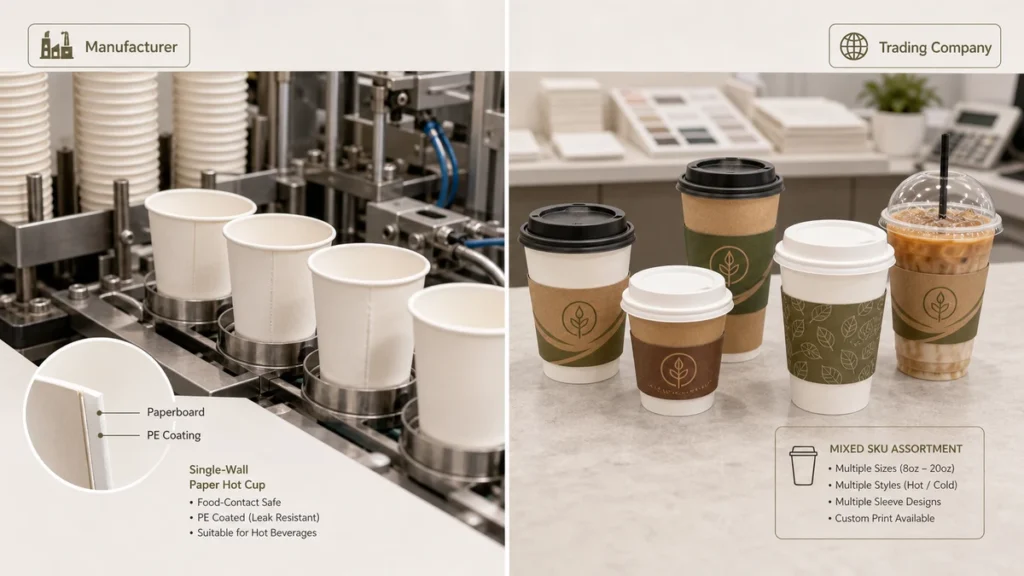
Choosing between a paper cup manufacturer and a trading company is not just a price decision. It changes how much control you have over specification, compliance, print consistency, lead time, and problem resolution. For most B2B buyers, the better option depends on order volume, MOQ tolerance, customization needs, and how much supply risk the business can absorb.
A paper cup manufacturer runs or directly manages the production process. That usually includes board selection, coating application, printing, forming, rim curling, packing, and lot traceability. A trading company manages the commercial side and sources cups from one or more upstream factories.
This distinction affects everyday buying decisions in practical ways.
A manufacturer usually gives you stronger control over:
A trading company usually gives you more flexibility on:
For buyers still comparing formats, it helps to review available vasos de papel before deciding which sourcing model fits the program.
In simple terms, the manufacturer model favors control. The trader model favors convenience. Neither is automatically better. The right choice depends on whether your main risk is overcommitting to stock or losing control of specification.
A direct paper cup manufacturer is often the stronger fit when your business needs stable reorders, branded printing, tight tolerance on lid fit, or clear food-contact documentation. A trading company can be useful when demand is uncertain, volume is low, or several packaging items must be consolidated quickly.
Many buyers compare only unit price. That is where mistakes start. A low ex-factory quote may become expensive once tooling, freight basis, sample charges, inspection, and excess inventory are included.
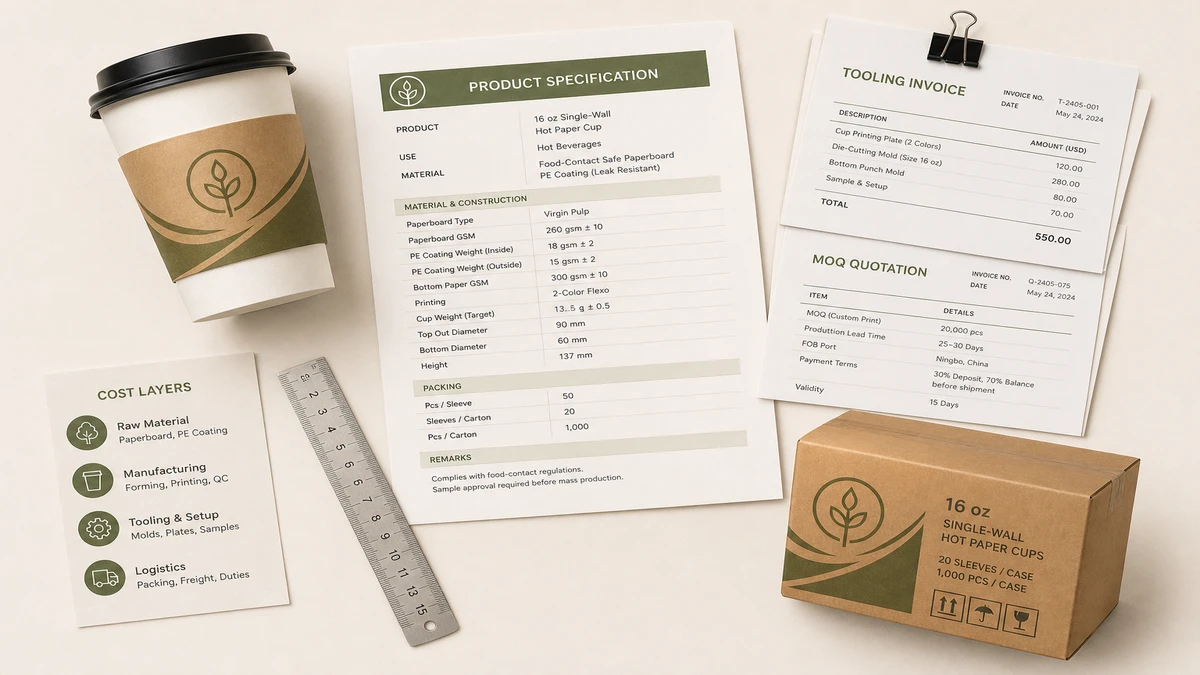
A paper cup manufacturer usually prices from raw material, coating, printing setup, forming cost, labor, packing, and shipping terms. For repeat high-volume work, this often creates the lowest price floor because there is no middle margin.
But direct sourcing often comes with conditions such as:
Typical custom MOQ can start around 10,000 to 50,000 units per design, depending on cup size, wall construction, and print method. Some projects may require more.
A trader buys from one or more factories and adds margin for coordination, order handling, sourcing, and sometimes local stock support. The unit price is usually higher, but the commercial risk can be lower if your demand is still being tested.
A trading company may help by offering:
This matters when the alternative is ordering more inventory than your operation can consume in a reasonable time.
When reviewing two quotes, ask for the same cost structure from both suppliers:
| Cost item | Fabricante | Empresa comercial |
|---|---|---|
| Unit price | Usually lower at scale | Usually higher |
| MOQ per SKU | Usually higher | Usually lower |
| Print setup | Often separate | May be bundled or partly absorbed |
| Sample cost | Usually charged plus courier | Similar, sometimes with added handling time |
| Inspección | Often buyer-arranged | Sometimes included, verify scope |
| Storage risk | Higher if MOQ exceeds demand | Lower if buying smaller lots |
| Reorder flexibility | More limited | Often better |
The key lesson is that cheapest per piece does not always mean cheapest in practice. If a factory MOQ creates months of excess stock, that working capital cost matters. If a trader lets you buy only what you need, the higher unit price may still be the safer business decision.
For foodservice packaging, accountability matters more than promises. If a cup leaks, softens, smells unusual, or arrives with missing paperwork, you need to know who owns the problem and who can prove what was made.
A paper cup manufacturer usually has the compliance advantage because documents can be tied directly to the production site, materials, and lot records. A trading company can still be acceptable, but only if it is transparent about the actual factory and shares traceable source documents.
Ask for the following before issuing a purchase order:
For food-contact guidance, the most relevant external baseline for many buyers is the FDA overview of food-contact substances: FDA overview.
Do not accept a vague description such as “high quality paper cup.” Ask the supplier to confirm:
If two suppliers do not provide these details in the same format, the quotes are not truly comparable.
A strong supplier can usually answer direct questions quickly. A weak one avoids specifics. If a trader cannot name the factory, if a compliance document shows a different address from the quotation, or if the certificate scope says “trading” rather than “manufacturing,” you should slow down and verify further.
Custom branding is often where the gap between a paper cup manufacturer and a trader becomes visible. Small errors in print placement, color, or seam location can turn a usable cup into unusable stock.
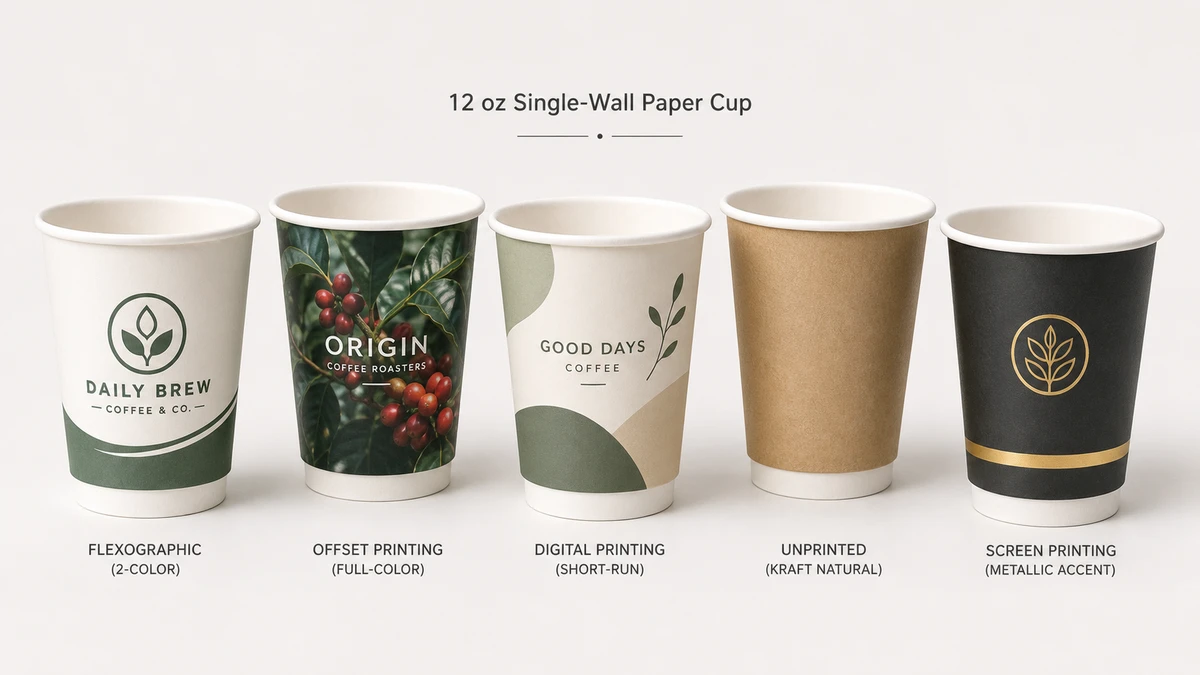
A manufacturer usually controls print setup more directly. That can mean better consistency in:
A trading company may still deliver acceptable printed cups, but the communication path is longer. Files pass through more hands, and each handoff can introduce error.
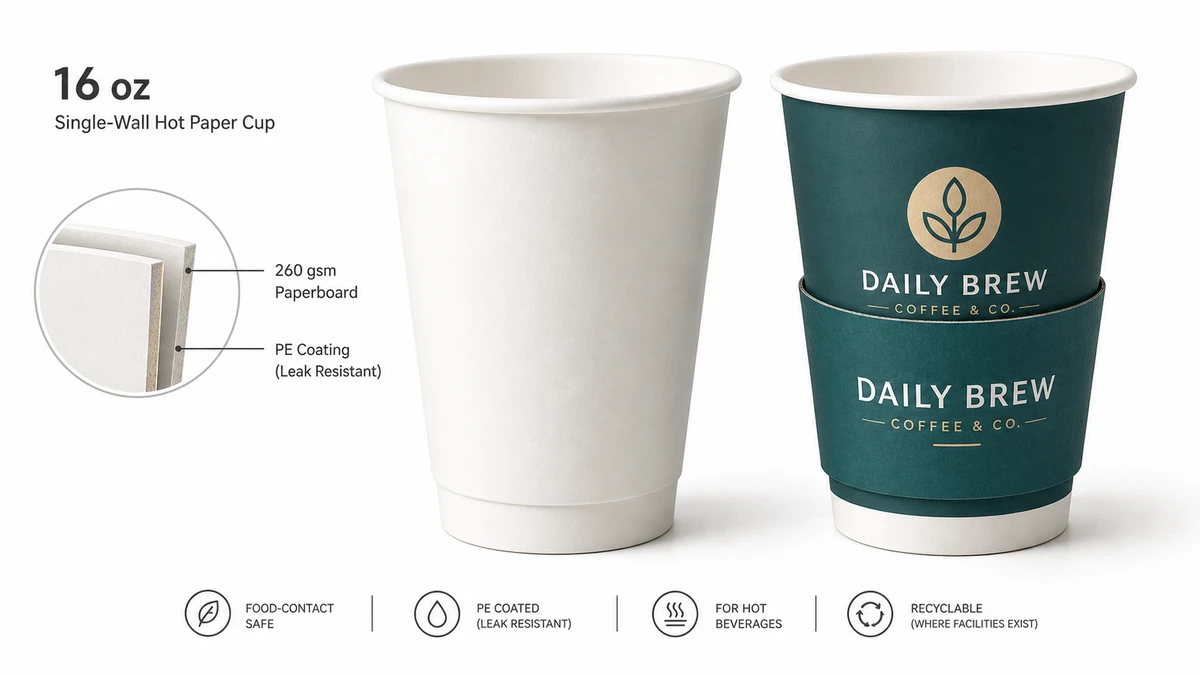
Buyers should confirm whether the cup uses PE or PLA coating and whether the material suits the intended use. Hot beverage service, short dwell time, sustainability positioning, and local disposal rules all affect material choice. Board gsm also matters because wall stiffness influences cup feel, heat performance, and lid retention.
Do not assume one 12 oz or 16 oz cup is the same as another just because nominal size matches. Material build changes performance.
One common sourcing problem is lid mismatch after changing supplier. Nominal size alone does not guarantee compatibility. Small differences in rim curl, top diameter tolerance, and wall stiffness can affect snap-on behavior.
If you use existing tapas para tazas de café, test the exact cup and lid combination before rollout. Do not approve based only on a drawing or a stock photo.
Request samples early and test them under real service conditions:
A sample that looks correct on the desk may still fail in operation.
Lead time should be defined clearly. A manufacturer may quote production lead time from artwork approval and deposit. A trader may quote dispatch time for stock items. Those are not the same.
A paper cup manufacturer often needs more time for a first custom run because artwork, tooling, production scheduling, and approval all happen before shipment. Repeat orders may be faster if the same specification is maintained.
A trading company may ship stock items quickly, but custom orders can still depend on the same upstream factory timeline plus extra coordination time.
Always ask:
MOQ and lead time should be reviewed together. If your monthly demand is modest and the factory MOQ creates 10 to 12 weeks of inventory, you are making a working capital decision, not just a packaging purchase.
Before finalizing specification, review the intended tamaños de vasos de papel and estimate demand per SKU. Too many sizes with low volume often create unnecessary stock risk.
Choose a manufacturer when:
Choose a trading company when:
Many buyers use a two-stage approach. They start with a trader for low-risk market entry, then move to a direct paper cup manufacturer once demand, artwork, and operations are stable.
Neither model is risk-free. The warning signs just appear in different places.
Use this checklist for either type of supplier:
If your program also includes broader environmental positioning, align the cup decision with your wider embalajes de papel sostenibles plan so messaging, materials, and documentation stay consistent.
Not always. A manufacturer usually has the lowest unit price at higher volume, but a trading company may be cheaper in practice when your order is below factory MOQ or when reducing inventory exposure matters more than per-piece cost.
Usually when your demand is repeatable, your artwork is stable, and you need stronger control over print, compliance, dimensions, or fit with accessories. A direct paper cup manufacturer is often the better long-term choice for standardized branded programs.
They can be, especially if they do not disclose the producing factory or if documentation cannot be traced back to the actual manufacturing site. A transparent trader with fixed factory partners can still work if paperwork is complete and consistent.
Custom printed runs often start around 10,000 to 50,000 units per design, though exact MOQ depends on cup size, print method, and factory setup. Traders may offer lower minimums, usually with a higher unit cost.
Ask both suppliers to confirm the same details: board gsm, coating type and coat weight, wall construction, cup dimensions, print method, case-pack, freight basis, and compliance document scope. If any item is missing, the quotes are not directly comparable.
Small differences in rim curl, top diameter tolerance, and wall stiffness can change snap-on performance even when the stated cup size is the same. Always test the exact cup with the exact lid before rollout.