¿Está listo para crear sus propios vasos o envases de papel con su marca?
Díganos sus requisitos -tamaño, revestimiento, impresión y destino- y nuestro equipo le preparará un presupuesto detallado en 24 horas.

Selecting the right food container materials is one of the most consequential decisions a procurement team or foodservice operator can make. Get it wrong and you face leaking bowls, failed audit inspections, confused waste-diversion claims, and unhappy customers. Get it right and your packaging quietly does its job — protecting food, meeting regulatory intent, and supporting your brand story without creating downstream headaches.
This guide walks through the four primary material families in commercial foodservice packaging — paper-based, conventional plastic, molded fiber, and compostable alternatives — and explains how to evaluate each one rigorously before committing to a SKU. Throughout, one principle applies without exception: a material family alone does not prove that any specific SKU will perform to your expectations, meet food-contact requirements applicable to your jurisdiction, or achieve the end-of-life outcome you are targeting. Verification at the SKU level is always the buyer’s responsibility.
Packaging decisions used to be simpler. A buyer chose a polystyrene clamshell or a wax-coated paper cup, placed a volume order, and moved on. Today, the landscape looks completely different. Municipal regulations vary by city and state. Foodservice sustainability commitments create internal pressure. Consumer expectations around compostability, recyclability, and food safety have grown more sophisticated — and more scrutinizing.
At the same time, the range of available food container materials has expanded dramatically. Kraft-lined paperboard, CPLA-lined fiber, PLA-coated paper, sugarcane bagasse, bamboo, recycled PET, and conventional polypropylene all compete for the same bowl or container slot. Each brings genuine advantages. Each also carries limitations that only become visible when you stress-test the SKU against your actual use case: fill temperature, hold time, sauce viscosity, portioning method, transport distance, and local end-of-life infrastructure.
Understanding the material families is therefore not the endpoint of sourcing — it is the starting point for asking better questions.
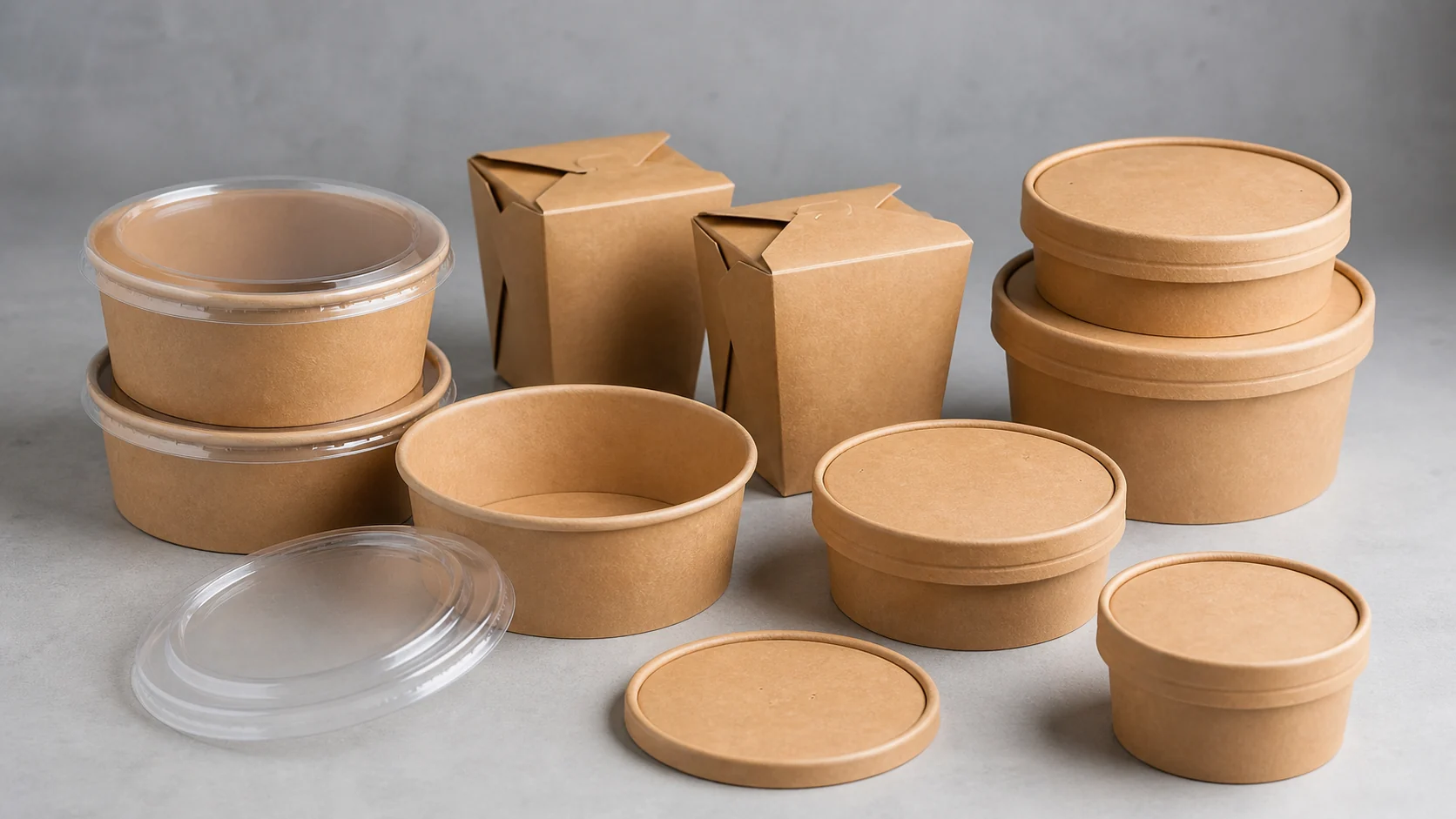
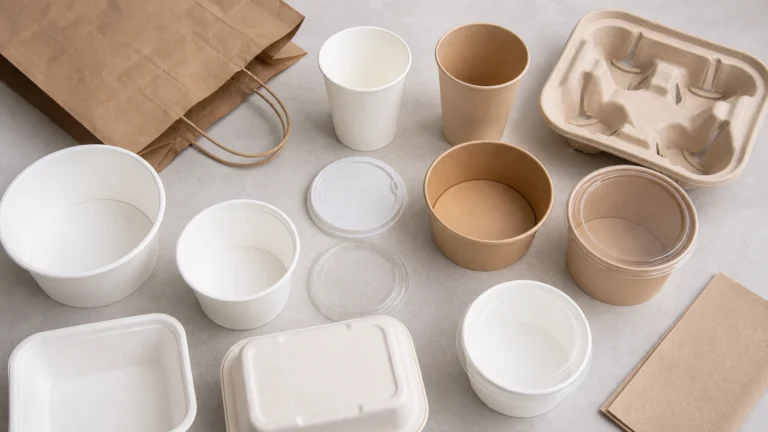
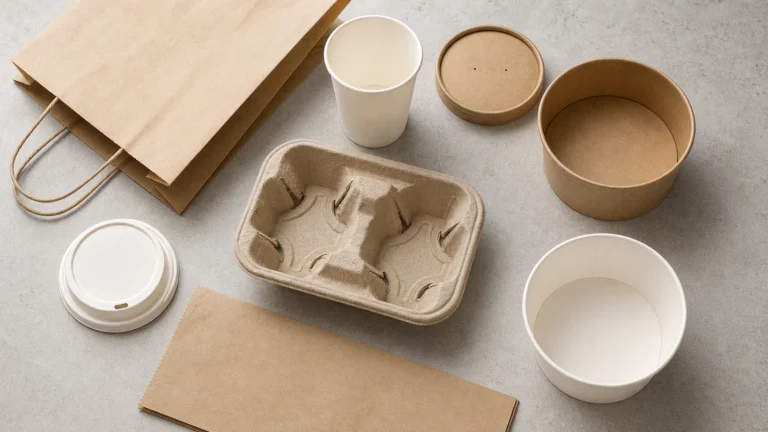
Paper-based packaging is the broadest category in commercial foodservice. It covers everything from simple printed paperboard lunch boxes to multi-wall sandwich bags and deep hot-soup bowls. What these products have in common is a cellulose fiber substrate — but the functional properties of any specific container depend heavily on what has been applied to or laminated onto that substrate.
Common paper-based construction types include:
The practical implication for buyers is significant. A container described as “paper” may contain plastic film layers that affect its recyclability, compostability, or grease resistance. A container described as “compostable” must still be confirmed against your local industrial composting facility’s accepted materials list — no material-family description substitutes for that facility-level check.
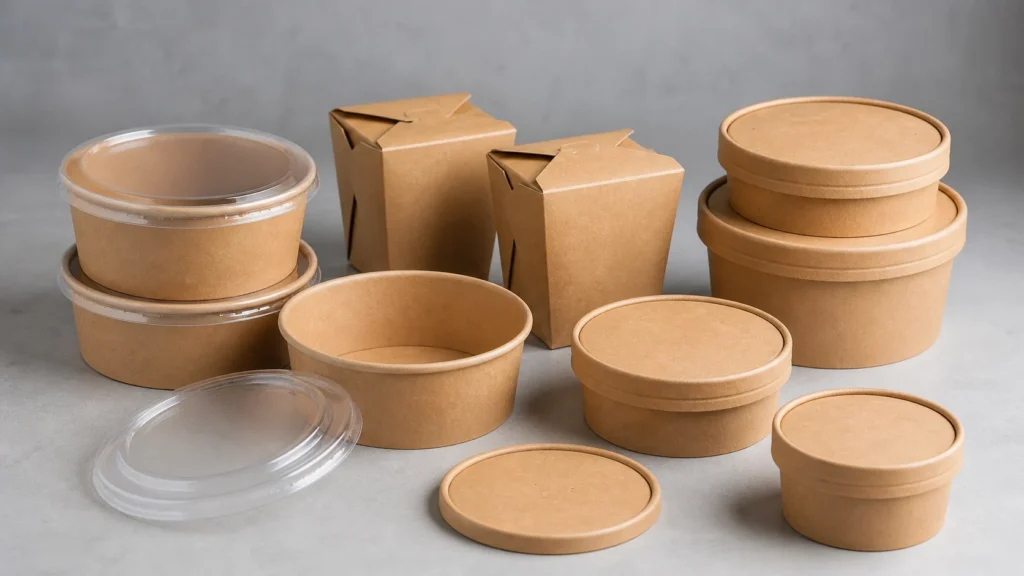
Cuencos de papel kraft are a popular choice for hot foods, grain bowls, and ramen-style dishes because the kraft aesthetic communicates warmth and naturalness to consumers. Buyers evaluating specific kraft bowl SKUs should verify the interior coating type, the declared oil and water resistance level, the stack height for their storage footprint, and whether the supplier can provide food-contact compliance documentation relevant to the target market.
Practical buyer checklist for paper-based containers:
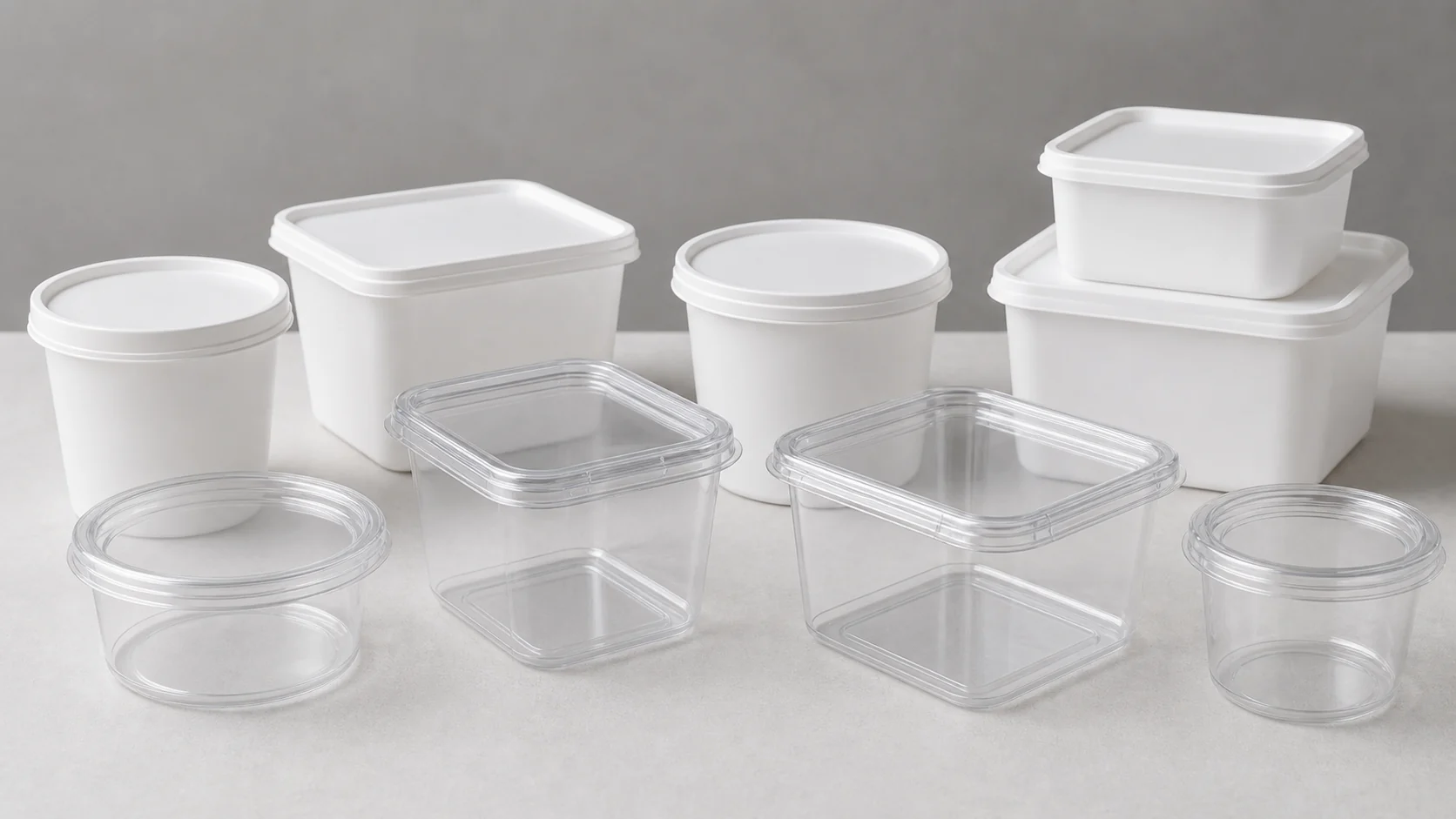
Conventional plastics — primarily polypropylene (PP), polyethylene terephthalate (PET), and to a lesser extent polystyrene (PS) — have dominated commercial foodservice for decades because they offer predictable, testable performance characteristics. They are generally resistant to leaks, tolerant of a wide fill-temperature range depending on resin grade, and stackable in standardized configurations that simplify storage and transport logistics.
For buyers considering envases alimentarios desechables in conventional plastics, the major sourcing questions have shifted in recent years. Increasingly, buyers must address:
Performance verification:
– What specific resin grade and wall thickness is used in the SKU?
– Has the container been validated for the intended fill temperature, food type, and hold time?
– Does the lid system — whether snap-on, friction-fit, or vented — seal to acceptable leakage standards under your distribution conditions?
Regulatory and food-contact compliance:
– The U.S. FDA maintains guidance on packaging and food-contact substances at their food ingredients and packaging resource. Buyers sourcing plastic containers should understand what documentation is relevant for their product category and jurisdiction, and request supplier compliance documentation accordingly.
– Buyers operating internationally must map requirements jurisdiction by jurisdiction — no single regulatory approval covers all markets.
End-of-life complexity:
– PP is accepted by many curbside recycling programs, but acceptance varies by municipality, and contamination from food residue affects real-world recycling rates.
– PET containers, particularly clear salad bowls and deli containers, are widely accepted in recycling streams in many U.S. markets, but specific acceptance depends on local MRF (materials recovery facility) capabilities.
– Polystyrene faces restrictions or bans in a growing number of jurisdictions. Buyers should confirm local regulatory status before specifying PS-based SKUs.
A material family designation — “polypropylene,” for instance — does not guarantee that any given SKU meets all applicable food-contact requirements, achieves the temperature performance you need, or is accepted in your local recycling infrastructure. Specification at the SKU level, with documented supplier data, is always required.
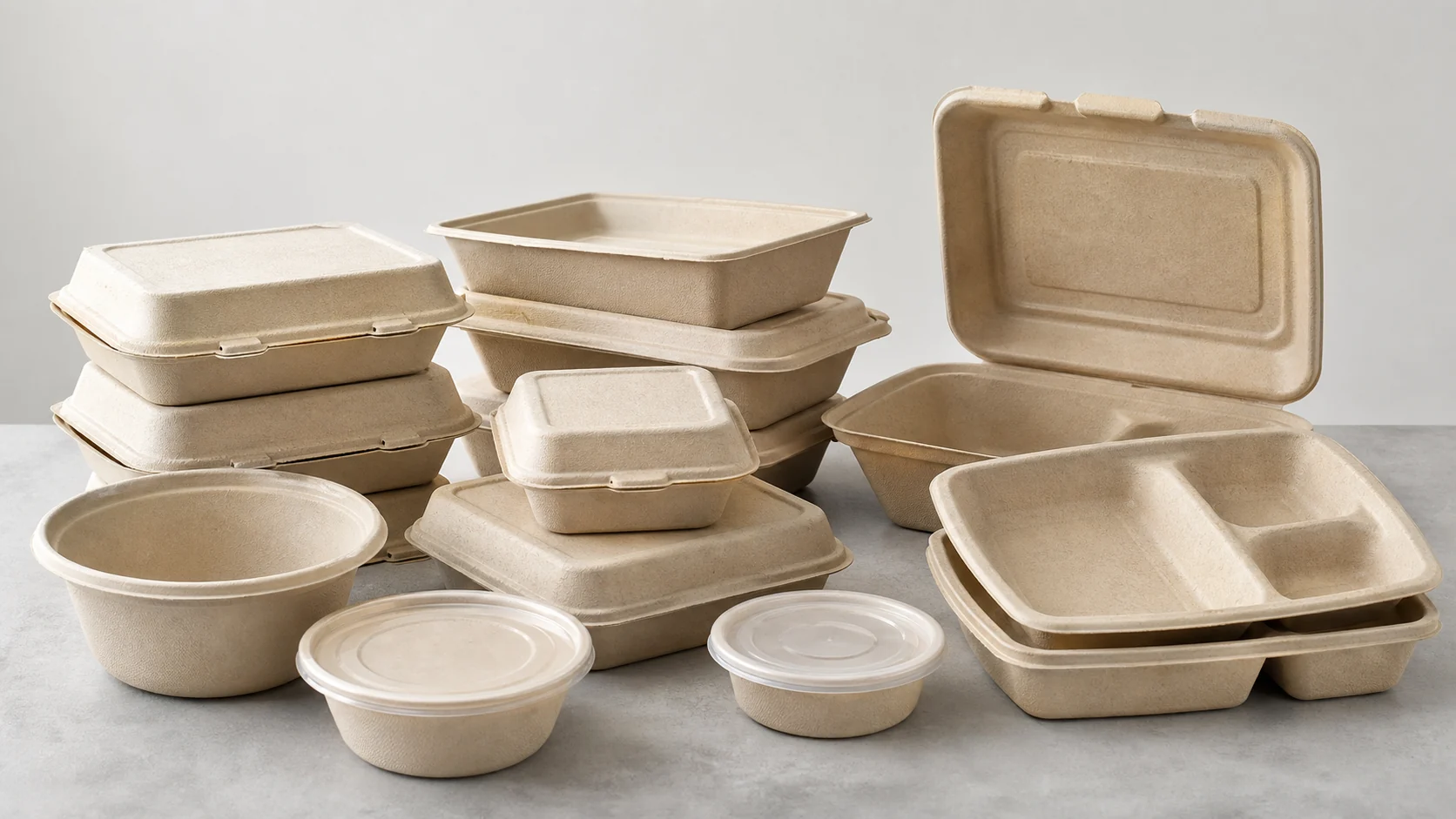
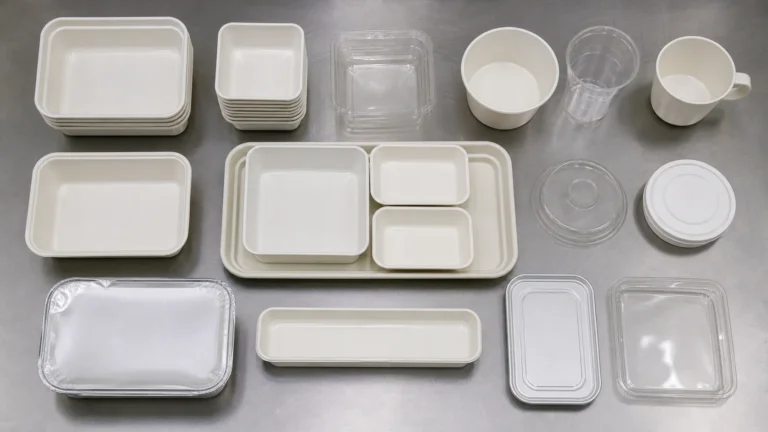
Molded fiber — sometimes called molded pulp — uses paper pulp formed into three-dimensional shapes including plates, clamshells, bowls, and trays. The raw material is typically recycled newsprint, kraft pulp, sugarcane bagasse (the fibrous byproduct of sugar processing), or bamboo pulp. Molded fiber products are commonly associated with compostability and sustainability positioning, and for good reason: the substrate is genuinely bio-based and, under appropriate conditions, biodegradable.
However, several sourcing nuances deserve careful attention.
Performance limitations buyers frequently encounter:
Compostability claims require facility-level verification:
Molded fiber containers are often certified to third-party compostability standards, but certification alone does not guarantee acceptance at your local composting facility. Industrial composting programs accept materials based on their own accepted-materials lists, which can differ significantly from what a certification implies. Buyers should contact their city or regional composting facility directly, or work with a waste consultant, before committing to a “compostable” SKU as part of a formal sustainability claim.
Sugarcane bagasse specifically has grown in popularity as a food container material because it uses agricultural byproduct as its raw material rather than virgin fiber. Buyers evaluating bagasse SKUs should confirm the specific processing, any coating applied, and the declared performance envelope — just as they would with any other material.
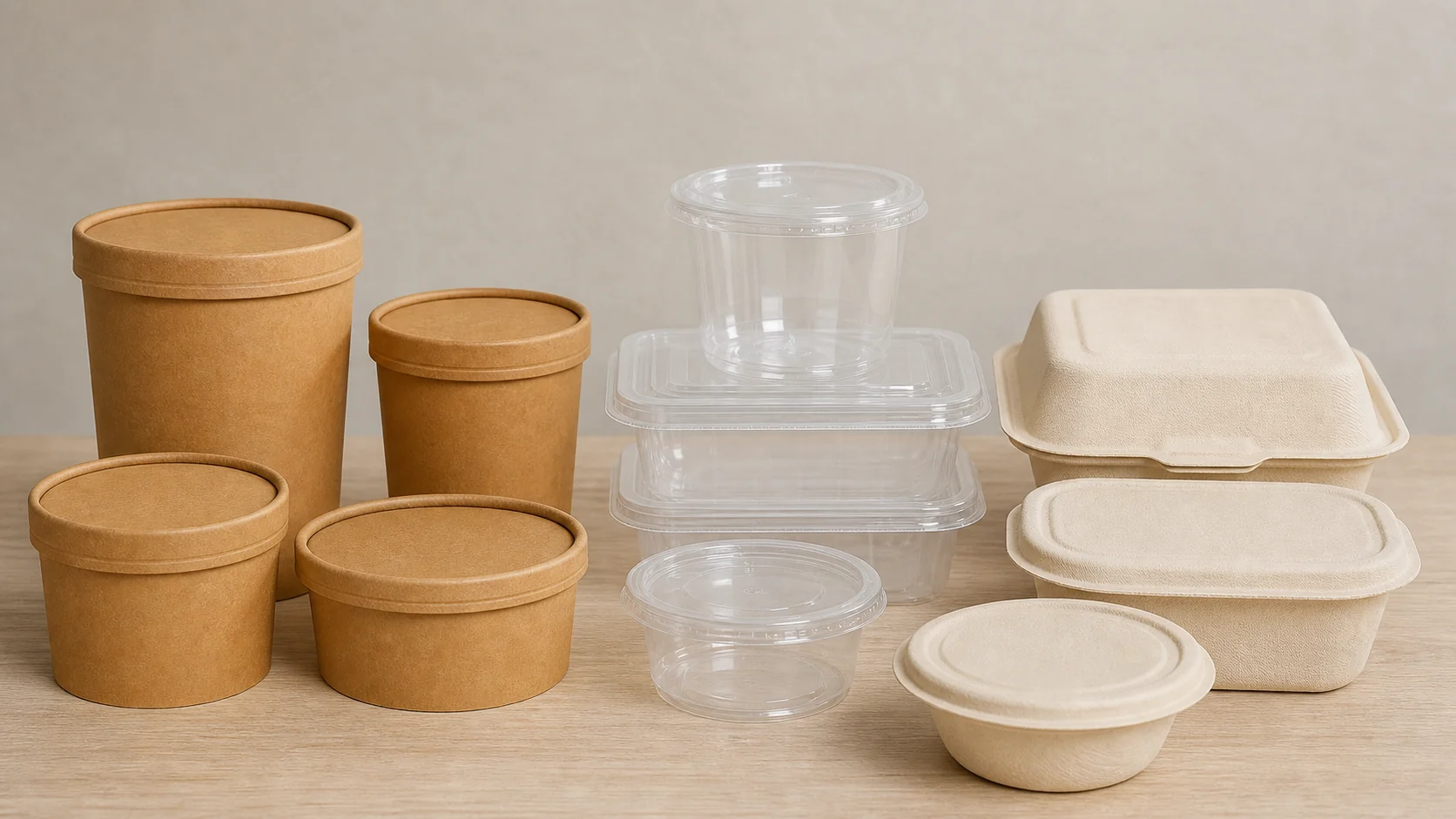
“Compostable” and “bio-based” are two distinct attributes that buyers sometimes conflate. Bio-based refers to the origin of the raw material (plant-derived rather than petroleum-derived). Compostable refers to the end-of-life behavior under specific composting conditions. A material can be bio-based but not compostable, compostable but not bio-based, both, or neither.
PLA (polylactic acid) is the most common bio-based plastic used in food containers and lids. It is derived from corn starch or other plant sugars. It is typically certified for industrial composting but generally requires industrial composting conditions to break down within a commercially relevant timeframe — home composting or landfill conditions will not achieve this. PLA is also frequently not accepted in curbside recycling streams because it can contaminate conventional PET recycling.
Key buyer verification points for compostable SKUs:
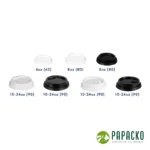
One additional area where claims require care: lids. A bowl made from certified compostable molded fiber may be paired with a lid made from conventional PVC or PET — which would compromise the compostability of the complete package. Buyers should evaluate the container system, not individual components in isolation. For example, tapas de papel para cuencos designed for compatibility with specific bowl SKUs can be an important part of achieving a coherent packaging specification.
The table below is intended to orient buyers within material families. It does not constitute performance guarantees for any specific SKU, and buyers should verify all attributes against individual product data sheets, supplier documentation, and applicable regulatory guidance.
| Material Family | Typical Strengths | Common Limitations | End-of-Life Pathway (verify locally) |
|---|---|---|---|
| Coated paperboard / kraft | Good printability; insulating; natural aesthetic | Coating type affects recyclability and compostability; moisture/oil resistance depends on coating | Recyclable or compostable depending on coating; verify with local facility |
| Conventional PP | Temperature consistency; leak resistance; cost-effective at scale | Petroleum-derived; regulatory scrutiny increasing in some markets | Recyclable in many curbside programs; local acceptance varies |
| Clear PET | Visibility for cold foods; widely recycled; rigid structure | Not suitable for hot-fill in most grades; petroleum-derived | Widely accepted in recycling; check local MRF |
| Poliestireno (PS) | Excellent insulation; low cost | Banned or restricted in growing number of jurisdictions; low recycling infrastructure | Limited recycling; verify local regulatory status before specifying |
| Molded fiber / bagasse | Bio-based; compostable under right conditions; strong sustainability story | Oil/moisture absorption without coating; possible PFAS concerns in some products | Industrial compostable in most programs; verify local acceptance |
| Papel recubierto con PLA | Bio-based coating; compostable if certified | Requires industrial composting; may not be accepted in recycling | Industrial composting only; not curbside recyclable in most markets |
| CPLA lids/accessories | Higher heat tolerance than standard PLA; bio-based | Niche; higher cost; facility-level composting acceptance still required | Industrial composting; verify locally |
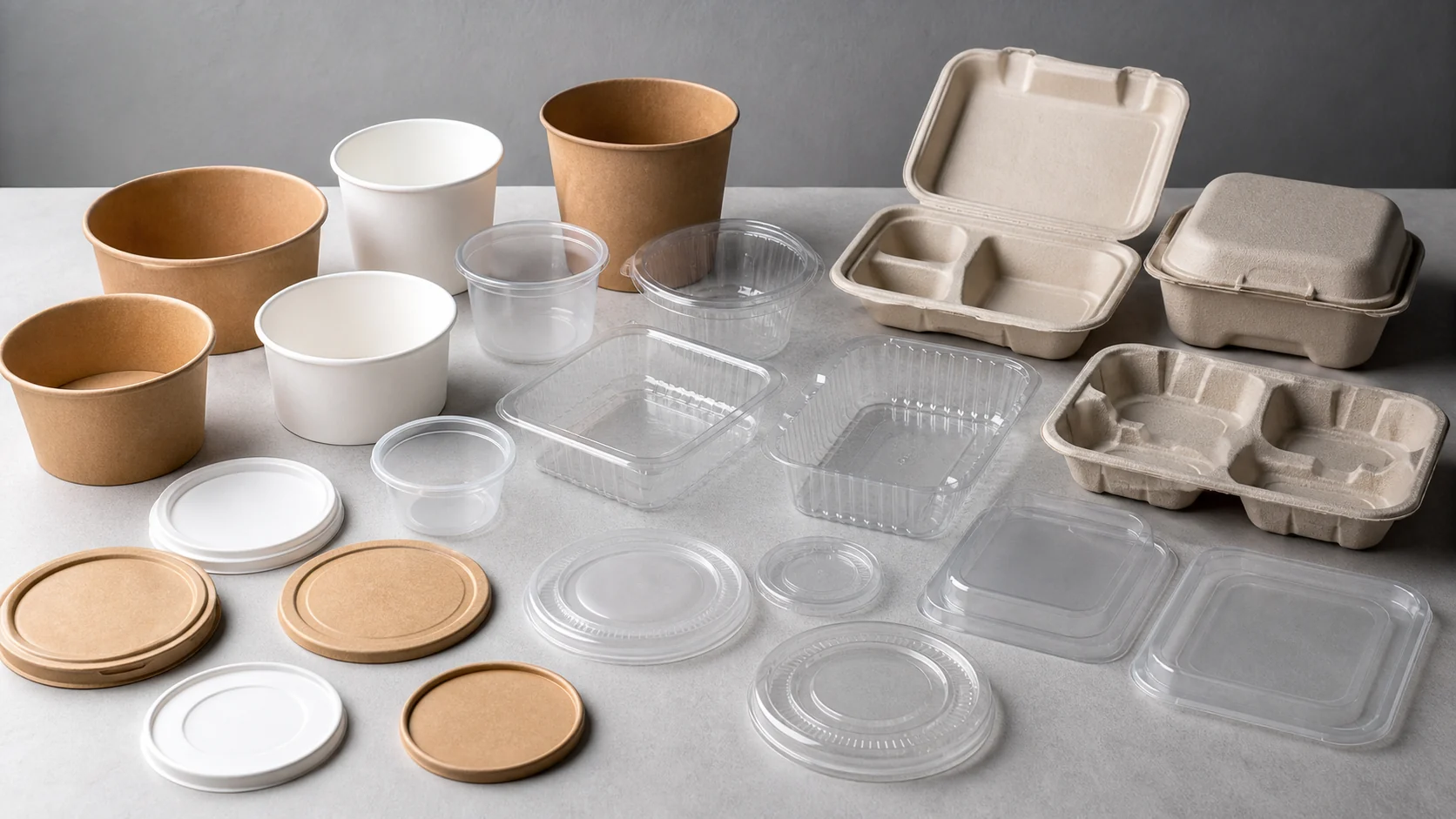
The gap between material-family descriptions and actual SKU performance is where procurement errors most commonly occur. A buyer who specifies “compostable bowl” without anchoring to a specific SKU, coating type, weight, and verified composting pathway may receive compliant product that still fails in the field.
The following structured approach is recommended before committing to any new container specification.
Step 1: Define the use case completely
Document the food type (wet, oily, dry, acidic), fill temperature, hold time before service, portioning method (manual, automated), transport conditions, and consumer-facing disposal expectation.
Step 2: Request SKU-specific data
Ask suppliers for technical data sheets covering wall thickness, weight, declared temperature range, oil and water resistance ratings, and any third-party performance certifications. Do not accept material-family generalizations as substitutes.
Step 3: Verify food-contact compliance
Request food-contact compliance documentation specific to the SKU and relevant to your target market. For U.S. operations, understand what FDA requirements apply to your food category and container type.
Step 4: Test under real conditions
Conduct fill tests using your actual product, at your actual fill temperature, over your actual hold time. Evaluate leakage, lid retention, structural integrity, and appearance degradation. No specification document replaces physical testing with your specific food.
Step 5: Validate the end-of-life pathway
Contact your waste hauler, composting facility, or MRF directly. Confirm that the specific material, with any coating, is accepted and will be processed as intended.
Step 6: Evaluate the complete system
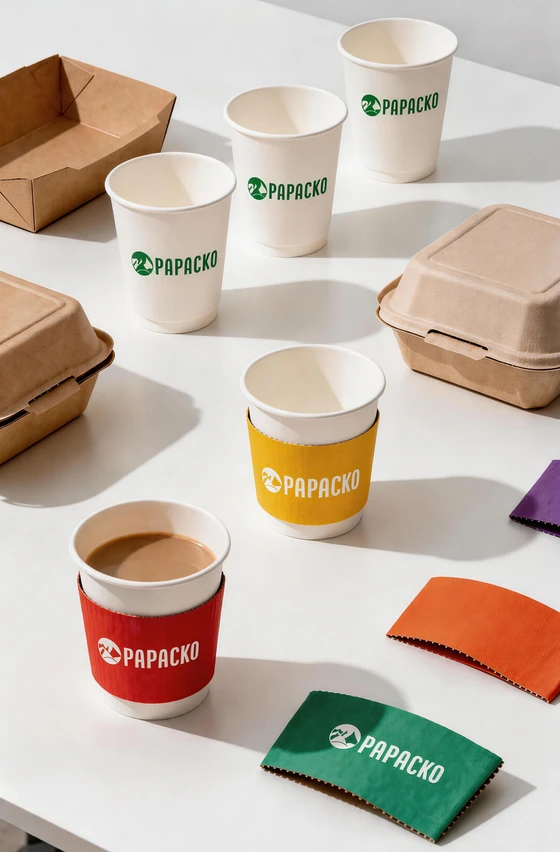
Assess the lid, the sleeve or wrap if applicable, and any secondary packaging. A container system that is not compatible across all components creates both operational and sustainability gaps.
Buyers assembling a complete envases para comida para llevar specification can use this framework to build a clear brief for supplier conversations and trials.
Once you have worked through the evaluation framework above, consolidating your requirements into a written brief serves two purposes: it disciplines your own thinking, and it gives suppliers a clear benchmark against which to propose.
A well-structured procurement brief for food container materials typically includes:
Sharing this brief with multiple suppliers and requesting SKU-specific proposals (not material-family proposals) gives you the basis for a genuine like-for-like comparison. The broader range of envases para alimentos available from commercial suppliers today means that buyers who arrive with a clear brief typically have more options, not fewer.
The guidance in this article reflects the practical sourcing challenges that procurement teams and foodservice operators commonly encounter when evaluating food container materials: the gap between marketing descriptions and SKU-level performance, the inconsistency between compostability certifications and real-world composting infrastructure, and the difficulty of comparing competing materials without a structured framework. The recommendations are structured around questions buyers should ask suppliers and waste-management partners — not around specific product endorsements — because the right answer depends on your application, your jurisdiction, and your verified end-of-life infrastructure.
Material performance claims in this guide are deliberately conditional. No specific temperatures, test results, or performance thresholds are stated as universal facts because these attributes vary by resin grade, coating type, wall thickness, and manufacturing process — and because buyers should obtain SKU-specific data rather than rely on category generalizations. Regulatory references direct buyers to authoritative sources, including applicable FDA guidance, rather than summarizing regulations that may change or vary by jurisdiction. Third-party certification bodies and local waste-management authorities are identified as the appropriate sources for compostability and recyclability verification, not this guide.
Use this article as a structured starting point, not a sourcing conclusion. Read the material-family sections to understand the landscape and the key questions each material raises. Use the comparison table to identify which material families warrant closer evaluation for your application. Apply the step-by-step SKU evaluation framework before finalizing any specification. Build your procurement brief from the outline provided and take it to supplier conversations with specific data requests. Revisit your specifications periodically as local regulations, supplier capabilities, and composting infrastructure evolve.
Food-contact compliance documentation for the specific SKU you intend to use is typically the most critical verification step. A material family description — “kraft paper,” “polypropylene,” “PLA-coated” — does not confirm that a given product is approved for contact with your specific food type, at your fill temperature, for your intended hold time. Buyers should request supplier documentation relevant to their jurisdiction and food category, and consult applicable regulatory guidance — such as FDA resources for U.S. operations — rather than relying solely on supplier claims.
Not necessarily. Compostability certifications indicate that a product meets a defined standard under specified composting conditions, but individual composting facilities operate their own accepted-materials lists based on their process equipment, throughput, and contamination management. Buyers should contact their local industrial composting facility directly and confirm that the specific certified SKU — including any coating or lamination — is accepted before making compostability claims to customers or in procurement commitments.
In general, mixing compostable and conventional plastic containers in the same bin undermines both recycling and composting outcomes. Compostable PLA containers contaminate PET recycling streams; conventional plastic containers contaminate industrial composting loads. Buyers who wish to make meaningful sustainability claims should map their entire packaging system — containers, lids, sleeves, and any secondary packaging — to a consistent and verified waste stream, and communicate clearly with staff and customers about correct disposal.
Because the functional properties of a paper-based container depend on coatings or laminations applied to the paper substrate — and those coatings or laminations may make the container incompatible with conventional paper recycling. A PE-coated soup bowl, for example, may be classified as non-recyclable paper because the coating cannot be separated from the fiber in standard recycling processes. Buyers should not assume that a container described as “paper” or “kraft” is automatically recyclable; they should verify the coating type and check with their local recycling infrastructure.
Lid compatibility should be evaluated as part of the complete container system specification, not as a separate decision. Dimensional fit (diameter and profile), seal type (snap-on, press-on, friction), venting requirements, and material consistency (especially if you are targeting a compostable system) all need to match between container and lid. Buyers should physically test lid retention under fill, transport, and consumer-handling conditions using the actual SKU combination — not assume compatibility based on nominal sizing. Suppliers who offer matched container-and-lid systems can simplify this process, but field validation is still recommended.
Recycled content is one sustainability attribute among several, and its value depends heavily on context. Post-consumer recycled (PCR) content in plastic containers, for example, can reduce virgin material demand and divert material from landfill — but the food-contact compliance picture for recycled plastics may differ from virgin material, and buyers should request relevant documentation. Recycled-content fiber in molded pulp products similarly uses materials that would otherwise be waste, but the end-of-life pathway for the finished container still needs to be verified. Buyers are encouraged to evaluate the full lifecycle picture — material origin, performance requirements, and verified end-of-life outcome — rather than treating any single attribute as a definitive sustainability indicator.