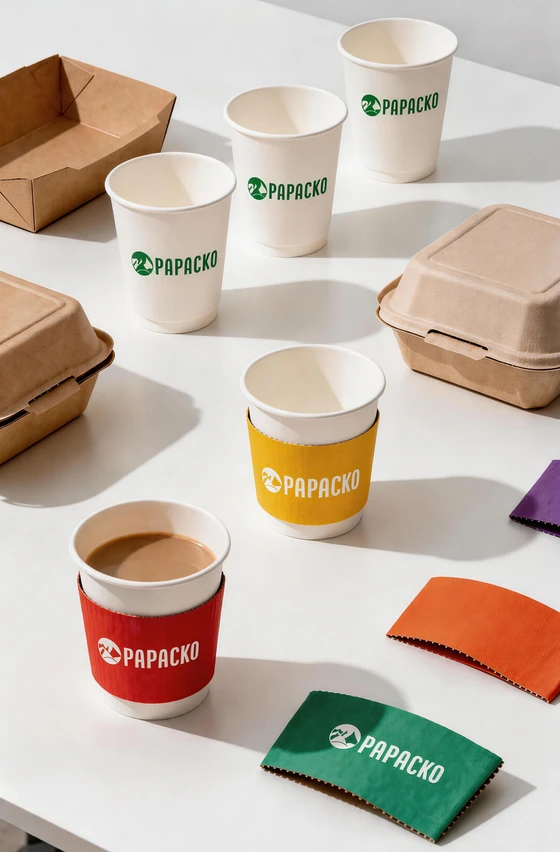
¿Está listo para crear sus propios vasos o envases de papel con su marca?
Díganos sus requisitos -tamaño, revestimiento, impresión y destino- y nuestro equipo le preparará un presupuesto detallado en 24 horas.

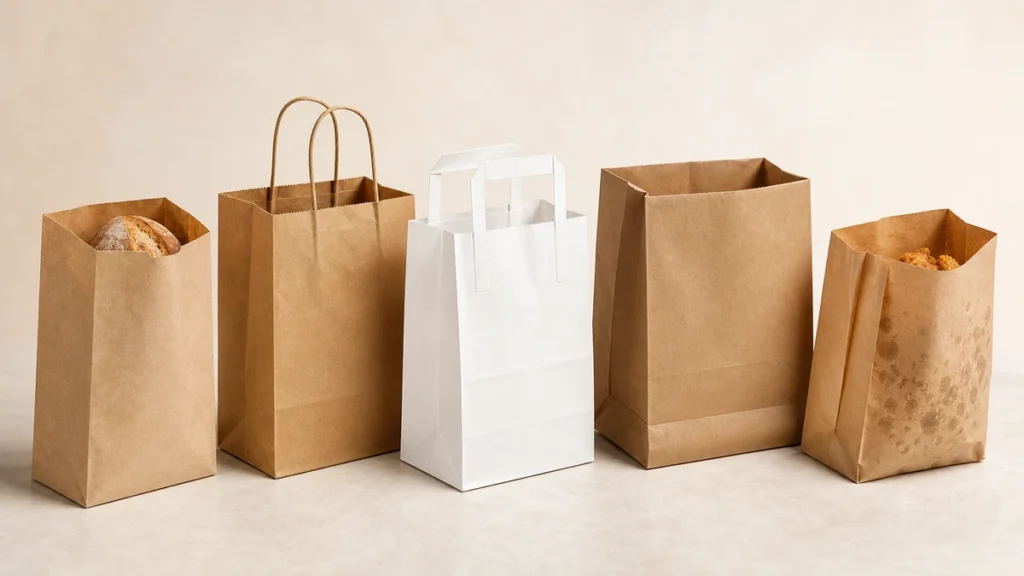
The best paper bags for foodservice wholesale are matched to your menu’s heat, grease, moisture, and carry weight: not the cheapest stock size on a quote sheet. For most buyers, that means selecting the right paper grade, gsm, barrier treatment, handle construction, and compliance documents before comparing unit price.
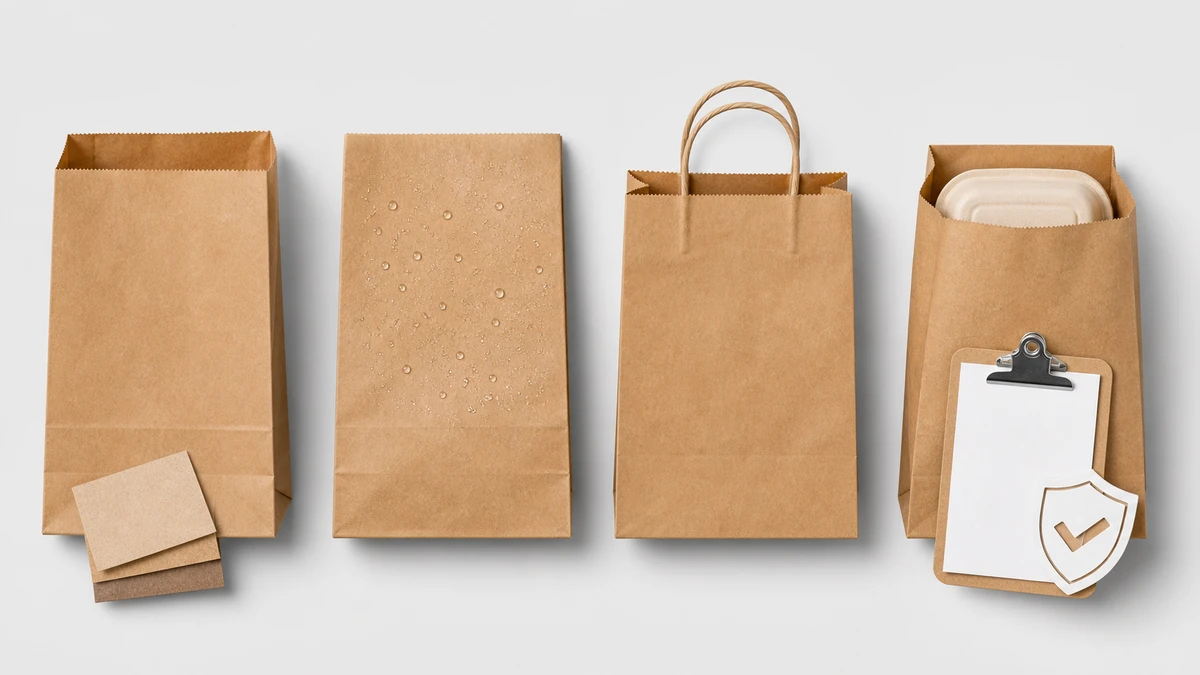
At wholesale level, bag selection comes down to four variables:
If one is underspecified, the failure shows up in service: a greasy patch at the counter, a soft base during delivery, or a handle that tears at handoff.
Kraft paper is the standard substrate because long fibers give good tensile strength for the weight. GSM is a load-control variable: 60-80 gsm suits dry bakery and light counter service; 90-120 gsm handles takeaway bags carrying filled containers or multiple items; 120 gsm+ is used for heavier handled or catering loads.
The inside treatment determines how long the bag stays structurally sound once hot or greasy food is packed. Uncoated kraft suits dry goods only; grease-resistant paper covers most short-hold takeaway; PE-lined paper handles higher-risk hot food. A burger-and-fries order with a 30-45 minute delivery window usually needs a stronger barrier than a pastry handed over in two minutes.
Twisted paper handles are the common all-round takeaway option; flat tape handles perform better for heavier loads; die-cut handles lower cost but weaken around the cut-out; handleless SOS bags are efficient for high-volume counter service. An SOS base is fast to pack, while a flat-bottom or wider-gusset bag gives better delivery stability. If orders include drinks, sauces, or bowls, match the bag footprint to the pack-out: especially when using larger formats from your wider line of envases para alimentos.
If the bag can touch food directly, documentation matters more than brochure language. For US supply, the FDA explains how food contact substances are regulated in its food-contact substances guidance. For EU markets, the European Commission explains migration and intended-use suitability in its food-contact materials guidance. At sourcing stage, ask for a Declaration of Compliance, a full material breakdown covering paper, coating, adhesive, and inks, and supporting test data for hot or greasy direct-contact applications.
| Caso de uso | Typical Paper Range | Barrier Approach | Preferred Format |
|---|---|---|---|
| Bakery / dry goods | 60-80 gsm | Sin recubrimiento | SOS or bakery bag |
| Cafe takeaway | 90-100 gsm | Grease-resistant | Twisted-handle bag |
| Hot food delivery | 100-120 gsm | Grease-resistant or PE-lined | SOS or handled takeaway bag |
| Deli / sandwich | 80-90 gsm | Grease-resistant | Flat bag or satchel |
| Catering / heavier loads | 120 gsm+ | Grease-resistant or lined | Flat-handle or reinforced bag |
The right bag type is the one that survives your actual service window with acceptable cost, storage impact, and disposal claims. Start with the food category, then work backwards through moisture, temperature, hold time, and load pattern.
| Categoría de alimentos | Better Bag Choice | Why It Performs | Limitación principal | Commercial Note |
|---|---|---|---|---|
| Bread, rolls, pastries | Uncoated kraft bakery/SOS bag | Breathes well; low cost; prevents trapped steam | No grease or moisture protection | Best for fast turnover and dry goods |
| Fried foods | Grease-resistant or lined bag | Slows oil migration and base softening | Higher unit cost; lined options complicate disposal claims | Worth it if hold time exceeds 15-20 minutes |
| Hot sandwiches / wraps | Grease-resistant satchel or duplex bag | Handles warmth and moderate filling moisture | Can soften if packed too hot and sealed too tightly | Check pack temperature at line, not just menu type |
| Cold deli / salads | Uncoated or ventilated paper bag | Reduces condensation buildup | Weak with dressings or leaks | Good for light, cold, immediate-service orders |
| Sauced or liquid-adjacent items | Lined or reinforced takeaway bag | Better leakage control and base integrity | More expensive and less flexible on claims | Usually safer for aggregator delivery |
| Premium branded takeaway | High-gsm handled kraft bag | Better print panel and carry feel | Slower packing, higher storage footprint | Suitable when brand presentation drives repeat trade |
| Delivery mixed orders | Reinforced SOS or handled flat-bottom bag | More stable across multiple pack types | Cartons are bulkier and heavier | Standardize if courier handling is rough |
Dry bakery and wrapped snacks are low-risk. The higher the grease and moisture load, the more the bag needs either dense fiber structure, a barrier treatment, or both.
Items packed above about 60 degrees C create internal condensation as they cool. A bag may test well on a bench but collapse when packed immediately after a lunch rush.
Counter handoff and third-party delivery are different packaging jobs. A bag used for a 5-minute carry-out can often be simplified; a bag exposed to 30-45 minutos of courier movement needs more structural margin.
A bag can meet the weight requirement and still perform poorly if the gusset is too shallow or the base too narrow. Compare bag dimensions to the packed footprint before standardizing, especially for bowls, clamshells, or drinks.
Material choice controls tear strength, grease holdout, print quality, humidity tolerance, and disposal profile. Choose the material system that holds through service without unnecessary cost or unsupported claims.
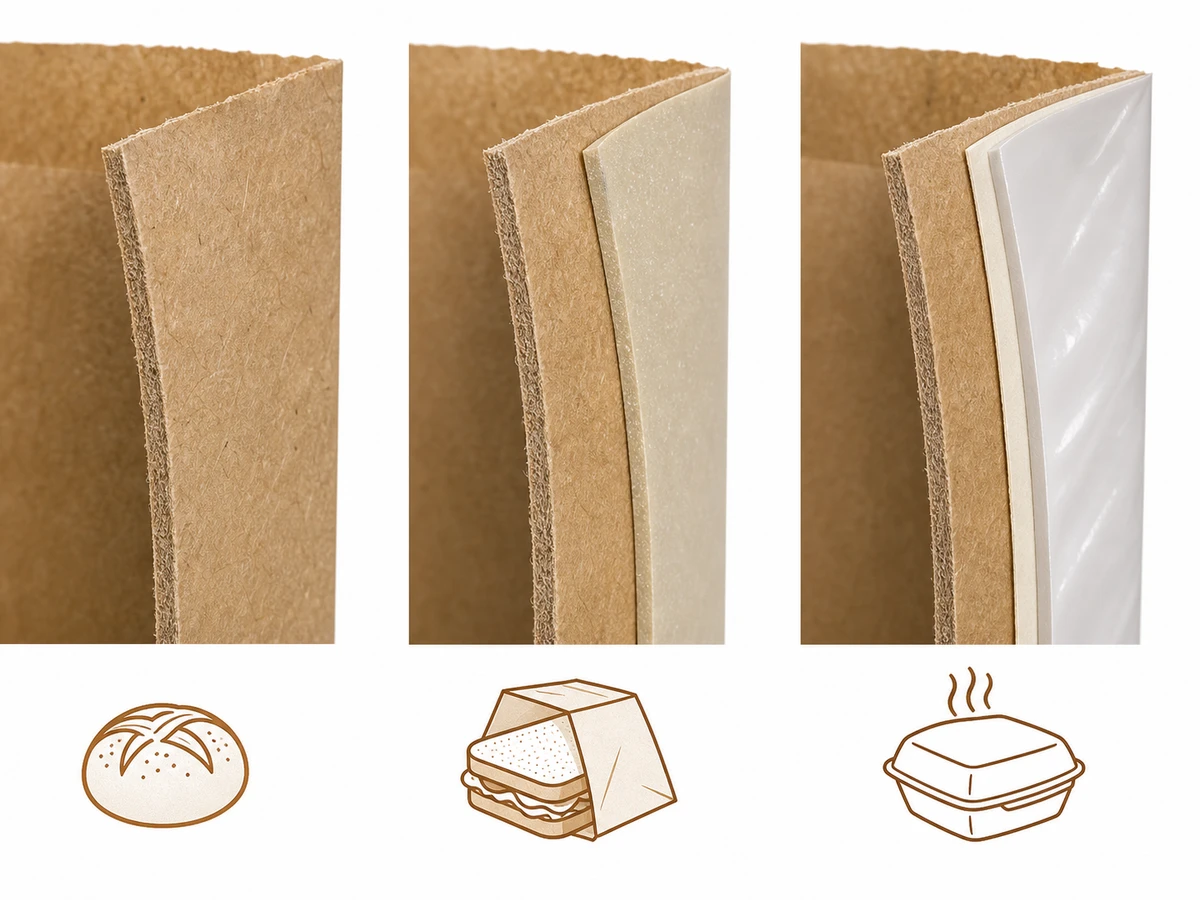
The standard for most foodservice and takeaway bags, offering good tensile strength and broad converting flexibility. Natural brown kraft is usually the most cost-efficient option; bleached white kraft gives a cleaner print appearance at an 8-15% cost premium with a slight strength trade-off.
Suitable for dry goods and outer carry bags, but repeated fiber processing reduces wet strength. Confirm where the bag sits in the service model: outer carry for wrapped food is lower-risk than direct contact with hot, moist product.
Machine-glazed paper has one smoother surface that improves print clarity and surface grease resistance at similar gsm. It is a better fit for sandwich and deli presentation than for heavier carry bags.
| Tipo de revestimiento | Resistencia a la grasa | Resistencia a la humedad | Disposal/Claim Caution | Best Fit |
|---|---|---|---|---|
| Sin recubrimiento | Bajo | Bajo | Easy to overclaim if used on messy foods | Dry bakery, bread |
| Grease-resistant paper | Moderate to high | Moderado | Performance varies by chemistry and use window | Sandwiches, pastries, short-hold hot food |
| Laminado PE | Alto | Alto | Not typically suitable for standard paper recycling streams | Hot, greasy, delivery-heavy orders |
| PLA or bio-based barrier | Moderado | Moderado | Compostability depends on certification and processing route | Selected ambient or eco-positioned applications |
| Wax / wax-alternative | Moderado | Moderado | Heat compatibility and claim language need care | Deli, bakery, niche uses |
A correctly coated 90 gsm sheet will often outperform a heavier uncoated one while reducing storage volume and freight weight.
A good bag specification can still become a poor buying decision if MOQ, case pack, and warehouse footprint are wrong. This is where many first wholesale orders go off track.
Stock bags are often available from a few hundred units through distributors, or 1,000-5,000 units direct. Custom printed bags commonly require 5,000-10,000 units for simpler flexo runs. The meaningful price break typically occurs between 1,000 and 5,000 units, then flattens. If weekly usage is less than about 2% of the MOQ, the bag is probably being sourced through the wrong channel.
| Case Pack | Lo mejor para | Main Trade-off |
|---|---|---|
| 250-500/case | Small cafes, testing, slow movers | Higher unit cost, easier rotation |
| 1,000/case | Mid-volume takeaway | Balanced handling and economics |
| 2,000-5,000/case | High-volume QSR, commissaries | Better cost, heavier cartons, more space pressure |
Carton weight for a 2,000-count case can reach roughly 18-22 kg depending on bag style and gsm. Request a sample carton, not just a sample bag: case-pack handling is often where a good unit price starts creating labor drag.
Kraft paper absorbs moisture once relative humidity climbs into the mid-60% range and above, causing bags to lose crispness and print to scuff. Check pallet size, racking compatibility, stack-height limits, and reorder points against lead time before committing to volume.
Break forecasts into average weekly usage by site, top 20% peak weeks, lead time cover, promotional uplift, and emergency buffer. This prevents the common pattern of a strong first order followed by fragmented top-up buys at higher prices because one site ran through stock faster than expected.
Custom print adds brand value but also changes MOQs, setup cost, lead time, and repeat-order discipline. The right print method depends on whether you are testing a concept, rolling out multiple sites, or locking a standard bag into ongoing replenishment.
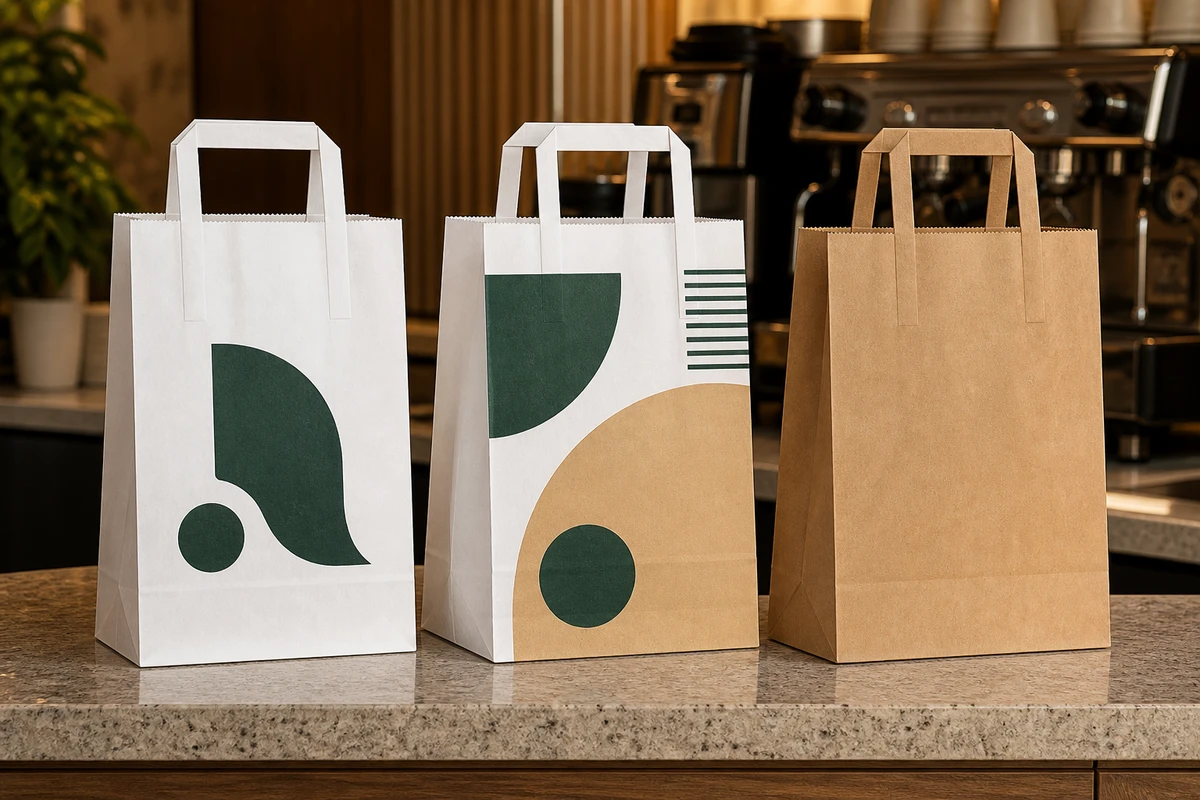
Best for established SKUs and higher volumes. Plate costs are paid up front but per-unit cost improves quickly as run size rises. Flexo makes commercial sense once the SKU is stable and volumes move beyond short-run testing.
Best for short runs, trials, or seasonal graphics, with MOQs sometimes from 500-1,000 units. Per-unit cost runs 20-60% above equivalent-volume flexo once flexo is amortized, making digital most useful when brand changes are likely or launch demand is uncertain.
Occasional niche use, but rarely the default for foodservice wholesale because cost and lead time are generally harder to justify.
| Escenario | Typical Lead Time | What Usually Drives It |
|---|---|---|
| Flexo, new artwork | 4-6 semanas | Plate production and proofing |
| Flexo, repeat run | 2-3 semanas | Converter schedule |
| Digital short run | 1-2 semanas | File prep and print queue |
| Offshore large-volume run | 8-14 weeks | Production plus freight |
The biggest delay in first runs is usually artwork handoff: missing vector files, unconfirmed Pantones, or late proof approval can easily cost a week.
For printed bags, request vector artwork requirements, an approved print area template, a color reference process, an ink suitability statement for any direct or near-direct food contact, and storage guidance for printed stock. In rollout programs, version control is a greater risk than color mismatch: a simple print approval matrix prevents multi-site operators from reordering from an old file.
Custom print tends to justify itself when the bag is highly visible to end customers, order volume is stable enough to absorb MOQ, and the design is not changing every quarter. Buyers planning branded secondary packaging can coordinate bags with accesorios de envasado and drink components such as tapas para tazas de café rather than overcomplicating the bag itself. It also helps to align branding decisions with guidance on diseño de envases minimalista y embalajes de papel sostenibles.
The best wholesale conversations start with service conditions, not artwork. If a supplier knows what is being packed, how fast it moves, how long it travels, and how it is stored, the quote becomes more useful and easier to compare.
Define what food goes in the bag, pack temperature, average and peak load, carry time or delivery window, and whether presentation or speed matters more. Cross-checking against paper cup sizes can prevent avoidable sizing errors when aligning bags with cup formats.
Give your supplier a clear brief covering bag type and dimensions, paper grade and target gsm, barrier requirement, handle type, print method and artwork scope, first order quantity and monthly repeat volume, case-pack preference, storage constraints, and destination market for compliance. When buyers only provide width, gusset, and height, suppliers usually quote the cheapest workable structure: fine for dry bakery, often wrong for hot takeaway.
Before approval, test opening speed, base stability, handle pull, print scuffing, and behavior after steam or courier handling. Use the heaviest real order, not a showroom sample.
Once approved, document dimensions, tolerances, paper grade, barrier type, handle construction, artwork version, case pack, lead time, MOQ, and claim language before committing to volume.
For many takeaway applications, 90-120 gsm is the most practical range because it balances strength, cost, and storage efficiency. Dry bakery bags can often go lighter, while heavier mixed orders may need more.
Not usually through standard paper recycling streams. Acceptance depends on local infrastructure and the exact construction, so disposal claims should be checked carefully before use.
Choose handled bags when the order is heavier, the customer carry distance is longer, or presentation matters more. SOS bags are often better for speed, stackability, and lower unit cost.
It can be suitable for outer carry bags and lower-risk applications, but performance varies once heat, grease, and humidity increase. Ask for strength data if the bag will be used with hot or moist items.
Grease-resistant paper slows oil migration through the fiber structure or treatment, while lined bags add a stronger barrier layer for more difficult moisture and grease conditions. Lined bags usually perform longer but can be less flexible on disposal claims.
In most cases, one or two well-chosen bag structures cover the majority of service needs better than a large SKU range. Fewer SKUs simplify forecasting, storage, training, and reordering.
Request the full material spec, print method, artwork template, proofing process, lead time, MOQ, case-pack details, and any food-contact or environmental claim documentation that applies. That prevents repeat-order drift and unsupported claims later.