Prêt à créer vos propres gobelets ou emballages en papier ?
Faites-nous part de vos exigences - taille, revêtement, impression et destination - et notre équipe établira un devis détaillé dans les 24 heures.


Dernière mise à jour: janvier 2026
Temps de lecture: 8 à 10 minutes
Auteur: Équipe de contenu de Papacko
Le couvercle du café est le héros méconnu du service à emporter - les clients ne le remarquent que lorsqu'il est défectueux. Un couvercle mal conçu provoque des brûlures au niveau des évents de vapeur, des arrière-goûts amers au contact du plastique ou des fuites désagréables pendant les trajets quotidiens. Un couvercle mal conçu provoque des brûlures par les évents de vapeur, des arrière-goûts amers au contact du plastique, ou des fuites désagréables pendant les trajets quotidiens.
Selon des enquêtes menées dans le secteur en 2025, les cafés perdraient entre 12 et 181 % de clients potentiels susceptibles de revenir en raison d'un mécontentement lié aux couvercles. Le problème ne se limite pas aux fuites : il s'agit de la frustration accumulée due à la difficulté à retirer le couvercle, aux angles de dégustation peu pratiques et à la condensation excessive qui s'égoutte sur les vêtements.
Ce guide présente les principes d'ingénierie qui sous-tendent les couvercles de café appréciés des clients : géométrie du trou de gorgée, systèmes d'aération, conception du bord et sélection des matériaux. Vous apprendrez à adapter les types de couvercles à la taille des gobelets, à la température des boissons et aux préférences des clients pour une meilleure expérience à emporter.
💡 À retenir: Les couvercles à café de haute qualité nécessitent une conception précise du trou de gorgée (diamètre de 3 à 6 mm pour un écoulement optimal), une ventilation efficace (empêche l'accumulation de vide), un encliquetage sûr (engagement du bord de ≥3 mm) et une sécurité alimentaire. polypropylène (tolérance à la chaleur de 120°C+).
Les couvercles en forme de dôme conviennent aux boissons chaudes ; les couvercles plats conviennent aux boissons froides.
La satisfaction des clients à l'égard des couvercles à café dépend de cinq attributs mesurables :
1. Résistance aux fuites pendant le transport
-Zéro déversement lorsqu'il est tenu normalement ou placé dans le porte-gobelet
-Résistance aux chocs, à l'accélération et au basculement
-Norme industrielle : Test d'inversion de 30 secondes sans goutte.
2. Confort et débit de l'eau potable
-Contact naturel avec les lèvres (pas de bords tranchants ni d'inconfort)
-Débit optimal : 15-25 ml/seconde pour le café chaud (pas trop rapide pour éviter les brûlures)
-Réduction du transfert de goût du plastique (la pureté du matériau est importante)
3. Gestion de la température
-Rétention de la chaleur : Minimiser l'échange d'air tout en permettant l'évacuation de la vapeur.
-Surface extérieure froide au toucher (couvercles à double paroi ou modèles isolés)
-Contrôle de la condensation (évite les gouttes)
4. Facilité d'utilisation
-Installation et retrait d'une seule main
-Localisation intuitive du trou de gorgée (marqueurs tactiles pour les aveugles)
-Indicateurs d'ouverture clairs (onglets surélevés, code couleur)
5. Esthétique et perception de la marque
-Apparence propre et moderne
-Compatibilité avec le marquage des gobelets
-Options de matériaux écologiques (attentes des clients en 2026)
🎯 Aperçu de l'industrie: Des tests de dégustation à l'aveugle révèlent que les clients jugent le café identique 15-22% de meilleure qualité lorsqu'il est servi avec des couvercles à dôme bien conçus par rapport aux couvercles plats de base, en raison d'une meilleure rétention de l'arôme et d'un meilleur angle de consommation.
La conception du couvercle a un impact direct sur la qualité perçue du café.
### Couvercles à dôme - Solution Premium pour le café chaud
Caractéristiques de la conception:
-Le dôme surélevé crée un espace d'air au-dessus du liquide (réduit les remous).
-La surface de buvée incurvée suit l'angle naturel des lèvres
-La protection intégrée contre les éclaboussures empêche l'éjection de liquides chauds
-Trous d'aération multiples (2-4) pour l'évacuation de la vapeur sans refroidissement
Données de performance:
-Rétention de la chaleur : 8-12% meilleure que les couvercles plats pendant 20 minutes
-Réduction des déversements : 85-92% moins d'incidents que les couvercles plats dans le transport de véhicules
-Préférence des consommateurs : 73% préfèrent le dôme pour le café chaud (enquête auprès de 2 400 consommateurs)
Meilleures applications: Cafés spécialisés, service haut de gamme, lattes/cappuccinos chauds, tasses de 12-20oz
Caractéristiques de la conception:
-Conception discrète (12-18 mm de hauteur)
-Trou d'égouttage simple (parfois à l'envers ou transversal)
-Utilisation minimale de matériaux (2-3g de polypropylène)
Compromis:
-Rétention de la chaleur : 15-20% refroidissement plus rapide que les couvercles à dôme
-Perte d'arôme : 30-40% plus de composés volatils s'échappent
-Risque d'éclaboussures : plus élevé en cas de déplacement ou dans des véhicules
Meilleures applications: Chaînes de restauration rapide, boissons glacées, opérations sensibles aux coûts, gobelets de 8 à 12 oz
### L'importance de la taille des trous d'insertion
Trop petit (2-3mm):
-Nécessite une forte aspiration (effort du client)
-La lenteur du débit est source de frustration
-Crée une accumulation de vide si l'aération est inadéquate.
-Meilleur pour les boissons pour enfants ou les boissons très chaudes (sécurité)
Plage optimale (4-6 mm):
-Vitesse de consommation naturelle sans aspiration
-Correspond au comportement de dégustation de l'homme
-Équilibre entre le contrôle du débit et la commodité
-La température atteint la bouche à 60-70°C (sûre, agréable)
Trop grand (8-10mm):
-Un écoulement rapide peut provoquer des brûlures (le café sort à 75-85°C).
-Risque d'éclaboussures lors de l'inclinaison du gobelet
-Mauvaise conservation de la température (renouvellement important de l'air)
-Apparence non professionnelle (comme boire dans une tasse ouverte)
✅ Bords biseautés: Contact doux avec les lèvres, réduit la perception du goût plastique
✅ Languettes détachables: Contrôle par l'utilisateur de la taille de l'ouverture, en fonction de ses préférences
✅ Double ouverture: Petit trou pour siroter, grand pour verser (polyvalence)
✅ Jantes texturées: Guide tactile pour la mise en bouche, réduit l'écoulement des gouttes
En l'absence d'une ventilation adéquate, les couvercles de café posent trois problèmes :
1. Formation du vide: Lorsque le café chaud refroidit, l'air interne se contracte, ce qui crée une aspiration.
-Empêche l'écoulement régulier à travers le trou de gorgée (frustration du client)
-Le couvercle se déforme ou se détache
-Il faut presser la tasse pour faire sortir le café
2. Montée en pression: La vapeur du café chaud se dilate
-Force le couvercle à s'enlever (éruptions désordonnées)
-Pousse le café par l'orifice de la gorgée lorsqu'il ne boit pas
-Risque de sécurité avec les boissons très chaudes
3. Refroidissement excessif: Les bouches d'aération surdimensionnées laissent échapper trop de chaleur
-Le café refroidit 25-35% plus rapidement que les couvercles correctement ventilés
-L'utilité des gobelets isothermes est réduite à néant
### Placement optimal des évents
✅ Trou de gorgée opposé (écart de 180°) :
-Permet l'admission d'air pendant la boisson
-Empêche la formation de vide
-Maintien d'un flux régulier
✅ Multiples petites ouvertures d'aération (4-6 autour du périmètre) :
-Libération de la pression distribuée
-Perte de chaleur minimale
-Empêche la concentration de vapeur
❌ Éviter les évents à proximité de l'orifice d'aspiration:
-La vapeur chaude peut brûler les lèvres ou le visage
-Réduction du confort de consommation
-La condensation coule sur le menton
Propriétés:
-Tolérance à la chaleur : 120-140°C (sans danger pour l'eau bouillante)
-Agréé pour le contact alimentaire : FDA 21 CFR 177.1520, UE 10/2011
-Résistance aux produits chimiques : Ne s'infiltre pas dans le café acide
-Recyclabilité : plastique #5 (largement accepté dans les programmes de recyclage)
Coût: $0,02-0,06 par couvercle (en fonction de la complexité de la conception)
Avantages:
-Une sécurité éprouvée (plusieurs décennies d'utilisation)
-Excellentes propriétés de formage (possibilité de formes complexes)
-Odeur/goût neutre en cas d'utilisation de matériaux vierges
-Bonne résistance aux chocs (ne se fissure pas en cas de chute)
Limites:
-A base de pétrole (problème d'éco-perception)
-Non compostable
-Nécessite une infrastructure de recyclage
Propriétés:
-Tolérance à la chaleur : 50-60°C (se ramollit au-delà de cette température)
-Compostable : Certifié BPI, 90-180 jours dans les établissements commerciaux
-Biosourcé : Fabriqué à partir d'amidon de maïs ou de canne à sucre
-Sécurité alimentaire : Conforme aux réglementations de la FDA et de l'UE
Coût: $0.04-0.09 par couvercle (+40-80% vs polypropylène)
Limitation critique: Le PLA se ramollit à 55-60°C. Un café standard servi à 70-85°C déforme les couvercles en PLA dans les 5-15 minutes, ce qui provoque.. :
-Effondrement structurel (le couvercle s'effondre vers l'intérieur)
-Distorsion du trou d'insertion (affecte le flux)
-Brûlures potentielles en cas de défaillance du couvercle
Meilleures applications: Boissons froides, boissons chaudes ≤60°C, clients soucieux de l'environnement et prêts à accepter des compromis en matière de performance.
Propriétés:
-Matériau : Pâte à papier comprimée avec revêtement barrière
-Tolérance à la chaleur : 90-100°C (adéquate pour le café)
-Compostable : 60-90 jours compostable à domicile (aucune installation nécessaire)
-Coût : $0,06-0,12 par couvercle (prix majoré)
Performance:
-Résistance aux fuites : 75-85% aussi efficace que le plastique (en fonction du revêtement)
-Confort de consommation : Texture plus rugueuse, sensation de papier perceptible
-Intégrité structurelle : Bonne, mais se ramollit en cas de saturation
État du marché: Adoption croissante parmi les marques premium/éco, mais encore <8% part de marché (2026)

### Indicateurs de qualité d'ajustement
✅ Ajustement adéquat:
-Claquement audible lors de la pose du couvercle (confirmation tactile)
-Pas d'espace visible entre le bord du couvercle et le bord du gobelet
-Il faut tirer délibérément pour l'enlever (force de 2 à 3 kg)
-Le couvercle reste en place lorsque le gobelet est retourné pendant 30 secondes
❌ Mauvaise adaptation:
-Placement lâche (vacille au toucher)
-Le couvercle se détache lorsqu'une légère pression est exercée sur la partie supérieure.
-Lacunes visibles sur le pourtour (voies d'accès aux fuites)
-Retrait facile avec un doigt (engagement insuffisant)
Problème: Conception non standardisée du bord du gobelet chez les différents fabricants
Impact: Le couvercle conçu pour les gobelets de la marque A peut ne pas convenir aux gobelets de la marque B de même taille nominale.
-Variance de diamètre : la tolérance de ±2 mm est courante
-Différences de profil de jante (bords carrés ou arrondis)
-Les variations d'épaisseur affectent la profondeur d'engagement
Solution:
1.Commander les couvercles auprès du même fournisseur que les gobelets (compatibilité garantie)
2.Demander des échantillons et tester l'ajustement avant de commander en gros
3.Spécifier le couvercle “convient aux gobelets de 90 mm” avec la confirmation du fournisseur.
4.Pour les gobelets multisources, choisissez des couvercles à usage universel (conception flexible du bord).
Température de service optimale60-70°C (le café est meilleur, il peut être consommé sans danger)
Vue d'ensemble: Les couvercles à dôme conservent le café dans la plage optimale 8 à 12 minutes de plus que les couvercles plats.
Stratégies de conception des couvercles:
-Utiliser une géométrie en dôme (l'espace d'air isole)
-Minimiser la taille/le nombre d'évents (tout en maintenant la fonction)
-Ajouter des caractéristiques isolantes (construction à double paroi, poches d'air)
-Utiliser un matériau plus épais (3,5-4,5 g contre 2,5 g pour les couvercles plats)
Stratégies opérationnelles:
-Préchauffer les tasses avant de les remplir (réduit la perte de chaleur initiale).
-Servir le café à 80-85°C (pour permettre le refroidissement pendant le transport).
-Utilisation tasses à double paroi avec couvercles en dôme (l'effet combiné maximise la rétention)
Enquête auprès de 3 200 consommateurs de café en Amérique du Nord et en Europe :
-68% préfèrent les couvercles marqués comme recyclables (même s'ils ne les recyclent pas réellement)
-52% prêts à payer $0.10-0.25 de plus pour des couvercles compostables
-41% changeraient de café sur la seule base de l'emballage durable
-29% apporter des gobelets réutilisables (contre 18% en 2023)
### Équilibre entre performance et durabilité
Approche premium/éco café:
-Proposer des couvercles en fibre moulée pour les boissons internes (température plus basse, durée d'utilisation plus courte)
-Fournir des couvercles à dôme en PP pour le café chaud à emporter (priorité de performance)
-Prélever $0.25 de moins pour les clients apportant des gobelets réutilisables
-Signalisation claire expliquant les choix/échanges
Approche en chaîne axée sur les coûts:
-Couvercles plats standard en PP (recyclables, fiables)
-Proposer des couvercles à dôme en PLA en tant qu'option premium (+$0.15 de supplément)
-Sensibiliser le personnel au choix du couvercle approprié pour chaque type de boisson
❌ Erreur #1: Utiliser des couvercles plats pour toutes les boissons afin d'économiser $0.02 par unité
✅ Approche correcte: Adaptez le type de couvercle à la boisson et au contexte de la commande. Les boissons chaudes spécialisées (latte, cappuccino) méritent des couvercles bombés : l'expérience améliorée qu'elles offrent génère une fidélisation dont la valeur dépasse largement celle d'un simple $0.02. Réservez les couvercles plats au café glacé et aux formules économiques uniquement.
❌ Erreur #2: Commande de couvercles auprès d'un fournisseur différent de celui des gobelets sans test d'adaptation
✅ Approche correcte: Le diamètre des bords des gobelets peut varier de ±2 mm d'un fabricant à l'autre. Commandez toujours des couvercles d'essai et testez-les avec vos gobelets avant de passer une commande en gros. Un mauvais ajustement est à l'origine de 15 à 25 % des réclamations des clients concernant les couvercles.
❌ Erreur #3: Choisir des couvercles en PLA pour le café très chaud (80-85°C) parce qu'ils sont “écologiques”.”
✅ Approche correcte: Le PLA se ramollit entre 55 et 60 °C. Le café chaud déformera les couvercles en PLA en 10 à 15 minutes, ce qui peut entraîner une défaillance du couvercle et des brûlures. N'utilisez le PLA que pour des boissons dont la température est inférieure ou égale à 60 °C, ou acceptez une baisse des performances. Pour les boissons chaudes, les couvercles bombés en PP offrent une meilleure expérience.
❌ Erreur #4: Ne pas tenir compte de la taille du trou de gorgée - en supposant que tous les modèles ont les mêmes performances
✅ Approche correcte: Le diamètre de l'orifice d'aspiration a une incidence considérable sur l'expérience de consommation. Les orifices de 3 à 4 mm nécessitent de sucer (ce qui est frustrant), tandis que ceux de 8 à 10 mm entraînent un débit trop rapide et des éclaboussures. Optez pour des orifices ronds de 5 à 6 mm ou ovales de 4 × 8 mm afin d'assurer une satisfaction optimale de la clientèle.
Les couvercles pour café sont conçus pour éviter les fuites pendant le transport, permettre de boire confortablement sans enlever le gobelet, maintenir la température de la boisson et constituer une barrière hygiénique. Les couvercles de haute qualité sont dotés de trous d'écoulement de précision (4-6 mm), d'un système d'évacuation de la pression, d'un système d'encliquetage sûr sur le bord des tasses et de matériaux résistants à la chaleur (polypropylène classé 120°C+).
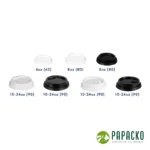
Les couvercles bombés présentent un renflement central qui crée un espace d'air au-dessus du liquide, offrant ainsi une meilleure rétention de la chaleur, une protection contre les éclaboussures et une meilleure conservation des arômes. Les couvercles plats sont discrets (hauteur de 12 à 18 mm), économiques et empilables, mais offrent une isolation thermique moindre. Les couvercles bombés conviennent aux cafés de spécialité chauds ; les couvercles plats sont adaptés aux boissons glacées et aux services économiques.
Les fuites de café peuvent avoir trois causes : un mauvais ajustement entre le couvercle et le gobelet (engagement du rebord 8 mm). Testez l'ajustement en retournant le gobelet pendant 30 secondes : l'absence de gouttes indique une étanchéité correcte. Remplacez les couvercles si la force de retrait est inférieure à 1,5 kg.
Les couvercles en PLA se ramollissent entre 55 et 60 °C, ce qui les rend dangereux pour le café classique servi entre 70 et 85 °C. Les boissons chaudes peuvent déformer les couvercles en PLA en 10 à 15 minutes, provoquant une défaillance structurelle et des risques de brûlures. Le PLA convient bien aux boissons froides ou aux boissons chaudes à une température inférieure ou égale à 60 °C. Pour le café chaud, utilisez des couvercles en polypropylène résistants à des températures supérieures à 120 °C.
Diamètre optimal de l'orifice : 5 à 6 mm (rond) ou 4 × 8 mm (ovale). Ces dimensions permettent un débit de 18 à 25 ml/seconde, soit une vitesse de consommation naturelle sans effort d'aspiration. Des trous plus petits (3 à 4 mm) demandent un effort et frustrent les clients. Des trous plus grands (8 à 10 mm) provoquent un débit rapide, augmentant le risque de brûlure et de renversement. Les bords biseautés améliorent le confort au niveau des lèvres.
Choisissez le type de couvercle en fonction de la boisson : couvercles bombés pour le café chaud (maintien de la chaleur, arôme), couvercles plats pour les boissons glacées (économiques), couvercles anti-fuites pour les personnes en déplacement (anti-fuites). Vérifiez la compatibilité du diamètre du rebord (80-82 mm pour 23 cl, 90-92 mm pour 350-600 ml). Demandez des échantillons et testez l'ajustement avant de passer une commande en gros — assurez-vous d'un engagement de 3 à 5 mm sur le rebord et d'une force de retrait de 2 à 3 kg.
Les couvercles en polypropylène (PP) sont recyclables en tant que plastique #5 dans la plupart des programmes municipaux — les rincer avant le recyclage. Les couvercles en PLA doivent être traités dans des installations de compostage industrielles (ils ne sont pas compostables à domicile). Les couvercles en fibre moulée sont compostables à domicile (60 à 90 jours). Vérifiez les directives locales en matière de recyclage, car les conditions d'acceptation varient. Les couvercles en PP recyclé (rPP) offrent les mêmes performances avec un impact environnemental moindre.
Pour choisir des couvercles à café qui améliorent l'expérience du client, il faut comprendre les principes techniques qui sous-tendent la prévention des fuites, le confort de dégustation et les performances thermiques. Les couvercles en forme de dôme permettent une meilleure rétention de la chaleur et la préservation des arômes pour les boissons chaudes spécialisées, tandis que les couvercles plats offrent des solutions rentables pour les boissons froides. La conception du trou de gorgée (5-6 mm optimal), l'aération appropriée et l'ajustement sûr du bord (3-5 mm d'engagement) ne sont pas négociables pour la satisfaction.
Principaux enseignements :
1.Les couvercles à dôme améliorent l'expérience du café chaud par 15-22%-mérite la prime de $0,02-0,04 pour les boissons spécialisées
2.La taille du trou d'insertion a une incidence directe sur le confort-5-6 mm pour un écoulement naturel sans brûlure ni frustration
3.L'adaptation du couvercle à la tasse doit être vérifiée.-les différences de diamètre sont à l'origine de 15-25% plaintes concernant des fuites
4.Les couvercles en PLA ne conviennent pas pour le café très chaud-se ramollit à 55-60°C ; utiliser le PP pour les boissons à 80-85°C
5.La mise à l'air libre permet d'éviter les problèmes de vide et de pression-2-4 trous d'aération à l'opposé du trou d'égouttage pour optimiser les performances
-Guide de sélection des tasses à café
-Solutions durables pour les plats à emporter
Papacko fournit aux cafés, aux restaurants à service rapide et aux chaînes de distribution de boissons des couvercles de café techniques : couvercles en forme de dôme pour les boissons chaudes, couvercles plats pour les boissons froides et alternatives écologiques. Notre gamme comprend des options en polypropylène, en PLA et en fibre moulée, avec une compatibilité vérifiée des bords pour les principales marques de gobelets - des quantités maximales de 10 000 unités avec une certification de sécurité alimentaire.
Le confort d'utilisation d'un couvercle de tasse à café ne dépend pas uniquement du couvercle lui-même. La température de la boisson, la taille de la tasse, l'ouverture pour boire et la manière dont on la transporte sont autant de facteurs qui influencent le sentiment de sécurité et de confort de l'utilisateur. Ces pages vous aident à approfondir votre réflexion.
Prenez contact avec nous :
Dernière mise à jour: janvier 2026