Prêt à créer vos propres gobelets ou emballages en papier ?
Faites-nous part de vos exigences - taille, revêtement, impression et destination - et notre équipe établira un devis détaillé dans les 24 heures.

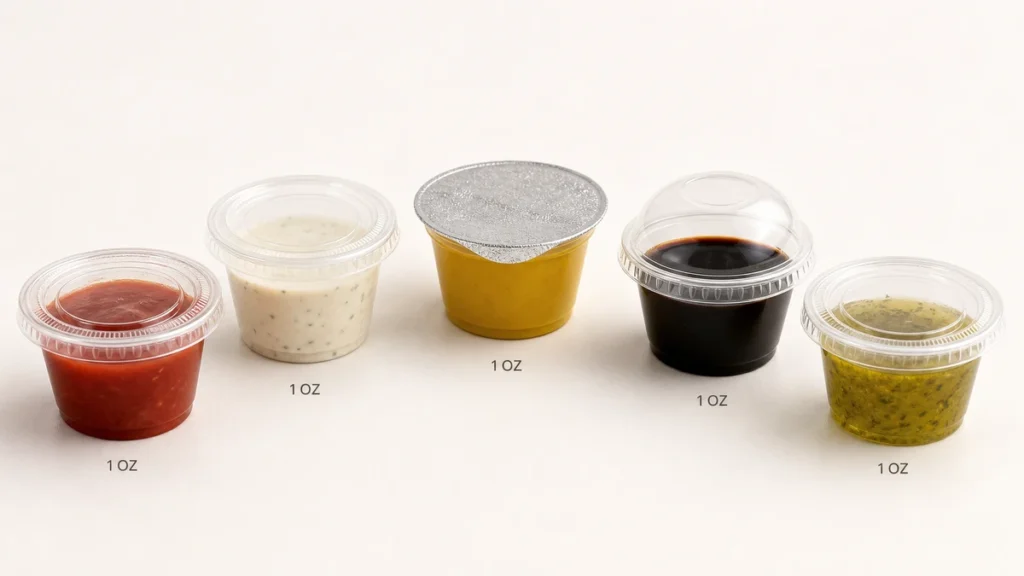
A 1 oz plastic cup with lid is a 30 mL portion pack built for controlled dispensing of sauces, dressings, condiments, tastings, or small samples. Cup resin, lid fit, sealing method, and printing all affect leak control, case-pack efficiency, and whether the SKU works in service, distribution, or retail.
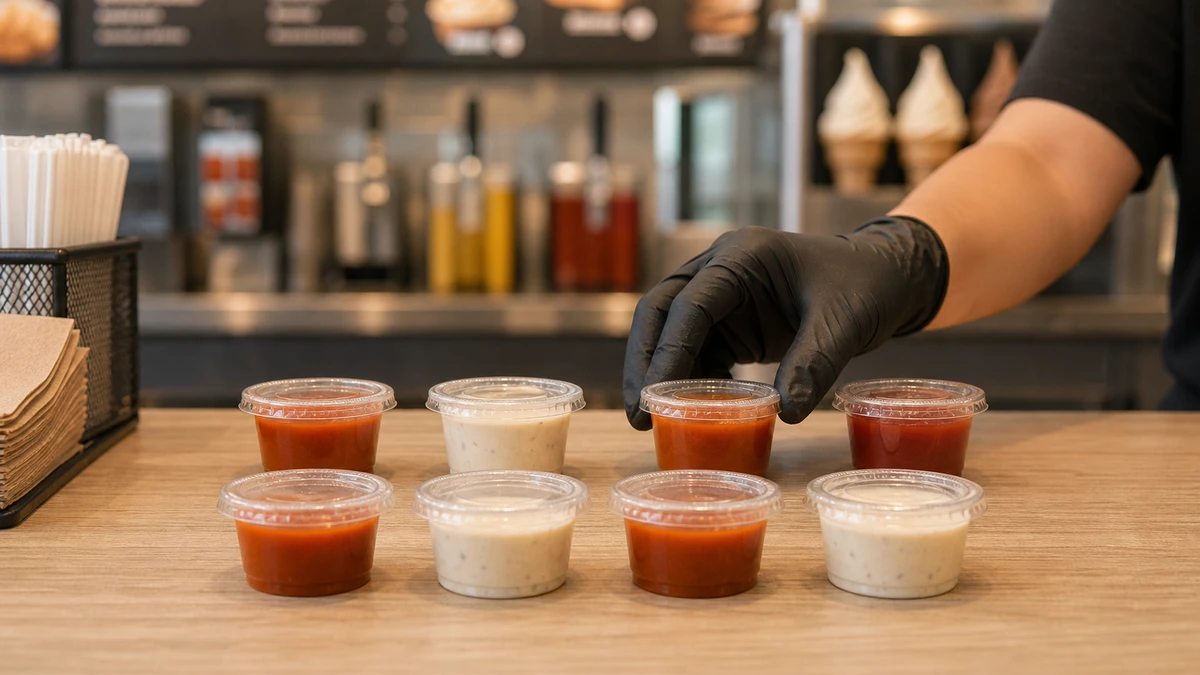
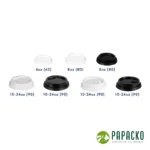
Most 1 oz cups are thermoformed or injection-molded in PP, PS, PET, or compostable alternatives. The lid is the real performance driver: snap-fit for fast service, foil seal for distribution, or vented dome when heat release matters. Even a 0.1-0.2 mm rim variation can cause lid pop-offs under stacking pressure, so buyers should validate rim diameter, bead engagement, and leak-testing method before scaling an order. For matched cup-and-lid programs, see Papacko’s gobelets en papier et couvercles de tasses à café ranges as format references for fit and closure logic.
This format works best when the portion is fixed and the handling cycle is short.
This is the wrong SKU when fill volume varies widely, when the cup must be reopened repeatedly, or when the product will see freezer cycling or heavy stacking after fill. In those cases, a heavier container with a rigid locking lid is the better choice.
Material choice determines clarity, heat tolerance, chemical resistance, and unit cost. Buyers are effectively choosing between performance and presentation: PP for workhorse use, PET for clear merchandising, PS for low-cost cold service, and PLA only when the end-of-life pathway is confirmed.
PP is the default material for most 1 oz portion cups because it balances cost, chemical resistance, and warm-fill tolerance, making it the safest starting point for foodservice buyers. Its trade-off is appearance: PP is hazier than PET and less suited to premium sample presentation. For comparison, Papacko’s emballages alimentaires compostables and disposable food packaging pages are useful when deciding whether to stay conventional or move to an alternative program.
PS offers better clarity and a stiffer feel than PP at a similar resin cost, making it common in cold sample service. The limitation is temperature and brittleness: PS cracks in rough handling and is a poor fit for hot fills. Procurement is also harder in markets where institutional buyers exclude PS on policy grounds.
PET is the clearest of the common plastics and reads as the most premium option at tasting counters or retail shelf. The trade-offs are cost and heat tolerance: PET usually costs more than PP or PS and is not suited to warm service, so the appearance uplift must justify the unit premium.
PLA supports compostability claims only when the full assembly and disposal pathway match the certification. Heat tolerance is lower than PP, the lid must also be compatible, and PLA is the most expensive common option. It is a viable choice only when both the program discipline and downstream composting access are in place.
| Matériau | Clarté | Hot-fill fit | Cold durability | Coût | Meilleure utilisation |
|---|---|---|---|---|---|
| PP | Low-medium | Oui | Bon | Faible | High-volume foodservice |
| PS | Moyen-élevé | Non | Juste | Faible | Cold samples |
| PET | Élevé | Non | Bon | Mid | Présentation haut de gamme |
| PLA | Élevé | Non | Juste | Élevé | Compostable programs |
The lid is the functional lock on a 1 oz cup. Buyers should choose based on heat, pressure, and whether the product leaves as a finished retail unit or a service-side portion.
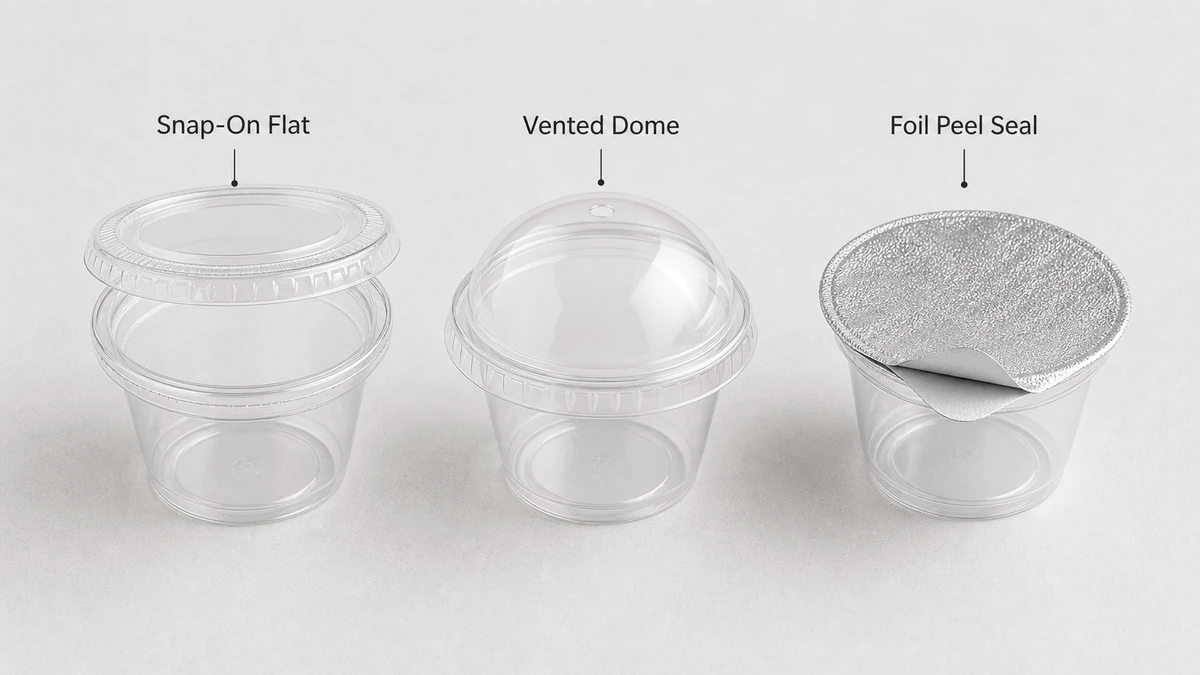
Snap-on lids are the fastest and cheapest closure option, suitable for cold sauces and low-pressure carryout. Leak risk is driven by dimensional fit: loose bead engagement causes leakage during stacking or when the cup is squeezed in a bag.
Dome lids create headspace for warm or visually appealing fills; vented versions relieve pressure as the fill cools. The trade-off is lower leak resistance and taller pack height, which can reduce carton density and raise freight cost in case-packed distribution. For a broader closure comparison, see Papacko’s paper bowl lids and paper cup lids options.
Foil seals provide the best tamper evidence and barrier performance, making them the preferred option for prefilled retail, cold-chain delivery, or longer hold times. The trade-offs are operational: sealing equipment or added labor is required, and inconsistent heat-seal control becomes a quality problem at scale.
| Type de couvercle | Résistance aux fuites | Tolérance à la chaleur | Labor/equipment | Le plus adapté |
|---|---|---|---|---|
| Snap-on flat | Modéré | Faible | Minimal | High-speed service |
| Dome / vented dome | Faible à modéré | Mieux | Minimal | Warm fills, display |
| Foil peel seal | Élevé | Depends on seal spec | Sealer needed | Prefilled retail and transport |
The right customization method depends on order volume, artwork complexity, and whether the cup needs to look branded at shelf or just identifiable in service.
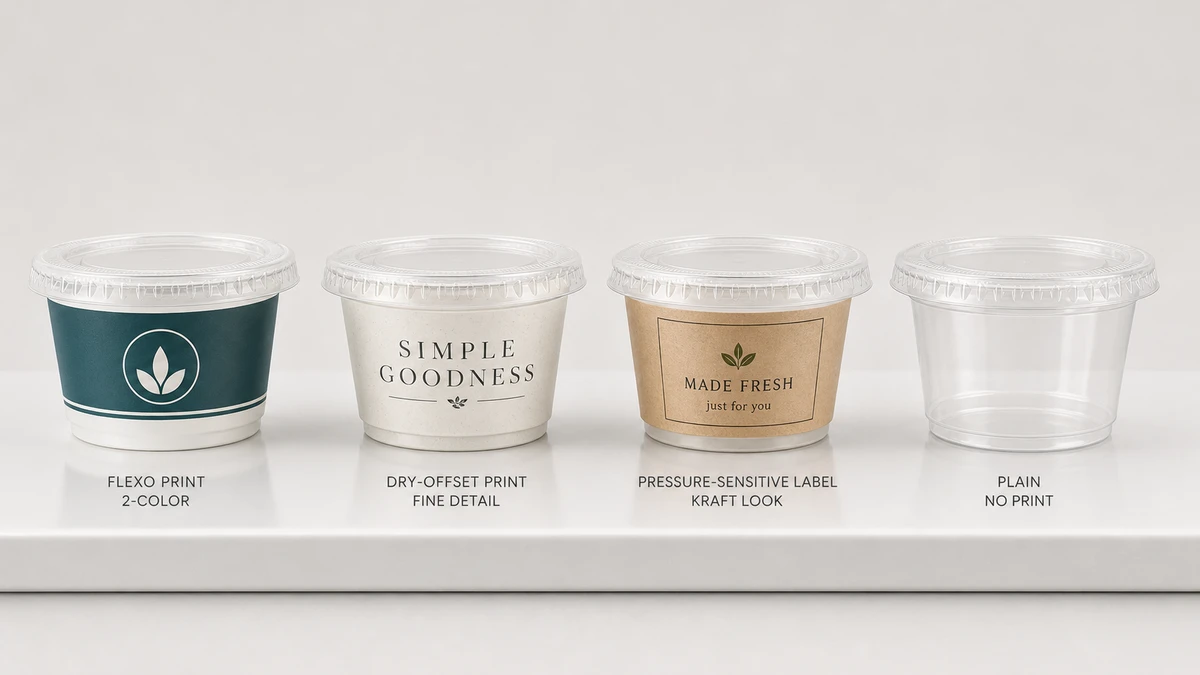
Flexographic printing is the volume option: economical on large repeat runs but expensive on short orders due to setup fees. Dry-offset printing delivers sharper registration on small curved surfaces, which matters when a logo must stay crisp at 1 oz scale. Pad printing suits smaller runs and test launches, while pressure-sensitive labels offer the fastest entry without tooling commitment, though labels can lift under cold or wet handling conditions.
Lids are visible in stacked display and grab-and-go service, but many programs print the cup only and leave the lid plain. Confirm lid branding before artwork is approved. For keeping brand treatment consistent across the full pack set, Papacko’s conception d'emballages minimaliste et sacs en papier personnalisés pages are useful references.
| Méthode | Practical minimum | Configuration | Le plus adapté |
|---|---|---|---|
| Flexographique | 50,000+ | Élevé | Standard SKUs |
| Dry-offset | 25,000+ | Moyen | Detailed brand work |
| Pad printing | 500-2,000 | Faible | Test runs, specialty brands |
| Pressure-sensitive labels | 250+ | Minimal | Short runs, seasonal use |
Before approving a custom run, confirm ink or label performance under refrigeration or heat, stackability after print, lead time from art approval to dock, vector file and Pantone requirements, and whether the lid can match the cup brand treatment. Custom-printed cups often need 4-8 weeks, while stock cups may ship in 1-2 weeks, a gap that matters when the order is tied to a promotion or menu launch.
Compliance is about matching resin, additives, and use conditions to the market. A cup can be food-contact compliant and still be the wrong choice if the temperature, fat content, or destination market differs from what the supplier tested.
For U.S. sourcing, suppliers should provide a letter of conformance identifying the exact resin and applicable CFR section. That document ties the product to the intended food-contact use rather than making a vague “food safe” claim. For an external benchmark, see the FDA’s food-contact substances guidance: https://www.fda.gov/food/food-ingredients-packaging/food-contact-substances-fcs
If the use includes hot or fatty foods, confirm the supplier’s compliance letter covers those conditions specifically. A cold-dry rating does not automatically cover warm sauces or oil-heavy dressings.
For European supply, buyers need a Declaration of Compliance and migration testing matched to the intended use. A supplier who can provide only U.S. paperwork may be adequate for domestic accounts but not for export cartons, distributor programs, or multinational retail. Papacko’s sustainable paper packaging and paper cup recycling articles help buyers compare end-of-life claims with actual disposal pathways.
Claims around recyclability and compostability must be qualified by the full assembly. A PP cup with a mismatched lid is not the same as a matched set, and a PLA cup is only a functional compostable solution if the right collection stream exists.
If sustainability is part of the spec, request the supporting certification and confirm whether it applies to the cup, the lid, or the full assembly.
At minimum, ask for resin-specific food-contact documentation, use-condition confirmation, lid material declaration, export paperwork if the SKU ships outside the U.S., and any certification tied to compostability or chain-account specs. The most common mistake is assuming one document covers every use case.
Buying the wrong pack count creates either shortage risk or slow-moving inventory. The best plan starts with real usage, not the supplier’s lowest listed MOQ.
Most 1 oz cups ship as bulk cups or as cup-and-lid sets. Bulk cases work when lids are purchased separately; combo packs reduce picking errors and simplify receiving.
| Configuration | Typical count | Meilleure utilisation |
|---|---|---|
| Cups only | 2,500/case | High-volume buyers |
| Cup + lid sets | 1,000-2,500/case | Standard service lines |
| Small wrapped packs | 100-500/box | Sampling, healthcare |
A useful reorder point is daily usage × lead time + safety stock. In a hypothetical example, a cafe uses 300 cups per day, has a 4-day lead time and keeps 7 days of buffer. The calculation is 300 × 4 + 300 × 7 = 3,300 cups. This example assumes steady daily usage; actual demand variation and storage space should inform the buffer.
Bulk cases lower unit cost but consume more cube. Full-pallet buying suits commissary and distributor settings; smaller cases are easier to store and rotate in ghost kitchens and trucks. Printed or colored lids should be kept away from direct sunlight to prevent cosmetic fading in dock-adjacent storage.
Standardizing on one qualified cup-and-lid set reduces substitution delay when a favorite SKU goes out of stock, which is the most common inventory problem in this category.
At supplier stage, the goal is to lock the spec, prevent substitutions, and confirm that the product sampled is the product that will be received.
Include material and clarity requirement, lid style and seal target, rim tolerance, case pack count, print requirement, compliance documentation, and acceptable MOQ and lead time.
Foodservice operators should weight consistent fit over small unit-price differences. Distributors should prioritize carton count and replenishment reliability. Retail brands should focus on appearance and print consistency. Sampling programs typically benefit most from short lead times and simple stock availability.
Ask: What is the rim diameter tolerance? Can you provide lot-level food-contact documentation? What happens if the specified resin is unavailable? What is the master case count and carton weight? What is the setup charge for custom print? Vague answers usually signal hidden substitution risk.
A one-page spec sheet should include:
1. 1 fl oz / 30 mL capacity
2. Material and lid type
3. Rim dimensions and tolerance
4. Case pack quantity
5. Compliance requirements
6. Print method and artwork format
7. Delivery timing
8. Sample approval requirement
That document turns the order into a controlled procurement event, which is the right way to buy a small but operationally sensitive SKU.
Oui, à condition que la résine du gobelet et le système de couvercle soient adaptés à cette température et que la fermeture soit certifiée pour résister à l'accumulation de chaleur. Le PP, associé à un couvercle compatible, constitue généralement la solution la plus sûre pour commencer.
Le PET offre la meilleure transparence, tandis que le PS est souvent utilisé pour les échantillons froids à bas coût. Le PP est préférable lorsque l'échantillon est susceptible d'être manipulé à température ambiante ou stocké aux côtés d'autres produits destinés à la restauration.
Non. Les opercules en aluminium offrent généralement une meilleure barrière de protection et une meilleure sécurité anti-falsification, tandis que les couvercles à encliqueter sont plus adaptés à un service rapide et économique. L'efficacité des couvercles à encliqueter dépend fortement de l'ajustement du rebord.
Pas en soi. Le couvercle, le mode de fermeture hermétique et le circuit d'élimination doivent tous être compatibles avec l'allégation de compostabilité, et le marché cible doit effectivement disposer d'une infrastructure de collecte adaptée.
Plan on 4-8 weeks after artwork approval in many programs. Stock cups usually move faster, so order timing matters when you are tied to a launch or promotion.
Assuming one lid fits all similar-looking cups. Small tolerance differences can create leak problems, especially when cups and lids come from different suppliers.
Keep them dry, clean, and out of direct sun, with printed components protected from fading and deformation. For distributor and commissary users, first-in-first-out rotation is the safest practice.