Prêt à créer vos propres gobelets ou emballages en papier ?
Faites-nous part de vos exigences - taille, revêtement, impression et destination - et notre équipe établira un devis détaillé dans les 24 heures.

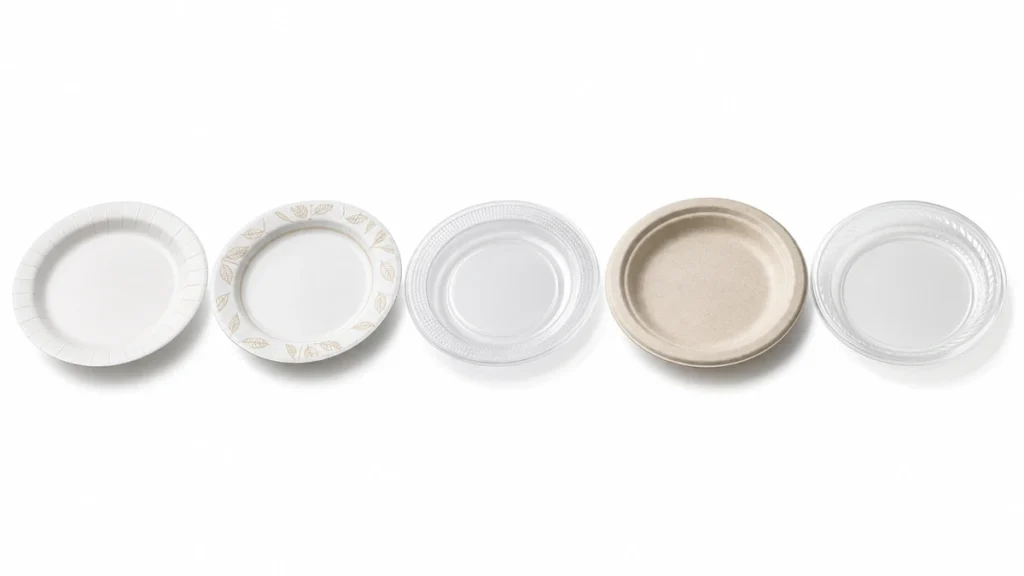
Les meilleures assiettes jetables pour l’achat en gros sont celles qui répondent à la fois aux exigences en matière de température et d’humidité des aliments, de durée de service, ainsi qu’aux critères de coût ou de durabilité. La plupart des acheteurs proposent au moins une référence économique et une option résistante ou compostable, afin d’éviter de surestimer les besoins pour certains menus et de les sous-estimer pour d’autres.
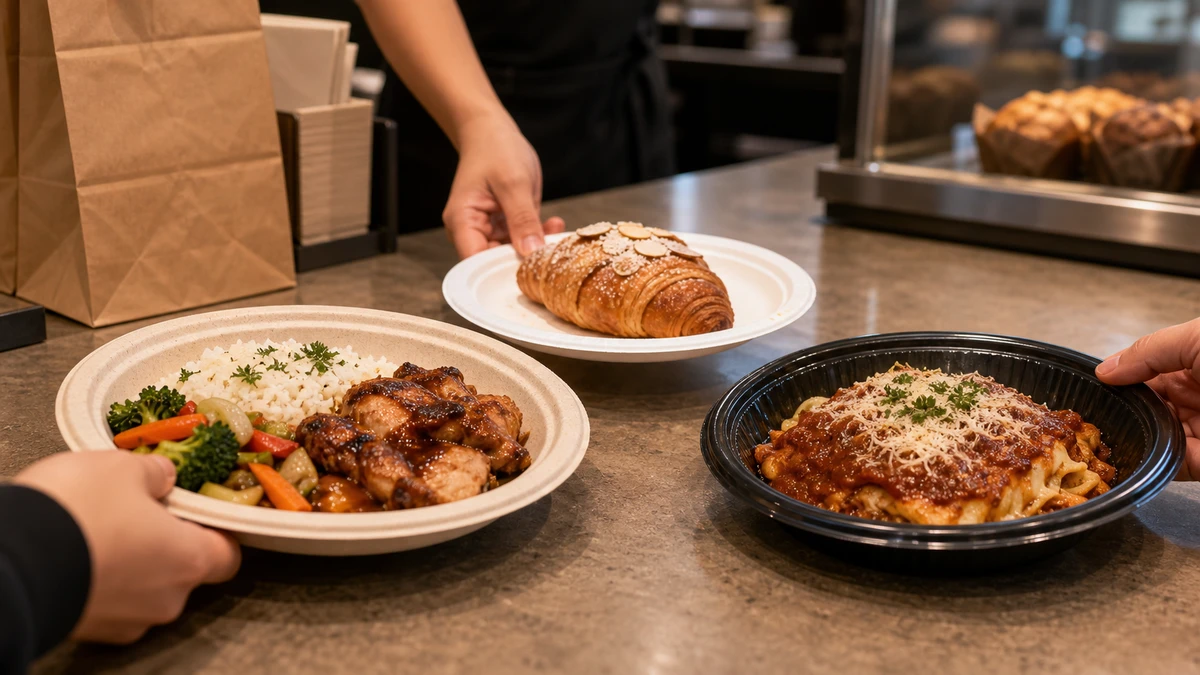
Commencez par examiner le comportement de l'assiette face à la chaleur, à la graisse et à la charge. Une économie de 1 TP4T0,01 par assiette sur le papier utilisé peut être annulée par les réclamations, la nécessité de servir deux assiettes et le gaspillage alimentaire pendant les heures de pointe.
Trois compromis déterminent le choix de l'assiette. Le système de barrière contrôle les infiltrations : une simple assiette en papier enduite de PE peut convenir pour une pizza, mais pas pour un bol de riz en sauce laissé 20 minutes. Le grammage détermine la rigidité : un papier économique d’environ 230 g/m² peut s’affaisser considérablement sous le poids d’un plat principal bien garni ; 280 g/m² constitue un seuil minimal plus réaliste pour le service de repas chauds. La géométrie et l’imbrication influent sur le fret : un rebord plus profond peut occuper 15 à 25% d’espace supplémentaire sur la palette, ce qui modifie le coût à la livraison.
Si vous en êtes encore à comparer des catégories générales, examinez des formats apparentés tels que contenants d'emballage alimentaire peut être utile, car de nombreux acheteurs s'intéressent avant tout à la durée de conservation et à la stabilité au transport plutôt qu'au seul coût de la barquette.
À l'échelle du commerce de gros, il s'agit d'un choix d'approvisionnement : quel substrat répond aux conditions d'utilisation tout en présentant le risque commercial global le plus faible, notamment en termes de défaillance des plaques, de transport, de conformité, de stockage et de régularité des réapprovisionnements ?.
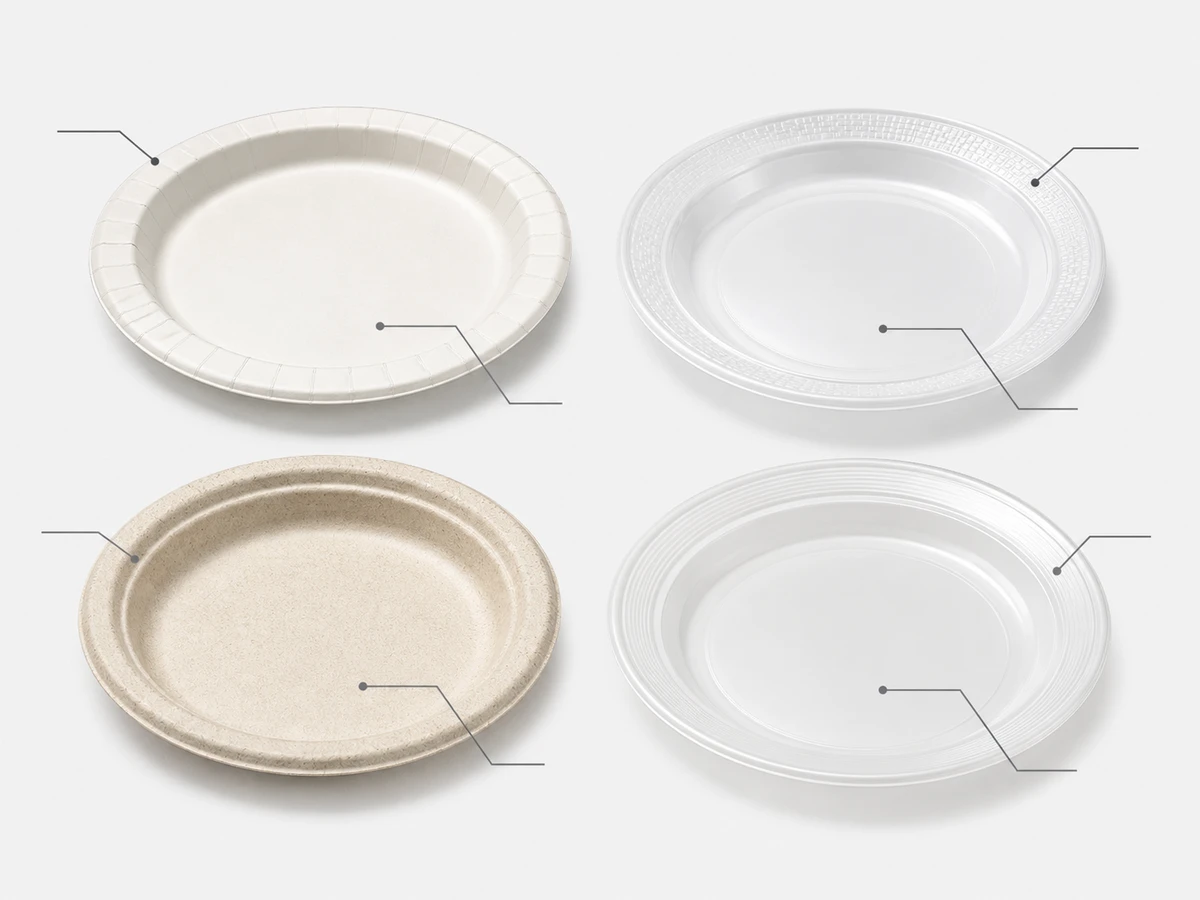
Les assiettes en papier sont recouvertes d'une couche de polyéthylène (PE), d'argile ou d'une barrière aqueuse : le revêtement est plus important que l'étiquette marketing. Le papier à revêtement simple peut convenir pendant 10 à 15 minutes pour des aliments légèrement humides ; les structures plus épaisses peuvent prolonger la tenue à l'humidité jusqu'à 30 à 45 minutes, mais il convient de vérifier cela à l'aide d'échantillons, et non en se fiant aux affirmations du catalogue.
Le PP résiste généralement à des températures de service allant jusqu'à environ 120 °C ; le PS est moins cher, mais moins résistant à la chaleur et à l'utilisation au micro-ondes. La caractéristique technique essentielle est l'épaisseur réelle de la paroi au niveau du rebord et du fond du plat, là où la défaillance commence.
On confond souvent deux produits distincts. Bagasse ou fibre moulée résiste à la graisse et à une humidité modérée sans pelliculage PE, avec une épaisseur de paroi généralement comprise entre 3 et 4 mm, et présente un surcoût de 20-45% par rapport au papier classique. PLA Il s'agit d'un bioplastique principalement destiné à une utilisation à froid ou à température ambiante : le PLA standard se ramollit bien en dessous des températures habituelles des plats chauds, ce qui en fait un choix peu adapté à la restauration chaude, malgré son caractère compostable.
| Critères | Papier couché | Plastique PP | Bagasse / Fibre moulée | PLA |
|---|---|---|---|---|
| Le plus adapté | Aliments secs ou légèrement humides | Aliments chauds, humides et lourds | Plats chauds présentés comme compostables | Vitrine réfrigérée ou desserts |
| Durée de maintien typique | 10 à 45 minutes selon le revêtement | Plus de 60 min | 30 à 60 minutes | À utiliser uniquement à froid |
| Tolérance à la chaleur | Modéré | Élevé | Conçu pour une utilisation intensive | Faible |
| Utilisation du micro-ondes | En général, non pour le papier enduit de PE | Souvent oui pour PP | Souvent oui, à vérifier par référence | Non |
| Qualité de l'image de marque | Élevé | Modéré | Modéré | Faible à modéré |
| Efficacité du transport de marchandises | Généralement solide | Modéré | Souvent, une pile plus volumineuse | Modéré |
| Économie unitaire type | Le plus bas à grande échelle | Milieu de gamme | Supérieur | Le plus élevé dans de nombreux cas |
| Risque principal lié à l'approvisionnement | Pénétration ou affaissement | Restrictions de marché | Payer une prime sans avoir accès au compostage | Panne de chauffage |
[Avis d'expert]
Pour les acheteurs qui doivent concilier leurs objectifs de développement durable avec les réalités opérationnelles, il est souvent judicieux de comparer les programmes de plaques avec des approches plus larges emballages alimentaires compostables et emballages alimentaires jetables normes déjà utilisées sur l'ensemble de la ligne.
La meilleure approche consiste à éliminer dès le départ les propositions inadaptées : commencez par examiner les points faibles, et non pas le graphisme ou le prix.
Pour une assiette de 9 pouces, la déformation centrale, lorsqu’on la tient d’une seule main par le bord, ne doit pas dépasser environ 10 à 15 mm lorsqu’elle est chargée d’un repas chaud ; c’est en effet en cas d’affaissement excessif que le papier fin cède en premier.
Effectuez un test de trempage avec de véritables plats à la température de service pendant 20 minutes ; cela est bien plus utile que n'importe quelle affirmation figurant dans une brochure. Demandez au fournisseur le type de revêtement, le grammage et les données relatives à la résistance à l'état humide.
Si votre établissement réchauffe des plats déjà dressés ou si vos clients réchauffent leurs restes au micro-ondes, vérifiez par écrit auprès du fournisseur que les matériaux utilisés sont adaptés à cet usage : le PP et certains types de fibre moulée peuvent convenir ; ce n’est généralement pas le cas de la plupart des papiers couchés et des formats en PLA.
Le passage à des plateaux à rebords plus hauts peut entraîner une variation inattendue du volume des cartons, ce qui perturberait l’organisation des rayonnages et les niveaux de stock de sécurité. Vérifiez donc la configuration des cartons avant de valider le volume.
Dans les zones de service humides, les produits en papier peuvent coller, se recourber ou ne pas se séparer correctement pendant les heures de pointe. Vérifiez la plage de température de stockage et la durée de conservation avant de commander des quantités par palette destinées à des entrepôts non climatisés.
La restauration collective et les services institutionnels mettent souvent en évidence une fragilité à la découpe sous l'effet des ustensiles métalliques, qui n'apparaît pas lors des essais de base : prévoyez un test de découpe si cela s'applique à votre activité.
Trois questions sont essentielles : ce produit est-il adapté au contact alimentaire ? Sa commercialisation telle que vous l'envisagez est-elle légale ? L'argument relatif à l'élimination tiendra-t-il la route sur le marché réel du client ?
Aux États-Unis, la conformité des revêtements et des laminés destinés à entrer en contact avec les aliments peut varier indépendamment du matériau de la plaque de base ; voir la présentation de la FDA : https://www.fda.gov/food/food-ingredients-packaging/food-contact-substances-fcs. Pour les marchés de l'UE, demandez la déclaration du fournisseur et la documentation relative à la migration pour l'article fini concerné. Si un fournisseur présente une assiette comme étant compostable, vérifiez que la certification s'applique bien à la article finalisé, et pas seulement la matière première.
Vérifiez si la quantité minimale de commande (MOQ) s'applique par référence (SKU) ou par commande, si les produits sont disponibles en stock ou fabriqués sur commande, ainsi que les délais de livraison par saison plutôt que dans le meilleur des cas. Demandez des échantillons provenant de plusieurs lots de production : de légères variations au niveau du diamètre, de la géométrie du rebord ou de la densité des fibres peuvent entraîner un manque d'uniformité lors de l'empilage et poser des problèmes au niveau du distributeur.
[Avis d'expert]
Une analyse plus approfondie de l'approvisionnement peut s'appuyer sur les recommandations actuelles en matière d'emballage concernant le Blog de Papacko.
“Le terme ” compostable » ne désigne pas un niveau de performance unique. Les questions importantes sont les suivantes : dans quelles conditions, selon quelle norme et auprès de quel organisme de certification ?
La plupart des assiettes compostables vendues en gros sont conçues pour compostage industriel, qui repose sur une chaleur constante d’environ 55 à 60 °C, de l’humidité et une activité microbienne – ce qui ne correspond pas aux conditions d’une cuisine de particulier. La bagasse s’avère généralement plus adaptée que le PLA pour la restauration à chaud, car elle offre d’abord des performances optimales en service, puis une voie de compostabilité là où les infrastructures nécessaires existent.
En Amérique du Nord, la certification BPI est l’un des indicateurs les plus reconnus attestant qu’un produit a été évalué au regard des critères de compostabilité industrielle applicables au produit fini ; les acheteurs peuvent consulter les détails du programme sur le site https://bpiworld.org/compostable-products. Un certificat relatif à la résine de base ou à la pâte à papier n'est pas suffisant si l'assiette finale comporte des revêtements, des impressions ou des additifs, et un certificat de compostabilité ne garantit pas son acceptation par toutes les installations de compostage locales.
Leur utilisation se justifie plus facilement lorsque votre client a accès à un service de collecte pour le compostage industriel, lorsque votre marque ou votre contrat exige un format compostable, ou lorsque le menu comprend des plats chauds qui mettraient à rude épreuve les assiettes en papier classiques. Elle est plus difficile à justifier lorsque le produit risque de finir dans les déchets résiduels, car vous payez un supplément sans tirer parti de la valeur prévue en fin de vie.
Pour un cadre plus général concernant le choix des matériaux et le positionnement des allégations, voir les recommandations de Papacko sur emballages en papier durables est un outil pratique pour harmoniser les références.
L'impression personnalisée peut servir à la création de marques de distributeur, à l'image de marque d'un événement ou à la standardisation au niveau d'une chaîne. Elle a également une incidence sur la quantité minimale de commande (MOQ), les délais de livraison et la complexité des exigences de conformité.
Idéal pour les programmes de production de grandes quantités d'assiettes en papier ; la mise en place devient rentable dès que le volume annuel atteint environ 50 000 à 100 000 unités par référence, moyennant des frais de mise en place et un délai de développement plus long.
Un rendu plus détaillé que la flexographie sur du carton haut de gamme, mais une mise en place plus complexe et moins de marge de manœuvre en cas de lancements urgents.
Quantité minimale de commande (MOQ) plus faible – parfois entre 5 000 et 10 000 unités – à un coût unitaire plus élevé ; utile pour les tests de marché, mais ne constitue généralement pas la meilleure structure de coûts à long terme.
L'impression a une incidence sur le choix des encres destinées au contact alimentaire, la déformation au niveau des bords et de la géométrie des formes, les cycles d'homologation et la planification de la durée de conservation. Lors des déploiements concrets, les retards sont souvent dus à la nécessité de valider les couleurs sur le support réel et de s'assurer que l'impression n'entrave pas la compostabilité ou la conformité aux exigences relatives au contact alimentaire.
Pour les commandes personnalisées réalisées à l'étranger, prévoyez 5 à 10 jours ouvrés pour la conception graphique et la prépresse, 10 à 20 jours pour la fabrication des matrices d'impression, 15 à 30 jours pour la production, auxquels s'ajoutent 3 à 6 semaines pour le transport maritime, les formalités douanières et la réception des marchandises. Les acheteurs expérimentés considèrent les plaques imprimées sur mesure comme un projet s'étalant sur 10 à 16 semaines.
Si votre volume annuel est faible ou si votre carte change souvent, les assiettes standard s’avèrent généralement plus avantageuses : vous évitez ainsi les coûts d’outillage, les longs délais de livraison et les stocks obsolètes, même si le coût unitaire est légèrement supérieur à celui d’un programme de marque de distributeur bien établi.
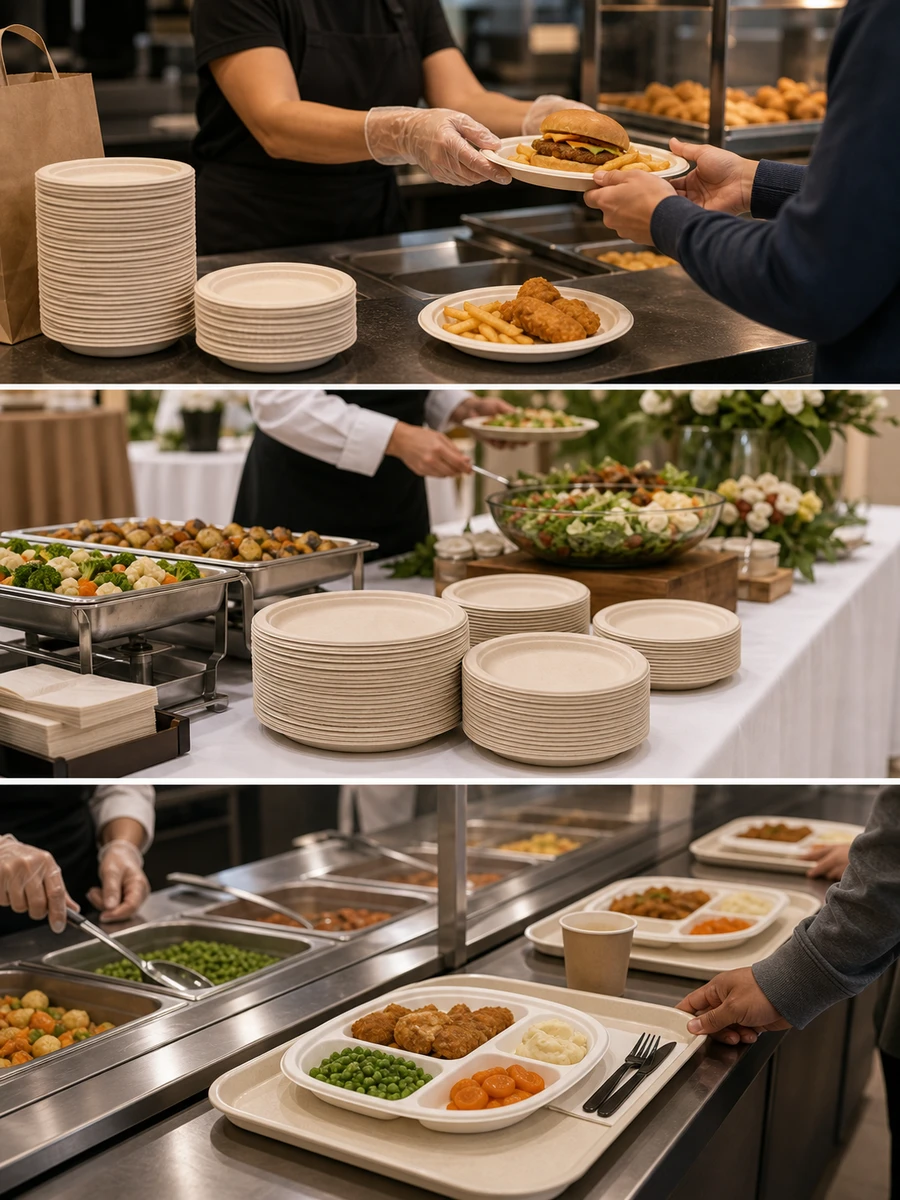
En général, on recherche un support peu coûteux et fiable, offrant une tenue de 15 à 20 minutes. Le papier couché convient aux aliments secs ou légèrement humides ; la fibre moulée est quant à elle adaptée aux plats plus riches en sauce. Une évolution du menu vers des plats plus humides peut, sans crier gare, rendre obsolète une ancienne spécification de papier.
L'exigence principale porte généralement sur la présentation et la capacité à maintenir la température du plat pendant 30 à 60 minutes, tout en offrant de meilleures performances au niveau des couverts. La fibre moulée s'impose souvent car elle résiste assez bien à la chaleur et offre un aspect plus haut de gamme que le papier bon marché, sans pour autant nécessiter le recours à des formats spécialisés coûteux.
Les exigences habituelles portent sur la régularité, l'efficacité du stockage et la prévisibilité du réapprovisionnement. La tolérance dimensionnelle est essentielle : un écart minime dans la géométrie des plaques devient un problème de manutention quotidien lorsque des milliers d'unités transitent par des distributeurs automatisés ou des rails.
En règle générale, ce qu'il faut, ce sont des références de catalogue fiables et un processus de réapprovisionnement simple. Il est souvent plus judicieux de miser sur la standardisation plutôt que de courir après des prix promotionnels ponctuels sur des références de remplacement, et le risque de rupture de stock revient souvent plus cher que de payer un peu plus cher par carton.
Une fois que vous connaissez le format de plaque approprié, la dernière étape à respecter lors de l'achat consiste à rédiger la commande de manière suffisamment précise pour préserver la marge.
Les articles standard disponibles en stock peuvent souvent être commandés en petites quantités. L'impression personnalisée nécessite généralement entre 50 000 et 100 000 unités par motif pour être rentable dans le cadre de programmes d'assiettes en papier : si la consommation annuelle ne justifie pas la quantité minimale de commande (MOQ), le fait de lancer un projet personnalisé entraîne généralement des stocks morts ou immobilise des liquidités dans des articles à faible rotation.
Un fournisseur technique doit fournir des échantillons de production avant les premières commandes importantes, la documentation relative au contact alimentaire et aux allégations spécifique au marché, les détails écrits concernant le conditionnement par carton et par palette, ainsi qu’une procédure claire de réclamation et de remplacement en cas d’envois non conformes aux spécifications. Aligner l'approvisionnement en assiettes sur la même rigueur documentaire que celle appliquée aux gobelets en papier – spécifications approuvées, contrôles d'impression reproductibles et paramètres de réapprovisionnement clairs – contribue à standardiser une gamme plus large de produits destinés à la restauration.
La prochaine étape concrète : établir une présélection par cas d'utilisation, tester des échantillons dans des conditions réelles d'exploitation, puis préciser les spécifications exactes et la configuration d'emballage sur le bon de commande. C'est ainsi que vous limitez les imprévus, maîtrisez le coût au dédouanement et développez un programme de plaques pouvant faire l'objet de réapprovisionnements fiables.
Pour les plats chauds, humides ou copieux, le plastique PP et la fibre moulée épaisse offrent généralement les meilleures performances. Le papier couché peut convenir, mais uniquement si la barrière et le grammage sont adaptés au menu.
En général, oui. Le papier couché est souvent l'option la moins chère, tandis que la fibre moulée certifiée compostable entraîne généralement un surcoût notable.
Non. Le fait qu'un produit soit d'origine végétale ne signifie pas pour autant qu'il soit certifié compostable. Vérifiez si l'assiette finie, revêtements et encres compris, est certifiée selon une norme reconnue.
Testez au minimum la capacité de charge, la résistance à la graisse, la résistance à la chaleur, la manutention par empilage et la durée de conservation en conditions réelles d’utilisation. Si l’assiette est destinée à la livraison ou à un service traiteur, testez-la après une période de transport ou de stockage.
C'est très important. Le nombre de manchons, le nombre de cartons et la densité de palettes ont une incidence sur le stockage, la main-d'œuvre et le fret ; ainsi, un prix unitaire plus bas peut tout de même se traduire par un coût total plus élevé.
Pas vraiment. Le PLA convient mieux aux applications à froid ou à température ambiante, tandis que la restauration de plats chauds privilégie le plus souvent la bagasse ou la fibre moulée.
En général, lorsque le volume annuel est suffisamment élevé pour permettre de répartir les coûts d'outillage et de mise en place sur plusieurs commandes répétées. Pour les petits volumes ou les campagnes de courte durée, les plaques en stock constituent souvent le choix le plus pratique.