Prêt à créer vos propres gobelets ou emballages en papier ?
Faites-nous part de vos exigences - taille, revêtement, impression et destination - et notre équipe établira un devis détaillé dans les 24 heures.

Dernière mise à jour: juillet 2026
Temps de lecture: 8 à 10 minutes
Auteur: Équipe de contenu de Papacko
Beverage spills account for 18-23% of delivery service complaints, costing restaurants an average of $180-350 monthly in refunds and lost customer trust. Understanding delivery porte-gobelets helps.A single spilled drink creates cascading problems: soiled food orders, damaged packaging, negative reviews, and decreased repeat order rates. Yet most delivery failures stem not from driver error but inadequate cup holder design.
This comprehensive guide examines cup holder solutions optimized for delivery and takeout services. Understanding delivery cup holders helps.You’ll discover holder types from 2-cup to 4-cup configurations, material strength comparisons (molded fiber vs corrugated cardboard vs plastic), anti-spill design features, capacity planning for delivery volumes, and cost-performance analysis showing how investing $0.15-0.45 per holder prevents $8-15 in spillage losses.
💡 À emporter rapidement: Effective delivery cup holders require 4-point cup stabilization preventing 360° movement, 280+ GSM molded fiber or double-wall corrugated construction, handles rated for 5+ lbs weight, and designs accommodating 12-24 oz cups with lids—reducing spill rates from 12-18% (bags only) to 2-4% (quality holders).
When evaluating delivery cup holders, consider the following:
Direct costs per incident:
-Replacement beverage: $3-8
-Replacement food (if contaminated): $8-20
-Delivery credit/refund: $5-15
-Driver time for redelivery: $8-12 (labor + vehicle)
-Total per spill: $24-55
Indirect costs:
-Negative review probability: 65-80% after spill incidents
-Customer retention drop: 40-55% won’t reorder after spill
-Social media complaints: 22% post about delivery failures
-Customer acquisition cost to replace lost customer: $25-75
Volume impact: Restaurant averaging 200 deliveries/week with 15% spill rate (no holders) = 30 spills/week = $720-1,650 weekly loss = $37,440-85,800 annually.
🎯 Aperçu de l'industrie: A 2025 delivery packaging study tracking 50,000 orders found that restaurants using dedicated cup holders reduced spill complaints by 78% (from 12% to 2.6%) and increased repeat delivery orders by 18%—with ROI achieved within 3-5 weeks despite $0.25-0.45 per-holder costs.
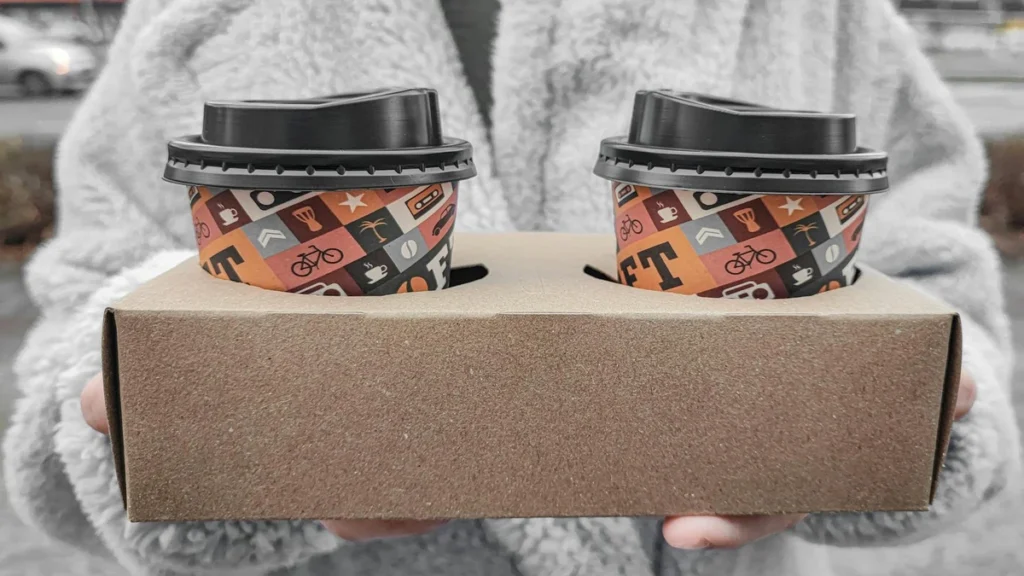
 coffee cups in secure cup holder carrier for safe transport” style=”border-radius: 8px; box-shadow: 0 2px 8px rgba(0,0,0,0.08);”/>
For delivery cup holders, focus on:
Design specifications:
-Dimensions: 180-220mm × 90-110mm footprint
-Capacité de la tasse: Two 12-24 oz cups with lids
-Weight capacity: 2-3 lbs (900-1400g)
-Poignée: Center carry handle or dual side grips
-Coût: $0.15-0.30 per holder
Meilleures applications:
-Coffee shop orders (2 coffees standard)
-Couple/small group deliveries
-Countertop takeout pickup
-Drive-through dual beverage orders
Design advantage: Compact footprint fits inside standard delivery bags without tipping, lower cost per unit than larger configurations.
When evaluating delivery cup holders, consider the following:
Design specifications:
-Dimensions: 220-260mm × 220-260mm (square footprint)
-Capacité de la tasse: Four 12-24 oz cups (2×2 grid)
-Weight capacity: 5-7 lbs (2300-3200g)
-Poignée: Reinforced center handle (double-thickness cardboard or molded grip)
-Coût: $0.30-0.55 per holder
Performance requirements:
-Handle strength: Must support 7+ lbs without tearing (safety factor 1.4x)
-Base stability: Flat bottom with 4 corner support points
-Cup separation: 10-15mm spacing prevents cup-to-cup contact/tipping
-Empilage: Should nest 20-30 units for storage efficiency
Material comparison:
Meilleur pour: Family meal deliveries, catering orders, office lunch groups, bulk pickup orders.
Understanding delivery cup holders requires attention to these factors:
Spécifications:
-6 tasses: 3×2 grid, 280-320mm × 200-240mm
-8-cup: 4×2 grid or 2-tier 4×2, 280-320mm × 240-280mm
-Weight capacity: 8-12 lbs (3600-5400g)
-Coût: $0.55-0.85 per holder
Critical design features:
-Reinforced handles: Double-ply or T-handle designs preventing handle tear
-Bottom support: Full corrugated base (not just cup wells) distributing weight
-Divider walls: Vertical separators preventing lateral cup movement
-Collapsible options: Flat-pack designs reduce storage volume by 70-80%
Applications: Corporate catering, event deliveries, large family orders, convenience store bulk purchases.
Coût-bénéfice: Higher per-unit cost ($0.55-0.85) but enables larger orders—8-cup delivery averages $35-60 revenue vs $15-25 for 2-cup orders.
The key to choosing delivery cup holders depends on:
Manufacturing process: Recycled paper pulp molded into 3D shapes under heat/pressure
Performance characteristics:
-GSM rating: 280-350 GSM for delivery-grade (250-280 GSM suitable for in-store only)
-Compression strength: 5-8 lbs per cup well before deformation
-Moisture tolerance: Moderate—handles condensation for 30-90 minutes, requires coating for extended exposure
-Temperature range: -10°C to 90°C (safe for hot and iced beverages)
-Durabilité: 100% compostable (45-90 days commercial composting), 80-100% recycled content
Options de revêtement:
-PLA coating: +$0.02-0.04 per holder, extends moisture resistance to 2-4 hours
-Revêtement de cire: +$0.01-0.03 per holder, budget option, adequate for 60-120 minutes
-Barrière à base d'eau: +$0.03-0.05 per holder, recyclable compatibility
Meilleur pour: Eco-conscious brands, short-to-medium delivery times (30-90 minutes), hot beverage transport.
The key to choosing the delivery cup holders depends on:
Construction types:
-À simple paroi (E-flute, 1.5mm): Light-duty, in-store pickup only
-Double paroi (B-flute + E-flute, 3-4mm): Delivery-grade, most common
-Triple-wall (rare, 5-6mm): Heavy-duty catering, overkill for most uses
Performance:
-Edge crush strength: 32-44 ECT (Edge Crush Test) for double-wall delivery grade
-Force d'éclatement: 200-275 lbs/sq inch (Mullen test)
-Moisture vulnerability: Absorbs water/condensation, loses 30-50% strength when saturated
-Cost-efficiency: Lowest per-unit cost ($0.15-0.25 for 2-4 cup holders)
Design features for strength:
-Vertical corrugation: Flutes run vertically for maximum handle-to-base strength
-Corner reinforcement: Double-thickness corners prevent collapse
-Handle cutouts: Die-cut handles with rounded edges (not sharp corners that concentrate stress)
Limitation: Not ideal for iced beverages with heavy condensation or rainy delivery conditions.
When evaluating delivery cup holders, consider the following:
Material types:
-rPET (recycled PET): 70-100% recycled content, recyclable
-PP (polypropylène): Durable, lightweight, recyclable
-HDPE: Rigid, lowest cost plastic option
Performance advantages:
-Waterproof: 100% moisture resistance (no performance degradation)
-Réutilisable: 200-500+ uses before structural failure
-Tolérance de température: -20°C to 100°C (wider range than fiber/cardboard)
-Léger: 20-30% lighter than molded fiber equivalents
Cost analysis:
-Initial cost: $0.40-0.80 per holder (2-3x fiber/cardboard)
-Cost per use (assuming 250 reuses): $0.0016-0.0032
-ROI: Break-even at 50-80 uses vs disposable alternatives
Applications: In-house delivery fleets (retrieve holders), reusable container programs, premium service differentiation.
Défi: Logistics of retrieval/sanitation for delivery services (feasible for in-house fleets, not third-party platforms).
When evaluating the delivery cup holders, consider the following:
Principe de conception: Cups must be prevented from moving in all directions (forward, backward, left, right).
Implementation methods:
Testing standard: Tilt test—holder with full cups should withstand 30° tilt in any direction without spills (simulates sudden braking, turns).
For delivery cup holders, focus on:
Handle failure points:
-Tear initiation: 85% of handle failures start at cutout corners
-Stress concentration: Sharp corners create 3-5x stress vs rounded corners
Design solutions:
-Rounded cutouts: Minimum 10mm corner radius prevents stress concentration
-Reinforced thickness: Double-ply cardboard at handle (2×250 GSM = effective 500 GSM)
-T-handle design: Distributes weight across wider surface area (for 4+ cup carriers)
-Finger grips: Contoured shapes improve grip security, reduce hand fatigue
Handle width standards:
-Support pour 2 tasses: 80-100mm handle width
-Support pour 4 tasses: 100-120mm handle width
-6-8 cup carrier: 120-150mm handle width (or dual handles)
For delivery cup holders, focus on:
Formule: Monthly delivery orders × Average cups per order × 1.1 (safety stock) = Monthly holder requirement
Exemple de calcul:
-Monthly deliveries: 2,400 orders
-Average cups per order: 1.8 cups
-Holder distribution: 40% need 2-cup, 30% need 4-cup, 30% single cup (no holder)
-2-cup holders needed: 2,400 × 40% × 1.1 = 1,056 holders/month
-4-cup holders needed: 2,400 × 30% × 1.1 = 792 holders/month
Cost calculation:
-2-cup holders: 1,056 × $0.22 = $232
-4-cup holders: 792 × $0.45 = $356
-Coût mensuel total: $588 ($0.245 per delivery order average)
Spill prevention savings:
-Previous spill rate (no holders): 15% × 2,400 = 360 spills
-New spill rate (with holders): 3% × 2,400 = 72 spills
-Spills prevented: 288 incidents
-Savings: 288 × $30 average cost = $8,640/month
-Bénéfice net: $8,640 – $588 = $8,052/month
The key to choosing the delivery cup holders depends on:
Storage requirements:
Flat-pack vs pre-assembled:
-Flat-pack: Reduces storage volume by 60-75%, requires 3-5 seconds assembly time per holder
-Pre-assembled: Ready to use, 2-3x storage volume, no labor cost
-Decision point: High-volume operations (100+ holders/day) = flat-pack savings justify assembly labor
Dispensing systems:
-Wall-mounted holder dispensers (gravity-feed for pre-assembled)
-Flat-pack storage bins with assembly station
-Point-of-use placement (near drink stations for staff efficiency)
When evaluating delivery cup holders, consider the following:
Calculation basis: Average spill cost $30, baseline spill rate 15% without holders.
Optimal choice by operation type:
-Third-party delivery (Uber Eats, DoorDash): Standard molded fiber ($0.25) or premium corrugated ($0.35)—no retrieval possible
-In-house delivery fleet: Reusable plastic ($0.65)—retrieve and sanitize for 250+ uses
-High-volume QSR: Budget-to-standard options ($0.18-0.28) with focus on volume pricing
-Premium cafés: Premium holders ($0.35-0.45) matching brand positioning
Understanding delivery cup holders requires attention to these factors:
Volume tiers (standard 4-cup molded fiber holder):
Considérations:
-Storage space: 10,000 holders = 5-7 cubic meters
-Cash flow: Higher upfront investment
-Usage timeline: Order 3-4 months supply to balance pricing and storage
Negotiation leverage:
-Commit to quarterly reorders for better pricing
-Consolidate holder sizes (fewer SKUs = volume discounts)
-Accept longer lead times (4-6 weeks vs 1-2 rush) for 8-12% savings
For the delivery cup holders, focus on:
Valeur marketing:
-Extends brand visibility beyond restaurant (holders travel to homes, offices, public spaces)
-Professional appearance vs generic holders (25% higher brand perception in consumer studies)
-Social media potential (18% of delivery customers photograph branded packaging)
Customization options:
Considérations sur le retour sur investissement:
-Branding investment: $0.08-0.15 per holder
-Brand recall increase: 30-45% vs unbranded
-Repeat order lift: 8-12% from enhanced professional perception
-Break-even: Requires 0.5-1% increase in repeat orders to offset branding costs
❌ Erreur #1: Choosing cheapest single-wall cardboard holders that collapse under weight of 4 beverages
✅ Approche correcte: Specify minimum 280 GSM molded fiber or double-wall corrugated (3mm+ thickness) for delivery use, the delivery cup holders matter.Single-wall holders work only for in-store pickup with immediate consumption. Test holders with full cups—should support 7+ lbs (1.4x actual load) without deformation.
❌ Erreur #2: Using holders with sharp-cornered handle cutouts that tear under stress
✅ Approche correcte: Verify 10mm+ corner radius on all handle cutouts, the delivery cup holders matter.85% of handle failures initiate at sharp corners. Request reinforced handles (double-ply) for 4+ cup carriers. Always perform lift test with full weight before ordering 10,000+ units.
❌ Erreur #3: Ordering uncoated molded fiber holders for iced beverage delivery in humid climates
✅ Approche correcte: Specify PLA or water-based coating (+$0.02-0.05) for iced drinks or >60 minute delivery times, the delivery cup holders matter.Uncoated fiber absorbs condensation, losing 30-50% strength within 45 minutes. Coating adds minimal cost but prevents 60-80% of moisture-related failures.
❌ Erreur #4: Selecting holder cup wells too large, allowing cups to slide and tip
✅ Approche correcte: Cup wells should be cup diameter +2-4mm only. Understanding the delivery cup holders helps.A 90mm cup in a 100mm well has 10mm movement space = high tip risk. Order samples with your actual cups to verify fit. Wells 30-40mm deep with tight diameter fit reduce spills by 75% vs shallow/loose designs.
Delivery cup holders are specialized carriers designed to secure multiple beverage cups during transport — preventing spills through features like deep cup wells (30-40mm), 4-point stabilization systems, reinforced handles, and moisture-resistant materials. Available in 2-cup to 8-cup configurations, they’re made from molded fiber (280-350 GSM), double-wall corrugated cardboard, or reusable plastic (rPET/PP). Quality holders reduce delivery spill rates from 12-18% to 2-4%, with costs ranging from $0.15-0.55 per unit depending on capacity and material.
Molded fiber (280+ GSM) with PLA coating is optimal for most delivery services—offering excellent strength, moisture resistance for 60-90 minutes, compostability, and $0.22-0.35 cost per holder. Understanding delivery cup holders helps.Double-wall corrugated cardboard ($0.18-0.28) works for dry conditions and budget operations. Reusable plastic ($0.40-0.80 initial, $0.002-0.004 per use) is best for in-house delivery fleets that can retrieve/sanitize holders. Avoid single-wall cardboard for delivery—it collapses under weight and absorbs moisture rapidly.
Cup holder costs vary by type: 2-cup holders cost $0.15-0.30 (molded fiber $0.20-0.30, corrugated $0.15-0.22), 4-cup holders $0.30-0.55, and 6-8 cup catering holders $0.55-0.85. Understanding the delivery cup holders helps.Volume pricing reduces costs by 38-47% at 10,000+ units. For a restaurant averaging 2,400 deliveries monthly with 1.8 cups per order, total holder costs are ~$590/month—but prevent $8,000+ in spill-related losses (refunds, replacements, lost customers), delivering 13:1 ROI.
Choose based on typical order patterns: 2-cup holders for coffee shop/couple orders (40-50% of deliveries), 4-cup holders for family meals (30-35% of deliveries), and 6-8 cup holders for catering/large groups (5-10% of deliveries). Understanding the delivery cup holders helps.Analyze your POS data—calculate average cups per delivery order, then stock holder sizes matching your distribution. Most restaurants need 60% 2-cup and 40% 4-cup inventory mix. Holders should fit 12-24 oz cups with lids (standard beverage sizes).
Cup holders prevent spills through four mechanisms: (1) Deep cup wells (30-40mm) prevent vertical lift-out during acceleration/braking, (2) Tight-fit diameter (cup size +2-4mm) eliminates lateral sliding, (3) Bottom friction ribs grip cup bases preventing rotation, and (4) Divider walls separate adjacent cups avoiding tipping contact, the delivery cup holders matter.Quality holders withstand 30° tilts without spills (simulates sudden vehicle movements). This reduces spill rates from 12-18% (cups in bags) to 2-4% (proper holders)—preventing 75-80% of delivery spills.
Choose flat-pack if: processing 100+ holders daily (assembly time justified by 60-75% storage savings), limited storage space, or purchasing in large volumes (10,000+ units), the delivery cup holders matter.Assembly takes 3-5 seconds per holder. Choose pre-assembled if: lower volume (<50 holders/day), prioritizing staff efficiency over storage costs, or operating in high-speed environments where assembly time impacts service. Pre-assembled costs same per unit but requires 2-3x storage space. High-volume operations save $800-2,000 annually in storage costs with flat-pack.
Yes, cup holders can be branded through flexographic printing (1-3 colors, MOQ 10,000-15,000 units, +$0.03-0.15 per holder) or digital printing (full-color, MOQ 5,000 units, +$0.15-0.25 per holder). Understanding the delivery cup holders helps.Branding extends visibility beyond restaurant (holders travel to homes/offices), increases brand recall by 30-45%, and improves professional perception driving 8-12% repeat order lift. Custom structural designs (unique shapes/dimensions) possible with 20,000+ unit orders and $800-2,500 tooling investment. ROI achieved when repeat order increase >0.5-1%.
Cup holders are essential delivery packaging investments that prevent costly spills, protect customer experience, and enhance operational efficiency. Understanding the delivery cup holders helps.Prioritize molded fiber or double-wall corrugated construction with proper cup stabilization, moisture resistance, and handle strength—transforming delivery from high-risk to reliable service.
Principaux enseignements :
1.Understanding the delivery cup holders helps.Choose 280+ GSM molded fiber or double-wall corrugated—single-wall collapses under delivery conditions
2.Understanding the delivery cup holders helps.Verify 4-point stabilization—deep wells (30-40mm) + tight fit (cup diameter +2-4mm) reduce spills 75-80%
3.Understanding the delivery cup holders helps.Coat for moisture resistance—PLA or water-based coating (+$0.02-0.05) essential for iced drinks or >60 min delivery
4.Understanding the delivery cup holders helps.Calculer le véritable retour sur investissement—$0.25-0.45 holder cost prevents $24-55 per spill (13:1 ROI typical)
5.Understanding the delivery cup holders helps.Stock holder mix matching order patterns—60% 2-cup, 40% 4-cup covers most restaurant delivery needs
Papacko supplies restaurants, cafés, and delivery services with high-performance cup holders in 2-cup through 8-cup configurations. Understanding delivery cup holders helps.Our range includes molded fiber (280-350 GSM), double-wall corrugated, and reusable plastic options—with PLA coating, custom branding capabilities, and MOQs from 5,000 units.
Delivery cup holders work best when the whole drink package is optimized for movement: secure lids, balanced sizes, and a carrier shape that matches drop-off conditions. These pages cover those related decisions.
Prenez contact avec nous :