Prêt à créer vos propres gobelets ou emballages en papier ?
Faites-nous part de vos exigences - taille, revêtement, impression et destination - et notre équipe établira un devis détaillé dans les 24 heures.

Hot food delivery imposes a set of simultaneous, competing demands on packaging that differ meaningfully from dine-in service or ambient takeaway. The container needs to be evaluated for structural behaviour under condensation pressure, vapour release, movement during transport and practical handoff. No single material or format resolves those demands equally well across every menu category, so procurement decisions must start with a clear-eyed account of what forces are actually at work.
When a hot meal is placed in a sealed container, residual cooking heat can continue to generate steam. If that vapour remains inside, it can return to the food surface; if venting is too aggressive, it can also change the temperature profile. The balance must be evaluated for the product, fill weight, container volume, route duration and ambient conditions.
Beyond vapour dynamics, the packaging system also has to be evaluated for the mechanical stress of loading, stacking, bag compression and courier handling. A container that appears satisfactory on a bench test but distorts in a representative stacked-transit configuration needs further review, regardless of its material category.
For restaurant groups, QSR operators, and foodservice distributors evaluating packaging options, the productive framing is not “which material is best” but “which combination of container, closure, liner, and vent geometry creates acceptable performance for this specific menu item, route length, and delivery scenario.” That investigation requires structured buyer criteria, comparative testing with production samples, and documented supplier accountability.
Procurement mistakes in hot food delivery packaging almost always originate at the same point: selecting a container before fully defining the menu and route parameters. Before comparing SKUs, operators should document the delivery scenario with enough specificity to filter options meaningfully.
Menu category and moisture profile. A grilled chicken bowl with steamed rice generates substantially more internal steam than a dry-rub smoked brisket portion. Curries, ramen, and braised dishes behave differently from fried items, flatbreads, and composed salads that include hot protein. Each moisture profile implies a different venting and liner strategy.
Fill weight and container volume. A container with limited headspace can manage vapour differently from one with more headspace. Fill ratio affects the internal conditions and should inform the review of venting or absorption options.
Route duration and vehicle type. A short urban drop is not the same delivery scenario as a longer suburban route or a multi-drop dark-kitchen consolidation run. Thermal bag quality, stacking configuration and ambient temperature all interact with route conditions between sealing and opening.
Destination and customer expectation. Premium restaurant delivery and high-volume QSR delivery operate under different customer expectations for presentation, portion visibility, and packaging quality. The container that reads as premium at the doorstep is not always the one with the highest material cost.
Regulatory and documentation context. Buyers should identify the food-contact documentation and destination-market requirements relevant to their proposed use. In the United States, the FDA maintains information on food contact substances and packaging, which buyers can review alongside supplier-provided documentation. Operators should request current exact-SKU evidence directly from their packaging supplier and not rely on generic material descriptions.
Completing this scenario profile before opening a product catalogue gives the buyer a clearer basis for selecting samples and defining a representative review.
The most persistent error in hot food delivery packaging procurement is treating the container, the lid, and the liner as three separate purchasing decisions. They are not. They form a single system, and the performance of that system depends on how well the three components interact under actual fill and transit conditions.
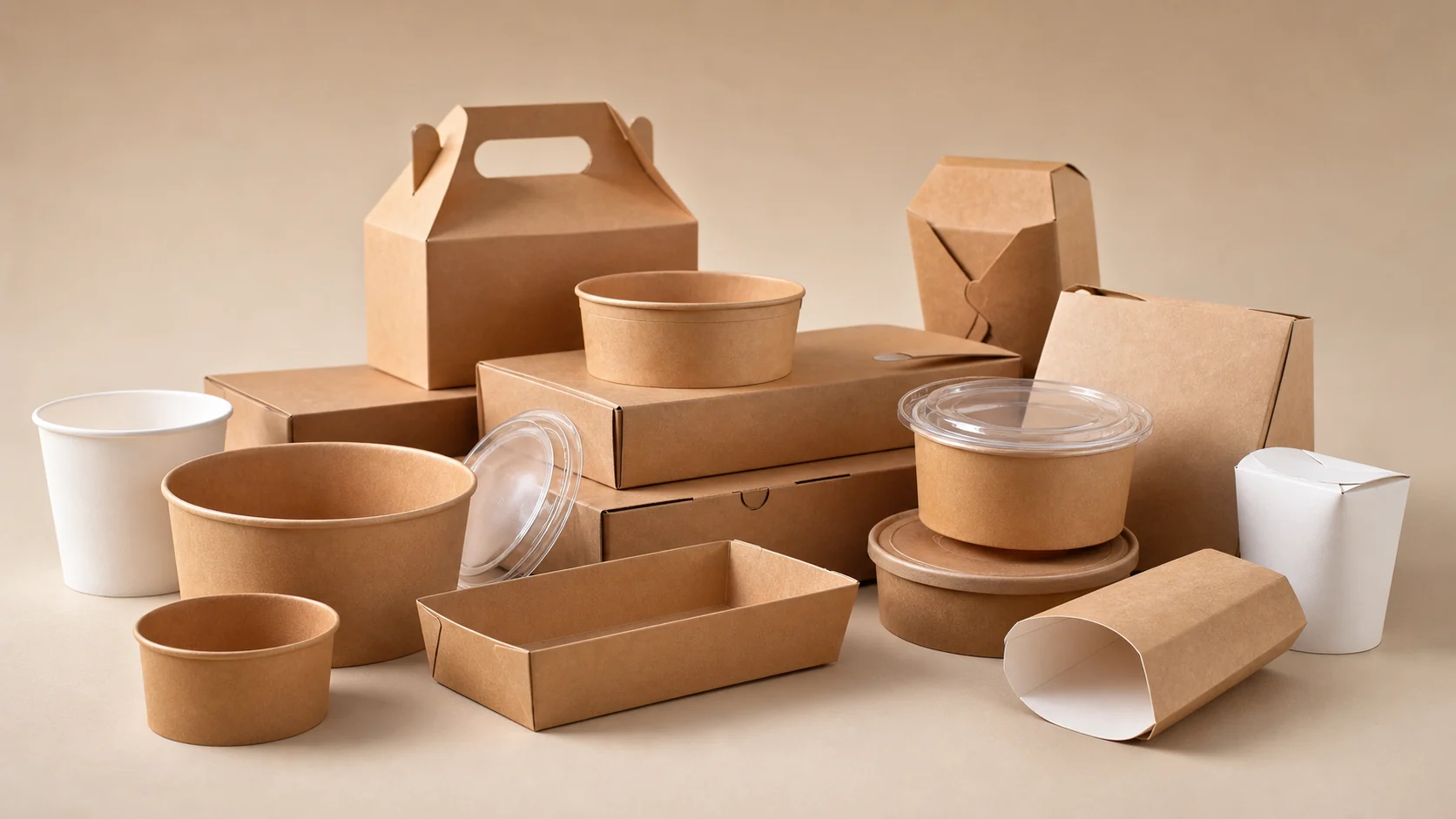
Container format selection. The base container determines the thermal mass, the mechanical load path, the stacking footprint, and the available closure geometry. Rigid formats—moulded pulp, coated paperboard, aluminium foil trays, and polymer shells—each have different stiffness characteristics under condensation-softened conditions. Operators evaluating contenants d'emballage alimentaire for hot applications should assess wall stiffness under a representative filled, steamed and transit-ready condition, not just at the moment of fill.
Paperboard-based containers, including kraft-constructed formats, offer a combination of printability, renewable material sourcing, and adequate structural performance for many hot-food applications, but they require internal treatment or lining to resist moisture migration through the wall. The suitability of any specific treatment for a given menu item and fill duration should be confirmed with the supplier through sample testing, not assumed from material category.
Lid selection and closure integrity. A lid that fits correctly at room temperature may develop gap at operating temperature if the container substrate warps slightly under heat. Lid-to-base fit should be tested at or near fill temperature using representative product loads, not empty containers at ambient conditions. Snap-fit, friction-fit, and tuck-in closure geometries each have different failure modes under the torsional stresses of bag insertion and removal.
For bowls and deep-profile containers, a well-fitted lid is part of the vapour and spill-control review. Couvercles en papier pour bols designed to pair with specific bowl diameters and wall profiles can offer a more directly matched starting point than separately sourced universal-fit lids. Verify the dimensional tolerance stack-up between your specific bowl SKU and lid SKU with the same supplier before committing to volume.
Liner selection. Liners—whether moisture-absorbing inserts, grease-resistant paper, or vented tray pads—can be assessed as a buffer between the food and the container base. They may be considered for condensate management, sauce-contact management or separation of components with different moisture levels. Liner selection should be driven by the specific condition under review and confirmed through representative fill trials.

Venting is the element of hot food delivery packaging that generates the most debate and the most inconsistent procurement practice. The practical reality is that venting geometry involves a genuine trade-off between moisture management and thermal retention, and the optimal configuration is menu-specific.
Passive vent apertures. Moulded vents in lid designs can provide a route for steam to escape after sealing. They may reduce headspace saturation for some menu conditions, while the same apertures can also change heat loss over a route. The aperture size, number and placement should be reviewed for the exact system; operators should not assume a stated vent configuration will deliver a specific thermal outcome without testing under their own route conditions.
Active or adjustable venting. Some closure systems include a vent that can be opened or closed by the operator at point of sealing, allowing the same container to be configured for a short, hot-retention-priority run or a longer, moisture-management-priority run. These systems add unit cost and require operator discipline at the packing station to function as intended.
Moisture-absorbing liners as an alternative to active venting. For some categories—particularly fried chicken, fries, and breaded products—a vented pad or absorbent insert addresses the condensate problem at the food surface rather than at the vapour level. This approach can be more forgiving of inconsistent venting execution but requires a liner SKU that is correctly sized, correctly positioned, and compatible with the container base geometry.
The thermal bag interaction. Vented containers inside a fully sealed thermal bag behave differently from the same containers in an open bag or loose transport. The bag creates a secondary enclosed environment that intercepts vented moisture and slows its dispersion. Evaluating vented containers in isolation on a bench, without the thermal bag in which they will actually be transported, produces misleading results. System testing must include the bag.
The goal of venting strategy is not to achieve a specific numerical outcome but to define a configuration that consistently produces acceptable food quality at the delivery point for a specific menu item and route profile, then to validate that configuration through structured sampling before rollout.
Performance criteria need to be defined before sampling begins, not inferred from sample results after the fact. Operators who test multiple containers without pre-specified acceptance criteria tend to select the container that performs best in testing without knowing whether that performance is actually sufficient for the operational context.
Food quality at delivery. Define the observations that matter for each menu item in measurable or consistently observable terms. Crust texture, sauce consistency, temperature at opening and structural integrity can be reviewed with a consistent internal method. Document the dine-in baseline and the buyer’s own acceptance criteria before testing.
Container integrity at the end of route. Define what structural failure looks like for your container: base deformation, lid separation, wall collapse, seal leakage. Test containers filled with representative product loads, transported by representative courier methods, for representative route durations, before evaluating results.
Thermal review. Rather than making a material-level claim, define how the buyer will assess temperature at opening. Then test the container, bag and route combination under actual conditions. The container is only one variable in a wider thermal system.
Handling and presentation. Courier handling introduces forces that bench testing cannot replicate. If your delivery partners use specific bag types, involve those bags in your trials. If orders are frequently multi-item, test stacked configurations as well as single units.
Establishing these criteria in writing before sampling creates a shared basis for reviewing production-equivalent samples and later supplier discussions.
The table below contrasts four common delivery configuration approaches by menu fit, selection focus, key trade-off, and what to verify in procurement. It is intended to structure your comparison, not to substitute for SKU-level testing.
| Configuration Approach | Menu Fit | Selection Focus | Key Trade-Off | Ce qu'il faut vérifier |
|---|---|---|---|---|
| Rigid polymer clamshell with passive vents | Burgers, sandwiches, fried items requiring base separation from lid | Closure security, vent geometry, stacking column strength | A vent configuration may change both moisture conditions and heat loss; a rigid base may collect condensate under product | Vent behaviour with actual product load; lid retention under courier bag compression; supplier food-contact documentation |
| Coated paperboard box or tray with film or board lid | Noodle bowls, grain bowls, composed plates, premium casual formats | Moisture-barrier treatment on interior walls, lid-to-tray dimensional fit, printability | Wall stiffness degrades under prolonged steam exposure; treatment suitability for specific sauce types varies; confirm liner need | Interior coating compatibility with fill content; wall integrity after representative steam exposure; dimensional match between tray and lid SKUs |
| Kraft paperboard bowl with fitted lid and absorbent liner | Curries, soups, stews, high-moisture protein bowls | Bowl-to-lid fit integrity, liner absorbency level, base stability under liquid load | Moisture-management benefit of liner requires correct positioning at packing station; higher per-unit cost than unlined formats | Liner SKU compatibility with bowl base profile; operator training on correct liner placement; food-contact status of liner material from supplier |
| Foil tray with board or film lid and optional vented tab | Roasted proteins, casseroles, meal-prep formats, catering delivery | Tray depth and gauge, lid heat-seal or snap fit, thermal-profile review | Reheating and lid behaviour require exact-SKU documentation and route-specific review | Reheat documentation if customer reheating is expected; lid seal behaviour at representative fill conditions; supplier handling guidance |
Operators should use this table as a starting framework, not a final selection guide. Each configuration approach encompasses multiple individual SKUs, and performance varies by specific product, supplier, and fill condition.

Moving from a selected packaging configuration to production deployment requires a structured implementation process. The following checklist covers the key validation and operational steps that buyer teams should complete before committing to volume.
Pre-sampling:
– [ ] Document the delivery scenario: menu items, moisture profiles, fill weight ranges, route durations, thermal bag type
– [ ] Define acceptance criteria for food quality, container integrity, and thermal adequacy at delivery point
– [ ] Identify destination-market food-contact documentation requirements
– [ ] Request exact-SKU supplier documentation relevant to the proposed food-contact use (without assuming its applicability to your specific context)
Sampling and validation:
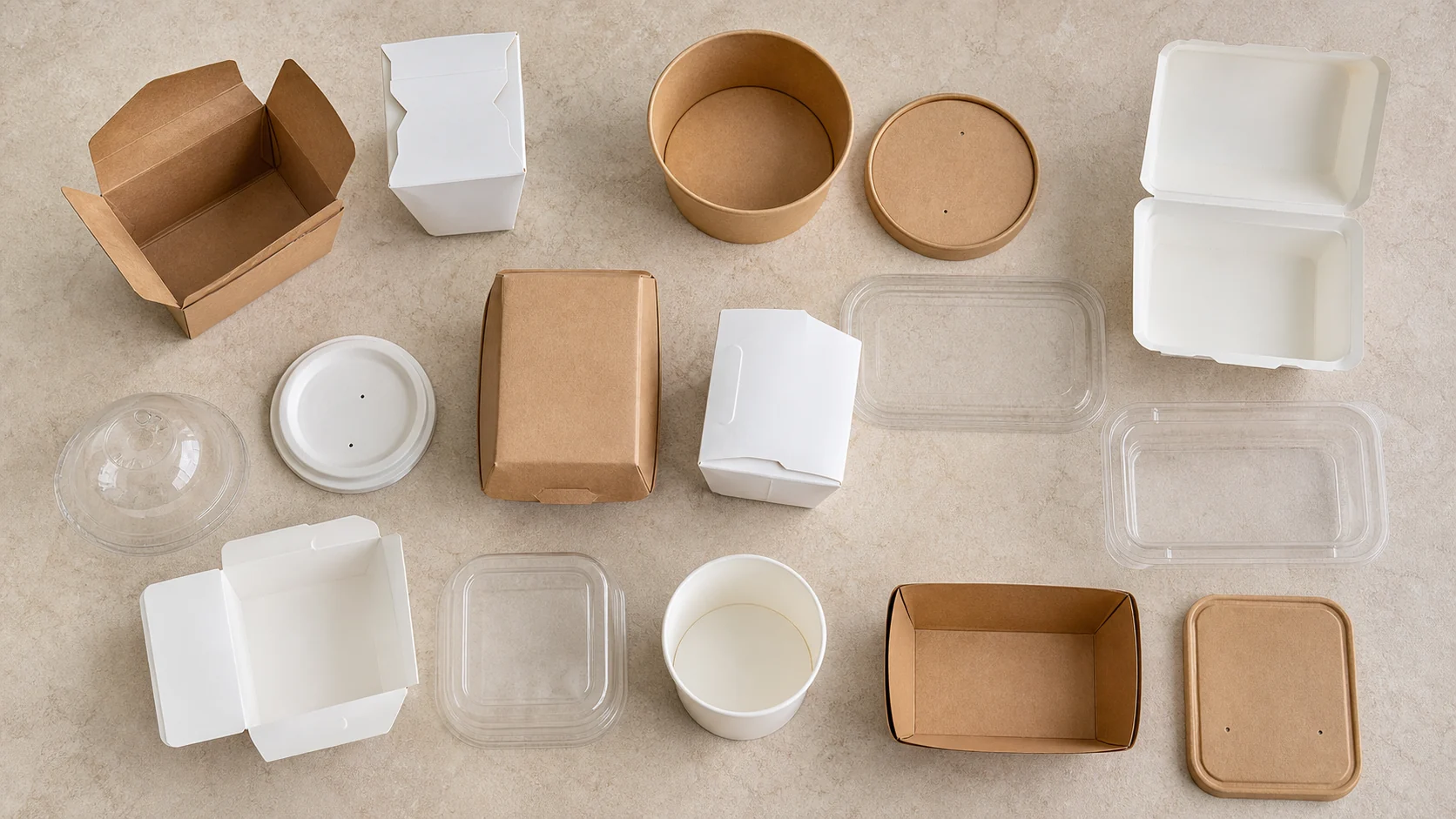
– [ ] Request samples of container, lid, and liner as a matched system, not individual components
– [ ] Conduct fill trials at production fill temperature, not ambient
– [ ] Test containers in the thermal bag and courier configuration that will be used operationally
– [ ] Run route simulations of maximum expected duration before opening and evaluating
– [ ] Evaluate stacked configurations if multi-item delivery is part of the operational model
– [ ] Record results against pre-defined acceptance criteria; do not accept results that do not meet criteria without a documented rationale
Supplier qualification:
– [ ] Confirm lead times, minimum order quantities, and availability of production-equivalent samples
– [ ] Establish what quality documentation accompanies each production batch
– [ ] Clarify how the supplier handles production deviations or material substitutions
– [ ] Define the re-testing trigger if supplier changes materials, treatments, or manufacturing location
Operational deployment:
– [ ] Train packing station staff on correct container assembly, liner placement, and lid engagement
– [ ] Establish a feedback loop for courier and customer quality observations
– [ ] Set a review cadence for packaging performance, particularly if menu, route, or volume changes occur
Implementation discipline at this stage is what separates a packaging decision that holds up at scale from one that produces inconsistent results or costly mid-cycle substitutions.
Selecting hot food delivery packaging is not a catalogue exercise. The interaction among menu, route, container format, liner, closure, thermal bag and documentation context calls for a structured brief rather than isolated product browsing.
Papacko works with restaurant groups, QSR operators, and foodservice distributors to develop packaging specifications grounded in actual delivery scenarios. The starting point is the operational context: what is being delivered, how far, in what bag configuration, and to what quality standard. From that foundation, a packaging brief can identify candidate container and closure formats, liner considerations, vent strategy and the documentation the buyer needs to request from the supply chain.
For operators assessing formats across multiple menu categories, emballages alimentaires jetables options can be evaluated as a coordinated range rather than a collection of individual SKUs, which simplifies supplier management and reduces the risk of dimensional mismatches between components from different sources.
For bowl-format delivery—particularly relevant for grain bowls, noodle dishes, and high-moisture protein applications—bols en papier kraft offer a starting point for custom brief development. Whether kraft construction is appropriate for a specific fill and route scenario requires the kind of liner-and-closure system analysis described in this guide, not a generic material assumption.
Operators managing a portfolio of hot formats across multiple service contexts—restaurant, catering, and QSR—should review emballages pour plats à emporter options in the context of a unified brief rather than category-by-category, to identify where consolidation is possible and where different performance requirements mandate distinct SKUs.
A packaging brief submitted to Papacko should include the delivery scenario documentation described earlier in this guide, the acceptance criteria you have defined, any compliance requirements for your destination market, and your current volume and projected growth parameters. This allows the commercial and technical team to propose configurations worth sampling rather than generic starting points.

This guide is written for commercial buyers and operational decision-makers in restaurant groups, QSR organisations, foodservice distribution, and delivery brands. The content addresses the structural and procedural dimensions of hot food delivery packaging selection: how to frame the problem, how to structure the evaluation, and how to manage the supplier relationship through to deployment. It does not reflect the experience of a single operator or a specific deployment; it reflects the recurring patterns in how packaging decisions succeed and fail across hot delivery contexts.
Sourcing context matters because material availability, treatment options, documentation requirements and delivery-format expectations can change. Buyers should update their specific SKU selections and destination-market verification against current supplier documentation, not against this article’s publication date.
The technical framing in this guide is grounded in operational packaging principles: vapour dynamics, container mechanics, closure geometry and thermal-system behaviour. No test results, temperature thresholds, time limits or material-specific performance claims are stated, because those parameters need evidence from the exact SKU combination and delivery scenario. The FDA food-contact information referenced in the documentation section is a useful official source for US-market buyers; buyers in other markets should consult the applicable local sources directly.
Buyers should not treat any description in this guide as a substitute for supplier-provided technical documentation, regulatory guidance, or representative sample testing under their own operational conditions.
Use the delivery scenario framework in the second section to document your context before approaching suppliers. Use the system selection logic in the container/closure/liner section to evaluate options as integrated systems rather than individual components. Use the performance criteria section to define acceptance thresholds before sampling. Use the comparison table as a conversation framework with suppliers and internal teams, not as a final specification. Use the implementation checklist to structure the transition from sample approval to production deployment. Submit a structured brief to Papacko or any qualified packaging supplier rather than asking for a general recommendation.
La variable la plus importante est l'adéquation entre le système de contenants et le scénario de livraison spécifique — et non pas un matériau ou une caractéristique en particulier. Une configuration adaptée à un trajet urbain court peut ne pas convenir à un trajet suburbain plus long, et un format utilisé pour des produits frits peut se comporter différemment avec un curry très humide. Définissez d'abord votre scénario ; le choix des contenants en découlera naturellement.
Not necessarily. Venting addresses steam saturation, which is a priority for items where surface texture is critical—fried foods, baked goods, flatbreads. For items where moisture retention is desirable, such as braised dishes or steamed proteins, venting may not improve the outcome and could reduce thermal retention over longer routes. The venting decision should follow a menu-by-menu assessment, not a blanket policy.
Conduct a fill trial using the container without a liner, transported under representative route conditions, and evaluate the food quality at the delivery point. If condensate pooling, base softening of fried items, or sauce migration is present, a liner may address the failure mode. If neither issue appears at your route duration and fill weight, a liner adds cost and handling complexity without a corresponding benefit. Test first; specify liner only where it resolves a demonstrated problem.
Request destination-market food-contact documentation for the exact SKU, details of any treatment or coating, dimensional specifications for the container and lid, and the other evidence needed for the proposed fill condition. In the US, the FDA food-contact substances information is a relevant official reference. Do not approve a container for production use on the basis of material-category descriptions alone.
Sometimes, but not always. A single container format can be considered across menu categories when those categories share similar moisture profiles, fill conditions and route demands, and when the buyer’s acceptance criteria are met in representative review. Operators with diverse menus may need more than one container configuration rather than assuming that one format applies across every category.
L’emballage doit faire l’objet d’une réévaluation chaque fois qu’une variable pertinente change : reformulation du menu, nouveau circuit ou nouvelle zone de livraison, nouvelles spécifications concernant les sacs isothermes, modification du volume des commandes ou de la composition des commandes, ou encore notification d’un fournisseur concernant des changements au niveau des matériaux ou de la fabrication. Il convient de réexaminer l’évaluation représentative lorsque ces conditions changent, plutôt que de se fier à une autorisation antérieure.