Ready to create your own branded paper cups or packaging?
Tell us your requirements — size, coating, printing, and destination — and our team will prepare a detailed quotation within 24 hours.

Last Updated: September 2026
Author: Papacko Content Team
Your customers judge your restaurant before they taste the food. How? By the napkin quality.
Thin, scratchy napkins that fall apart when wet signal cheap operation. Quality napkins that absorb spills and feel substantial communicate attention to detail. But napkin specifications are confusing: ply count, basis weight, virgin vs recycled pulp, fold types, sizes.
In this guide, you’ll learn:
•Ply count and what it actually means (2-ply isn’t always better than 1-ply)
•Fiber sources and manufacturing types: virgin pulp, recycled, bamboo, tissue
•Absorbency standards and testing methods
•Size and fold types for different service styles
•Color options and bleaching processes
Ply = Number of paper layers bonded together
1-Ply Napkin:
•Single layer of paper
•Basis weight: measured in gsm (grams per square metre), separately from thickness
2-Ply Napkin:
•Two paper layers bonded
•Example: PAW SDD200000 dinner napkin uses 16gsm per ply (32gsm total)
3-Ply Napkin:
•Three paper layers bonded
•Basis weight: confirm each ply and the combined gsm; three layers do not specify thickness
•Premium option
•Absorbency and softness depend on the finished product
Myth: More Ply = Always Better
Reality: Ply count alone doesn’t determine quality. A high-quality 2-ply napkin can outperform a low-quality 3-ply.
What Actually Matters:
1.Basis weight (gsm per ply): Mass per area; does not by itself establish water capacity per gram
2.Pulp quality: Fiber source and processing affect feel; compare finished samples
3.Embossing: Creates texture and can change absorption performance
4.Bonding method: Bonding helps resist delamination (layers separating); check performance when wet
1-Ply Napkins:
Best For:
•Fast-casual restaurants (burgers, pizza)
•Food trucks, street vendors
•Self-serve napkin dispensers (high volume, low cost)
•Takeout packaging (included in bag)
Buying considerations:
•Compare unit cost with actual napkins used per customer
•Suitable for dry foods
Limitations:
•May need more sheets for wet or greasy foods; assess the actual product
Typical Size: 30cm × 30cm (12″ × 12″) when unfolded
Illustrative Cost Example: 10,000 napkins = $50-100
2-Ply Napkins:
Best For:
•Casual dining, family restaurants
•Cafés, coffee shops (table service)
•Business lunch venues
•General-purpose restaurant use
Buying considerations:
•Compare absorbency on the spills expected in service
•Compare texture and feel between samples
•Versatile for most food types
•Compare cost per service, not only cost per napkin
Performance considerations:
•Softness is not determined by ply count alone
•May need 2 napkins for very messy foods
Typical Size: 33cm × 33cm (13″ × 13″) or 40cm × 40cm (16″ × 16″)
Illustrative Cost Example: 10,000 napkins = $100-180
3-Ply Napkins:
Best For:
•Fine dining, upscale restaurants
•Hotels, event venues
•Premium cafés, brunch spots
•Positioning: luxury, attention to detail
Buying considerations:
•Assess performance with heavy sauces and greasy foods
•Some products offer a soft, cloth-like feel
•Premium perception
•Fewer sheets may be needed if tested performance is better
Other considerations:
•Compare the quoted cost for the chosen size and grade
Typical Size: 40cm × 40cm (16″ × 16″) or 45cm × 45cm (18″ × 18″)
Illustrative Cost Example: 10,000 napkins = $200-300
What It Is: Paper made from fresh wood pulp (not recycled paper)
Processing:
•Wood fibre → pulping → optional bleaching → formed into paper
•Chemical or mechanical pulping
•Bleached (white) or unbleached (natural brown)
Properties to compare:
•Texture: Depends on fibre selection and processing
•Absorbency: Compare measured performance; fresh fibre alone does not set capacity
•Wet strength: Depends on the finished sheet and treatment
•White color (if bleached): Clean, premium appearance
Environmental considerations:
•Environmental impact depends on fibre sourcing and production
Best For:
•Fine dining (customers expect premium quality)
•Hotels and resorts (luxury positioning)
•Businesses selecting a particular feel and appearance
What It Is: Paper made from recovered fibre, which may include pre-consumer and postconsumer sources
Processing:
•Recycled paper collected → pulped and cleaned/de-inked as needed → formed into napkins
•Fibre properties depend on the recovered feedstock and processing
•Gray/beige color natural (or bleached)
Content and purchasing:
•Recovered fibre: Reuses paper fibre; check the stated recycled content
•Cost: Compare actual quotes for equivalent specifications
•Sustainability positioning: Use “100% recycled” only when that content is substantiated
•Acceptable quality: Modern recycled napkins perform well
Performance and appearance:
•Texture: Varies; recycled products can also be soft
•Absorbency: Measure the finished product rather than applying a fixed discount
•Color: White as well as natural shades are available
•May contain imperfections: Small flecks, slight discoloration
Best For:
•Eco-conscious restaurants, organic cafés
•Businesses with sustainability messaging
•Casual dining
•Budget-conscious operations
What It Is: Paper made from bamboo pulp (fast-growing grass, not wood)
Processing:
•Bamboo harvested → pulped (mechanical or chemical) → formed into paper
•Can be blended with wood pulp or 100% bamboo
Properties to assess:
•Texture: Depends on fibre processing and sheet construction
•Absorbency: Assess the finished product
•Environmental claims: Substantiate environmental claims beyond the material name
Processing considerations:
•Processing concerns: Check the pulping process and the supplier’s chemical and wastewater controls
Best For:
•Venues seeking bamboo-based products
•Asian cuisine restaurants (bamboo cultural connection)
•Businesses differentiating on sustainability
Tissue Grade:
•Traditional napkin manufacturing
•Paper formed on wire mesh, pressed, dried
Airlaid:
•Fibres laid using air as the forming medium, then bonded
•Creates fluffier, bulkier paper
•Absorption depends on the fibre web and bonding system
•Texture depends on formulation and processing
When Airlaid Makes Sense:
•Fine dining where a cloth-like presentation is desired
•Medical/hygiene applications (absorbency critical)
•Brands seeking an airlaid feel and drape
Selection: Choose tissue or airlaid by sample performance and service needs
Standard Tests:
Water Absorbency Capacity (WAC):
•Measures grams of water absorbed per gram of napkin
•Higher WAC means more water per gram under the same method; absorption speed is separate
Wet Strength:
•Measures tensile strength after controlled wetting
•Important: Napkins shouldn’t disintegrate when wiping spills
•Compare wet tensile results using the same method, specimen width and direction
•Higher wet tensile strength means greater resistance in that test
•Embossing can change absorption capacity; the effect depends on the paper and pattern
•Embossing creates surface area and air pockets
•Patterns: Dots, diamonds, waves common
Basis Weight (gsm):
•Grammage measures mass per area; assess absorption capacity separately
Fiber Length:
•Virgin pulp: fibre properties vary with species and processing
•Recycled pulp: recovered furnish and processing affect performance
•Wicking depends on the fibre network and pore structure, not length alone
Embossing Depth:
•Pattern and pressure affect bulk, strength and absorption
•Excessive embossing can weaken the sheet
Bonding Quality:
•Ply bonding helps layers stay together; wet performance depends on the finished product
•Poor bonding = delamination (layers separate), poor performance
•Sample check: Wet and rub the napkin for the intended use; compare layer separation. This is not a standardized tensile test.
Cocktail Napkins (Small):
•Size: 25cm × 25cm (10″ × 10″) unfolded
•Quarter-folded: 12.5cm × 12.5cm (5″ × 5″)
•Use: Bars, cocktail parties, appetizers
•Ply: Usually 1-ply or 2-ply
•Cost: Compare price at the same size and grade
Lunch Napkins (Standard):
•Size: 33cm × 33cm (13″ × 13″) unfolded
•Quarter-folded: 16.5cm × 16.5cm (6.5″ × 6.5″)
•Use: Cafés, casual dining, fast-casual
•Ply: Compare available ply counts for the selected size
Dinner Napkins (Large):
•Size: 40cm × 40cm (16″ × 16″) or 45cm × 45cm (18″ × 18″) unfolded
•Quarter-folded: 20-22.5cm (8-9″)
•Use: Full-service restaurants, fine dining
•Ply: 2-ply or 3-ply
Guest Towels (Specialty):
•Size: 30cm × 40cm (12″ × 16″) unfolded (rectangular)
•Folded: Usually tri-fold or bi-fold
•Use: Bathrooms, upscale venues
•Ply: 2-ply or 3-ply
Quarter Fold:
•Folded in half twice (four folded panels; not four plies)
•Square when the unfolded napkin is square
•Easy to dispense from holders
Interfold (Dispenser-Friendly):
•Napkins interleaved (pulling one exposes next)
•Used in countertop dispensers
•Designed to support one-at-a-time dispensing; results depend on the system
•Common in fast-casual, self-serve
Bi-Fold:
•Folded in half once (two folded panels; not two plies)
•Shape depends on the unfolded dimensions
•Used for guest towels, larger napkins
•Premium presentation
Decorative Folds:
•Fan, pyramid, rose shapes for table settings
•Choose dimensions to suit the intended fold
•Fine dining, events, hospitality
•Can be folded by staff to suit the table setting
Bleaching Methods:
Chlorine Bleached:
•Traditional method, very white result
•Environmental concerns (dioxin byproducts)
•Less common in modern production
Chlorine Dioxide Bleached (ECF – Elemental Chlorine Free):
•Uses chlorine dioxide rather than elemental chlorine
•Still very white
Totally Chlorine-Free (TCF):
•Oxygen, ozone, or hydrogen peroxide bleaching
•No chlorine compounds
Color: Bright white, clean appearance
Best For: Traditional restaurants, fine dining, hotels (classic look)
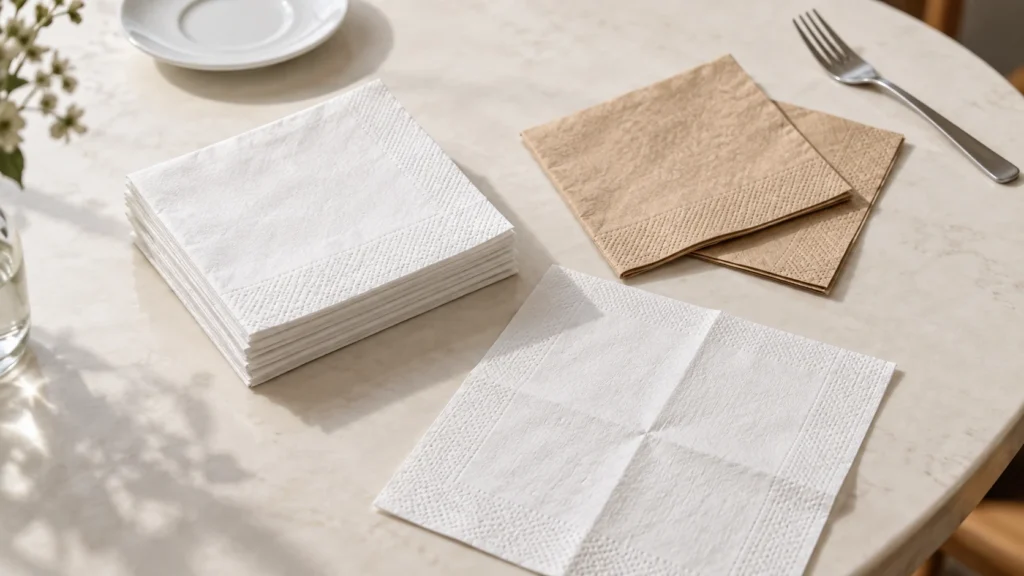
Color: Beige, tan, light brown (natural paper color)
Processing: No bleaching stage; other pulping and papermaking processes still apply
Production and appearance:
•Avoids a bleaching stage; overall environmental impact depends on production
•Compare quoted costs; unbleached does not guarantee a lower price
•Process description (“unbleached”)
•Warm, natural aesthetic
Appearance in service:
•Aesthetic fit depends on the venue
Best For: Eco-conscious cafés, organic restaurants, rustic/casual venues
Options: Black, red, blue, green, pastels (custom colors available)
Dyeing Process: Pigments added during pulp stage or surface coating
Use Cases:
•Black: Upscale, modern restaurants (test stain visibility with your menu)
•Brand colors: Match restaurant branding
•Seasonal: Red/green for holidays, pastels for spring
Design considerations:
•Brand differentiation (memorable)
•Stain visibility (depends on food and background colour)
•Aesthetic variety
Illustrative Napkin Usage Assumptions:
•Fast-casual: 2-3 napkins per customer
•Casual dining: 1-2 napkins per customer (table service, on-demand)
•Fine dining: 1 napkin per customer (staff replaces as needed)
Annual Calculation:
Annual Napkins = (Customers per day) × (Napkins per customer) × (Operating days per year)
Illustrative Example – Casual Café Open 365 Days:
•200 customers/day
•1.5 napkins/customer average
•200 × 1.5 × 365 = 109,500 napkins/year
Cost Calculation:
•2-ply recycled napkins: $0.012 each
•109,500 × $0.012 = $1,314/year
Alternative Sample Price:
•2-ply virgin pulp: $0.018 each
•109,500 × $0.018 = $1,971/year
•Additional cost: $657/year (+50%)
Value Analysis: Is +$54.75/month justified by the difference you observe in sample use?
Packaging and Order Examples:
•Cartons of 5,000-10,000 napkins
•Bulk orders: 50,000-100,000 napkins
Storage Requirements:
•Keep dry (moisture degrades quality)
•Control moisture and avoid damp storage conditions
•Off ground (pallets, shelving)
•Away from direct sunlight (bleached napkins can yellow)
Shelf Life: Follow the product’s storage and shelf-life guidance
Order Frequency:
•Small café (100k/year): For steady use, 25k every 3 months or 50k every 6 months
•Large restaurant (500k/year): Average use is about 41,667 per month before stock adjustments
Ply count alone does not decide the better product:
Choose 2-ply after checking its actual specifications:
•Casual dining, cafés, most table service
•Assess absorbency and softness on the chosen product
•Compare cost per service
Choose 3-ply:
•Fine dining, upscale positioning
•Premium customer expectations
•Messy foods (BBQ, pasta with sauce)
Reality: Well-made 2-ply can outperform low-quality 3-ply. Focus on gsm and pulp quality, not just ply count.
Yes, when the finished product meets your service needs:
Modern Recycled Napkins:
•Compare actual wet strength, absorption and texture
•Softness varies with the product and processing
When Recycled Works:
•Casual dining, cafés
•Eco-conscious positioning
•Budget-conscious operations
•Customers value sustainability
When to Compare Virgin-Pulp Alternatives:
•Fine dining (customers expect premium)
•Test both options for BBQ, sauces and greasy foods
•Softness is brand differentiator
By Service Style:
Fast-Casual, Self-Serve:
•33cm × 33cm (13″ × 13″) lunch napkins
•Quarter fold, or a refill specified for your dispenser
•1-ply or budget 2-ply
Casual Dining, Table Service:
•33-40cm (13-16″) dinner napkins
•Quarter fold or bi-fold
•2-ply standard quality
Fine Dining:
•40-45cm (16-18″) large dinner napkins
•Decorative folds possible
•2-ply premium or 3-ply
Rule: Balance size with usage patterns (messy foods = larger napkins).
Printing Cost Examples — Illustrative Assumptions, Not Supplier Quotes:
Flexographic Printing (Illustrative):
•Total first order (50k): 50,000 × ($0.018 base + $0.02 print) + $800 setup = $2,700 ($0.054/napkin)
•Reorders: $0.038/napkin (assuming no repeat setup fee)
Digital Printing (Illustrative):
•Total (10k): 10,000 × ($0.018 base + $0.04 print) + $200 setup = $780 ($0.078/napkin)
When Custom Makes Sense:
•Brand differentiation (logo recognition)
•Premium positioning
•Events, weddings (napkins as keepsake)
•Order volume justifies the quoted setup and unit costs
Alternative: For stamped branding, verify the ink and finished napkin are suitable for the intended food-contact use; an ordinary stamp pad is not sufficient evidence.
Yes, strategic approach:
By Location:
•Dining room: Premium 2-ply or 3-ply (table service)
•Bathroom: Guest towels (2-ply, smaller quantity)
•Takeout: Budget 1-ply (included in bag, high volume)
By Service:
•Dine-in: Higher quality (customer experience)
•Takeout/delivery: Lower cost (functional, not experiential)
Illustrative Cost Mix:
•70% volume = takeout (1-ply, $0.008)
•30% volume = dine-in (2-ply, $0.015)
•Blended cost: Lower than 100% premium napkins
Caution: Don’t mix quality at same service point (e.g., some tables get premium, others get budget). Inconsistency creates negative perception.
Yes, match napkin fold to dispenser:
Countertop Dispensers:
•Use the specified refill system; some accept interfold napkins, while others use counterfold
Tabletop Holders:
•Use a fold that fits the holder
•Check the holder’s dimensions against the folded napkin
Floor Stands (Freestanding):
•Use the fold specified for that model
•Check capacity for the selected model and refill
Custom Branded Dispensers:
•May require model-specific refill dimensions
•Check compatibility before bulk ordering
Pro Tip: Select a listed compatible dispenser/refill pair; the same supplier name alone does not ensure fit. Mismatched sizes waste napkins (jamming, multiple dispensing).
Napkins:
•Purpose: Cleaning hands, wiping mouth, absorbing spills during meals
•Construction: Product-specific basis weight and ply count; often embossed
•Texture: Varies by product; facial-grade napkins are also available
•Sizes: 25-45cm (large surface area)
Tissues (Facial):
•Purpose: Blowing nose, gentle facial use
•Construction: Product-specific basis weight and ply count; some include lotion
•Texture: Very soft (comfort for sensitive skin)
Can You Substitute?: Choose a product intended for the use: evaluate dimensions, texture, wet strength and any food-contact requirements.
Restaurant Use: Stock napkins for dining, tissues for restrooms (different purposes).
Paper napkin quality can affect the dining experience.
Key Takeaways:
1.Specify both ply count and basis weight; compare finished samples rather than assuming a universal grade
2.Compare virgin and recycled samples for measured performance, feel and quoted cost
3.Embossing changes paper structure; absorption effects depend on the paper and pattern
4.Ply count alone doesn’t determine quality: Consider basis weight, fibre properties, processing and measured performance
5.Size by service style: for example, 33cm for casual or 40-45cm for fine dining; check the folded size and service needs
6.Annual cost calculation: Customers/day × napkins/customer × operating days/year × unit cost
7.Test before bulk ordering: Request samples to verify absorbency and texture with your food types
Invest in napkin quality appropriate to your positioning.
•Packaging Accessories – Napkins, straws, cutlery, and more
•Food Packaging Containers – Complete packaging solutions
•Sustainable Paper Packaging – FSC chain-of-custody guidance
Papacko lists 1-ply and 2-ply napkins, with higher ply counts on request, in kraft, white and bamboo options for restaurants and food service.
Why choose Papacko:
•Material options: Kraft, white and bamboo options
•Custom printing: Logo printing in one or multiple colours; confirm the method and order minimum
•Size variety: Listed square sizes from 20 to 48cm, plus a 33 × 40cm rectangle; confirm the selected size
•Fold types: Quarter-fold, one-eighth fold and dispenser formats
•Sample enquiries: Test quality before ordering
Napkin quality often sits inside a broader tabletop or takeaway experience. Buyers comparing napkins usually also evaluate embossing, premium presentation, eco-friendly accessory choices, and how the rest of the coffee-service pack feels in hand.
Get in touch:
•Request a Quote – Napkin pricing by ply, material, size
•Ask About Samples – Test absorbency and softness with your food
•Discuss Your Requirements – Calculate annual needs and optimize costs