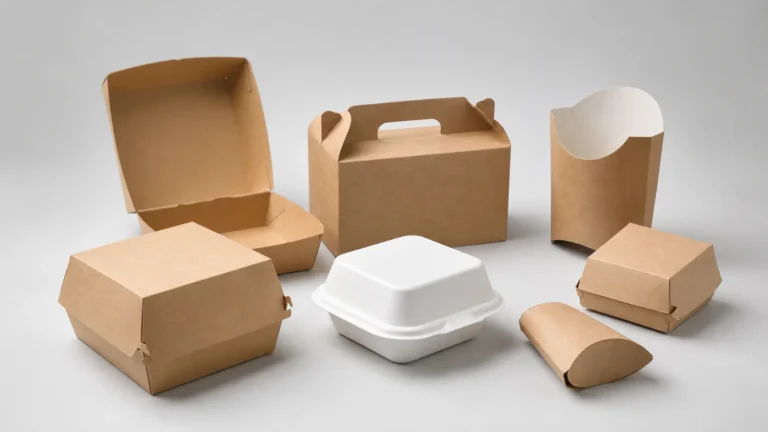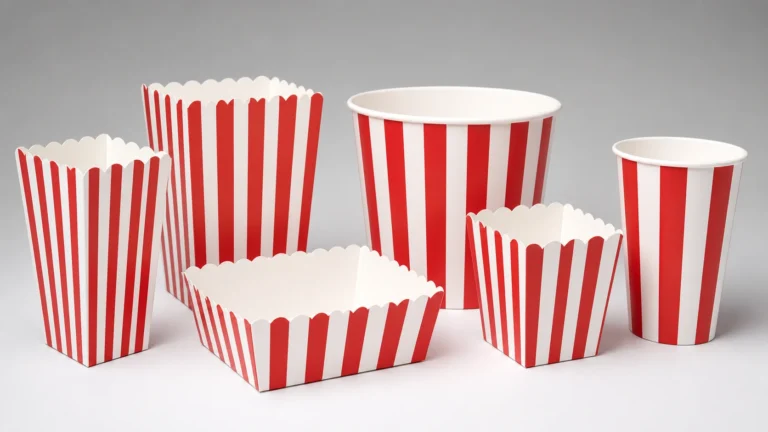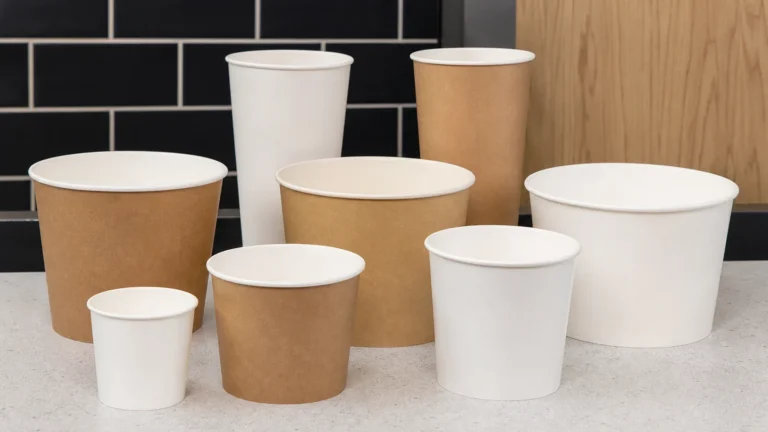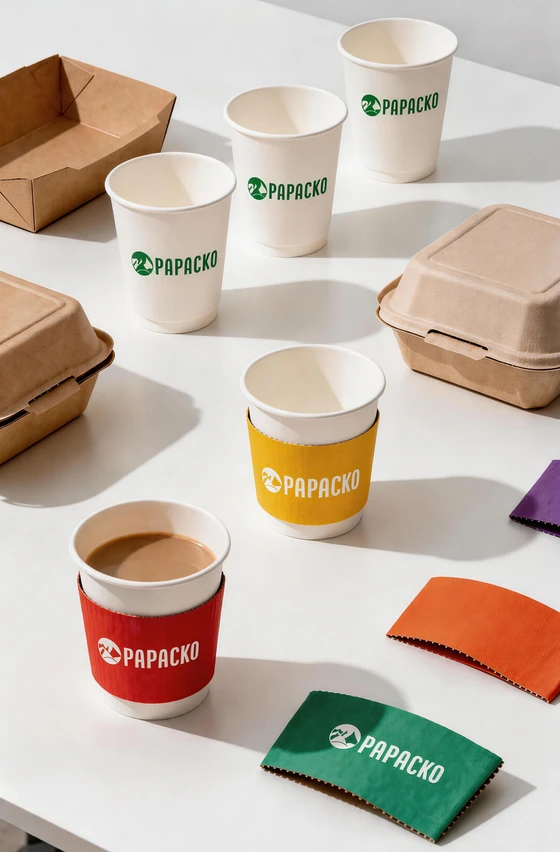
هل أنت مستعد لإنشاء أكواب ورقية أو عبوات ورقية تحمل علامتك التجارية الخاصة بك؟
أخبرنا بمتطلباتك - الحجم والطلاء والطباعة والوجهة - وسيقوم فريقنا بإعداد عرض أسعار مفصل في غضون 24 ساعة.

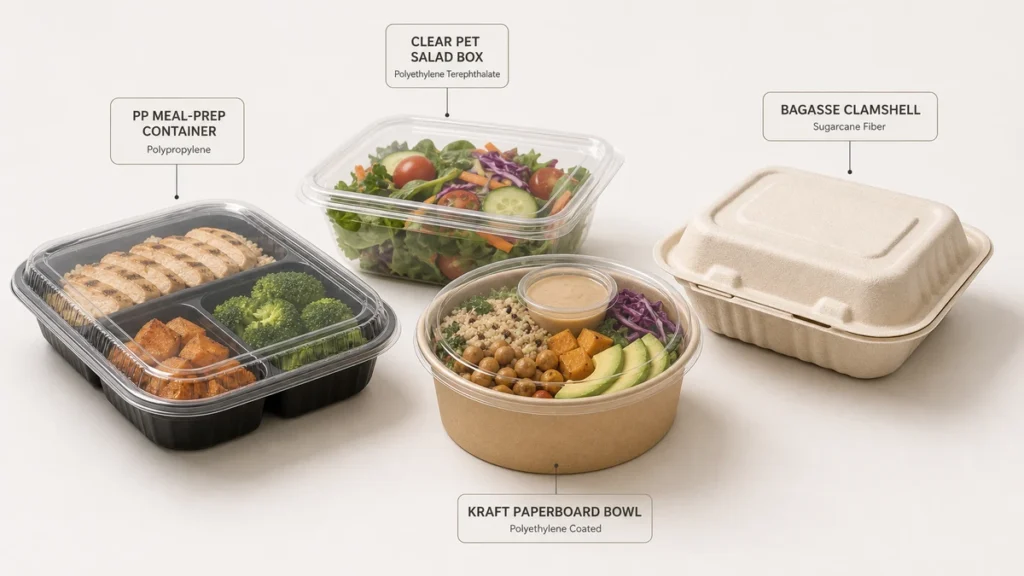
Disposable food containers are single-use or limited-use packs used to hold, transport, or serve food without return logistics or washing. For wholesale buyers, the real decision is matching food temperature, leak risk, lid fit, print needs, and order volume to the right material and supply model.
Wholesale buying typically means case quantities of 200 to 1,000 units per SKU, sourced through a factory, importer-distributor, or domestic foodservice supplier-a channel that directly affects MOQ, lead time, unit cost, and specification control.
Material sets the operating ceiling for the container. PP handles heat up to roughly 120 degrees C; PET gives retail clarity for cold display but softens above 60-70 degrees C; coated paperboard works for dry or lightly sauced foods, with barrier quality mattering more than the paper itself. Two questions narrow the field fastest: what temperature does the food reach inside the pack, and what disposal route is realistic in your market?
Direct factory suits custom sizing or branded print at scale, with MOQs of 50,000-100,000 units per SKU and 30-75 day lead times. Importer-distributor offers MOQs of 1,000-10,000 units at 15-35% above factory-direct cost, with faster replenishment and lower inventory risk. Foodservice supply platform works for trial and urgent top-up buying at the highest unit cost. A common pattern: validate lid fit and fill performance at low MOQ on stock SKUs, then shift proven items to higher-volume purchasing once demand stabilizes.
Before approving any wholesale order, confirm food-contact documentation for the exact material and coating combination-the FDA outlines the framework here: https://www.fda.gov/food/food-ingredients-packaging/food-contact-substances-fcs. Also verify wall thickness or gauge (a 0.3 mm and 0.6 mm container behave very differently under load), lid-to-base compatibility across production runs, case count and pallet configuration, and storage sensitivity for printed or fiber-based items.
Sort disposable food containers by function first, then material. The right buying question is not “which type is best,” but “which type protects this menu item through fill, hold, transport, and handling at a workable cost?”
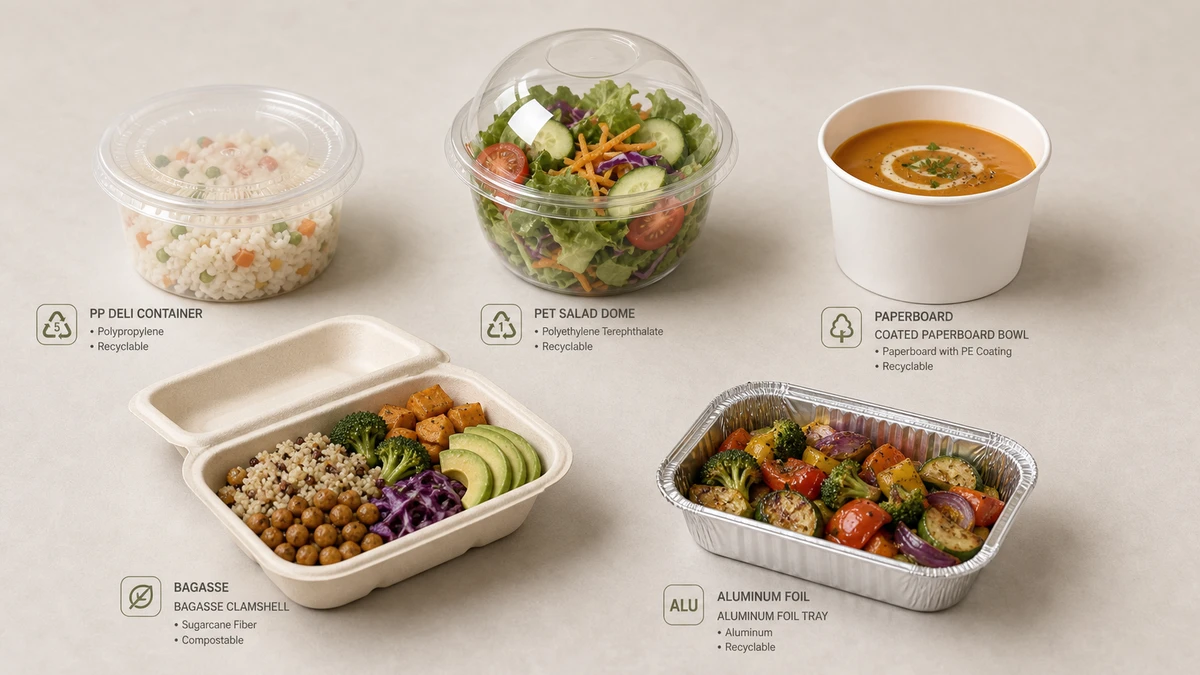
حاويات البولي بروبلين are the standard workhorse for hot meals and meal-prep formats, handling microwave reheat and stacked handling well. PET containers are a cold-food and display-led choice and should not be selected for hot-fill or microwave use. تفل قصب السكر والألياف المقولبة suit fiber-based presentation but require caution around sauce load, soak time, and warehouse humidity. ورق مقوى مطلي is versatile for bowls and takeaway packs, with PE, PLA, or aqueous barrier systems each carrying different heat tolerance, recyclability, and cost trade-offs. Aluminum is best for oven-ready and catering applications where thermal conduction matters.
| التنسيق | Strongest Use Case | Typical Buyer Priority | Commercial Watchout |
|---|---|---|---|
| Clamshell | Fast service meals, hot takeaway | Fast packing, one-piece handling | Bulky case volume and lid alignment issues |
| Tray + separate lid | Meal prep, catering, sealed programs | Stackability and portion control | Extra SKU management and mismatch risk |
| Deli container | Soups, sides, cold prep, grab-and-go | Standardized sizing and broad lid availability | Wrong lid tolerance creates recurring leak claims |
| Bowl / soup cup | Liquid or semi-liquid foods | Heat retention and seal integrity | Paper formats need barrier validation for soak time |
| Compartment tray | Airline, QSR combo meals | Food separation and presentation | More tooling complexity, harder substitutions |
| Portion cup | Sauces and condiments | High-volume standardization | Limited insulation, easy to under-spec lid fit |
If you stock many sizes across many customers, prioritize industry-common diameters and interchangeable lid systems over slightly cheaper proprietary sizes-that reduces dependency risk and simplifies replenishment when one SKU goes short.
Use these three filters before comparing prices:
Sample review should happen before serious price negotiation. A catalog image tells you shape and branding potential; it does not tell you whether the rim is round, the base flexes under load, or the coating survives a real hot-fill test.
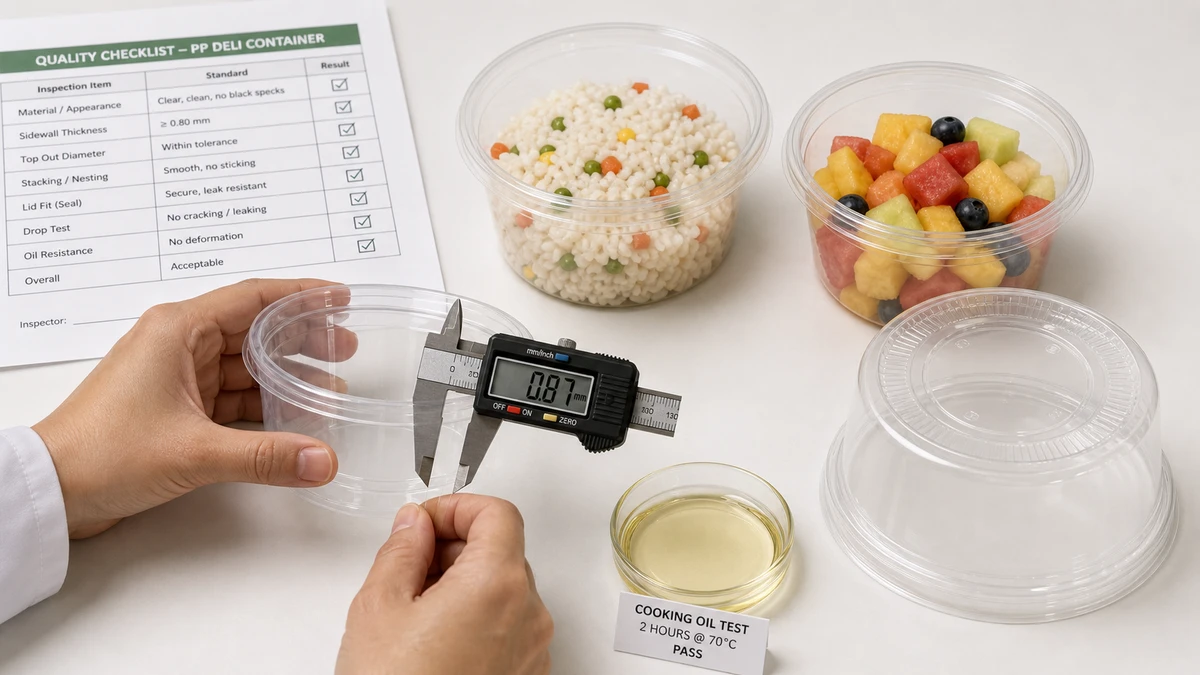
Request at least three units per SKU from confirmed current tooling, ideally across more than one production run. Sample dispatch within 10-14 business days is a reasonable signal that the supplier controls inventory and throughput. Two issues surface repeatedly even on visually good samples: lids that loosen after hot fill, and nested stacks that jam in packing stations due to minor rim geometry variation between lots.
| Checkpoint | What to Test | Practical Benchmark |
|---|---|---|
| سماكة الجدار | Measure base, sidewall, rim with calipers | Tight, even readings; major thinning at corners is a red flag |
| ملاءمة الغطاء | Close, invert, apply light perimeter pressure | No seepage after 60 seconds at ambient |
| مقاومة الشحوم | Apply cooking oil and wait 10 minutes | No visible bleed-through |
| Hot-fill performance | Fill at 85-95 degrees C, hold 3 minutes | No warping, delamination, or lid distortion |
| Stack stability | Stack 10 units | No lateral collapse or uneven seating |
| Print adhesion | Scratch test on printed area | No flaking or edge lift |
| Odor | Check interior after unpacking | No strong solvent or petrochemical odor |
| سلامة الطلاء | Inspect cut or scored edges | No exposed weak points likely to wick moisture |
سماكة الجدار reveals process control-sharp thinning at corners raises cracking risk under normal handling. Rim geometry determines seal reliability; a slightly out-of-round rim may close in a hand test but creates inconsistent lid seating and slows line speed. أداء الحاجز should be tested under actual menu conditions, since oil, steam, and hot sauce expose failure points faster than water alone.
Ask for documented tolerances, inspection practice, and recent food-contact or migration test data. Key questions: What thickness tolerance is controlled in production? What outgoing inspection method is used? Has the lid/base combination been validated as a set? A supplier who answers with documents usually runs a better operation than one who returns only to pricing.
Custom printing changes the economics of disposable food containers immediately, affecting MOQ, lead time, print durability, and storage risk. Branded packaging can improve recognition, but only if the artwork program matches actual order velocity.
الطباعة الفلكسوغرافية is best for stable, high-volume repeat SKUs, typically starting at 50,000-100,000 units-plate charges make it efficient only when artwork is expected to stay in use. الطباعة الرقمية works best for test markets and seasonal runs, often from 500-5,000 units; it avoids plate charges and reduces design lock-in, even though unit cost rises at volume. For buyers developing cups or related takeaway packaging, comparing print planning with standard cup formats on Papacko’s أكواب ورقية page before finalizing a run strategy is useful.
Buyers should confirm whether inks are on the food-contact side or exterior only, whether the supplier can provide a food-contact declaration for the printed structure, whether adhesion holds at expected service temperatures, and whether artwork is approved on the actual substrate-not just a digital proof. For regulatory context in the EU, food-contact material guidance explains composition and migration requirements: https://food.ec.europa.eu/safety/chemical-safety/food-contact-materials_en
Custom print makes sense when unit velocity is predictable, artwork is stable, and the packaging supports a consistent delivery or retail shelf identity. It becomes risky when the SKU is seasonal, menus change frequently, or distributor stocking is mixed across many small accounts where printed inventory may age before use. For buyers exploring lower-waste visual systems, Papacko’s guide to تصميم التغليف البسيط offers a useful reference when balancing branding with print complexity.
These three variables usually decide whether a container succeeds in field use. If a pack fails, it is often because thermal needs, barrier level, and lid geometry were not specified together.
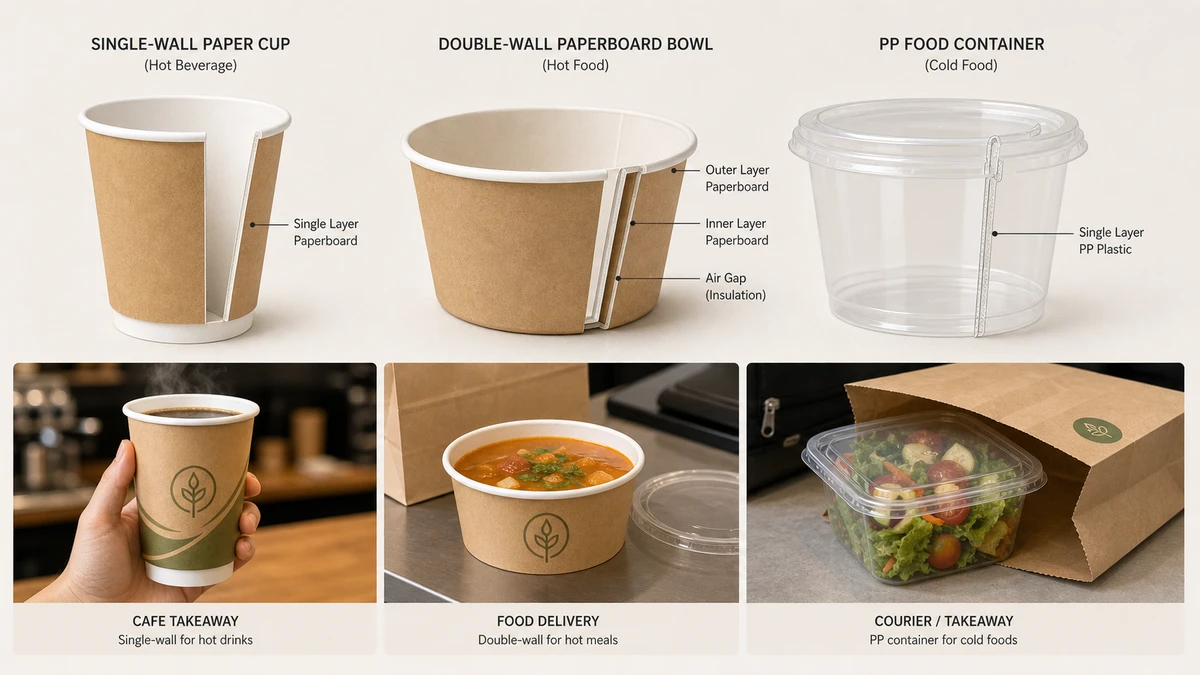
EPS retains heat well, typically keeping hot food serviceable for 20-40 minutes depending on load and ambient conditions. Double-wall paperboard creates an air gap sufficient for caf service or quick-consumption bowls. Single-wall paper offers little insulation and should be reserved for ambient or cold foods. Buyers comparing hot beverage or heat-sensitive takeaway formats should also review Papacko’s أكواب ورقية صديقة للبيئة and compatible أغطية أكواب القهوة when standardizing a broader service line.
Thin bases flex under stacked transport, pushing liquid toward the weakest part of the lid join, and steam-heavy hot foods can soften weak barrier systems faster than room-temperature tests suggest. A practical test: fill, close, invert briefly, then apply side pressure around the lid perimeter-this better reflects what happens in courier bags and stacked takeaway orders. For soup, salad, or bowl-led assortments, Papacko’s food packaging containers range allows comparison by use case rather than appearance alone.
Lid-fit issues create recurring complaints, line slowdowns, and unnecessary SKU complexity, typically caused by rim diameter variation, taper geometry mismatches, and mixing suppliers based on nominal size only. Problems often appear after print rollout or scale-up-not during small trials-because higher-volume runs expose minor tolerance drift. Standardizing approved lid/base combinations early prevents this; Papacko’s packaging accessories page is useful for coordinating lids, sleeves, and other fit-critical items.
Price matters, but in wholesale disposable food containers, terms often matter just as much. A lower unit cost with the wrong MOQ, poor claim terms, or inflexible releases can produce a higher total packaging cost.
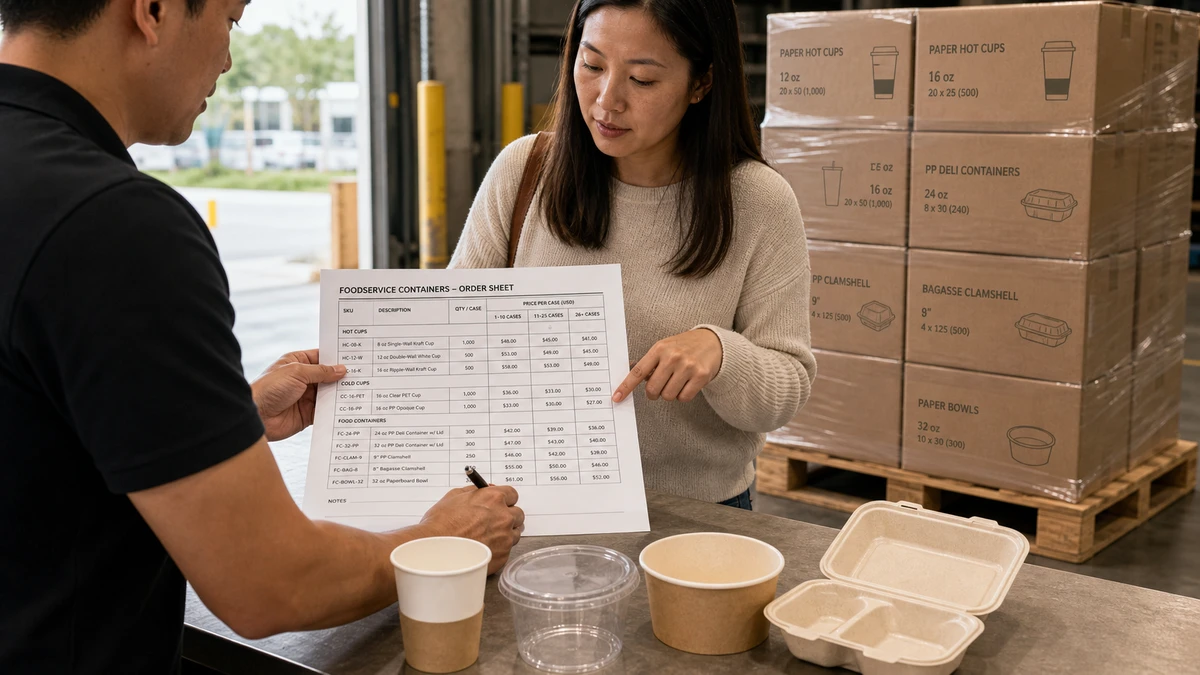
| Volume Tier | حجم الطلب النموذجي | Typical Commercial Effect |
|---|---|---|
| Trial | 1-5 cases | List price, low commitment |
| البيع بالجملة القياسية | 10-50 cases | Initial discount range |
| Mid-volume | 50-200 cases | Better unit cost, stronger leverage |
| Pallet or larger | 200+ cases | Lowest routine unit price |
| Annual commitment | Contracted volume | Flat pricing, rebates, or release scheduling |
A buyer near a tier threshold should always ask what quantity unlocks the next price break-suppliers are usually willing to confirm it.
Clarify whether MOQ applies per SKU, per mixed order, per pallet, or per annual commitment with scheduled releases. Bulky clamshells and low-nesting formats can consume warehouse space quickly, so the cheapest quote is not automatically the cheapest landed storage decision.
Ask for the full price-break schedule, lead time for stock and custom items, split-pallet or mixed-SKU options, plate or tooling charges itemized separately, defect claim process and thresholds, payment terms after account history is established, and safety stock or release scheduling for repeat purchases. For import programs, confirm export carton strength and pallet pattern early-weak cartons create more transit damage than most buyers account for in their first landed-cost review.
By the time you are ready to source, the technical brief should define: material and structure, wall thickness or board weight, lid format, fill temperature, expected hold or delivery time, moisture or grease exposure, print requirement, case-pack target, and documentation required for your market. That level of detail shortens quoting cycles and reduces the chance of suppliers quoting “equivalent” items that are not functionally equivalent.
For buyers expanding sustainable lines, Papacko’s perspective on التغليف الورقي المستدام is worth reviewing alongside the technical spec-claims around recyclability, compostability, and barrier performance need to match actual local collection and use conditions.
A sound sourcing process typically follows this sequence:
That approach is slower than buying on a catalog photo, but far faster than correcting a failed rollout after complaints, write-offs, or distributor returns begin.
PP and some insulated formats are usually the safest starting point for hot food delivery because they handle heat and transit better than standard PET or lightly coated paper. The right choice still depends on delivery time, sauce load, and lid performance.
Start with enough stock to test actual service conditions without overcommitting, often at case level or a small mixed order. The goal is to validate fit, leakage, storage, and usage rate before moving into pallet pricing.
Not automatically. Coating type, local recovery options, food contamination, and actual end-of-life handling all affect whether a paper-based format performs better environmentally in practice.
Do not rely on nominal diameter alone. Request a fit matrix if available and run physical testing with actual production samples, especially for hot-fill or delivery use.
Usually when artwork is stable and volume is high enough to spread setup costs efficiently. For short campaigns or multiple small brands, digital printing often reduces risk even if the unit price is higher.
Buying on unit price without checking lid fit, wall thickness, and case-pack practicality. Those issues create more operational cost than a small price difference on the quote.
Before production. If documentation problems appear after goods are made, your leverage is lower and correcting the order becomes much more expensive.