Prêt à créer vos propres gobelets ou emballages en papier ?
Faites-nous part de vos exigences - taille, revêtement, impression et destination - et notre équipe établira un devis détaillé dans les 24 heures.
Dernière mise à jour: novembre 2025
Temps de lecture: 8 à 10 minutes
Auteur: Équipe de contenu de Papacko
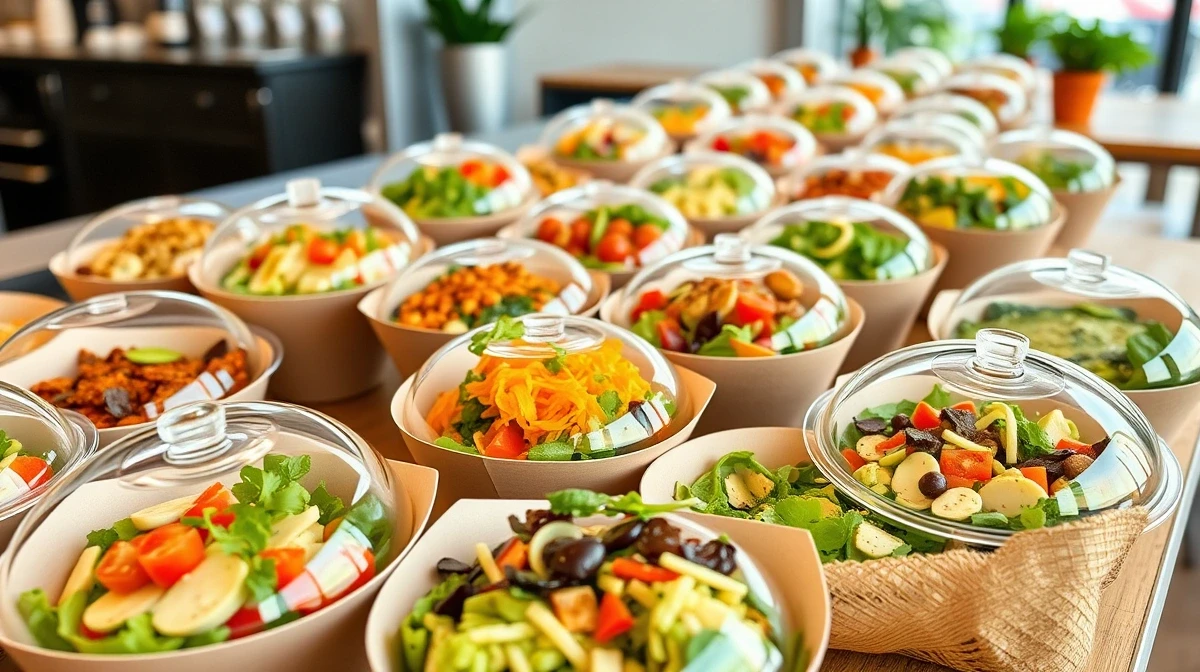
Dans le monde compétitif de la restauration rapide saine, l'emballage est plus que fonctionnel, c'est un outil de vente. Les salades emballées dans des récipients opaques cachent leurs couleurs vives, leurs ingrédients frais et leurs portions généreuses. Mais les salades saladiers avec des couvercles à fenêtre transparente transforment l'emballage en un atout visuel pour le merchandising, augmentant les achats impulsifs jusqu'à 34% selon des études de psychologie de la vente au détail.
Ce guide explique comment l'emballage des salades avec couvercle à fenêtre influence le comportement des consommateurs, compare les options de conception pour une visibilité maximale et fournit des stratégies d'approvisionnement pour des entreprises allant des cafés axés sur la santé aux services de livraison de repas préparés.
Dans cet article, vous apprendrez :
-Principes du merchandising visuel qui font des couvercles de fenêtre des moteurs de vente efficaces
-Variations de conception (fenêtre complète, fenêtre partielle, découpes façonnées) et leurs applications
-Considérations matérielles pour la clarté, la recyclabilité et la sécurité alimentaire
-Stratégies de personnalisation pour l'image de marque autour de la transparence
💡 À retenir: Les couvercles à fenêtre transforment l'emballage des salades de “stockage” en “vitrine”. Les clients voient la qualité des ingrédients et la taille des portions avant d'acheter, ce qui réduit les hésitations et augmente les taux de conversion de 20-35% dans les lieux de consommation immédiate.
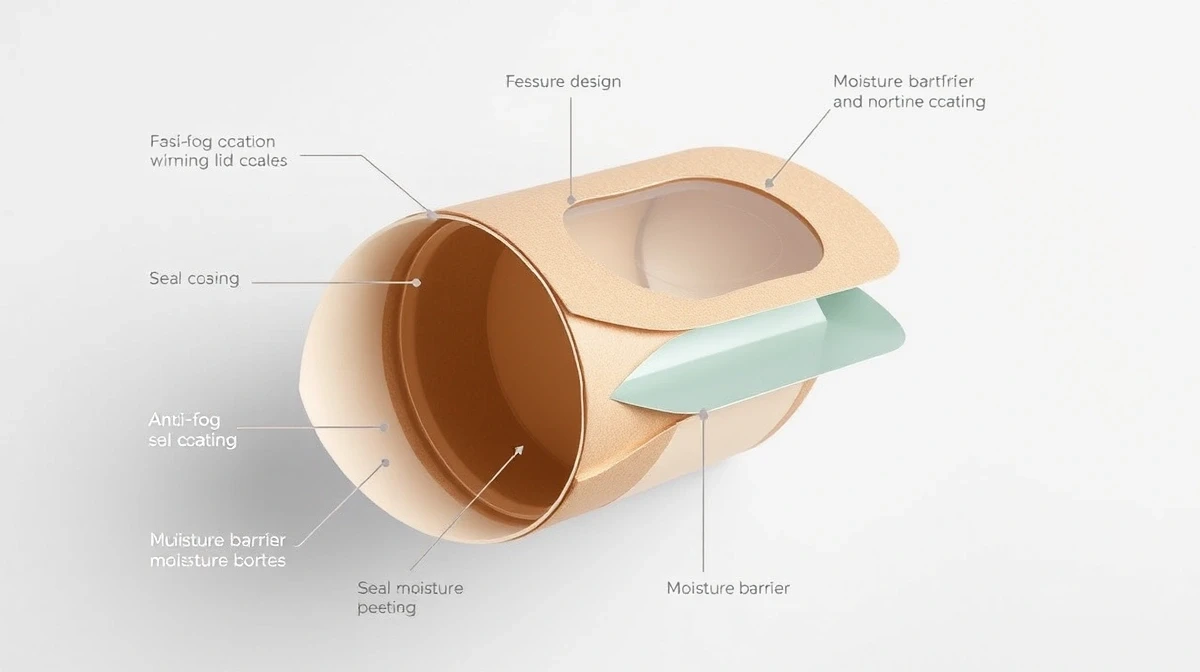
Les bols en papier avec couvercles à fenêtre combinent la durabilité des contenants à base de fibres avec les avantages de visibilité des couvercles transparents. Ils présentent généralement les caractéristiques suivantes
-Bol en fibre moulée ou en carton couché (kraft ou blanc, capacité de 16 à 32 oz)
-Couvercle bi-matière avec fenêtre transparente (PET, PLA ou film de cellulose) encadrée par du papier/carton
-Joint d'étanchéité résistant aux fuites (par encliquetage, par friction ou par thermoscellage selon le modèle)
-Revêtements anti-buée (facultatif) pour maintenir la visibilité sous réfrigération
Principaux cas d'utilisation :
Perception du consommateur Avantages :
-Vérification de la fraîcheur: Les clients confirment visuellement la qualité des ingrédients avant l'achat
-Transparence des portions: La visibilité de la taille des portions réduit l'incertitude de la valeur perçue
-Appel des couleurs: Les légumes, les verdures et les garnitures aux couleurs vives stimulent l'appétit.
-Renforcement de la confiance: La transparence est un gage de confiance dans la qualité des produits
🎯 Aperçu de l'industrie: Les restaurants qui sont passés des récipients à salade opaques aux récipients à fenêtre ont enregistré une augmentation de 28% des ventes de salades et une diminution de 41% des questions des clients sur les ingrédients et la taille des portions.
Activation de l'appétit par la couleur :
La recherche en psychologie alimentaire montre que des combinaisons de couleurs spécifiques suscitent des intentions d'achat plus fortes :
Principaux résultats: Les salades multicolores bénéficient davantage des couvercles à fenêtre complète, tandis que les bols unicolores peuvent être plus performants avec des fenêtres partielles qui intègrent une photographie de marque.
La transparence réduit l'hésitation de l'achat à l'aveuglette :
-Récipient opaque: 47% des clients incertains quant au rapport qualité-prix
-Récipient avec couvercle à fenêtre: 18% incertains (61% réduction en doute)
Expériences de perception des portions :
Perspective: La transparence totale entraîne une légère surestimation de la taille des portions, ce qui se traduit par un taux de conversion à l'achat plus élevé.
Construction :
-Matériau: Dôme ou couvercle plat en plastique PET, PLA ou OPS
-Cadre: Rebord de papier minimal (5-10 mm) pour le soutien structurel
-Scellement: Fixation par encliquetage ou par friction sur le rebord de la cuvette
Avantages :
-Visibilité maximale: Toute la composition de la salade est visible
-Vue à 360: Les clients peuvent évaluer la situation sous plusieurs angles
-Impact de la couleur: Optimise l'attrait visuel des salades à ingrédients multiples
Limites :
-Espace de marque: Limité à l'impression d'une petite étiquette supérieure ou d'un corps de cuvette
-Intégrité structurelle: Nécessite un plastique plus épais (0,4-0,6 mm) pour la rigidité.
-Perception de la durabilité: La visibilité élevée du plastique peut inquiéter les clients soucieux de l'environnement
Meilleur pour :
-Bar à salades haut de gamme avec des couches d'ingrédients complexes
-Vitrines en libre-service où les produits se concurrencent visuellement
-Les entreprises donnent la priorité à la qualité des ingrédients plutôt qu'à l'image de marque
Construction :
-Matériau: Couvercle en carton avec fenêtre centrale transparente (insert PET/PLA)
-Cadre: Le papier structurel offre une surface de marquage
-Scellement: Fermeture à pression sécurisée avec revêtement résistant à l'humidité
Avantages :
-Visibilité et image de marque équilibrées: La fenêtre présente les ingrédients clés tandis que le cadre en papier porte le logo/les graphiques.
-Meilleure histoire de durabilité: Plus de papier, moins de plastique en masse
-Polyvalence structurelle: Le bord du papier ajoute de la rigidité et de la stabilité à l'empilage
Optimisation de la conception :
Meilleur pour :
-Les restaurants à service rapide concilient image de marque et transparence
-Opérations de franchise nécessitant un placement cohérent du logo
-Produits dont les ingrédients de la couche supérieure (protéines, garnitures) sont les principaux arguments de vente
Construction :
-Matériau: Couvercle entièrement en carton avec fenêtres découpées (support en film PET/PLA)
-Conception: Formes personnalisées (feuille, cercle, silhouette du logo de la marque)
-Scellement: Film collé sur la face inférieure du carton pour un aspect extérieur lisse.
Avantages :
-Différenciation des marques: Les formes uniques des fenêtres créent une signature visuelle
-Récit de l'histoire: Les fenêtres en forme de feuilles mettent l'accent sur la durabilité et les ingrédients naturels
-Rentabilité: Matériau moins transparent que les fenêtres pleines
Formes populaires :
Meilleur pour :
-Les marques dotées d'une forte identité visuelle cherchent à se différencier
-Concepts d'alimentation biologique/naturelle mettant l'accent sur la durabilité
-Lignes de produits limitées pour lesquelles la reconnaissance de l'emballage est précieuse
Critères de sélection :
Choisir PET si :
-Votre marché dispose d'une solide infrastructure de recyclage du PET
-La clarté est essentielle à la différenciation des produits
-L'optimisation des coûts est une priorité
Choisissez l'APL si :
-Vous avez des partenariats de compostage industriel
-Les clients donnent la priorité au message “sans plastique” (malgré les nuances techniques)
-Prêt à investir dans une prime de durabilité
Choisissez la pellicule de cellulose si :
-Vous voulez un compostage domestique complet
-Peut accepter une légère teinte
-Cibler le segment haut de gamme soucieux de l'environnement
Problème: Les salades réfrigérées créent de la condensation sur les couvercles froids, ce qui obscurcit la visibilité.
Solutions :
Recommandation: Pour les salades à emporter conservées <24 heures, le revêtement anti-buée sur les fenêtres en PET offre la meilleure visibilité possible. Pour une durée de conservation plus longue (préparation des repas, distribution au détail), combiner le revêtement avec des inserts absorbant l'humidité.
Branding Surface Allocation :
Meilleures pratiques en matière de conception :
1. Maximiser l'image de marque du corps de la cuvette :
Comme la vitrine présente la salade, l'extérieur du bol devient votre principale toile de marque :
-Conception enveloppante: Maintient la visibilité de la marque sous tous les angles
-Couleurs très contrastées: Assure la reconnaissance dans les vitrines encombrées
-Éléments verticaux de la marque: Lisibles même lorsqu'ils sont empilés
2. Conception stratégique du cadre du couvercle :
La partie papier du couvercle doit compléter, et non concurrencer, la visibilité du produit :
-Logo en haut au centre: 30-50mm de diamètre, n'obscurcit pas la fenêtre
-Messagerie frontalière: Lignes de conduite, icônes de durabilité sur le bord du couvercle
-Espace négatif: Évitez l'encombrement - laissez la fenêtre faire la vente
3. L'impression intérieure au service de la narration :
Imprimez sur la base intérieure du bol pour diffuser des messages qui ne seront visibles qu'après l'achat :
-Histoires d'approvisionnement en ingrédients: “Choux frisés biologiques de [Nom de l'exploitation]”.”
-Points forts en matière de nutrition: Affichage des macros, informations sur les calories
-Appréciation de la marque: “Merci d'avoir choisi [Marque]”
Exemples d'études de cas :
La différenciation par la cohérence :
L'utilisation de la même forme de fenêtre pour toutes les tailles de salades crée des problèmes :
-Reconnaissance instantanée: Les clients identifient votre produit de l'autre côté de la pièce
-Présence en rayon: Un design cohérent crée un “bloc” visuel dans les présentoirs de vente au détail
-Appel à la photographie: Les posts sur les médias sociaux présentent une silhouette d'emballage reconnaissable
Compromis entre profondeur et diamètre :
Recommandation: Pour la prise en main de la vitrine, donnez la priorité large et peu profond pour maximiser la visibilité de la répartition des ingrédients. Pour la livraison/préparation de repas, choisissez étroit et profond pour un empilage et un transport efficaces.
La réalité du recyclage :
Problème: Les couvercles multi-matériaux nécessitent séparation des consommateurs pour un recyclage correct, mais les taux de conformité sont généralement inférieurs à 15%.Solutions :
1.Instructions de séparation clairement étiquetées: “Retirer la fenêtre du couvercle avant le recyclage”
2.Conceptions mono-matériaux: Couvercles PET entièrement transparents (sacrifier l'espace de marquage pour la recyclabilité)
3.Systèmes compostables: Carton entièrement compostable + fenêtre en cellulose (coût plus élevé)
Stratégie de marketing: Afficher les certifications les plus reconnaissables (FSC, “Plastic-Free”) bien en vue sur le corps du bol ; placer les certifications techniques (BPI) sur le dessous du couvercle pour informer les clients.
Compléments de personnalisation :
### Délais et planification des stocks
Standard Stock vs. Custom :
Gestion de la demande saisonnière :
-Pic de l'été (salades) : Commandez 6 à 8 semaines à l'avance pour éviter de payer le prix fort pendant la période d'affluence des fournisseurs.
-Stock de sécurité: Maintenir un stock de 3 à 4 semaines pour les modèles personnalisés (cycles de commande plus longs).
❌ Erreur #1: Choisir des couvercles opaques pour économiser sur les matériaux des fenêtres
✅ Approche correcte: Test A/B fenêtre contre couvercle opaque - la plupart des entreprises constatent une augmentation des ventes de 20-35% qui dépasse de loin l'augmentation des coûts d'emballage de 15-25%.
❌ Erreur #2: Maximiser la taille des fenêtres sans tenir compte de la condensation
✅ Approche correcte: Pour une exposition réfrigérée de plus de 4 heures, investissez dans un revêtement antibuée ou acceptez une fenêtre de 70-80% (au lieu de 100%) pour équilibrer la visibilité et la fonctionnalité.
❌ Erreur #3: Marquage excessif du cadre du couvercle, masquant la vue du produit
✅ Approche correcte: Limiter le graphisme du couvercle à un petit logo/icône - laisser la salade se vendre elle-même à travers la vitrine.
❌ Erreur #4: Utiliser des fenêtres en PLA sans vérifier l'infrastructure de compostage
✅ Approche correcte: Vérifier les capacités locales de gestion des déchets ; si le compostage industriel n'est pas disponible, choisir le PET recyclable à la place.
Les bols en papier avec couvercles à fenêtre combinent des contenants à base de fibres (papier moulé ou carton couché) avec des couvercles à fenêtre transparente (PET, PLA ou film de cellulose encadré par du carton). Ils permettent aux clients de voir les ingrédients de la salade tout en respectant le positionnement écologique de l'emballage.
Oui, des études montrent que les ventes de 20-35% augmentent lorsque l'on passe de contenants opaques à des contenants à couvercle à fenêtre dans des environnements de type "grab-and-go". La transparence réduit les hésitations à l'achat et met visuellement en valeur la qualité des ingrédients et la taille des portions.
La couverture de la fenêtre 70-100% génère les ventes les plus élevées pour les salades multi-ingrédients. Cependant, les fenêtres partielles de 50-70% équilibrent la visibilité avec l'espace de marquage et peuvent être plus performantes pour les produits où la reconnaissance de la marque est essentielle.
Cela dépend. Les fenêtres en PET avec des cadres en carton sont recyclables si les consommateurs séparent les composants (taux de conformité généralement <15%). Les couvercles en PET mono-matériau sont plus faciles à recycler. Les fenêtres en PLA contaminent le recyclage et nécessitent un compostage industriel.
Les revêtements antibuée appliqués sur les fenêtres en PET ou PLA conservent leur clarté pendant 24 à 48 heures au réfrigérateur. Combinez-les avec des vitrines à température contrôlée (2-4°C) et des inserts absorbant l'humidité pour prolonger la durée de conservation des produits.
Les couvercles à fenêtre coûtent 15-35% de plus que les couvercles en carton opaque, en fonction de la taille de la fenêtre et du matériau. Pour un bol de 32 oz, comptez $0,48-0,85 par unité contre $0,35-0,55 pour les équivalents opaques (prix à partir de 1000 pièces).
Oui, mais la découpe à l'emporte-pièce nécessite des quantités plus importantes (plus de 20 000 pièces) et des coûts d'outillage plus élevés ($500-$2 000). Les formes standard (cercle, rectangle, ovale) sont disponibles à des quantités moindres auprès de la plupart des fournisseurs.
Les bols en papier avec couvercles à fenêtre représentent l'intersection de l'emballage durable et du merchandising visuel. En transformant des contenants opaques en vitrines de produits, ils répondent à la demande de transparence des consommateurs tout en respectant l'environnement grâce à des matériaux à base de papier.
Principaux enseignements :
1.Les couvercles de fenêtre augmentent les ventes 20-35% dans les lieux de consommation immédiate en réduisant l'hésitation à l'achat et en mettant en valeur la qualité
2.La couverture optimale de la fenêtre est 70-100% pour les salades à ingrédients multiples ; 50-70% pour les stratégies axées sur la marque
3.Les fenêtres en PET offrent une clarté et une recyclabilité optimales; Le PLA convient aux marchés du compostage industriel
4.Les revêtements antibuée sont essentiels pour une exposition réfrigérée d'une durée >4 heures
5.Équilibrer l'image de marque et la transparence: Laisser le produit se vendre lui-même à travers la vitrine ; utiliser le corps de la cuvette pour le marquage principal
Que vous exploitiez un café axé sur la santé, un service de préparation de repas ou un bar à salades, l'investissement dans un emballage à fenêtre est généralement rentabilisé en 3 à 6 mois grâce à l'augmentation du volume des ventes et à la réduction des demandes de renseignements des clients sur la taille des portions et les ingrédients.
-Contenants pour emballages alimentaires
-Solutions d'emballage durables
Papacko fabrique des bols en papier personnalisés avec des couvercles à fenêtre conçus pour une visibilité maximale des produits et des matériaux durables. Nos solutions comprennent des options de fenêtres en PET anti-buée et en PLA compostable, des formes de fenêtres personnalisées et l'impression en couleur à partir de 5 000 pièces.
Les saladiers à fenêtre se situent à mi-chemin entre les emballages de présentation et les emballages à emporter hermétiques. Les acheteurs les comparent généralement aux saladiers classiques, aux couvercles en papier et à d'autres formats de récipients alimentaires avant de finaliser leur gamme.
Prenez contact avec nous :
Dernière mise à jour: novembre 2025