Prêt à créer vos propres gobelets ou emballages en papier ?
Faites-nous part de vos exigences - taille, revêtement, impression et destination - et notre équipe établira un devis détaillé dans les 24 heures.

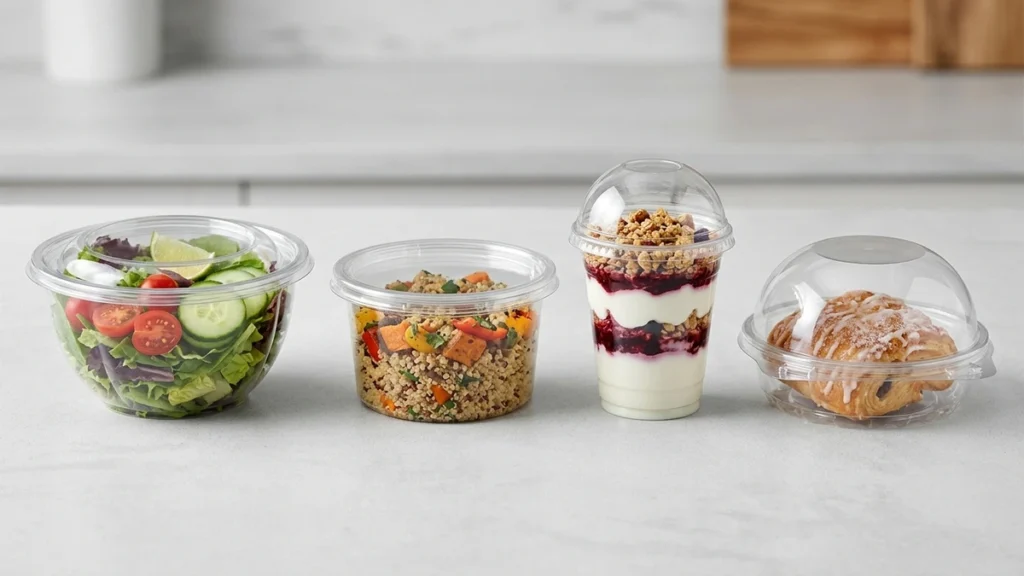
Clear food containers help buyers balance product visibility, operational fit, and packaging reliability. For most B2B foodservice and retail programs, the right choice depends on four practical variables: fill temperature, required clarity, lid performance, and supply chain requirements. Cold salads, chilled desserts, and bakery display usually point toward PET or rPET. Warm fill, reheating, or microwave use usually push the decision toward PP.
This matters because a container that looks good in a sample review can still fail in production. Lid pop-off, sidewall flex, poor stacking, condensation, and supplier variation are common issues when clear packaging is selected by catalog image rather than tested in the real workflow. Buyers reviewing multiple formats can also compare related contenants d'emballage alimentaire when planning a broader packaging range.
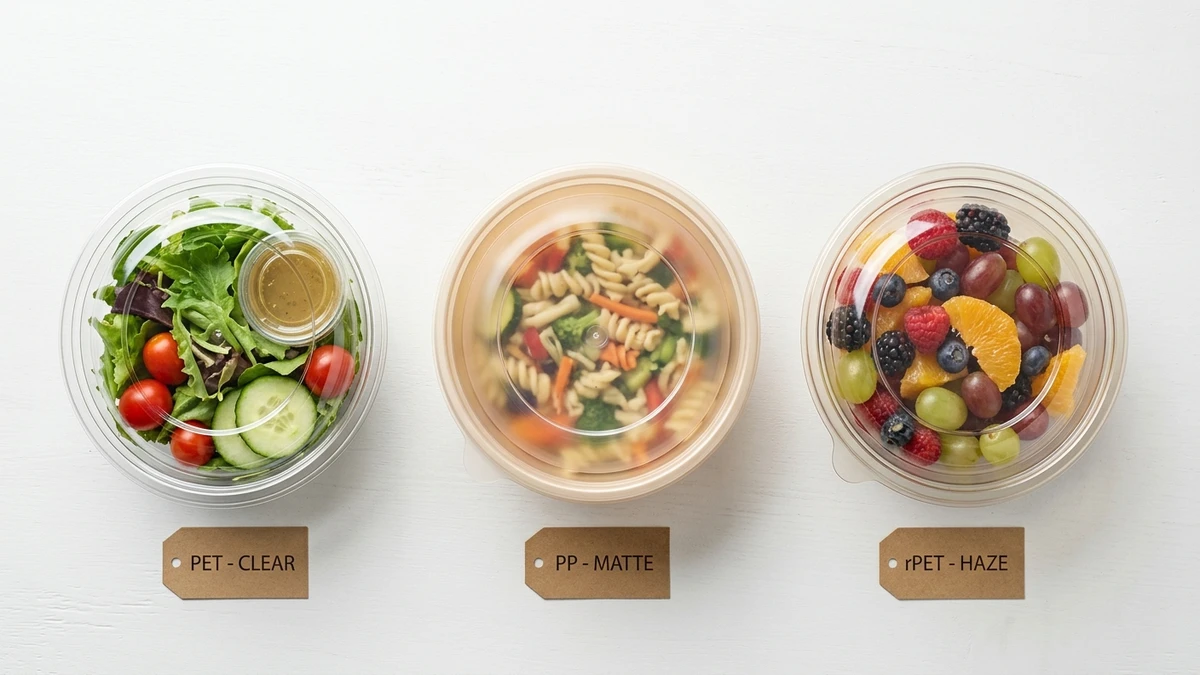
Material should be chosen from actual use conditions, not just cost per piece. The core decision is simple.
PET is widely used for salads, cold deli items, fruit, bakery display, and dessert cups because it delivers strong clarity and shelf appeal. Its weakness is heat. If the product is packed warm or gives off residual steam, PET can lose shape and lid fit.
rPET is often the next choice when recycled content is part of a procurement requirement. It can perform similarly to PET, but clarity depends on feedstock quality and recycled content percentage. Before approval, buyers should request food-contact declarations and recycled-content documentation. For US compliance review, the FDA guidance on food-contact substances is the most relevant authority link for source and process validation.
PP trades some transparency for heat resistance. It is the more practical option for warm deli sides, hot-fill components, or microwaveable programs. If the food is sold on visual freshness cues, however, PP may not merchandise as strongly as PET.
A fast screening method is:
Salad and deli packaging needs more than transparency. It has to close consistently, resist leakage, survive stacking, and maintain presentation through prep, cold holding, transport, and display.
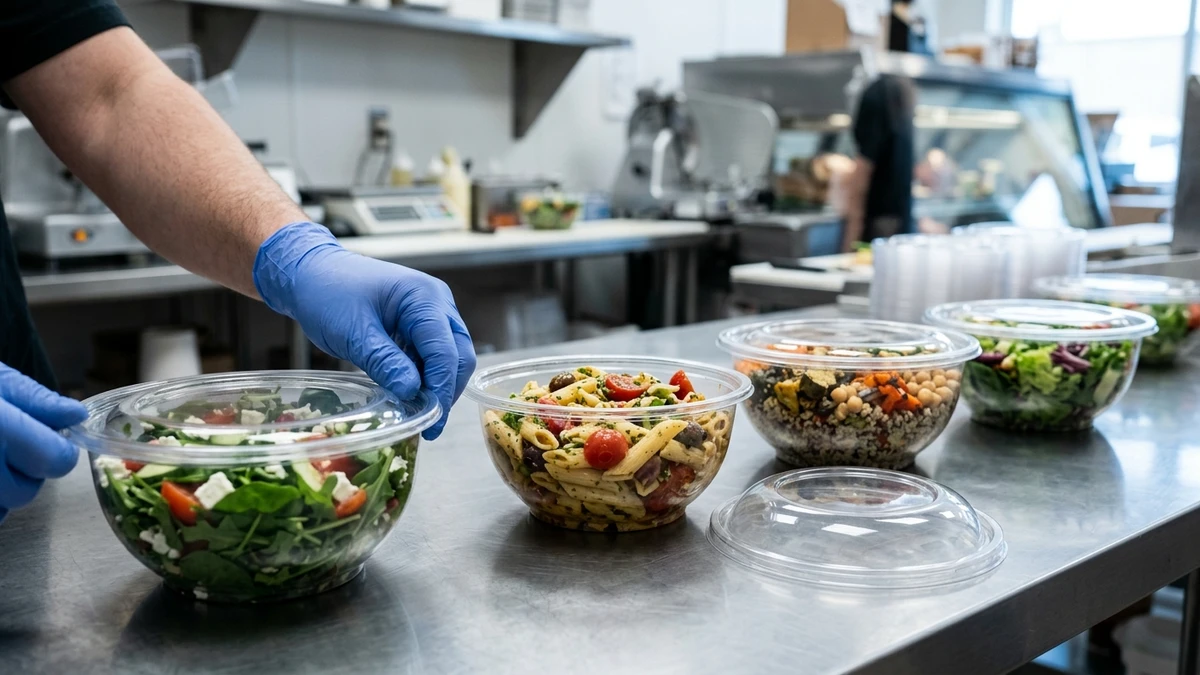
For cold salads, grain bowls, cut fruit, and deli mixes, PET is usually the first material to test. It gives good sidewall clarity and a crisp look in refrigerated display. But the best container is not always the one with the highest clarity. Wet products, oily dressings, and bulky toppings can all affect pack performance.
Buyers should check these points first:
A practical rule is to avoid filling to the absolute rim. A salad bowl that is technically the right volume may still perform poorly if toppings press against the lid and break the closure. Dome lids help with garnish height, while flat lids often improve stacking and shelf density.
Lid fit is where many programs fail. Matching diameter numbers alone is not enough. Rim profile, snap force, and molding tolerance vary by supplier. Cross-sourcing lids and bowls often causes leakage, difficult closure, or pop-off in bagging and transport. Buyers should request matched-set samples from the intended production mold, not only showroom samples.
MOQ and lead time also matter. Stock salad bowls may be available at lower MOQs with shorter replenishment cycles, while custom tooling or custom color lids can require higher minimums and longer lead times. For growing operations, standardizing two or three core sizes is often better than managing too many near-duplicate SKUs. Teams balancing clear and paper formats in the same operation may also review emballages alimentaires jetables to simplify sourcing.
Dessert packaging is strongly presentation driven. In clear food containers, sidewall clarity, cup geometry, and dome clearance often matter as much as the material itself.
PET is commonly the best starting point for chilled parfaits, mousses, puddings, and layered desserts. It shows color contrast well and supports a premium display look. rPET can be a good alternative when recycled content is required, but slight haze or color shift should be checked with production-grade samples before a large order.
For dessert applications, buyers should evaluate:
Smaller dessert cups can become unstable if the base is too narrow relative to height. Larger parfait cups may flex if the wall gauge is too light. A container can look acceptable empty but feel weak once filled, lidded, and stacked.
Lid engagement needs physical testing. A cup and lid that seem compatible on paper may not stay secure after chilled holding or transport vibration. This is especially important for liquid layers, syrups, and whipped toppings. If the dessert will be merchandised for several hours or moved through third-party delivery, secure closure matters more than the lowest unit price.
Branding should support visibility rather than cover it. For most buyers, pressure-sensitive labels remain the lowest-risk option because they suit smaller MOQs and shorter lead times. Direct print, shrink sleeve, or in-mold labeling make more sense once one SKU has stable volume and unchanged artwork. If visual branding is part of a wider product family, principles from conception d'emballages minimaliste can help preserve product visibility while keeping a clean brand presence.
Retail display packaging must protect the food while helping it sell. In bakery, grab-and-go, and chilled merchandising, the right clear food containers preserve shape, resist crushing, and keep the product visible over the intended display window.
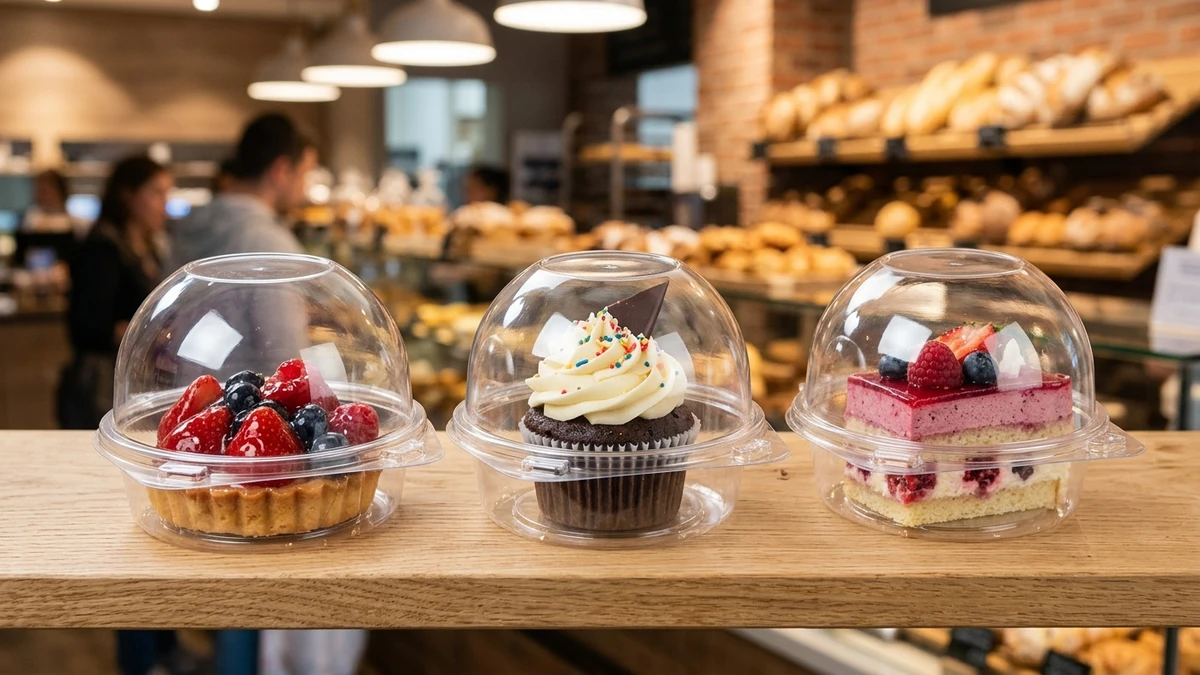
For bakery items, dome geometry is often more important than nominal volume. Frosting, glaze, fruit topping, or layered decoration can be damaged if the lid clearance is too tight. Buyers should measure the tallest product point after finishing and cooling, then allow extra clearance for handling.
Key buyer checks for display packaging include:
Clamshells can speed packing because they remove the separate lid step and reduce mismatch risk. Separate lid systems offer more flexibility, especially when a base can pair with flat and dome options. The better choice depends on throughput, display style, and SKU complexity.
For retail bakery and patisserie, PET often remains the preferred material because it delivers strong clarity and shelf appeal. For warm bakery fills or products packed before full cooling, buyers need to verify whether residual heat will affect the container. A visually attractive package loses value quickly if the lid warps or the walls draw in after packing.
Programs with sustainability goals sometimes ask whether PLA is a substitute for PET in display packaging. In some applications it can be, but only where industrial composting infrastructure exists and the temperature range fits the product. Buyers comparing those options can review emballages alimentaires compostables before making a material change.
Once the format is narrowed down, procurement discipline becomes the main risk control. Clear food containers should be approved as an operating system, not just as a single item.
Start with the commercial basics:
Custom printing, custom embossing, and custom molds usually increase MOQ and extend lead time. If monthly demand is still unstable, a stock container with a custom label is often the safer launch option. For mature SKUs with predictable volume, custom programs may improve branding and cost control.
Material and coating choices should also be confirmed in writing. Buyers may need to specify:
– Virgin PET, rPET, PP, or PLA
– Recycled-content percentage range
– Anti-fog treatment for cold display
– Surface treatment if direct printing is planned on PP
– Tamper-evident or vented lid features where relevant
Supplier documentation is a non-negotiable part of approval. At minimum, request:
Finally, test samples through the actual workflow. That means filling, closing, stacking, chilled holding, bagging, transport simulation, and display review. This step exposes real problems such as lid mismatch, condensation haze, and top-load failure before inventory is committed. If the packaging program also includes beverage and takeaway coordination, related items like couvercles de tasses à café may need to align with the same sourcing and branding standards.
PET is usually the best first choice because it combines high clarity, good rigidity, and dependable cold-case performance. rPET is a strong alternative when recycled content is a procurement priority and the clarity is acceptable for the application.
Some can, but not all. PET and rPET are generally poor choices above about 60 C, while PP is typically the safer option for warm fill or microwaveable use.
Often close, but not always identical. Clarity depends on recycled feedstock quality and PCR percentage, so production-grade samples should be approved before a large order.
Not reliably. Rim profile and tolerance vary by supplier, so cups, bowls, and lids should be tested as matched sets before operational rollout.
Usually when one SKU has stable monthly volume and the artwork will not change often. For lower volumes or seasonal programs, labels are normally the more flexible and lower-risk option.
In most programs, it is poor lid-to-base fit rather than the material itself. Cross-sourcing components or skipping transit testing is a common cause of pop-off and leakage issues.