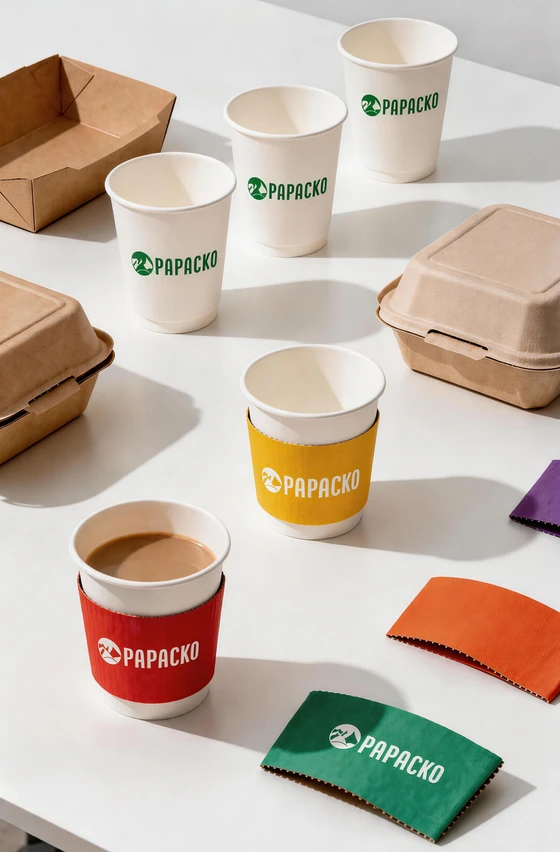
هل أنت مستعد لإنشاء أكواب ورقية أو عبوات ورقية تحمل علامتك التجارية الخاصة بك؟
أخبرنا بمتطلباتك - الحجم والطلاء والطباعة والوجهة - وسيقوم فريقنا بإعداد عرض أسعار مفصل في غضون 24 ساعة.

Wholesale paper cups usually start around 1,000-5,000 units per SKU for stock items and move to 10,000-50,000 units for custom print, depending on size, wall construction, and artwork complexity. The practical decision is not just MOQ-it is choosing the right size platform, lining, and accessory fit so the cup works commercially across service, storage, freight, and reorder cycles.
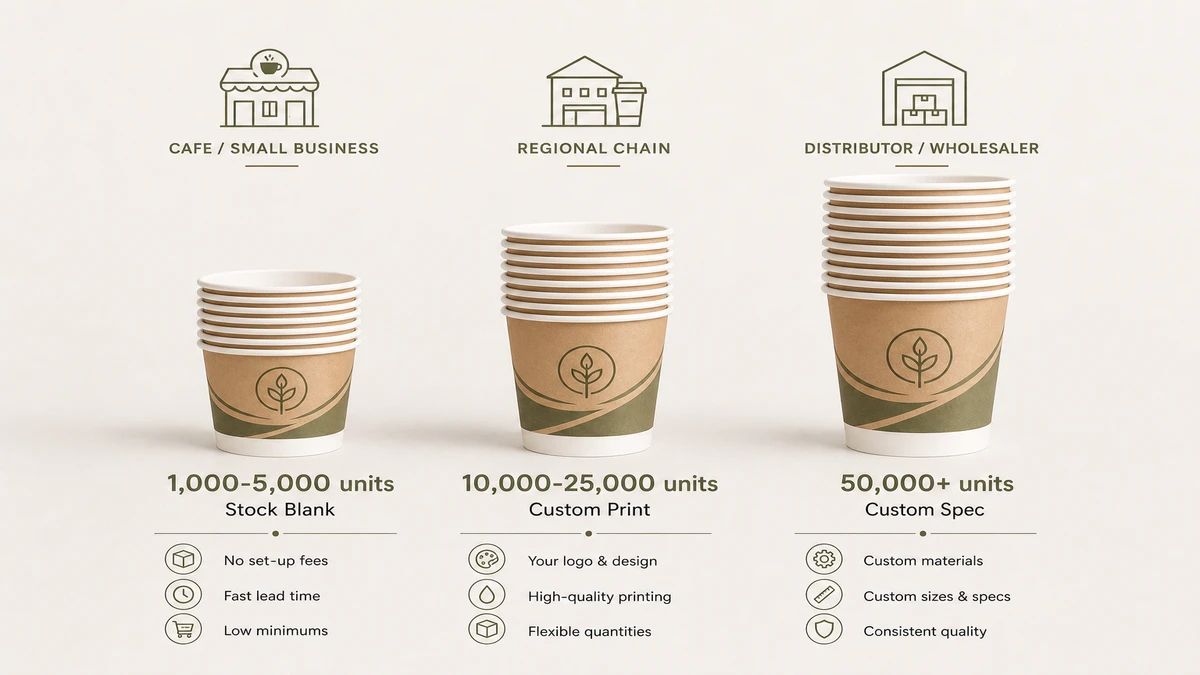
MOQ is a manufacturing economics issue. Fixed setup costs-print plates, ink calibration, material loading, forming setup, and carton packing-are distributed across the run, so lower volumes carry a higher fixed-cost burden per unit.
| نوع الطلب | الحد الأدنى المعتاد للطلب | What drives it | Commercial consequence |
|---|---|---|---|
| Stock blank cups | 1,000-5,000 وحدة | Warehouse inventory already exists | Fast replenishment, highest flexibility, less price leverage |
| Basic custom print | 10,000-25,000 units per SKU | Plate setup and press changeover | Better branding economics if repeat volume is real |
| Full custom size or board spec | 50,000+ units | New die, mandrel, or non-standard material run | Lowest unit cost at scale, highest inventory commitment |
For small operators, stock cups avoid tying cash into slow-moving inventory. A common blanket-order model is 50,000 units annualized with 5,000-unit call-offs, which lowers unit cost without forcing one large storage event.
Volume affects four things buyers feel directly:
A low MOQ can become expensive once freight and setup are included. Paper cups are light and bulky, so a 3,000-unit order may carry a workable unit price and still land poorly after dimensional shipping charges and receiving labor. If the order does not support efficient freight mode or repeat replenishment, the apparent flexibility is often false economy.
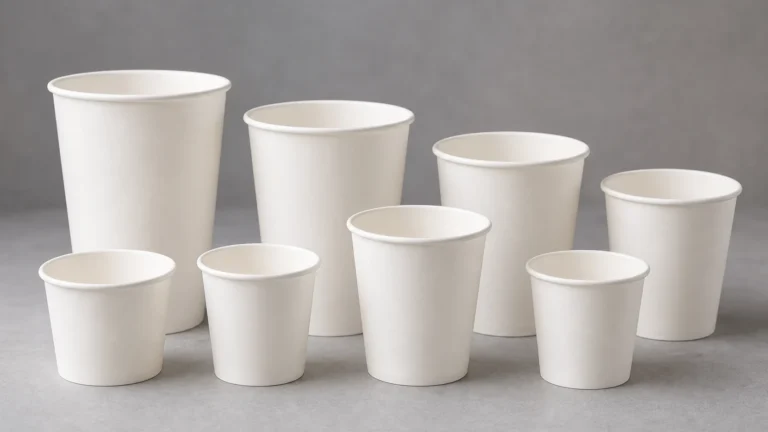
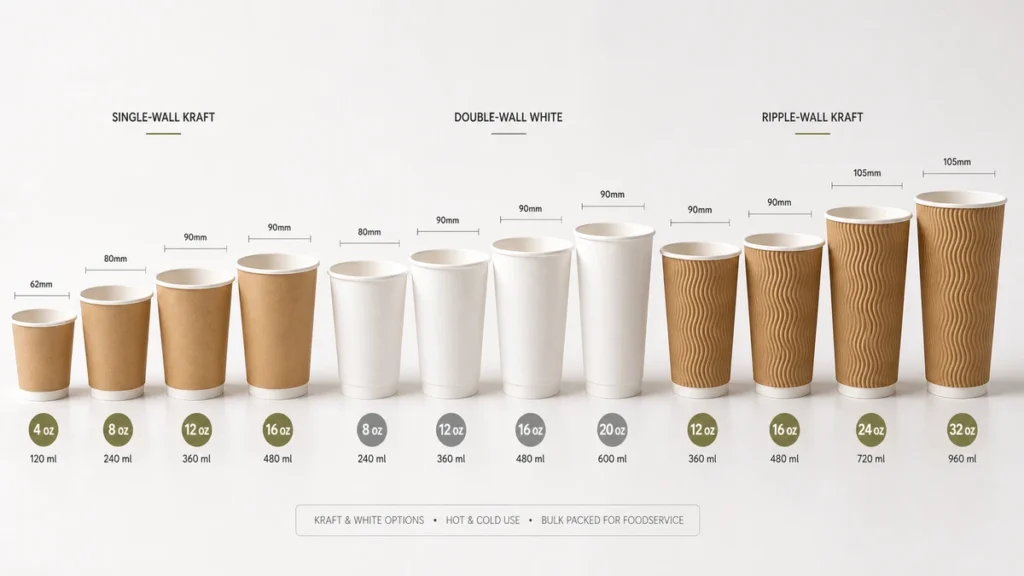
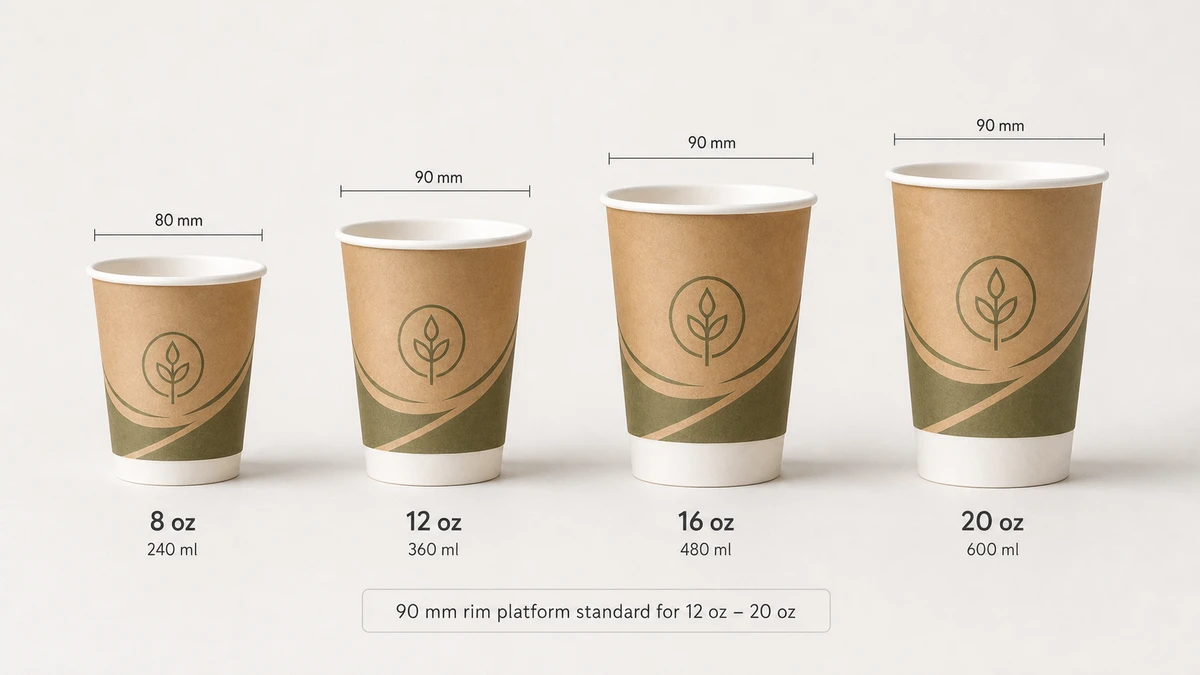
Most wholesale ranges run from 2 oz portion cups to 32 oz cold cups, with 8 oz, 12 oz, and 16 oz hot cups forming the commercial core. For sourcing and operations, the deciding specs are rim diameter, base diameter, height, and wall construction-not just the ounce label.
| حالة الاستخدام | Typical Size Range | قطر الحافة النموذجي | لماذا يختارها المشترون |
|---|---|---|---|
| Portion / espresso | 2-4 oz | 62-70 mm | Sampling, espresso, condiments |
| Standard hot beverage | 8-16 oz | 80-90 mm | Core cafe and QSR demand |
| مشروب ساخن كبير الحجم | 20-24 أونصة | 90-98 mm | Travel beverages, longer dwell times |
| Cold drinks | 12-32 oz | 83-98 mm | Fountain, iced coffee, smoothies |
The largest share of demand sits in 12 oz and 16 oz hot cups, which have the broadest supplier base, fastest replenishment, and fewest tooling issues. Moving into less common sizes-such as 22 oz hot cups-narrows supplier options and often raises MOQ by 20-40%.
Standardize the rim platform first. A 90 mm rim shared across 10 oz, 12 oz, 16 oz, and 20 oz hot cups reduces lid complexity, simplifies stockholding, and cuts mismatch risk. A slightly cheaper cup that forces a new lid series often costs more over time once storage space, split purchasing, and service disruption risk are included.
Board weight and wall structure control stiffness, the lining controls moisture barrier, and outer construction determines hand temperature and print surface. The wrong material choice shows up as leakage, poor grip comfort, accessory issues, or avoidable cost.
For a broad overview of available formats, buyers often start by reviewing أكواب ورقية alongside actual service conditions rather than treating all cup styles as interchangeable.
| التنسيق | Typical Spec Range | أفضل استخدام | Main limitation | Typical cost effect |
|---|---|---|---|---|
| Single-wall PE-lined | 170-220 gsm | Cold drinks, hot service with sleeve | Exterior heats quickly with hot fills | خط الأساس |
| Double-wall PE-lined | Two plies, typically 260-320 gsm combined | Hot drinks without sleeve | Higher unit cost, lower pack density | +25-45% vs single-wall |
| جدار متموج | Inner cup + bonded corrugated outer wrap | Hot drinks, tactile insulation | Uneven outer surface can limit print area and dispenser fit | Often slightly below double-wall |
| PLA-lined | Similar board to single-wall, PLA lining | Programs with industrial composting | Cost premium and heat limitations by grade | +30-60% vs single-wall |
| كرافت غير مطلي | No liquid barrier | Dry goods, outer sleeve use | Poor liquid hold | Niche use |
Single-wall PE-lined cups are the volume standard, offering strong freight efficiency and broad availability. The trade-off is thermal performance: with hot liquid above about 70 degrees C, the cup surface becomes uncomfortable quickly unless a sleeve is added, turning one cup SKU into a two-SKU system.
Double-wall construction insulates by trapping air between two layers; ripple-wall uses a corrugated outer layer for a similar effect. For hot-beverage programs, these formats can eliminate sleeve application at the counter-removing one handling step can improve consistency at peak service speed-but thicker walls reduce units per pallet and ripple formats can create fit issues in some dispensers.
PLA-lined cups swap the PE lining for polylactic acid, which may support industrial compostability claims when the finished product is certified and processed in the correct waste stream. Buyers making compostability claims should verify the relevant certification path through bodies such as BPI; food-contact compliance still needs to be checked separately for the market of sale. The main commercial mistake is buying compostable cups into a market that sends used cups to landfill-the price premium remains while the intended environmental outcome does not.
The real choice is usually single-wall + sleeve versus double-wall without sleeve.
| Buying Model | Wins when | Watch-outs |
|---|---|---|
| جدار واحد + غلاف | Lowest cup price, flexible sourcing, cold/hot mixed programs | Two SKUs, more handling at service, sleeve fit must be controlled |
| جدار مزدوج | Faster service, premium feel, no sleeve inventory | Higher unit cost, larger freight cube |
| جدار متموج | Strong insulation and tactile grip | Dispenser fit, less consistent print surface |
If hot drinks move fast and branding matters, double-wall often justifies itself. Buyers should compare double wall paper cup specs against line speed, shelf space, and freight cube rather than ex-works price only.
Standardization often matters more than absolute cup cost. Single-wall usually forms the core SKU because it stocks broadly, while insulated formats are added selectively for premium accounts. Buyers should review compatible أغطية أكواب القهوة early in the process-lid mismatch remains one of the most common causes of duplicated inventory and rushed reorders.
The operational questions are: Is the cup food-contact compliant for the destination market? Is the liner compatible with the actual disposal system in use? Buyers comparing conventional and compostable systems should map the disposal pathway first, then review broader التغليف الورقي المستدام guidance before locking the cup spec.

Cup selection is only half the system. The most expensive cup problems are often accessory coordination failures, not print or material issues.
Cup volume does not determine lid fit; rim diameter does. Two 12 oz cups can look similar and still require different lids if one is 89 mm and the other is 90 mm-that 1 mm difference is enough to cause leakage or pop-off during transport. Standardizing one hot-cup rim series across multiple sizes reduces purchasing complexity and lowers stocking error risk.
Sleeves grip based on the contact band along the cup taper, not just nominal cup size. If the taper angle falls outside the sleeve’s intended range, sleeves sit loose or drag during application-at high service volumes, even a small delay multiplies across hundreds of drinks a day. When cups and sleeves are sourced separately, request the diameter at the sleeve seat height, not just rim and base dimensions.
Carriers are driven by base diameter and filled-cup stability; delivery-heavy operations should also check cup height with lid attached against bag and tray clearance. Reviewing the broader packaging accessories range as one coordinated system, rather than approving each SKU separately, reduces receiving and picking errors caused by mixed sleeve counts or unstable cartons.
Paper cups are low in weight and high in cube, so freight planning matters significantly. Buyers who focus only on unit price often miss the larger landed-cost effect: dimensional freight, pallet density, storage volume, and reorder timing.
Carriers often bill bulky cup cartons on dimensional weight rather than actual weight. A standard case of 1,000 single-wall 8 oz cups may weigh only 10-14 lbs yet bill at roughly 56-60 lbs equivalent because of carton size. The practical threshold for many buyers is to order enough volume to move on LTL rather than parcel-the freight mode shift can improve landed cost more meaningfully than a small ex-works price reduction.
Confirm the schedule from artwork approval through production, transport and warehouse receipt before setting a reorder date.
Double-wall and ripple cups reduce units per carton and per pallet, affecting warehouse slotting, rack utilization, container fill rates, and replenishment frequency. A cup that improves service may still be the right choice, but downstream storage cost should be included in the comparison. For general planning references, buyers can also use Papacko’s المدونة as a supporting resource during specification review.
Compliance for paper cups covers the food-contact materials, not just the cup as a finished shape.
In the United States, FDA food-contact substance guidance addresses substances used in packaging materials that contact food; buyers can review the framework here: Food Contact Substances (FCS). In the EU, food-contact materials rules govern which materials may contact food and under what conditions-requirements that matter for import clearance and private-label approval in European markets.
Ask for documents tied to the exact product configuration being bought: food-contact declaration for the liner material, print or ink compliance declaration where relevant, fiber sourcing certification if required, compostability certification only if the product is being sold with that claim, and current factory quality documentation. If a supplier provides a generic certificate for a broad product family, confirm it covers the specific item code, size, lining, and print arrangement being ordered-this is a common validation gap in custom print projects.
Fill sample cups with the intended beverage temperature and hold for 15 minutes to check seal integrity and grip comfort. Test lids across several sample cups-not one-to account for normal forming tolerance. These two checks catch most field failures that are expensive to discover after a container has already shipped.
A strong cup brief lets suppliers quote the same job on the same assumptions, enabling meaningful price comparisons.
A lower quote is only useful if the structure, lining, print method, and packing match. A 16 oz cup quoted on 180 gsm single-wall board is not interchangeable with a 16 oz insulated format on two plies. Compare on equal spec, then compare landed cost, then compare reorder practicality.
Treat the order as a packaging system rather than a cup purchase. Confirm accessory fit, receiving format, lead time assumptions, and storage capacity before the PO is issued to reduce change requests and avoid solving one problem-such as heat retention-while creating another in freight or inventory handling.
Stock cups commonly start at 1,000-5,000 units per SKU, while custom-printed cups often begin at 10,000 units or more. Non-standard sizes or custom tooling usually push MOQ higher.
عادةً ما تكون الأكواب الساخنة سعة 12 أونصة و16 أونصة هي الأسهل في التوريد، نظرًا لأنها تحظى بأكبر طلب في السوق وأوسع تغطية من الموردين. وهذا يعني عادةً فترات تسليم أقصر، وخيارات أكثر للأغطية، وحدود حد أدنى أقل.
ليس دائمًا. فالتصميم ذو الجدار المزدوج يوفر راحة أكبر عند تناول المشروبات الساخنة ويغني عن الحاجة إلى استخدام الغلاف الخارجي، لكنه أكثر تكلفة ويشغل مساحة أكبر في التخزين والشحن.
نعم، شريطة أن يكون قطر حافة تلك الأكواب متماثلاً. يعتمد العديد من المشترين على معيار موحد لحافة الأكواب بحيث يمكن استخدام غطاء واحد لعدة أحجام مختلفة من الأكواب الساخنة.
Only when the disposal system supports them. If used cups are going into general waste, compostable cups may add cost without delivering the intended end-of-life benefit.
Test leak resistance, lid fit, grip comfort with the intended fill temperature, and print appearance on a physical sample. Also check the case pack and carton labeling if the order will move through warehouse receiving.
Base the reorder point on total landed lead time, not production time alone.