¿Está listo para crear sus propios vasos o envases de papel con su marca?
Díganos sus requisitos -tamaño, revestimiento, impresión y destino- y nuestro equipo le preparará un presupuesto detallado en 24 horas.

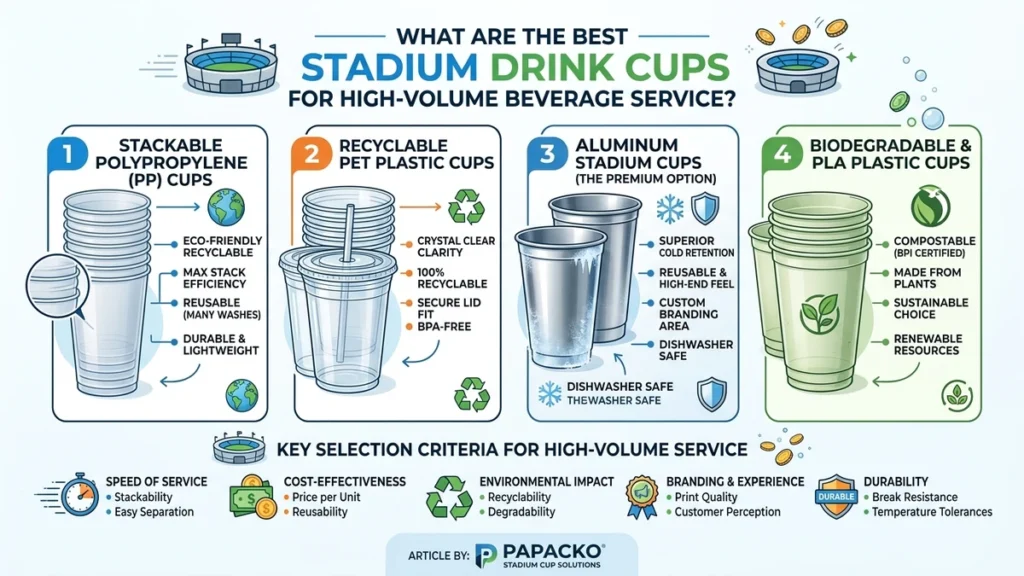
¿Cuáles son los mejores vasos para el servicio de bebidas a gran escala en estadios? Para el servicio de bebidas a gran escala en estadios, los mejores vasos suelen ser los vasos transparentes de PET para cerveza y bebidas frías de alta gama, y los vasos de PP cuando se prevé un manejo brusco.
Para el servicio de bebidas en estadios con gran afluencia de público, los mejores vasos suelen ser Vasos transparentes de PET para cerveza y bebidas frías de alta gama, Vasos de PP cuando la resistencia a los golpes y a las grietas es más importante que la transparencia, y vasos de papel para bebidas de máquina y programas de venta de productos de marca. La elección adecuada depende de velocidad de la línea, ajuste de la tapa, separación de las cajas, eficiencia del embalaje en cajas y requisitos relativos a los residuos, y no solo el precio unitario.
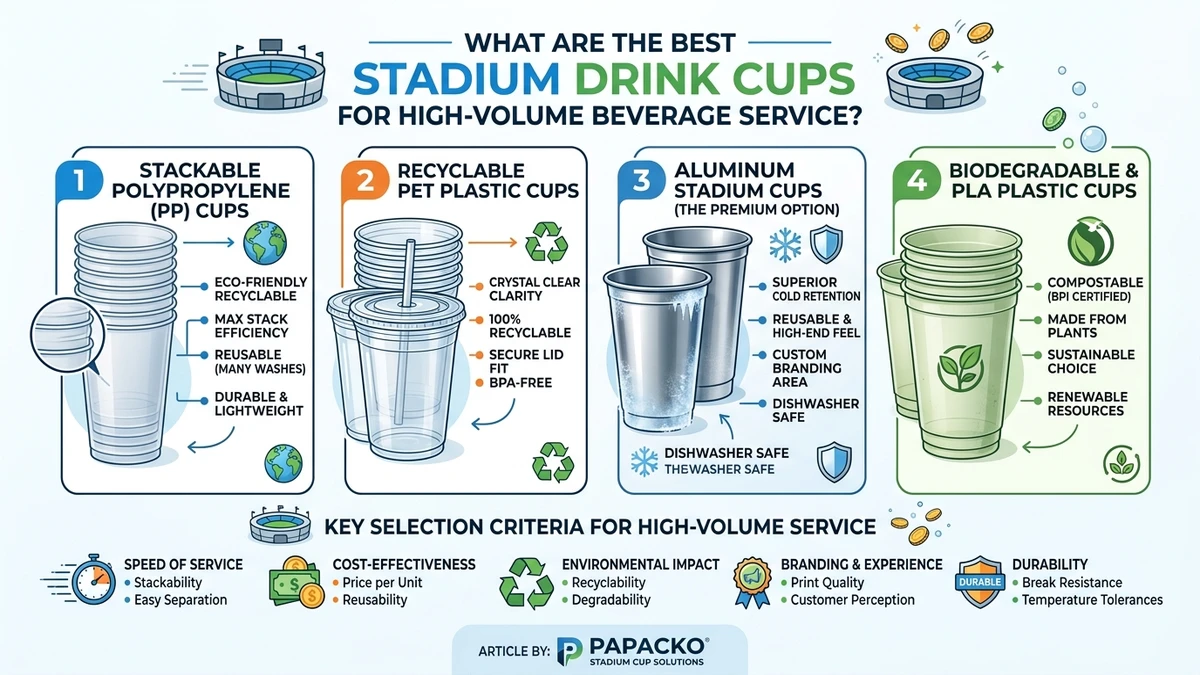
Los compradores de estadios suelen optar por 340 g, 454 g, 567 g y 680 g En primer lugar, elija los materiales en función de su rendimiento durante las horas punta: fácil extracción de los dispensadores, llenado rápido, cierre fiable y resistencia durante el transporte desde el almacén hasta la zona de embarque.
El PET suele ser la mejor opción cuando la visibilidad del producto favorece las ventas y permite verificar rápidamente los pedidos. Funciona bien para cerveza embotellada en frío y bebidas de alta gama en envases de 350-700 ml, pero los compradores deberían confirmarlo de todos modos Consistencia del borde y desmoldeo de la pila para evitar que el dispensador funcione con lentitud.
El PP suele ser la opción elegida cuando los vasos se rompen durante el transporte, la reposición o la manipulación con fuerza. Aunque pierde algo de transparencia, su mayor resistencia a los golpes lo convierte en una opción más práctica para los programas de bebidas frías.
Los vasos de papel siguen siendo prácticos para los refrescos de máquina, los menús combinados y los programas de venta de productos patrocinados, ya que ofrecen Gran capacidad de impresión y compatibilidad con los sistemas de tapa más habituales. Los compradores deben asegurarse de que peso y revestimiento del tablero al tiempo real de mantenimiento del calor, para que la taza no se ablande durante el servicio.
Elige PET si su prioridad es la presentación de las bebidas, la confirmación visual del pedido o el uso de vasos transparentes para la cerveza y las bebidas frías de alta gama.
Elige PP si su prioridad es reducir las roturas de vasos durante el transporte y la manipulación interna brusca.
Elige papel si su prioridad es un servicio basado en máquinas expendedoras, un espacio de impresión con su marca o sistemas de tapas de servicio rápido ya consolidados.
En las compras en el estadio, los fallos en las copas suelen manifestarse como fallos en la línea, y no los errores de laboratorio. Las comprobaciones más útiles son liberación de pilas, uniformidad de los bordes, eficiencia en el embalaje y el paletizado, resistencia de las cajas, plazos de impresión y control de referencias Por lo tanto, los soportes no admiten vasos y tapas que no sean compatibles.
Un método habitual consiste en ejecutar una familia de vasos transparentes para bebidas frías, ideal para alcohol y bebidas frías de alta gama y una plataforma de papel para bebidas de máquina. Esto evita confusiones con las tapas y simplifica la reposición.
En el servicio de los estadios, el vaso forma parte del sistema de distribución. Si se atasca en el dispensador, se deforma durante el llenado o hay que ejercer una fuerza adicional para taparlo, incluso un Un retraso de 1-2 segundos por pedido puede alargar notablemente las colas en el descanso.
Los puestos de cerveza, las zonas de bebidas de barril y los bares de cócteles tienen sus propias dificultades, por lo que un único tipo de vaso no siempre es la solución ideal. Las zonas de gran volumen suelen necesitar diámetro uniforme del borde, fácil extracción con una sola mano, rigidez suficiente e identificación clara del tamaño.
El objetivo operativo es un trago, un vaso, un pase. Antes de la puesta en marcha, compruebe que el vaso se desmolde correctamente, se mantenga rígido durante el llenado y admita las tapas sin necesidad de retoques.
Muchas perturbaciones provienen de desajuste entre la taza y la tapa, sobre todo cuando las instalaciones combinan distintos proveedores o cuentan con demasiados diámetros. En muchos estadios, 450 g, 560 g y 680 g puede satisfacer la mayor parte de la demanda y, al mismo tiempo, reducir el riesgo de desajuste.
Los vasos deben someterse a pruebas en condiciones reales de uso, no solo en pruebas de muestras. Comprueba la separación manual, el rendimiento del dispensador, la estabilidad al llenado en frío y la colocación de la tapa tras la exposición a zonas húmedas de la trastienda o a diferentes tipos de material.
[Opinión de un experto]
– Analiza los vasos después de que hayan permanecido toda la noche en las condiciones propias de la trastienda del local, no solo a temperatura ambiente.
– Si en un puesto se utiliza un modelo de dispensador diferente, compruébalo también allí; la mezcla de equipos suele poner de manifiesto problemas ocultos de desanidación.
– Realizar un seguimiento de los errores por stand durante los eventos piloto. El problema suele ser específico de cada ubicación, no generalizado en todo el recinto.
Los tamaños adicionales pueden aportar flexibilidad, pero a menudo ralentizan el servicio en los puestos de comida. Una estructura más compacta, con un formato pequeño, uno estándar y uno grande, suele mejorar la rapidez, la previsión de necesidades y la reposición de existencias.
El rendimiento de los vasos también es una cuestión logística. Comprueba el número de manguitos, las dimensiones de las cajas para su almacenamiento debajo del mostrador y asegúrate de que el etiquetado sea claro, para que el personal pueda reponer el stock rápidamente en las estrechas zonas de venta.
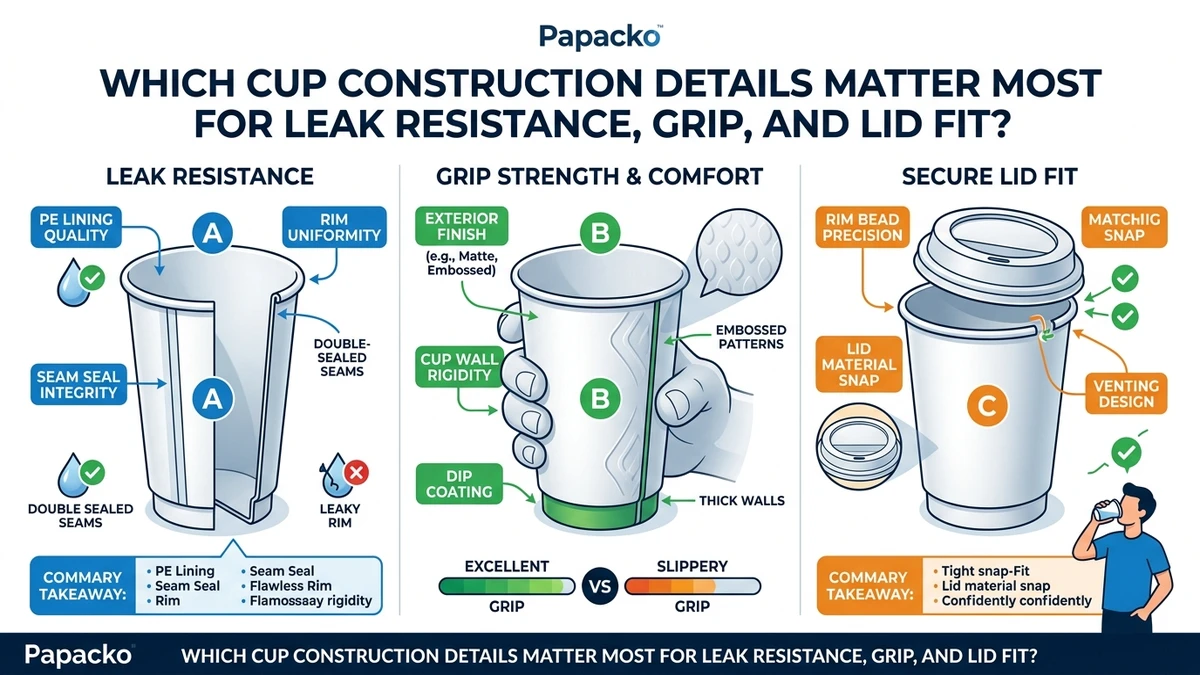
En el servicio de bebidas de los estadios, la especificación clave no es solo el tipo de material. La mayoría de los fallos se originan en el costura lateral, sellado inferior, borde o flanco, especialmente bajo la presión del dióxido de carbono, el peso del hielo y el movimiento de la gente.
Busca una costura sellada térmicamente de forma continua o unida por ultrasonidos con un solapamiento uniforme. Los puntos débiles de la costura pueden provocar fugas debido a la carbonatación, al impacto del hielo o a la presión de las manos.
Asegúrese de que el borde inferior esté bien formado y bien ajustado a la pared lateral. Es posible que los sellados de la base defectuosos no fallen de inmediato, pero pueden empezar a gotear tras varios minutos de uso.
La rigidez de la pared debe ser la adecuada peso de la bebida, tiempo de reposo y presión de la mano. Si la pared lateral se deforma, el asiento de la tapa puede deformarse y aumenta el riesgo de fugas.
En el caso de los vasos de papel, compruebe que el recubrimiento cubra por completo la superficie en contacto con el líquido, especialmente en la zona de la costura. Las directrices de la FDA sobre el contacto con alimentos explican por qué los materiales de envasado deben ser adecuados para el uso previsto y las condiciones de exposición: https://www.fda.gov/food/food-ingredients-packaging/food-contact-substances-fcs.
Solicita que te hagan pruebas con llenados con hielo primero, bebidas carbonatadas y tiempos de reposo de entre 20 y 60 minutos. Por lo general, las pruebas de retención de agua estática no son suficientes para obtener la homologación del estadio.
Los acabados brillantes pueden parecer más bonitos, pero pueden volverse resbaladizos con la condensación o la espuma. Las superficies mates o ligeramente texturizadas suelen facilitar el manejo con una sola mano.
Una buena rigidez del aro ayuda a que el recipiente mantenga su forma, limite las pérdidas por salpicaduras y mantenga la tapa bien ajustada. En condiciones reales de uso, la falta de rigidez suele manifestarse antes de que se produzcan fugas reales.
Los vasos de plástico suelen presentar más condensación exterior que los de papel, lo que puede afectar al agarre. El papel más grueso o con aislamiento térmico puede mejorar el tacto, pero ello conlleva algunas desventajas en cuanto a coste y almacenamiento.
La forma cónica de las copas y el centro de gravedad son factores importantes en el tráfico por pasillos y escaleras. Las copas altas y estrechas pueden parecer menos estables, incluso cuando cumplen los objetivos de capacidad.
[Opinión de un experto]
– Los problemas con las tapas suelen deberse a variaciones en el borde del vaso, y no a la tapa en sí.
– Un acabado brillante puede tener un buen aspecto, pero puede no dar los resultados esperados en condiciones de lluvia, condensación o al servir cervezas con mucha espuma.
– Si los aficionados llevan bebidas por los pasillos o las escaleras, la estabilidad del diseño es casi tan importante como la resistencia a los derrames.
Un rizado uniforme del borde es fundamental para que la tapa se mantenga en su sitio. Si el borde presenta irregularidades a lo largo de la circunferencia, es posible que un lado se rompa mientras que el otro se levante al moverla.
El diámetro superior del vaso debe mantenerse dentro de los límites de ajuste especificados por el proveedor de las tapas en todos los lotes. El uso de proveedores diferentes suele provocar una acumulación de tolerancias que da lugar a ajustes demasiado holgados o a una fuerza excesiva.
La tapa debe encajar bien sin necesidad de ejercer una gran presión con el pulgar. Si se aplica demasiada fuerza, se ralentiza el montaje y se puede deformar el vaso; si se aplica muy poca, aumenta el riesgo de que se salga.
La cerveza y los refrescos ejercen una presión diferente sobre las tapas que las bebidas sin gas, ya que la espuma y la carbonatación afectan a la interfaz. El control del nivel de llenado es tan importante como las especificaciones de la tapa.
Limitación: las especificaciones deficientes pueden provocar una pérdida de nitidez en exposiciones prolongadas
Vasos de papel de doble pared o aislantes
Ventajas e inconvenientes: mayor coste, menor eficiencia de apilamiento, mayor espacio de almacenamiento
Vasos transparentes de PET o PP
Compromiso: la gestión de la condensación y la falta de coincidencia de las tapas requieren una validación más exhaustiva
Estructuras de espuma
Antes de aprobar una copa del estadio, confirme por escrito:
– materiales y estructura de las paredes
– Método de sellado de costuras laterales
– Diseño del sellado inferior y método de prueba de estanqueidad
– perfil y tolerancia de la llanta
– Referencias de tapas compatibles
– Rendimiento en cuanto al tiempo de conservación de bebidas frías y carbonatadas
– adherencia en condiciones de condensación
– capacidad de apilado y velocidad de desapilado
– Acabado de impresión frente a riesgo de deslizamiento
– Embalaje por caja, densidad de paletización y resistencia a la compresión
La copa del estadio debería aprobarse como sistema: el cuerpo del vaso, el borde, la tapa y el formato logístico en su conjunto.
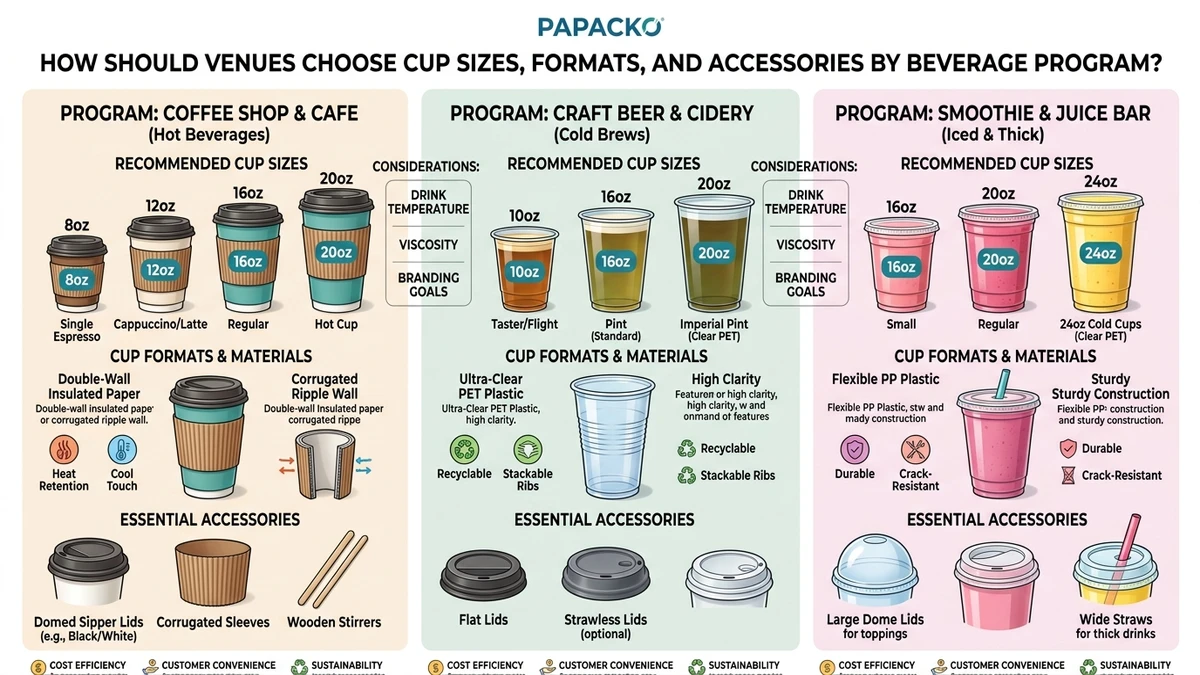
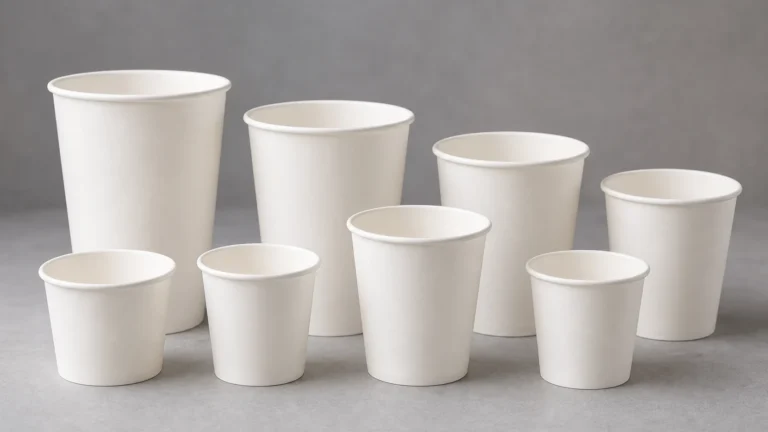
Los locales deben elegir el tamaño de los vasos y los accesorios partiendo de la bebida. Los programas más sólidos suelen separar fuente central, bebidas alcohólicas o especialidades frías, y bebida caliente familias, en lugar de imponer un único tamaño de taza en todo el edificio.
La capacidad nominal es solo uno de los factores a tener en cuenta, ya que el nivel de llenado real varía en función de la espuma, el hielo, la guarnición y el espacio libre necesario para un transporte seguro. Dos vasos con la misma capacidad en onzas pueden comportarse de forma diferente según su diámetro, altura y velocidad de llenado.
| Carta de bebidas | Rango de tamaños habitual | Formato de copa más adecuado | Necesidades de accesorios | En qué destaca | Cuándo no es la opción más adecuada |
|---|---|---|---|---|---|
| Refresco de máquina | 450-900 g | Vaso para bebidas frías con tapa hermética plana o con abertura para pajita | Tapa, pajita (si es necesario), bolsa para la compra de varios artículos | Rápida tramitación, estructura clara de ventas adicionales | Los vasos de gran tamaño aumentan el consumo de hielo, los residuos y las aglomeraciones en las máquinas de recarga |
| Cerveza de barril | 340-680 g | Vaso transparente para bebidas frías u otro recipiente adecuado para cerveza con paredes laterales resistentes | A menudo sin tapa; opcional según la zona de movimiento | Verificación rápida del vertido, presentación visible | Las copas poco rígidas no aguantan bien la espuma |
| Cócteles | 340-567 g | Opción de vaso para bebidas frías con tapa, pensada para llevar | Tapa, abertura para beber o pajita, según la receta | Porciones controladas, mayor facilidad para desplazarse por el vestíbulo | Las tazas demasiado grandes diluyen la presentación |
| Bebidas heladas | 340-680 g | Vaso de boca ancha con paredes laterales más resistentes | Tapa abovedada, pajita/cuchara-pajita | Más adecuado para productos viscosos y coberturas | Las paredes delgadas se deforman durante el vertido |
| Agua | 250-700 g | Vaso para bebidas frías económico | Tapa opcional en configuraciones premium | Servicio de hidratación a bajo coste | Es posible que los formatos básicos tengan una presencia insuficiente en los clubes |
| Café/té | 280-560 g | Vaso térmico de pared simple o doble | Tapa caliente, funda si es de pared simple | Manejo seguro, uso flexible del menú | El uso de vasos para bebidas frías conlleva riesgo de quemaduras y fugas |
| Suites premium/servicios de hospitalidad | 250-450 g | Formatos más rígidos y centrados en la presentación | Tapas a juego, cucharas para remover y servilletas | Mejor percepción por parte de los huéspedes | Un número excesivo de referencias de productos especializados complica la reposición |
La mayoría de los locales obtienen mejores resultados con una estructura de precios bien definida, como por ejemplo: pequeño, mediano y grande para las bebidas de fuente; un tamaño estándar y uno premium para la cerveza; y dos tamaños para las bebidas calientes. Esto simplifica la configuración del punto de venta, la formación del personal y el control del inventario; véase tamaños de vasos de papel.
Las tapas deben asignarse en función de la posibilidad de que se derrame el contenido, y no utilizarse de forma automática. Son más adecuadas para escaleras, trayectos largos y bebidas con mucho hielo, pero a menudo alargan innecesariamente el tiempo de preparación cuando las bebidas se consumen cerca del puesto.
Los accesorios deben resolver un problema de servicio sin generar una carga innecesaria en el catálogo de productos. Entre las familias de productos relevantes se incluyen: envases para alimentos y accesorios de envasado.
Es raro que un estadio necesite un único modelo de vaso en todas partes. Condiciones generales dan prioridad a la rapidez y la estandarización, mientras que salones y suites a menudo requieren una mejor presentación, un servicio con cubiertos y una mayor variedad de bebidas con las que maridar.

La estrategia de impresión no solo influye en el aspecto. También determina el pedido mínimo, la rapidez de reposición, la flexibilidad de los patrocinadores, la carga que supone el almacenamiento y el riesgo de quedarnos con stock obsoleto; por eso, los programas escalables se diferencian volumen de referencia de gráficos de ventana corta.
Los planos de impresión más prácticos dividen el material gráfico en tres capas: identidad del recinto, contenido del evento o de temporada, y contenido de los patrocinadores. Mantener los artículos de gran volumen con diseños fijos reduce el riesgo de pérdidas, mientras que los diseños personalizados de tiradas cortas pueden reservarse para eventos en los que el valor comercial justifique una mayor complejidad. Se aplica una lógica similar en diseño de envases minimalista.
Son ideales para recintos con una oferta de eventos variable o con planes de patrocinio aún por definir. Su principal ventaja es que el riesgo de previsión es menor y la redistribución entre eventos resulta más sencilla.
Estas estrategias tienen sentido cuando el valor para el patrocinador está claro, el diseño gráfico se cierra con antelación y la demanda está concentrada. La contrapartida es una mayor sensibilidad a los plazos de entrega y un mayor riesgo de que el inventario quede obsoleto.
Para muchos estadios, la estrategia más eficaz consiste en una oferta básica permanente, complementada con campañas personalizadas para partidos estrella, activaciones de patrocinadores y zonas VIP. De este modo, se garantiza el servicio y se reducen las pérdidas.
No todos los formatos deben personalizarse por igual. Los formatos de gran volumen suelen justificar en primer lugar la personalización de los gráficos, mientras que los formatos especiales de bajo volumen conllevan un mayor riesgo de pérdida de dinero y de que queden obsoletos.
En el caso de temporadas largas o recintos de uso mixto, las compras por etapas suelen funcionar mejor que una sola compra a gran escala. Una estructura práctica consiste en un pedido básico de pretemporada, un pedido de ajuste a mitad de temporada y pedidos personalizados para eventos concretos, solo para la demanda confirmada.
Cuantas más variantes impresas tenga un recinto, más importante es el orden en el almacenamiento de las cajas. Las cajas deben indicar claramente el tamaño, el código del diseño, el lote y la cantidad por caja, para que el personal pueda reponerlas correctamente y evitar enviar el vaso de patrocinador equivocado al puesto equivocado.
Para obtener más información sobre cómo equilibrar el suministro de productos de marca con la sostenibilidad práctica y el control de existencias, consulte embalajes de papel sostenibles.
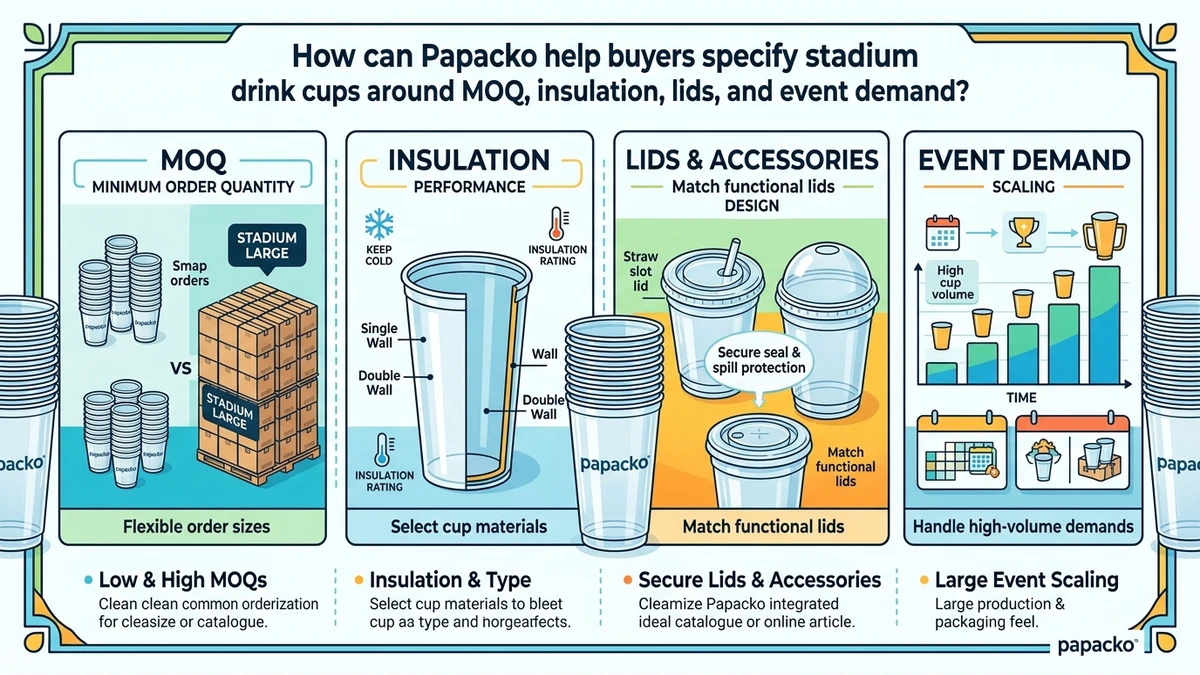
Para los operadores de estadios, los concesionarios y los distribuidores de bebidas, la verdadera decisión no se reduce a elegir entre papel o plástico. Se trata de cómo adaptar el formato de los vasos, el aislamiento, el ajuste de la tapa, la cantidad mínima de pedido y la demanda de cada evento a un programa que pueda validarse, estandarizarse y reabastecerse sin inmovilizar capital en existencias de baja rotación.
La forma más rápida de elaborar un resumen práctico sobre vasos es definir los tipos de bebidas, los tamaños reales que se venden, el estilo de servicio, la concentración de eventos, las limitaciones de almacenamiento y los requisitos de marca. Esto suele indicar si el local necesita una gama generalizada de vasos para bebidas frías o gamas separadas para bebidas de máquina, cerveza y bebidas calientes.
Para los compradores que estén valorando opciones de productos de papel, resulta útil comparar tanto la gama general como las específicas de cada formato, como los vasos de papel y los vasos de papel ecológicos.
El pedido mínimo (MOQ) debe evaluarse en función de los patrones de consumo reales, y no solo de las estimaciones anuales. En la práctica, adaptar primero las tallas con mayor rotación suele ofrecer el mejor rendimiento y reducir el riesgo de quedarse con excedentes.
Para bebidas calientes, vasos de papel de una sola capa el traje corto es adecuado cuando las mangas son aceptables, mientras que vasos de doble pared o con pared ondulada un café de invierno o un café premium. En el caso de las bebidas frías, el principal problema suele ser la condensación y la pérdida de textura con el paso del tiempo, más que la mera retención del calor.
Un error habitual es aprobar primero el vaso y revisar las tapas más tarde. En el servicio de grandes estadios, el pliego de condiciones debe confirmar el perfil del borde, la gama de tapas, el estilo de las tapas, la seguridad en el transporte y la velocidad de separación antes de dar la aprobación.
La demanda en los estadios se dispara antes del inicio del partido, durante el descanso y entre entradas o periodos, por lo que la selección de vasos debe evaluarse teniendo en cuenta el número máximo de vasos por minuto y los tamaños más demandados en cada grada. Para muchos recintos, la mejor solución es una gama de fuentes de gran caudal, una de cerveza o bebidas frías especiales cuando sea necesario, y una gama de bebidas calientes con aislamiento térmico.
Para agilizar la elaboración de presupuestos y el envío de muestras, los compradores deben preparar:
– Uso de la taza: para bebidas calientes, frías o ambas
– tamaños objetivo y volumen anual por tamaño
– Requisitos de impresión estándar o personalizados
– Número de ilustraciones y cobertura
– Tipos de tapas según el tamaño
– Requisitos de construcción o aislamiento de las paredes
– calendario de eventos y picos de demanda
– Limitaciones relacionadas con las cajas de cartón y los palés
– condiciones de envío
– Calendario de muestras y pruebas
Ese nivel de detalle suele reducir los problemas de ajuste de las tapas, el stock personalizado obsoleto y los fallos de manipulación el día del evento.
El PET suele ser la primera opción cuando lo que importa es la visibilidad y la rapidez en la comprobación del vertido, mientras que el PP puede ser más adecuado si se han producido problemas de roturas durante una manipulación brusca. La mejor opción depende de si la prioridad operativa es la presentación en el punto de venta o la durabilidad.
Sí, los vasos de papel suelen ser muy adecuados para los sistemas de dispensación, ya que admiten una gran cobertura de impresión, cuentan con tapas habituales y son cómodos de manejar. No obstante, las especificaciones del vaso deben ajustarse a la cantidad de hielo y al tiempo de conservación previsto.
La mayoría de los establecimientos con gran volumen de ventas obtienen mejores resultados con una gama reducida de tallas básicas que con un surtido amplio. Un número menor de tallas suele reducir los desajustes en las tapas, simplifica la reposición de existencias y mejora la previsión de la demanda.
Las causas habituales son las variaciones en el borde, la acumulación de tolerancias, una fuerza de aplicación excesiva o un rendimiento deficiente debido a la carbonatación y al movimiento. Por eso, los sistemas de vaso y tapa deben someterse a pruebas conjuntos en condiciones de uso reales.
La impresión personalizada suele ser más eficaz en tiradas de gran volumen vinculadas a una imagen de marca consolidada o a campañas financiadas por patrocinadores. El riesgo aumenta cuando el diseño cambia con frecuencia o la demanda es incierta.
Como mínimo, comprueba el desanidamiento, el rendimiento del dispensador, la estabilidad del llenado, el ajuste de la tapa, la seguridad durante el transporte y el tiempo de conservación con las bebidas que se vayan a servir realmente. También conviene realizar pruebas de apertura de cajas y reposición antes de un lanzamiento a gran escala.
Mantén existencias de productos de temporada para cubrir la demanda básica, reserva los pedidos personalizados para eventos de gran valor ya confirmados y distribuye las compras a lo largo de la temporada en lugar de comprarlo todo de una sola vez. Esto suele reducir las pérdidas y mejora la flexibilidad de almacenamiento.