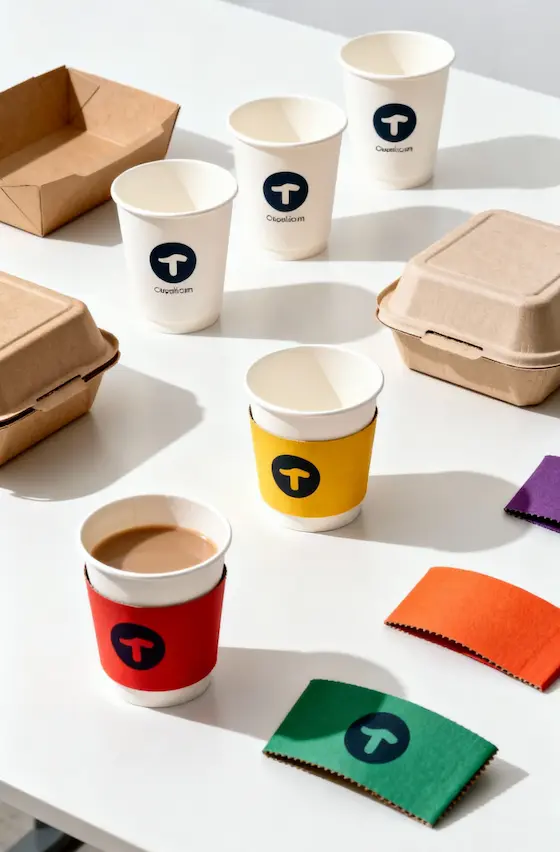
Готовы создать собственные фирменные бумажные стаканчики или упаковку?
Сообщите нам свои требования - размер, покрытие, печать и место назначения - и наша команда подготовит подробное коммерческое предложение в течение 24 часов.

Последнее обновление: August 2026
Время чтения: 8-10 минут
Автор: Papacko Content Team
The sustainable packaging industry stands at a technology inflection point in 2026. While PLA bioplastics and recycled paperboard have become mainstream (representing 36% of global production), the next generation of materials is emerging from laboratories and pilot facilities: seaweed-based coatings that biodegrade in 4-8 weeks, mushroom mycelium packaging grown than manufactured, agricultural waste transformed into protective materials, edible packaging eliminating disposal entirely, and nano-cellulose coatings offering performance superior to petroleum-based alternatives.
This comprehensive industry analysis examines sustainable packaging innovations actively developing in 2026: emerging material performance data, new manufacturing technologies, detailed commercialization timelines (lab-scale through mass production), cost trajectories as volumes scale, regulatory pathways, and evidence-based predictions for industry transformation through 2030. Whether you’re a packaging manufacturer, brand manager, sustainability officer, or investor, understanding these innovations determines competitive positioning in the rapidly evolving landscape.
Быстрый вынос: Sustainable packaging innovations in 2026 include seaweed-based coatings (4-8 week biodegradation, pilot production stage), mushroom mycelium packaging (lab-to-commercial transition for protective packaging), agricultural waste materials (commercial availability at 15-35% cost premium), edible packaging (niche applications, 2028-2030 scaling), and nano-cellulose coatings (2027-2028 commercialization).
Industry predicts 65% of foodservice packaging will use bio-based materials by 2030.
For eco-friendly sustainable packaging innovations, focus on:
Состав материала:
-Primary component: Alginate and carrageenan extracted from brown and red seaweed
-Application: 10-20 GSM coating on paperboard (similar thickness to PLA)
-Function: Moisture and oxygen barrier for food contact applications
Performance characteristics (2026 pilot data):
### Environmental Advantages
For quality sustainable packaging innovations, focus on:
Углеродный след:
-Seaweed cultivation: Carbon-negative (absorbs 5-10x more CO₂ than terrestrial plants per hectare)
-Processing energy: 30-40% lower than PLA (no fermentation step required)
-Lifecycle emissions: 65-75% lower than PLA, 80-88% lower than PE
Ocean health benefits:
-Seaweed farming reduces ocean acidification (absorbs dissolved CO₂)
-Creates habitat for marine biodiversity
-No freshwater, fertilizer, or pesticide requirements (unlike corn/sugarcane for PLA)
-Potential to utilize ocean “deserts” (nutrient-poor areas) with proper farming techniques
Scalability considerations:
-Global seaweed production (2026): 35 million tons annually (mostly food-grade)
-Estimated availability for packaging: 2-3 million tons without displacing food use
-Sufficient to supply 8-12% of global paper coating demand if fully scaled
When evaluating sustainable packaging innovations, consider the following:
Current deployment:
-Pilot production: 3 facilities in Norway, Iceland, Indonesia (combined capacity: 8,000 tons/year)
-Commercial partnerships: 2 major European packaging manufacturers signed development agreements (2025)
-Regulatory status: EU Novel Food assessment ongoing, FDA most times Recognized as Safe (GRAS) application submitted
Commercialization roadmap:
-2026-2027: Pilot scaling to 25,000 tons/year capacity, first commercial products (premium niche)
-2028: Initial mass production facilities (100,000+ tons/year), cost reduction to $2,800-3,500/ton
-2029-2030: Broad commercial availability, cost approaching PLA parity ($2,200-2,600/ton)
-2030+: Potential 8-15% market share in compostable coatings segment
Barriers to adoption:
-Supply chain development: Seaweed farming infrastructure limited to coastal regions
-Processing technology: Extraction and coating application methods still optimizing
-Consistency: Batch-to-batch variation higher than petroleum-based materials (improving)
-Perception: Consumer/brand familiarity with seaweed in packaging (education required)
The key to choosing quality sustainable packaging innovations depends on:
Как это работает:
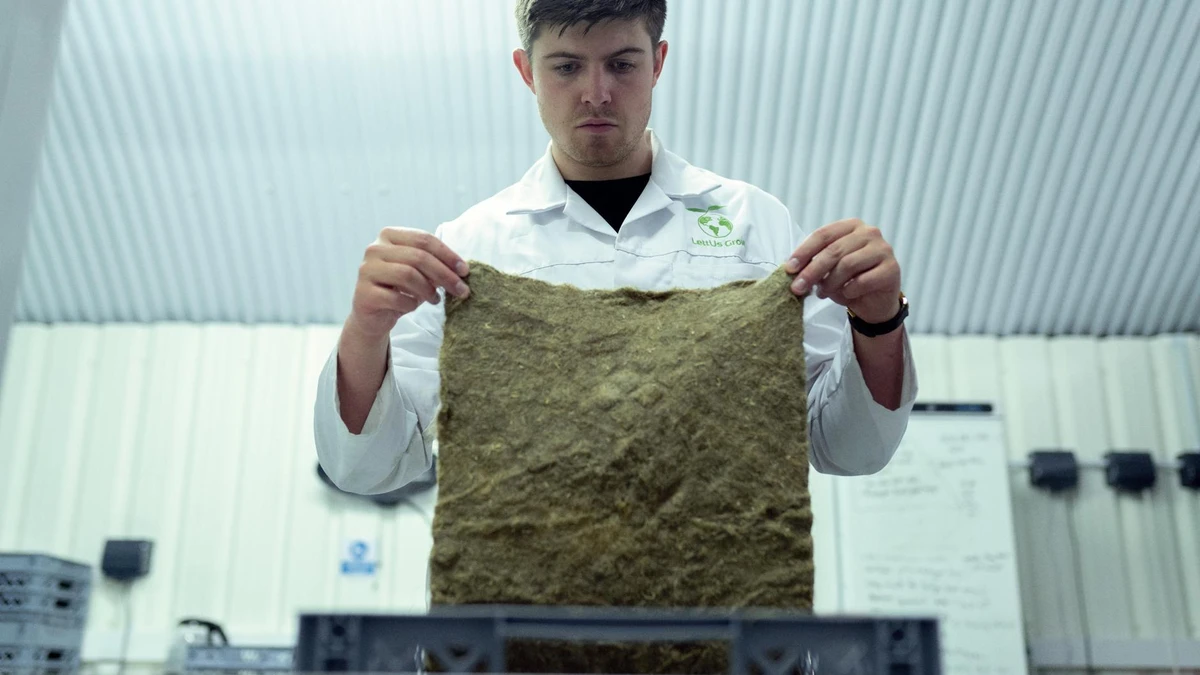
-Feedstock: Agricultural waste (corn stalks, hemp hurds, sawdust) mixed with mushroom spores
-Growth process: Mycelium (mushroom root structure) grows through waste material in 5-7 days
-Bonding: Natural enzymes from mycelium bind particles into solid structure
-Finishing: Heat treatment stops growth, creates final product (inert, shelf-stable)
Material properties:
*Unit = protective insert for electronics/fragile items (equivalent to molded EPS)
The key to choosing sustainable packaging innovations depends on:
Current commercial applications:
-Protective packaging: Electronics, wine bottles, fragile items (replacing EPS foam)
-Insulated shipping: Temperature-sensitive products (pharmaceuticals, food)
-Architectural materials: Acoustic panels, insulation boards (non-food packaging)
Market adoption (2026):
-Global production capacity: ~18,000 tons/year (12 commercial facilities)
-Primary markets: North America (60%), Europe (35%), Asia-Pacific (5%)
-Well-known manufacturers: Ecovative Design (USA), Magical Mushroom Company (Netherlands), MycoComposite (Canada)
-Market size: $85 million (2026), projected $420 million by 2030 (38% CAGR)
Application limitations:
-❌ Food contact surfaces: Regulatory approval pending (not yet FDA/EU cleared for direct contact)
-❌ High moisture environments: Requires coating/treatment (mycelium absorbs water)
-❌ Mass production speed: 5-7 day growth cycle slower than instant molding (EPS, cardboard)
-✅ Protective packaging: Excellent fit (replaces EPS foam with 30-90 day biodegradation)
The key to choosing the sustainable packaging innovations depends on:
Price evolution:
-2022: $5.50-8.00/unit (early commercial, limited production)
-2024: $3.80-5.50/unit (capacity expansion, process optimization)
-2026: $2.50-4.00/unit (12 facilities, improved yields)
-2028 (projected): $1.80-2.80/unit (automation, 50,000 ton/year capacity)
-2030 (projected): $1.20-2.00/unit (approaching EPS cost parity in some applications)
Barriers to mass adoption:
-Production time: 5-7 days vs seconds for EPS molding (inventory planning complexity)
-Consistency: Natural growth process creates 10-15% variation (vs <2% for synthetic materials)
-Scalability: Requires controlled environment facilities (humidity, temperature, contamination prevention)
-Supply chain: Agricultural waste feedstock logistics (collection, processing, storage)
The key to choosing sustainable packaging innovations depends on:
Material sources and applications:
### Wheat/Rice Straw PackagingMajoring Example
Understanding quality sustainable packaging innovations requires attention to these factors:
Material characteristics:
-Cellulose content: 30-40% (sufficient for paperboard-like products)
-Processing: Similar to wood pulp (chemical or mechanical pulping)
-Performance: Comparable to virgin paperboard at 20-30% heavier basis weight
Environmental benefits:
-Utilizes agricultural waste otherwise burned (reducing air pollution)
-No additional land use (byproduct of existing grain production)
-Carbon footprint: 40-55% lower than virgin wood pulp
-Water usage: 30-40% lower (shorter fibers require less processing)
Commercial deployment:
-Production capacity (2026): 450,000 tons globally (primarily China, India, Southeast Asia)
-Market share: 2.8% of global molded fiber packaging
-Cost: $680-920/ton (15-25% premium vs virgin pulp at $580-740/ton)
-Applications: Food containers, bowls, plates, protective packaging
Вызовы:
-Seasonal availability: Harvest-dependent supply (requires storage infrastructure)
-Fiber quality variation: Crop quality affects packaging strength consistency
-Collection logistics: Distributed agricultural sources (vs centralized forestry)
-Regional concentration: Limited adoption outside Asia-Pacific (infrastructure gap)
For quality sustainable packaging innovations, focus on:
Market maturity:
-Commercial since 2018, mainstream adoption by 2024
-Global production (2026): 1.2 million tons (8% of molded fiber market)
-Cost: $720-980/ton (competitive with virgin pulp + molding)
-Applications: Takeaway containers, plates, bowls, clamshells
Performance advantages:
-Heat resistance: 90-120°C (suitable for hot foods, microwave-safe)
-Grease resistance: Naturally higher than wood pulp (less coating required)
-Strength: Equal to or better than virgin pulp at equivalent basis weight
-Compostability: 45-90 days in commercial facilities, 90-180 days home compost
Supply chain:
-Feedstock availability: 250+ million tons global sugarcane bagasse annually
-Current utilization: <1% for packaging (mostly burned for energy or discarded)
-Growth potential: Could supply 20-30% of global molded fiber demand without supply constraints
Understanding quality sustainable packaging innovations requires attention to these factors:
Active technologies (2026):
1. Seaweed-based edible films:
-Composition: Alginate, agar, carrageenan
-Thickness: 20-50 microns (similar to plastic wrap)
-Applications: Individual condiment packets, beverage pods, food wraps
-Taste: Flavorless or flavored (herb-infused, sweet options)
-Shelf life: 6-18 months (moisture-sensitive, requires secondary packaging)
-Commercialization: Pilot products available (NotpLA UK, Loliware USA)
2. Milk protein (casein) coatings:
-Composition: Casein extracted from skim milk
-Application: 5-15 micron coating on paperboard
-Performance: Oxygen barrier 500x better than LDPE plastic
-Biodegradation: Edible or 30-day compost breakdown
-Status: Pilot-scale production (USDA partnership, commercial 2027-2028)
3. Starch-based materials:
-Composition: Corn/potato/tapioca starch + plasticizers
-Form: Films, coatings, molded containers
-Applications: Single-serve packaging, utensils
-Edibility: Safe to eat but limited palatability
-Status: Commercial availability (limited volumes, niche products)
Understanding sustainable containers innovations requires attention to these factors:
Current market size:
-2026 global edible packaging: $82 million (0.02% of total packaging market)
-Growth projection: $680 million by 2030 (52% CAGR, still <0.1% market share)
-Primary segments: Beverage pods (40%), condiment sachets (30%), food wraps (20%), other (10%)
Consumer acceptance challenges:
-Safety perception: 58% of consumers concerned about edible packaging hygiene (2025 survey)
-Taste concerns: 42% unwilling to consume packaging even if flavorless
-Cultural barriers: Higher acceptance in Asia (68% willing to try) vs North America (34%)
-Education gap: 71% unaware edible packaging exists (awareness-building required)
Successful niche applications:
-Coffee/tea pods: Edible casings eliminate disposal (commercial products available)
-Beverage flavor shots: Seaweed spheres (used in bars, events)
-Fast-food condiments: Single-serve ketchup/sauce in edible films (limited pilot programs)
Understanding sustainable packaging innovations requires attention to these factors:
Performance limitations:
-Moisture sensitivity: Most edible materials degrade when wet (requires dry environment)
-Shelf life: 6-18 months vs years for conventional packaging
-Strength: Lower tensile strength (not suitable for heavy/sharp items)
-Scalability: Production costs 3-8x conventional packaging (volume-dependent)
Regulatory complexity:
-Dual classification: Both food AND packaging (must meet both sets of regulations)
-Novel food approval: EU requires pre-market authorization (2-3 year process)
-FDA GRAS status:y Recognized as Safe determination required (12-18 months)
-Labeling requirements: Must disclose edibility, ingredients, allergens
Realistic timeline:
-2026-2028: Niche applications, limited commercial availability, high cost ($0.15-0.50/unit)
-2028-2030: Scaling begins, cost reduction to $0.08-0.25/unit, regulatory clarity improves
-2030+: Potential 2-5% market share in single-serve packaging (still niche, not mainstream)
When evaluating the sustainable packaging innovations, consider the following:
Состав материала:
-Source: Plant cellulose broken down to nanoscale fibers (1-100 nanometers diameter)
-Production: Mechanical grinding or chemical treatment of wood pulp
-Application: 3-8 GSM coating (thinner than conventional coatings)
Performance advantages:
### Commercial Readiness and Scaling
When evaluating eco-friendly sustainable packaging innovations, consider the following:
Current status (2026):
-Pilot production: 4 facilities in Scandinavia, Japan, Canada (combined 12,000 tons/year capacity)
-Commercial partnerships: Stora Enso, Nippon Paper, Kruger collaborating on scaling
-Regulatory approval: FDA and EU food contact approvals obtained (2024-2025)
-Market testing: Limited commercial products in Japanese market (premium segment)
Cost reduction pathway:
-2026 (pilot): $5,200-7,800/ton
-2027 (early commercial): $3,800-5,200/ton (economies of scale, process optimization)
-2028-2029 (scaling): $2,600-3,600/ton (approaching PLA cost range)
-2030+ (mass production): $2,000-2,800/ton (competitive with PLA, premium to PE)
Advantages over conventional coatings:
-Superior barrier performance at lower thickness (material savings)
-100% bio-based and renewable (vs petroleum-based PE)
-Recyclable in standard paper streams (vs PLA requiring composting)
-Carbon footprint 60-70% lower than PE coating
Barriers to adoption:
-Production capacity: Current 12,000 tons << global coating demand (millions of tons)
-Processing equipment: Requires specialized coating machinery (capital investment)
-Supply chain: Limited nano-cellulose suppliers (concentration risk)
-Industry inertia: Established PLA/PE infrastructure creates switching costs
For eco-friendly sustainable packaging innovations, focus on:
Mineral-based barriers (already commercial in Japan/Korea):
-Composition: Calcium carbonate or talc dispersions
-Advantage: PFAS-free, recyclable, heat-stable
-Limitation: Brittleness, requires careful handling
-Cost: $2,800-3,600/ton (competitive with PLA)
-Market share: 3% in Asia-Pacific, expanding to Europe 2027
Chitosan coatings (из панцирей ракообразных):
-Source: Shrimp/crab shell waste (1.5 million tons available annually)
-Performance: Antimicrobial properties + oxygen barrier
-Applications: Food preservation packaging, extending shelf life
-Status: Pilot stage, commercialization 2028-2029
-Cost projection: $4,200-5,800/ton at commercial scale
Understanding eco-friendly sustainable packaging innovations requires attention to these factors:
Projected coating market share by 2030:
Предположения:
-Continued regulatory pressure in 25+ additional jurisdictions
-Nano-cellulose and seaweed cost reductions on track (50-60% reduction by 2030)
-Consumer willingness to pay 10-20% premium for verified sustainable products
Understanding quality sustainable packaging innovations requires attention to these factors:
### Regulatory and Policy Predictions
The key to choosing sustainable packaging innovations depends on:
Likely regulatory developments (2026-2030):
✅ Расширенная ответственность производителя (EPR):
-Expansion to 30+ jurisdictions (currently 12) by 2028
-Manufacturers fund 40-70% of collection/recycling costs
-Creates economic incentive for sustainable materials (lower EPR fees)
✅ Single-use plastic bans:
-Additional 25-35 countries/regions implement PE coating restrictions by 2030
-Shift 20-28 billion additional cups/containers to compostable alternatives
-Accelerates demand for PLA, seaweed, nano-cellulose coatings
✅ Compostability labeling standards:
-ISO harmonization of compostability claims (global standard by 2028)
-Mandatory certification logos (BPI, TÜV, or equivalent) for “compostable” marketing
-Reduces greenwashing, increases consumer trust
⚠️ PFAS restrictions:
-Comprehensive PFAS ban in food packaging (EU by 2028, US states by 2028-2030)
-Eliminates final PFAS-containing barrier coatings
-Accelerates water-based, nano-cellulose, mineral coating adoption
Investment implications:
-$8-12 billion global investment in sustainable coating capacity (2026-2030)
-Consolidation: 15-25 acquisitions as major packaging companies acquire technology startups
-Venture capital: $2-3 billion raised by material innovation companies (2026-2030)
When evaluating sustainable sustainable packaging innovations, consider the following:
Cost per metric ton (projected 2030, at scale):
Total cost of ownership (TCO) factors:
-Material cost: 45-55% of TCO
-Processing/application: 20-25%
-Certification/compliance: 5-10%
-Waste management/EPR fees: 8-15% (advantage for compostables: -40% disposal cost)
-Brand value/marketing: 10-15% (sustainability premium justifies higher prices)
The most promising sustainable packaging innovations in 2026 include: (1) Seaweed-based coatings offering 4-8 week biodegradation (65-75% lower carbon footprint than PLA, carbon-negative cultivation), currently in pilot production with commercialization projected 2027-2028; (2) Nano-cellulose coatings providing superior oxygen barriers comparable to aluminum while being 100% bio-based and recyclable in paper streams, with four pilot facilities operating and mass production expected 2028-2029; (3) Agricultural waste materials like sugarcane bagasse and wheat straw already commercially available at 1.2 million tons global production (8% of molded fiber market); (4) Mushroom mycelium protective packaging replacing EPS foam with 30-90 day biodegradation, commercially available from 12 facilities at $2.50-4.00/unit. Industry predicts 65% of foodservice packaging will use bio-based materials by 2030.
When evaluating the sustainable packaging innovations, consider the following:
Seaweed-based packaging offers significant environmental advantages over PLA: carbon-negative cultivation (seaweed absorbs 5-10x more CO₂ than terrestrial plants), 65-75% lower lifecycle emissions, 30-40% lower processing energy (no fermentation required), faster biodegradation (4-8 weeks vs 90-180 days for PLA), and both home and commercial compostability (PLA requires commercial facilities only), the sustainable packaging innovations matter.Performance shows 85-90% of PLA’s moisture barrier capability, superior oxygen barrier properties, and 50-75°C heat tolerance (vs 45-85°C for PLA). Current limitations include higher cost ($3,800-5,200/ton pilot production vs $2,200-2,800 for PLA) and limited supply chain infrastructure, but costs are projected to approach PLA parity ($2,200-2,600/ton) by 2029-2030 as production scales to 100,000+ tons annually.
Understanding sustainable packaging innovations requires attention to these factors:
Mushroom mycelium packaging is grown from agricultural waste (corn stalks — hemp, sawdust) mixed with mushroom spores, where mycelium (mushroom root structure) grows through the waste material in 5-7 days, naturally bonding particles into solid protective packaging. Understanding sustainable sustainable packaging innovations helps.Heat treatment stops growth and creates the final inert product. It offers 30-90 day biodegradation (vs 500+ years for EPS foam it replaces) with comparable compressive strength (0.5-2.0 MPa) and superior thermal insulation to corrugated cardboard. Currently available commercially for protective packaging (electronics, wine bottles, fragile items) from 12 facilities with 18,000 tons/year global capacity. Market size is $85 million (2026), projected to reach $420 million by 2030 (38% CAGR) as costs decrease from current $2.50-4.00/unit toward EPS parity ($1.20-2.00) by 2030.
The key to choosing sustainable packaging innovations depends on:
Yes, agricultural waste materials are commercially available with sugarcane bagassewell-knowng at 1.2 million tons global production in 2026 (8% of molded fiber market), used for takeaway containers, plates, bowls, and clamshells at $720-980/ton (competitive with virgin pulp). Understanding the sustainable packaging innovations helps.Wheat and rice straw packaging produces 450,000 tons annually (2.8% market share, primarily China, India, Southeast Asia) at $680-920/ton for food containers and bowls. These materials offer 40-55% lower carbon footprint than virgin wood pulp, 30-40% less water usage, and utilize agricultural waste otherwise burned. Challenges include seasonal availability requiring storage infrastructure — fiber quality variation affecting consistency, and regional concentration (limited adoption outside Asia-Pacific). Sugarcane bagasse shows strongest growth potential with 250+ million tons annual availability globally and less than 1% currently utilized for packaging.
For eco-friendly sustainable packaging innovations, focus on:
Edible packaging will likely remain niche through 2030, not mainstream. Understanding sustainable containers innovations helps.Current market size is only $82 million (0.02% of total packaging), projected to reach $680 million by 2030 (52% CAGR but still <0.1% market share). Timeline: 2026-2028 sees niche applications in beverage pods, condiment sachets, and food wraps at $0.15-0.50/unit; 2028-2030 begins scaling with cost reduction to $0.08-0.25/unit and improving regulatory clarity; 2030+ potential 2-5% share in single-serve packaging only. Barriers include consumer acceptance challenges (58% concerned about hygiene, 42% unwilling to consume packaging), performance limitations (moisture sensitivity, 6-18 month shelf life, lower strength), regulatory complexity (dual food-and-packaging classification requiring FDA GRAS and EU Novel Food approvals), and cost (3-8x conventional packaging). Successful applications will likely be limited to coffee/tea pods, beverage flavor shots, and fast-food condiments.
For sustainable containers innovations, focus on:
Nano-cellulose coatings are 100% bio-based barriers made from plant cellulose broken down to nanoscale fibers (1-100 nanometers) applied at 3-8 GSM thickness (thinner than conventional 15-25 GSM coatings). Understanding sustainable containers innovations helps.They offer superior performance: oxygen barrier comparable to aluminum, 85-95% of PE’s moisture barrier, excellent grease resistance, 100-150°C heat tolerance, recyclability in standard paper streams, and 30-60 day compostability with 60-70% lower carbon footprint than PE. Currently in pilot production at four Scandinavian, Japanese, and Canadian facilities (12,000 tons/year capacity) with FDA and EU food contact approvals obtained (2024-2025). Commercial timeline: 2027 early commercial availability at $3,800-5,200/ton, 2028-2029 scaling to $2,600-3,600/ton (approaching PLA cost), 2030+ mass production at $2,000-2,800/ton with projected 8% market share by 2030.
Understanding sustainable containers innovations requires attention to these factors:
By 2030, the sustainable packaging market will undergo significant transformation with bio-based materials reaching 65% of foodservice packaging (up from 42% in 2026), eco-friendly sustainable packaging innovations matter.PE coating market share will decline from 58% to 38% (-20 points) due to regulatory phase-outs and sustainability pressure, while PLA grows modestly to 28% (+4 points), water-based coatings double to 14% (+6 points driven by PFAS-free regulations), nano-cellulose reaches 8% (new entrant), and seaweed-based achieves 5% (new entrant). Cost reductions enable adoption: nano-cellulose drops 58% to $2 —000-2,800/ton, seaweed drops 48% to $2,200-2,800/ton, approaching cost parity with conventional materials. Regulatory drivers include Extended Producer Responsibility expanding to 30+ jurisdictions (from 12), single-use plastic bans in 25-35 additional regions, ISO harmonized compostability standards, and comprehensive PFAS bans in food packaging. Industry investment totals $8-12 billion in sustainable coating capacity with 15-25 acquisitions and $2-3 billion venture capital raised.
Sustainable packaging innovations in 2026 signal a fundamental industry transformation over the next 3-5 years. While PLA bioplastics and recycled paperboard have achieved mainstream adoption (36% combined market share), emerging technologies—seaweed-based coatings, nano-cellulose barriers, agricultural waste materials, mushroom mycelium, and edible packaging—offer pathways to 65%+ bio-based materials by 2030. Success depends on cost reduction through scaling (nano-cellulose and seaweed targeting 48-58% cost drops), regulatory support (EPR expansion, plastic bans, PFAS restrictions), and consumer acceptance of new material paradigms.
Основные выводы:
1.Understanding quality sustainable packaging innovations helps.Seaweed and nano-cellulose lead innovation—Commercialization 2027-2029, approaching cost parity
2.Understanding sustainable sustainable packaging innovations helps.Agricultural waste already commercial—Sugarcane bagasse, straw at 1.7M tons production, 15-25% premium
3.Understanding sustainable packaging innovations helps.Mycelium replaces EPS foam—Protective packaging niche, $85M market growing to $420M by 2030
4.Understanding sustainable containers innovations helps.Edible packaging remains niche—Consumer acceptance and cost barriers limit to <2% market share
5.Understanding quality sustainable packaging innovations helps.Industry investment accelerates—$8-12B in capacity, consolidation, venture-backed startups
-Контейнеры для упаковки пищевых продуктов
Papacko actively monitors emerging packaging technologies and maintains partnerships with material innovators to bring next-generation solutions to market. Understanding eco-friendly sustainable packaging innovations helps.Our current sustainable offerings include PLA compostable coatings, water-based barriers, and agricultural waste materials (sugarcane bagasse), with pilot programs for nano-cellulose and seaweed-based alternatives launching 2027-2028. Contact us to discuss your sustainability roadmap and future material strategies.
Innovation pages matter most when they connect back to real regulatory and material choices. Buyers interested in new sustainable formats usually also need to check certification, market traction, and whether the compostable or recyclable route is commercially realistic today.
Свяжитесь с нами: